Tesla Issues Massive Recall for 2.74 Million Chinese-Built Model 3 and Model Y Units
China's State Administration for Market Regulation reported Tesla's recall filing on August 21, covering 2,740,642 domestically built Model 3 and Model Y units manufactured between March 4, 2019 and December 7, 2025.
Aldous Moorland·updated August 24, 2026
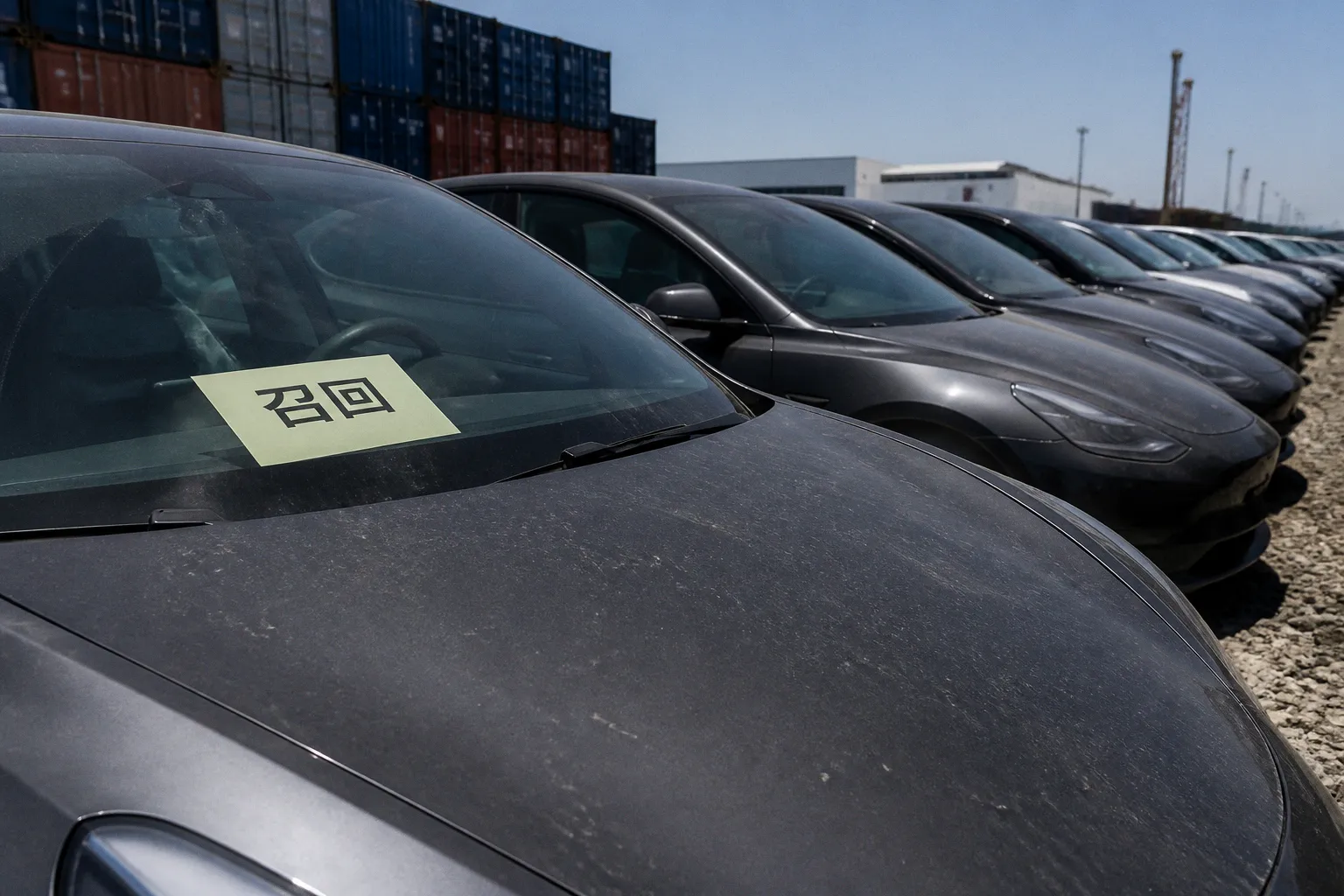
Defect: torque-only attention monitoring failed to escalate warnings on sustained gaze deviation during combined driving assistance. Remedy is software-only — a free over-the-air patch introducing in-cabin camera monitoring. Diagnostic impact: on unrelated service work, firmware version and camera calibration are verified before driver-attention complaints are escalated to hardware investigation.
Attention monitoring — what changes post-update
Steering-wheel torque input is an unreliable proxy for driver engagement. Hands placed on the rim yield steady torque data while visual attention migrates elsewhere. Per SAMR's notice, the prior algorithm did not raise alerts at the required cadence when gaze deviation persisted, increasing inbound collision probability if manual intervention lagged.
The OTA layers interior camera monitoring atop the torque sensor. Gaze direction, head pose, and ocular state integrate into a fused driver-state model. Vehicles unable to accept the update remotely are routed through Tesla service. Notification reaches owners through Tesla's mobile application, text, and email.
For independent shops accepting a post-update vehicle for unrelated work: firmware version and interior-camera calibration are confirmed before any driver-attention complaint is assigned to hardware failure. A blocked, occluded, or misaligned camera forces fallback to torque-only inference, replicating the original defect. Baseline verification: a forced gaze-shift test under combined driving assistance must produce an escalated alert; absence of escalation indicates the camera subsystem is not contributing to driver-state inference.
Companion door-release campaign in the same filing
The August 21 notice bundled a second Tesla action: 2,975,910 domestic and imported units across Model 3, Model Y, Model S, and Model X. The mechanical interior emergency door release, finished in a color matched to surrounding trim, becomes difficult to identify after a severe collision. Tesla's remedy consists of warning labels marking each release point, plus an OTA that drops the windows automatically on collision detection — restoring a mechanical escape path when bus voltage collapses.
Across the broader 4.3-million-unit Chinese action, Tesla accounts for approximately 2.98 million units. Companion actions: Xiaomi (390,435 SU7 sedans, 2024 model year), Leapmotor (371,200 C11 and C01), Xpeng (264,842 across G6, P7+, and X9), and Zeekr (92,658 across 007 and X) receive parallel labeling and software remedies. The campaign precedes 2027 Chinese requirements that will restrict concealed or retractable door handles in their current form on new vehicles.
Vehicles imported into North America are not enrolled in this dataset. The underlying fault class — electrically actuated release with no conspicuous mechanical fallback — persists as a diagnostic consideration on any post-crash Tesla intake. Procedure: if a wrecked vehicle presents with intact bus voltage and unresponsive exterior handles, the mechanical release is located and exercised before any high-voltage disconnect sequence is initiated.