How to Get Your Check Engine Light Scanned for Free at Local Auto Parts Stores
According to a recent Motor1.com piece, the major parts chains will pull codes from your check engine light without charging a dime.
Judson Grier·updated August 25, 2026
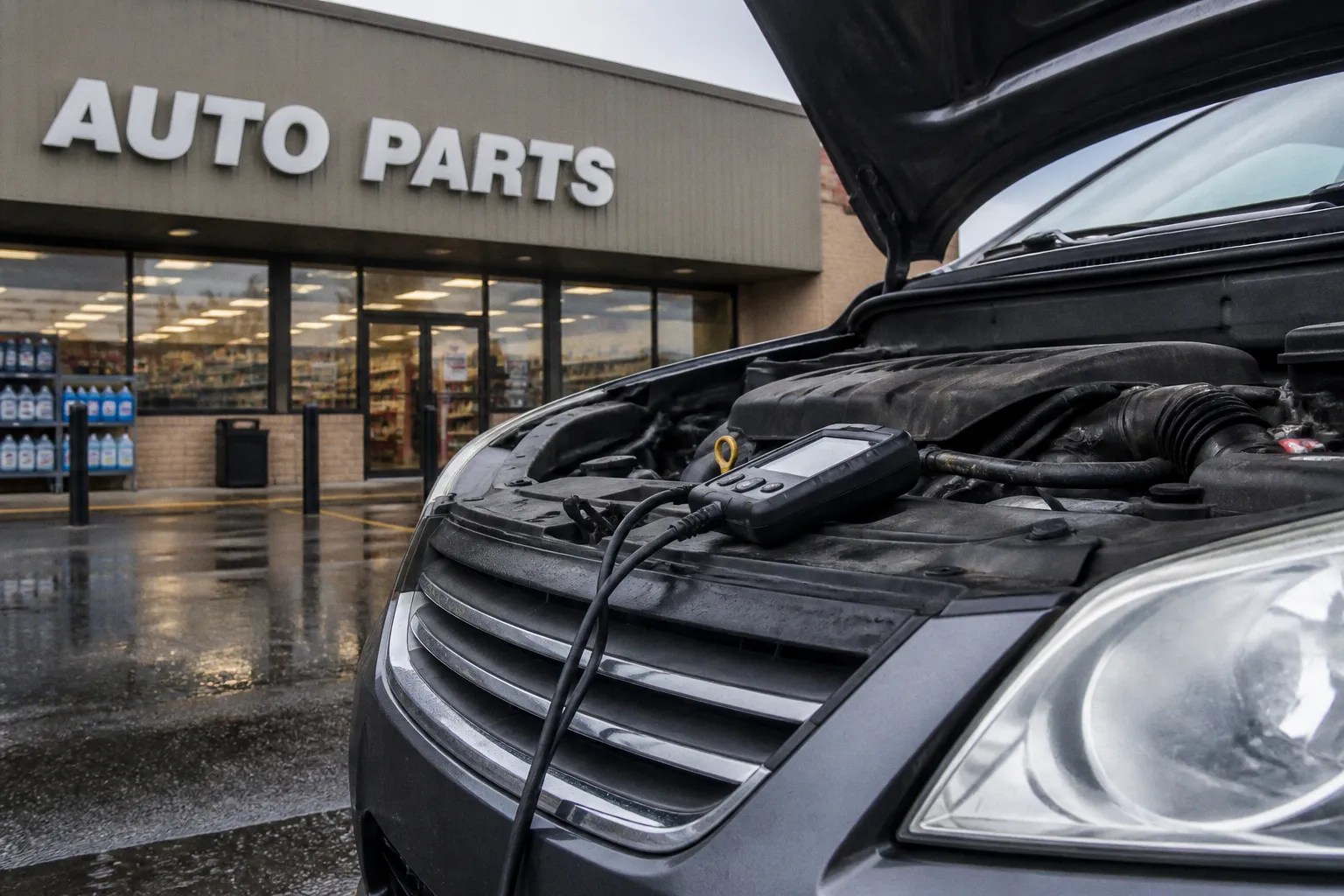
For those of us who spend weekends under European and Asian imports, that's worth filing away before the next glowing amber dash icon sends us reaching for the wallet. A free scan at the counter has become a sensible first stop — one that costs nothing but a few minutes and might just save you a diagnostic fee at the shop.
What the code actually tells you
Since the 1996 model year, vehicles sold in the US have run a standardized OBD-II diagnostic system. When one of the car's computers senses something drifting outside its expected range — a fuel mixture running lean, an ignition coil misfiring, a vacuum hose breathing where it shouldn't — it stores a Diagnostic Trouble Code. The free scan at the parts counter pulls those codes out in under a minute and hands you a printout.
Here's the catch we tell every apprentice who walks in with a slip of paper in their hand: a DTC points to where the car's brain noticed something wrong, not necessarily which component failed. A cylinder misfire code, for instance, could trace back to a worn spark plug, a tired ignition coil, a clogged injector, or a vacuum leak. The scanner hands you a starting point. The wrenches still have to do the rest of the talking.
How the free scan plays out at the counter
The process is straightforward. You drive up, an employee plugs a reader into the OBD-II port — usually tucked under the dash near the driver's knees — and the unit chats with the vehicle's computers. AutoZone brands the service as Fix Finder, O'Reilly runs it under the name VeriScan, and Advance Auto Parts advertises free engine code scanning for OBD-II-equipped vehicles. At AutoZone you can actually borrow the scanner, hook it up yourself, and bring the device back inside for the readout.
You aren't obligated to buy anything. Take the code home, look up the freeze-frame data, search forums for your specific chassis, or hand the printout to your independent shop and ask them to verify the diagnosis before throwing parts at it. A recent YouTube walkthrough of a 2015 Audi Q5 throwing P2188 and P0444 is a useful reminder of how layered that hunt can get — both codes kept steering the owner back toward the PCV system once the obvious culprits had been ruled out.
When to skip the parts store entirely
There's one exception we don't bend on. If the check engine light is flashing, or the engine is shaking, overheating, losing power, or making noises it shouldn't, the car is telling you to stop, not to limp three blocks for a free scan. Coast to the shoulder, scan from your phone if you have a Bluetooth reader, or get it towed. A flashing light usually means an active misfire dumping unburned fuel into the catalytic converter — exactly the kind of damage that turns a zero-dollar scan into a four-figure exhaust repair.
For everything else, treat the free scan as step one of a real diagnosis. It costs nothing, it moves you forward, and it keeps the shop from billing you for the same five minutes of work. We keep a Bluetooth OBD-II adapter in the drawer for exactly this reason, and we use it before we ever quote a customer a diagnostic fee.