Air vs cordless impact wrenches: which setup is best?
The belief that pneumatic impact wrenches categorically outperform cordless tools is a holdover from the early lithium-ion era. Modern high-torque battery tools have changed the comparison so thoroughly that peak output alone no longer settles it.
Merritt Vane·Updated: August 12, 2026·21 min read
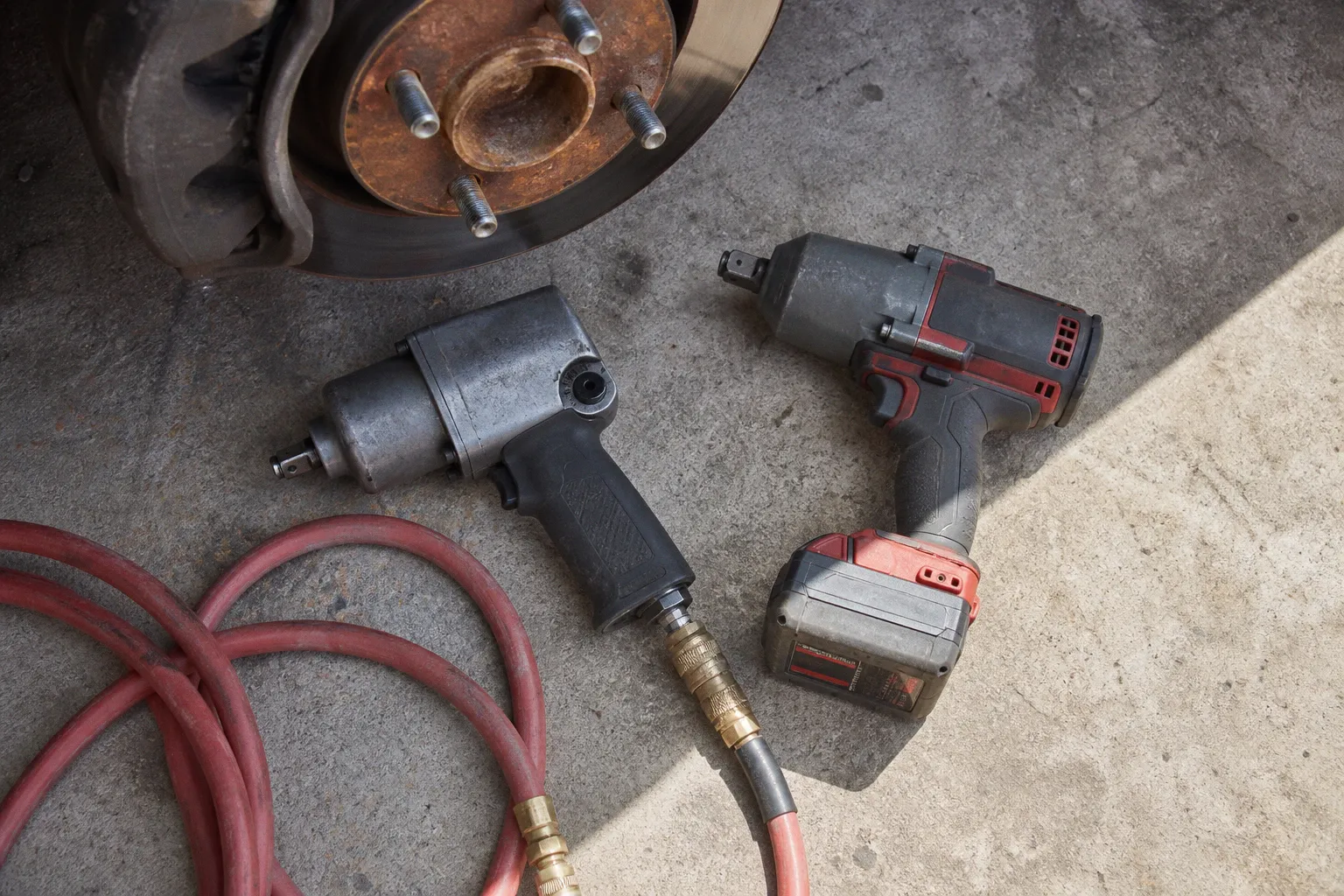
Consider one useful reference point: the Milwaukee 2967-20 1/2-inch cordless impact wrench is rated at 1,600 foot-pounds of nut-busting torque and 1,200 foot-pounds of fastening torque. Those figures meet or exceed many familiar 1/2-inch pneumatic offerings, including the long-referenced Ingersoll Rand 2235TiMAX, rated at approximately 1,350 foot-pounds of nut-busting torque.
Compare car rental deals in United Kingdom
See available offersPartner link — DiscoverCars comparisonThose numbers are manufacturer ratings, not a promise that every bolt will see the same result in every garage. Battery state, socket fit, fastener condition, hose size, regulator settings, and compressor capacity all affect what reaches the fastener. Even so, the old assumption that a cordless impact is automatically the weaker tool is no longer reliable.
For the home mechanic building or rebuilding a garage setup, the real question is not simply which platform produces more force. It is which one imposes fewer downstream costs, fits the existing electrical and spatial constraints, and integrates into a workflow without continuous logistical friction.
That reframing—from peak output to total system cost and usability—is where most comparison pieces stop, and where the actual decision begins.
The Performance Shift: Modern Cordless vs. Pneumatic Power
For roughly two decades, the pneumatic impact wrench held an uncontested claim on sustained, repeatable high-torque output. Brushless cordless motors, by contrast, were treated as underpowered conveniences suited to assembly work, wheel changes, and light passenger-vehicle repairs.
That consensus has not aged gracefully.
A high-output cordless 1/2-inch impact can now remove seized suspension fasteners and stubborn wheel nuts that, not long ago, would have demanded an air tool and a breaker bar. The Milwaukee 2967-20’s published 1,600 foot-pounds of nut-busting torque is one prominent example. A comparable 1/2-inch pneumatic wrench such as the Ingersoll Rand 2235TiMAX is rated at approximately 1,350 foot-pounds. The difference between those figures is real, but it is narrow enough to overturn the older assumption that pneumatic power automatically wins.
The comparison becomes more complicated when fastening torque enters the picture. “Nut-busting” or breakaway torque describes the tool’s ability to loosen a fastener under test conditions. Fastening torque describes a different operation and should not be treated as a final tightening specification. Neither number replaces a calibrated torque wrench when the service manual calls for a particular value.
| Parameter | High-torque cordless 1/2-inch impact | Comparable pneumatic 1/2-inch impact |
|---|---|---|
| Published nut-busting output | Can reach or exceed 1,600 ft-lbs on leading models | Approximately 1,350 ft-lbs on familiar high-output models |
| Published fastening output | Often around 1,200 ft-lbs on leading models | Commonly lower than breakaway output and dependent on air supply |
| Tool weight before accessories | Usually heavier once the battery is installed | Typically lighter at the tool head |
| Power source | Battery pack and charger | Compressor, receiver tank, hose, regulator, and fittings |
| Mobility | Unrestricted until the battery needs charging | Limited by hose length and routing |
| Output consistency | Depends on battery state, temperature, and control electronics | Depends on delivered airflow, pressure, hose size, and compressor duty cycle |
Two engineering shifts explain the convergence. First, brushless motor design has matured to the point where power density is no longer a novelty. Second, modern battery management systems can support high-current draw more effectively than earlier packs, while controlling heat and protecting the cells. The result is a cordless platform that can deliver serious fastening torque without being tethered to a compressor.
That does not make pneumatic tools obsolete. Three-quarter-inch and 1-inch pneumatic drives remain important in heavy commercial and industrial work. They can run for long periods when paired with a compressor and distribution system sized for the demand, and the tool itself may remain more compact than a battery equivalent. The issue is that the supporting air system becomes substantial. A tool that requires 8 to 15 CFM at 90 PSI is not being supported by the same kind of compressor used for occasional tire inflation.
For a home garage, where the work usually spans suspension components, driveline fasteners, brake work, and the occasional seized bolt, both platforms are viable. The torque argument is no longer a sufficient reason to install compressed air from scratch. Infrastructure, ergonomics, noise, and duty cycle now matter just as much.
The torque gap that once justified a dedicated pneumatic workshop has narrowed dramatically; the better choice is usually the platform whose limitations fit the garage you actually have.
Peak output also needs to be separated from control. A cordless impact often gives the operator several power or speed modes, allowing the tool to slow down during installation. That can reduce the chance of immediately over-tightening a smaller fastener. Pneumatic tools can offer excellent control as well, especially in experienced hands, but the behavior changes with regulator pressure, trigger position, lubrication, and the condition of the air motor.
In either case, an impact wrench is primarily a removal and run-down tool. Final tightening on wheel lugs, suspension hardware, steering components, and other safety-critical fasteners belongs to a torque wrench and the vehicle manufacturer’s specification.
The Hidden Infrastructure Costs of a Pneumatic Garage
A pneumatic impact wrench does not arrive alone. The tool itself—even a premium 1/2-inch model—represents only part of the system cost, because compressed air is not a utility that exists in most garages by default. It must be generated, stored, distributed, regulated, and maintained.
A quality 30-gallon electric compressor suitable for intermittent impact-wrench work can cost roughly $500 to $1,500, depending on its brand, pump design, CFM rating, and noise-control features. If the garage lacks a suitable 240-volt circuit, electrical work may add several hundred dollars for the breaker, wiring, and receptacle. Some compressors operate on standard household power, but that does not automatically mean the existing circuit is appropriate for the starting load or continuous duty. The installation should match the equipment and local electrical requirements rather than relying on an extension cord.
Air distribution is the next cost. A basic rubber hose and reel may be enough for a small workspace, while a hard-piped system with several drops, shutoff valves, and quick-connect fittings costs more but is easier to use. The RapidAir Home Garage Kit, for example, has been a commonly cited entry point for hard-piped systems, with a listed price of $129.95 for roughly fifty feet of 3/4-inch aluminum tubing and fittings. That price covers a kit, not necessarily the entire installation: isolation valves, a hose reel, connectors, mounting hardware, and a suitable workstation filter may still be required.
Add the compressor, electrical service, distribution, and fittings conservatively, and a functional pneumatic setup can reach roughly $800 to $2,400 before the impact wrench is attached. A quality 1/2-inch pneumatic tool may add another $200 to $400. A comparable high-torque cordless setup requires the tool, usually priced around $400 to $700, plus batteries and a charger. The exact battery investment depends on whether the mechanic already owns tools from that platform, but there is no receiver tank, permanent air line, or dedicated compressor circuit to install.
That changes the economics of the decision. Pneumatic ownership becomes much easier to justify when a compressor is already present for other work—painting, blow-off, inflation, or air-powered specialty tools—or when several pneumatic tools will share the system. The compressor is then an existing piece of infrastructure rather than a purchase made solely to support one impact wrench.
A first-time buyer choosing an impact wrench as the entry point into air tools should calculate the entire system, not compare the price of one bare tool against another. The lower purchase price of a pneumatic wrench can be misleading if the garage still needs a compressor, power circuit, hose, regulator, fittings, and a safe distribution method.
There is also a space cost. A compressor occupies floor area, needs ventilation, and may need to be moved away from the workbench because of noise. A tank should remain accessible for draining, and the air line should be routed where it will not become a trip hazard or snag on a vehicle. Cordless tools have their own storage requirements, but those are usually measured in shelf space and charging access rather than permanent floor area.
Ergonomics and Weight: The Impact of Battery Packs
Weight comparisons between cordless and pneumatic impact wrenches produce an immediate, slightly misleading result: pneumatic tools are generally lighter at the head. The Ingersoll Rand 2235TiMAX weighs about 4.6 pounds, while the Milwaukee 2967-20 bare tool is listed at about 5.9 pounds. Once a high-output battery is installed, the cordless tool becomes heavier still.
That does not end the ergonomic comparison. A pneumatic wrench is tethered to an air hose, and the hose adds drag, weight, and a constant restriction on movement. The effect is minor when removing a single wheel nut and much more noticeable during a long suspension job. A hose can catch on a lift arm, route around a control arm, or pull sideways as the operator changes position. The tool head may be lighter, but the operator is managing the tool and the hose together.
The cordless wrench has no trailing connection. Its total in-use weight is fixed at the tool-and-battery combination, and that weight is the operator’s principal load. Whether that is better depends on the task and the position.
For underbody work—subframe bolts, control-arm fasteners, differential hardware, and exhaust components—the cordless advantage is often decisive. The tool can be carried around the vehicle without dragging a hose across the floor or threading it through suspension components. It is also faster to move from one side of the vehicle to the other.
For bench work or jobs performed with the tool held vertically for long periods, the lighter head of a pneumatic wrench can reduce wrist and shoulder fatigue. A hose may be inconvenient, but the lower mass at the front of the tool can still matter. The balance of the cordless tool also changes with the battery design. A compact pack may improve handling but reduce runtime under heavy load; a high-output pack may deliver better performance while making the tool noticeably more top-heavy.
The best comparison is therefore not “5.9 pounds versus 4.6 pounds.” It is tool weight, battery or hose burden, balance, reach, and the number of times the operator must reposition during a job.
Noise and the residential garage
Noise is the second major ergonomic variable. Pneumatic impact wrenches can produce sound levels exceeding 100 dB at the operator’s position, depending on the model, pressure, socket, and work surface. That is hearing-protection territory, not a minor comfort issue. A compressor adds another source of noise each time it cycles, and a small compressor may run frequently when the tool is used near its airflow limit.
Cordless impacts are not silent, but they generally eliminate the compressor’s cycling noise and often sound less intrusive during short bursts. In a residential garage with shared walls, that distinction can determine whether a repair is practical at a convenient time. A detached workshop with no nearby rooms or neighbors presents a different calculation.
Hearing protection remains appropriate with either platform. The absence of a compressor does not make a cordless impact harmless to hearing, and the impulse noise from repeated impact blows can still be fatiguing.
Airflow Requirements and Compressor Limitations
A pneumatic impact wrench is the visible end of a system whose bottleneck sits upstream in the compressor’s CFM rating. This dependency is one of the most common sources of disappointment in new pneumatic setups.
A standard 1/2-inch pneumatic impact wrench may require approximately 4 to 5 CFM at 90 PSI for intermittent use—the pattern of removing a lug nut, pausing, repositioning, and repeating. A sustained run on a stubborn fastener can raise the demand into the 5 to 7 CFM range, depending on the tool and the manufacturer’s test method.
A consumer-grade 30-gallon compressor rated at 5.0 CFM at 90 PSI may technically meet an intermittent specification, but that does not mean it will supply unrestricted performance. If the tool is operated continuously, the pump may run almost constantly, tank pressure may fall, and delivered airflow may become the limiting factor. The impact wrench can still function, but its output may feel inconsistent or weaker than the published rating.
The number printed on the compressor matters less than where it is measured. CFM at 90 PSI is more useful for this comparison than a larger “displacement” or “peak” figure. The compressor must also be connected through a hose and fittings that can pass the required volume. A restrictive coupler, undersized hose, clogged filter, or regulator set too low can reduce the pressure at the tool even when the compressor’s label appears adequate.
Hose length is not automatically a problem, but hose diameter and connection design matter. A long, narrow hose with restrictive fittings can create a meaningful pressure drop under load. The wrench may show normal static pressure while sitting idle, then lose pressure as soon as the trigger is pulled. Checking pressure while the tool is operating gives a more realistic picture than reading the gauge with no airflow.
Larger pneumatic drives amplify the problem. A 3/4-inch drive impact wrench can require approximately 8 to 10 CFM at 90 PSI, while a 1-inch drive may require 10 to 15 CFM at the same pressure. Few residential compressors meet those demands comfortably. Units that do are often 60-gallon or larger industrial machines, and the system cost rises sharply before plumbing is considered.
Duty cycle matters as much as tank size. A large tank can provide a reserve for short bursts, but it does not transform an undersized pump into a continuous-duty system. Once the stored pressure falls, the pump must replace the air being consumed. For occasional wheel or suspension work, a reserve tank may be perfectly adequate. For repeated heavy fasteners, the pump’s delivered CFM becomes the deciding specification.
The cordless platform has no equivalent airflow bottleneck. The battery is the tool’s energy supply, and the motor, electronics, and pack are designed as one system. That does not make runtime unlimited. High-torque impacts consume batteries quickly under sustained load, and cold temperatures or worn packs can reduce available output. The difference is that the limitation is visible and portable: install a charged spare battery rather than redesigning the garage’s air system.
Compressed air is not delivered by the wrench; it is delivered by an upstream system whose cost, noise, and duty-cycle limits remain invisible until the first stubborn fastener exposes them.
For a mechanic working mostly on passenger vehicles, a cordless 1/2-inch impact covers the common fastener range without airflow calculations or regulator adjustments. That simplicity is especially valuable when the garage is still being assembled. A pneumatic system becomes more compelling when the mechanic already understands the compressor’s capacity and plans work that requires sustained air use.
Safety Hazards in Air Line Installation
The plumbing of a compressed-air system introduces a category of risk that does not exist in a cordless setup. It deserves the same seriousness as the electrical work because the danger comes from stored energy, not merely from a pipe’s ordinary pressure rating.
The most common preventable mistake is using ordinary PVC pipe for compressed-air distribution. PVC is widely used for water and other applications, but compressed air presents a different failure hazard. If a fitting separates or the pipe ruptures, the expanding air can fragment the material and propel pieces across the workspace. The issue is not that PVC water pipe is generally rated below some universal pressure threshold; pressure ratings vary by pipe type, diameter, temperature, and manufacturer. The issue is that many PVC products and installation practices are not approved or recommended for compressed-air distribution, and the stored-energy failure mode is severe.
A garage air system should use materials specifically suitable for compressed air and installed according to the product manufacturer’s instructions and applicable local requirements. Common choices include copper tubing, aluminum compressed-air piping, and approved multilayer systems such as PEX-AL-PEX where permitted. The material is only one part of the safety equation. Fittings, supports, transitions, shutoff valves, and the method of anchoring the line all need to be compatible with the pressure and environment.
Do not hide a questionable installation behind drywall or route it where a failure would put people directly in its path. Keep lines protected from impact, heat, vehicle movement, and sharp edges. A shutoff valve at each workstation allows a damaged hose or fitting to be isolated without depressurizing the entire garage.
Every receiver tank should have a pressure-relief valve, typically installed by the compressor manufacturer. Its purpose is to vent if pressure rises beyond the rated limit because of a control or regulator failure. The valve should not be removed, blocked, or replaced with an improvised fitting. The tank itself also requires routine draining because moisture collects as compressed air cools.
Moisture control deserves a more precise explanation than “install a filter and the problem is gone.” A filter-regulator at the workstation can remove some liquid water and particulate contamination while regulating pressure, but it does not turn wet compressed air into dry air. A separator, automatic drain, refrigerated dryer, desiccant dryer, or a combination of these may be needed depending on the climate, compressor duty cycle, and tools being used. Draining the receiver and low points in the line remains part of normal maintenance.
For an impact wrench used intermittently, a properly placed filter-regulator and routine draining may be sufficient to reduce contamination and protect the tool. That is not the same as eliminating moisture from the system. If the air line is producing visible water, if the garage is humid, or if the system also feeds paint equipment, the conditioning requirements become more demanding.
The cordless platform removes the air-line and receiver-tank hazards, but it does not become risk-free. Use impact-rated sockets and extensions, keep hands clear of rotating assemblies, and inspect the battery and charger for damage. Housing protection is model-specific: some cordless impact wrenches have enhanced seals or an ingress-protection rating, while others do not. A tool’s battery-powered design should never be treated as proof that it is sealed against dust, water, brake-cleaner overspray, or general garage contamination.
Keep ventilation openings clear, avoid blowing abrasive debris directly into the tool, and follow the manufacturer’s cleaning and storage instructions. If a battery has been dropped, swollen, overheated, or physically damaged, remove it from service rather than continuing to charge it.
Choosing the Setup and Maintaining It
The decision reduces to a few concrete questions, and answering them honestly is more useful than treating a specification table as a verdict.
1. Is a compressor already installed for other tools? A paint gun, sandblaster, inflation station, or other air-powered equipment can justify the compressor and distribution system. If the infrastructure is already suitable, adding a pneumatic impact wrench is relatively straightforward. Confirm that the existing compressor can deliver the required CFM at the pressure the tool needs; a tank in the corner is not automatically a capable impact-wrench system.
2. What does the workload look like? Intermittent passenger-vehicle work—tires, suspension components, brake jobs, and occasional engine repairs—fits comfortably within the capability of modern cordless 1/2-inch impacts. Sustained heavy work on commercial vehicles, large equipment, or repeated large fasteners pushes the decision toward pneumatic 3/4-inch or 1-inch drives and the compressor system that supports them.
3. What does the garage environment permit? A residential garage with shared walls, limited electrical service, and little floor space favors cordless for practical reasons. A detached workshop with dedicated electrical service, room for a compressor, and several planned pneumatic tools is a more neutral environment.
4. How often will the tool be used away from the bench? If the work involves moving around a vehicle, working outdoors, or handling repairs at more than one location, cordless mobility has a value that is difficult to capture in torque figures. If the tool will stay at one workstation for repeated cycles, the hose may be less troublesome than the battery weight.
5. What happens when the tool is needed immediately? A cordless setup requires charged batteries and a place to store them at an appropriate temperature. A pneumatic setup requires the compressor to be ready, the tank to have pressure, and the hose and fittings to be in working order. Both systems have preparation requirements; they simply appear at different points in the workflow.
Maintenance affects the true cost of either platform, but it does not support a universal service-life promise. A pneumatic wrench’s longevity depends on air quality, lubrication, operating pressure, workload, impact mechanism, and the availability of replacement parts. A cordless tool’s service life depends on the motor and impact mechanism, battery cycles, heat, contamination, storage conditions, and how aggressively it is used. No responsible comparison can guarantee that one will last a decade while the other will fail after three years.
For cordless systems, a sensible routine includes:
- Store batteries according to the manufacturer’s guidance, particularly when the tool will sit unused for an extended period. Avoid leaving packs in extreme heat or cold, and do not assume that full-charge storage is ideal for every battery chemistry and charger system.
- Keep cooling vents clear of dust, metal filings, and compacted debris. Clean around the vents rather than forcing contamination deeper into the housing.
- Inspect the anvil, friction ring or pin detent, and socket-retention mechanism for wear. A socket that fits loosely can create impact damage and an inaccurate or unsafe connection.
- Check battery contacts and the charger for corrosion, dirt, or physical damage. Do not use a pack that is swollen, cracked, leaking, or unusually hot.
- Use the tool’s lower power modes for run-down work when appropriate, then finish critical fasteners with a torque wrench.
For pneumatic systems, the routine is more extensive:
- Drain the compressor receiver after use or according to the manufacturer’s schedule. Water left in the tank promotes corrosion and can eventually become a tank-safety concern.
- Inspect the intake filter and replace or clean it when restricted. A compressor that cannot breathe properly loses efficiency and runs hotter.
- Check pressure at the tool under load, not only at the tank while the system is idle. Pressure loss can come from an undersized hose, restrictive coupler, clogged filter, leaking fitting, or failing regulator.
- Inspect lines, reels, and fittings for abrasion, kinks, corrosion, and movement at the joints. Depressurize the system before repairing or disassembling a connection.
- Use the type and quantity of pneumatic-tool lubricant specified by the tool manufacturer. Some tools require oil through the inlet; others use a different service procedure. More oil is not automatically better, and excess oil can contaminate the exhaust area or attract abrasive dust.
- Keep moisture separators and drains functional. A filter-regulator can help protect the tool, but it is not a substitute for a dryer when genuinely dry air is required.
Both platforms reward consistency. The mechanic who keeps the compressor drained, the air clean, and the wrench properly lubricated is giving a pneumatic tool the conditions it was designed for. The mechanic who stores batteries sensibly, keeps vents clear, and replaces worn retention parts is doing the same for a cordless system. Actual service life will vary with model, workload, environment, and maintenance; the useful goal is not to promise a fixed number of years but to avoid preventable wear.
The torque argument is no longer the main event. For most home garages, a cordless 1/2-inch impact wrench delivers enough power without adding a compressor, permanent air lines, moisture management, and installation hazards. It is the simpler system and usually the easier one to live with.
Pneumatic still earns its place when the compressor already exists, when several air tools will share it, or when the work demands sustained operation and larger drive sizes. In that setting, the hose is not an unnecessary burden; it is part of an established system.
The best air vs. cordless impact wrench garage setup is therefore not the one with the most impressive isolated torque rating. It is the one whose power source, limitations, maintenance, and safety requirements match the garage that already exists—and the work you genuinely expect to do there.