Jack stands vs car ramps: safety and clearance compared
The conventional wisdom inside home garages tends to flatten the distinction: ramps are simpler, therefore ramps are safer. The premise does not survive contact with the work envelope.
Merritt Vane·Updated: August 12, 2026·19 min read
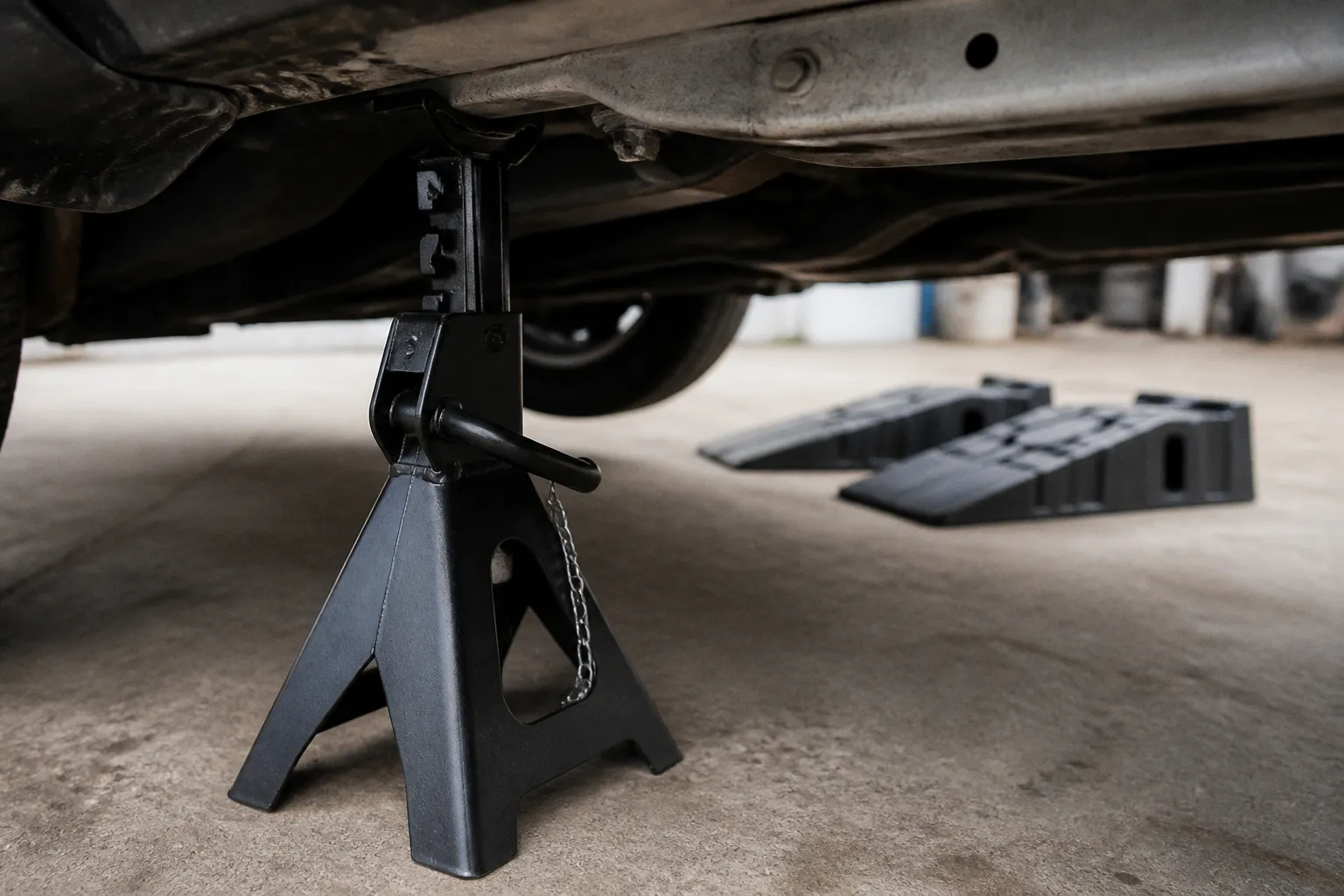
A pair of low-profile ramps may lift a passenger vehicle only a few inches—enough to reach a drain plug or oil filter housing, but not enough for most work that involves the wheels, brakes, suspension, or deeper chassis components. Jack stands, set after a floor jack has raised the vehicle, provide substantially more usable clearance and open the lower chassis to direct access.
Compare car rental deals in United Kingdom
See available offersPartner link — DiscoverCars comparisonThat difference in vertical reach decides which tool belongs under the vehicle before the question of comparative safety is even useful. Ramps and stands are not two versions of the same product. They manage the vehicle's weight through different geometries, introduce different operator errors, and support different kinds of maintenance. The safest choice is therefore not the tool that appears simpler on a store shelf. It is the tool whose operating limits match the job.
Mechanical Clearance and Lift Height Capabilities
Lift height is the first axis on which ramps and stands diverge, and it is the axis most often misreported in casual comparisons. The geometry of a drive-on ramp is a wedge inclined at a fixed angle. The vehicle moves up that wedge under its own power until the tires rest on the horizontal platform at the top. Vertical gain is consequently limited by the length of the ramp, its approach angle, and the amount of clearance available beneath the vehicle before the tires begin climbing.
Low-profile ramps typically provide roughly 2.5 to 5.5 inches of lift. They are useful for sports cars and lowered suspensions because the approach angle is designed to reduce the chance of the front bumper or undertray catching on the ramp. The tradeoff is straightforward: the lower the ramp is at the approach, the less room there may be at the top. A low-profile ramp can be the right answer for an oil change on a vehicle that will not accept a taller, steeper ramp, but it does not transform the car into a high-clearance work platform.
Standard ramps commonly provide around 6 to 10 inches or slightly more, depending on the design. That is enough for many sedans, crossovers, and light trucks to make fluid service more comfortable. It can also improve visibility during an inspection, give a little more room to remove a lower splash shield, and make access to an exhaust or front underbody panel less cramped. It still leaves the vehicle at axle height. A ramp cannot keep gaining height indefinitely without becoming longer, steeper, or more difficult to approach safely.
Jack stands operate from a different mechanical principle. A floor jack raises the vehicle, and the stand supports the load at a specified point once the desired height has been reached. The final clearance depends on the jack's reach, the vehicle's jacking points, the stand's minimum and maximum height, and the shape of the chassis. Many common stand-and-jack combinations provide somewhere in the neighborhood of 13 to 20 inches of clearance at the supported end, although the actual result varies considerably by vehicle and equipment.
That additional space changes the work itself. A few inches of ramp clearance may expose the sump plug, filter, and lower engine cover. It may not expose the steering rack, transmission pan, front subframe fasteners, or suspension hardware in a usable way. The point is not simply that the mechanic can fit a larger tool underneath. The entire body position changes. There is room to see the fastener, keep a socket square, use a breaker bar, and move the component being removed without immediately contacting the floor.
Clearance is not the same as access
A car can be technically high enough for a mechanic to reach a component and still be badly positioned for the job. The front wheels on ramps remain in contact with the ramp platforms. The suspension is loaded in a way that may be useful for some inspections but unhelpful for others. The ramp itself can obstruct the area around the tire, lower control arm, or front edge of the chassis.
Stands create their own limitations. They must be placed at suitable support points, so the stand location can occupy part of the space the mechanic would otherwise want to use. A stand under a pinch weld may make a nearby fastener easier to reach from one direction and harder from another. On some imports, the recommended support point is close to a plastic underbody panel, a welded seam, or a jacking pad that requires careful positioning. More height does not eliminate these constraints; it simply gives the mechanic a larger envelope in which to work.
| Parameter | Car ramps | Jack stands with a floor jack |
|---|---|---|
| How the vehicle is raised | Tires drive up a fixed wedge | Floor jack lifts the vehicle to a selected height |
| Typical working height | Low to moderate, often axle-height | Moderate to high, depending on stand and vehicle |
| Wheel status | Wheels remain installed and loaded | Wheels can be removed once the vehicle is properly supported |
| Best suited to | Oil changes, filter service, quick inspections | Brakes, suspension, wheel-off work, deeper underbody access |
| Main clearance limit | Ramp length, approach angle, and platform height | Jack reach, stand height, jacking-point location, and chassis shape |
| Additional equipment | Wheel chocks and a stable floor | Floor jack, stands, chocks, and suitable support points |
The practical comparison is therefore simple but not simplistic: ramps are efficient when the job fits inside their fixed height, while stands are adaptable when the vehicle must be raised farther or supported with the wheels removed.
Load Capacity and Structural Integrity Standards
Capacity labels are useful only when read in context. A rating applies to a particular product, configuration, and loading condition; it is not a universal promise that any vehicle can be placed on any pair of ramps or stands. The vehicle's curb weight is only the starting point. Load distribution changes as the vehicle is driven onto ramps, lifted at one end, stripped of components, or supported at multiple points.
A ramp rated for a certain load per ramp must be considered as part of a pair and used in the orientation intended by its manufacturer. The rating is not an invitation to place one ramp under an unexpected point on the chassis, stack ramps, or use a ramp as a substitute for a stand. Plastic, composite, and steel products can all be engineered for automotive use, but their construction, reinforcement, surface grip, and resistance to impact are not interchangeable.
Jack stands are normally sold by rated capacity for the set or for each stand, depending on the manufacturer. That distinction should be confirmed before purchase rather than inferred from the large number printed on the box. A vehicle that weighs several thousand pounds may still be within the combined rating of a suitable set, but the mechanic must also consider how much of the vehicle's weight is actually carried by the supported end and whether the stands are being used in a stable, symmetrical arrangement.
Capacity is not the same thing as height, either. A higher-capacity stand may have a larger base, heavier components, and a different adjustment range, but it is not automatically the best choice for a low sedan. Minimum height matters when the stand must fit beneath a designated jacking point, while maximum height matters only if the vehicle can be raised safely far enough to use it. A stand that is too tall for the floor jack or too tall for the vehicle's approved support point is not an upgrade. It is incompatible equipment.
What structural quality looks like in use
The most important features are often less dramatic than the capacity number:
- The base should sit flat and remain stable on a sound, level surface.
- The saddle should match the shape of the vehicle's approved support point rather than balancing on a narrow edge.
- The height-adjustment mechanism should engage completely, with no half-seated pin or partially engaged ratchet.
- Welds, pins, teeth, and contact surfaces should be free from cracking, distortion, severe corrosion, and improvised repairs.
- The equipment should have a clear rating and identifiable manufacturer information, not just a generic capacity sticker.
- The ramp's tire-stop or upper platform should provide a positive indication that the tire has reached the intended position.
A ramp transfers the load through the tire contact patch, into the ramp body, and then into the garage floor. Its stability depends on the ramp staying in place, the tire remaining centered, and the vehicle stopping at the platform rather than continuing over the end. A stand transfers the load through a small support interface into its post and base. Its stability depends on correct placement, a vertical load path, full engagement of the adjustment mechanism, and a floor that will not allow the feet to sink or slide.
That difference explains why the two products should not be compared by capacity labels alone. A ramp may have a substantial load rating and still be unsuitable if the vehicle's tires do not fit the channel, if the approach angle is too steep, or if the ramp cannot sit securely on the floor. A stand may have more than enough rated capacity and still be dangerous if its saddle is placed against a thin panel or if the post is not fully locked.
Manufacturing standards and product certifications can provide useful evidence of design and testing, but they do not replace inspection or correct use. Standards also vary by product type and jurisdiction, so a claim that every ramp or stand has been tested under the same regime should be treated cautiously. The useful question in the garage is more direct: does this specific product have a clear rating, an intact structure, a stable base, and instructions that match the vehicle and the job?
Operational Risks: Overshooting Ramps and Placement Errors
Each format carries a distinct failure mode, and conflating them masks both.
A ramp is approached under the vehicle's own momentum. Without a spotter or another reliable way to judge the stopping point, a driver can overshoot the platform, drive off the high edge, or place one tire against the ramp's lateral wall. The result can be abrupt: the front of the vehicle drops, the ramp shifts, or the vehicle ends up with one wheel positioned differently from the other. The risk is kinetic and concentrated at the moment of loading.
The safest ramp setup begins before the vehicle moves. The floor must be level and free of loose gravel, oil, ice, or other material that can reduce friction. The ramps should be aligned with the tires, and the approach should be straight rather than angled. Wheel chocks belong behind the wheels that remain on the floor. The parking brake and transmission setting are additional precautions, not replacements for chocks or correct ramp placement.
A driver should know where the tire is meant to stop. Some ramps have a raised stop, a change in surface angle, or another tactile and visual cue. If the vehicle is difficult to position accurately, a spotter can stand to the side where the driver can see them without placing any part of their body in the vehicle's path. Once the car is on the ramps, the mechanic should confirm that both tires are centered, both ramps remain flat, and the vehicle has reached the intended platform before getting underneath.
Jack stands introduce a different risk class. A stand only performs as designed when its saddle is fully seated on a manufacturer-recommended jacking point, the post is vertical, and the base rests on a surface that resists sinking or tipping. The vehicle's owner's manual or service information should determine where the floor jack lifts and where the stands support. These locations are not always identical. A point strong enough to accept a jack saddle may not be the correct place for a stand, and a pinch weld may require a compatible saddle adapter to avoid bending the metal.
The transfer from jack to stands deserves particular attention. The floor jack raises the vehicle; it does not become a permanent support simply because it appears solid. The stand must be adjusted before the lift begins, positioned so it can receive the vehicle without being dragged across the floor, and lowered into contact in a controlled manner. After the load is transferred, the mechanic should verify that the saddle has not rolled off the support point and that the stand remains upright.
A hydraulic jack is a lifting instrument, not a long-term support. The stand carries the vehicle only after it is correctly placed, fully engaged, and visibly stable.
A useful practice is to give the supported vehicle a deliberate, controlled stability check from outside the danger zone before any body goes underneath. The purpose is not to shake the car violently. It is to reveal an obvious seating, alignment, or contact problem while the mechanic can still step away. If the vehicle shifts, rocks unexpectedly, or settles farther than expected, the job stops. The answer is not to reach under and adjust the stand.
Common placement errors
Several mistakes recur because the setup can look acceptable from above:
1. Supporting a thin body panel instead of a structural point. A convenient flat section of floor pan may be close to the recommended location but is not necessarily designed to carry the vehicle.
2. Using a pinch weld without protecting it. A narrow saddle can crush or deform the seam, especially when the load is not centered.
3. Leaving the adjustment mechanism partially engaged. A pin that has not passed completely through the height position, or a ratchet that has not seated, is not a locked support.
4. Placing a stand on a sloped or damaged surface. Even a strong stand becomes unstable when one foot is unloaded or the floor allows it to sink.
5. Lifting one corner farther than the others without considering the load shift. The vehicle's center of gravity changes as the suspension extends and the load moves between contact points.
6. Working with the jack still carrying most of the load. The jack can remain in a supporting role only if the manufacturer's procedure allows it and the stands are still positioned to carry the vehicle. It should never be treated as the only safeguard.
Ramps are not free from placement mistakes, and stands are not automatically dangerous because they require more steps. The distinction is that ramps concentrate risk in approach and wheel positioning, while stands concentrate it in lifting, support-point selection, and load transfer. Knowing which error the tool invites is part of choosing it responsibly.
Versatility Constraints: Why Wheel-Off Tasks Require Stands
The most consistent line between ramps and stands is non-negotiable: ramps keep the wheels under load. Any procedure that requires wheel removal—pad and rotor replacement, caliper service, tire rotation, suspension bushing replacement, control-arm work, or wheel-bearing inspection—cannot be completed with the vehicle supported only on drive-on ramps.
The issue is geometric, not merely procedural. The wheel occupies the work area and carries the vehicle's load. Removing it changes the load path and the vehicle's balance. A ramp does not provide a substitute support beneath the chassis when the tire is no longer present. The vehicle must be raised with a floor jack and transferred to stands placed at appropriate support points.
This is also why ramps are poorly suited to many jobs that sound like ordinary under-car maintenance. An exhaust inspection may be possible from ramps if the relevant section is accessible and the vehicle remains stable. Replacing a section of exhaust may require more height, more lateral room, or the ability to lower and maneuver the component. A transmission service may begin with a ramp-like height requirement but quickly become constrained by the crossmember, transmission pan, or need to support a component separately.
Stands offer the necessary flexibility for wheel-off tasks, but they do not make every job equally convenient. Two stands supporting the front or rear axle may leave the opposite end on the ground, which can be appropriate for a focused repair but does not create a level platform for every procedure. Four-corner support requires a deliberate sequence and a stable arrangement. The mechanic must consider the manufacturer's support points, the order in which each end is raised, and the way the vehicle's weight shifts during the process.
Ramps and stands can work in series. Ramps may be useful for a quick oil change, while the floor jack and stands are reserved for repairs that require wheel removal or greater clearance. They should not be treated as interchangeable shortcuts. A ramp is not a low-cost substitute for a stand, and a stand is not a faster version of a ramp.
For an import owner, the vehicle-specific details matter. Some cars have low front lips, enclosed jacking points, reinforced pinch welds, or underbody panels that make generic placement advice inadequate. A repair manual may identify separate points for lifting and supporting. It may also specify whether a suspension component must remain loaded during an inspection or whether the vehicle needs to be level for a fluid service. The equipment choice has to follow those requirements, not the other way around.
Ramps preserve wheel contact; stands create wheel-off access. That single distinction decides whether the tool can perform the job at all.
There are also tasks where neither format is the complete answer. A wheel-off brake job may require a separate support for a caliper rather than allowing it to hang from the hose. A suspension repair may require a second jack to control a spring-loaded or articulated component. A vehicle raised high enough for one task may still not have enough room to remove a long exhaust section. Lifting equipment creates access; it does not remove the need to control the parts being removed.
Investment Analysis: Balancing Tool Costs and Garage Utility
The capital requirement for each format is asymmetric. A high-quality set of steel ramps may cost less than the complete equipment needed to use jack stands. A pair of stands may be relatively inexpensive by itself, but it depends on a floor jack to position the vehicle. Chocks, a suitable work surface, and sometimes adapters for pinch welds or jacking pads also belong in the real calculation.
For a homeowner who performs only fluid service, ramps can be the economical and practical choice. They offer a fast setup, preserve the wheels in their normal position, and provide enough room for an oil change on many vehicles. The purchase still needs to be matched to the car: the approach angle must clear the front bumper, the tire width must fit the ramp, and the platform must be long and wide enough for the vehicle to sit securely.
For someone intending to perform brake service, suspension work, wheel removal, or deeper inspection, the stand-and-jack combination is the primary investment. Ramps may remain useful as a convenience tool, but they no longer cover the central maintenance tasks. Buying ramps first is not necessarily wasteful; it simply means the owner should understand that a later purchase of a floor jack and stands will still be required.
A sensible progression for a new DIY mechanic working on import vehicles might look like this:
1. Start with a suitable floor jack and one correctly rated pair of jack stands. Confirm the jack's minimum height, maximum lift, saddle shape, and reach against the vehicle's jacking points. Confirm how the stand rating is stated and whether the pair is appropriate for the vehicle.
2. Add a second pair of stands when the work requires stable four-corner support. This is useful for broader inspections, brake work on multiple corners, and repairs where repositioning the vehicle would interrupt the job.
3. Add ramps for routine fluid service if the approach angle and platform fit the vehicle. Choose them for stable loading and usable geometry, not simply for the highest advertised lift.
4. Add accessories that protect the vehicle and improve control. Chocks, a pinch-weld adapter, a low-profile jack pad, and a way to prevent a removed wheel from rolling away can be more useful than paying for a higher capacity that does not fit the car.
Each step adds capability rather than duplicating it. The ramp investment earns its keep when a job can be completed at axle height and the faster setup matters. The jack-and-stand investment earns its keep whenever the vehicle must be raised, supported from the chassis, or worked on with a wheel removed.
Cost should also be measured against the cost of a bad fit. A ramp that contacts the front bumper may damage an undertray before the work begins. A stand that deforms a pinch weld can turn a routine repair into bodywork. A jack that cannot reach the manufacturer's lifting point without being angled creates a poor transfer from the first movement. The least expensive piece of equipment is not the one with the lowest price tag; it is the one that fits the vehicle, the floor, and the job without forcing improvised techniques.
Position
Jack stands and car ramps are not competitors. They are instruments designed for different vertical envelopes and different operational tasks.
Ramps deliver a fast, repeatable lifting solution for fluid service at axle height. They are relatively simple to position, but they depend on accurate driving, tire alignment, a stable floor, and a positive stop. Their limitation is built into the design: the wheels remain installed, and the vehicle stays close to the height of the ramp platform.
Jack stands, paired with a floor jack, provide greater working clearance and support wheel-off maintenance. They also demand more preparation. The mechanic must identify the correct lifting and support points, place the stands accurately, engage the locking mechanism fully, manage load transfer, and confirm stability before going underneath. Their greater versatility is not a free safety advantage; it comes with a more involved setup and more opportunities for placement errors.
The useful question is not whether car ramps are safer than jack stands in the abstract. Both can be safe when used within their design limits, and both can become dangerous when the vehicle is misaligned, the load rating is exceeded, or the equipment is used as something it is not. The useful question is which work envelope the job demands.
For an oil change or a quick underbody inspection, properly selected ramps may be the cleanest solution. For brakes, suspension, wheel removal, or work that requires meaningful chassis clearance, a floor jack and correctly placed jack stands are the appropriate foundation. The best-equipped garage treats the jack as the lifting instrument, the stands as sustained support, and the ramps as the axle-height convenience tool that saves time when the job genuinely fits them.