Two-post garage lifts: is the installation worth it?
A two-post lift earns its keep the first time you need to remove a transmission, reach the center of a rusted exhaust system, or replace suspension parts without crawling across a cold concrete floor.
Judson Grier·Updated: August 12, 2026·17 min read
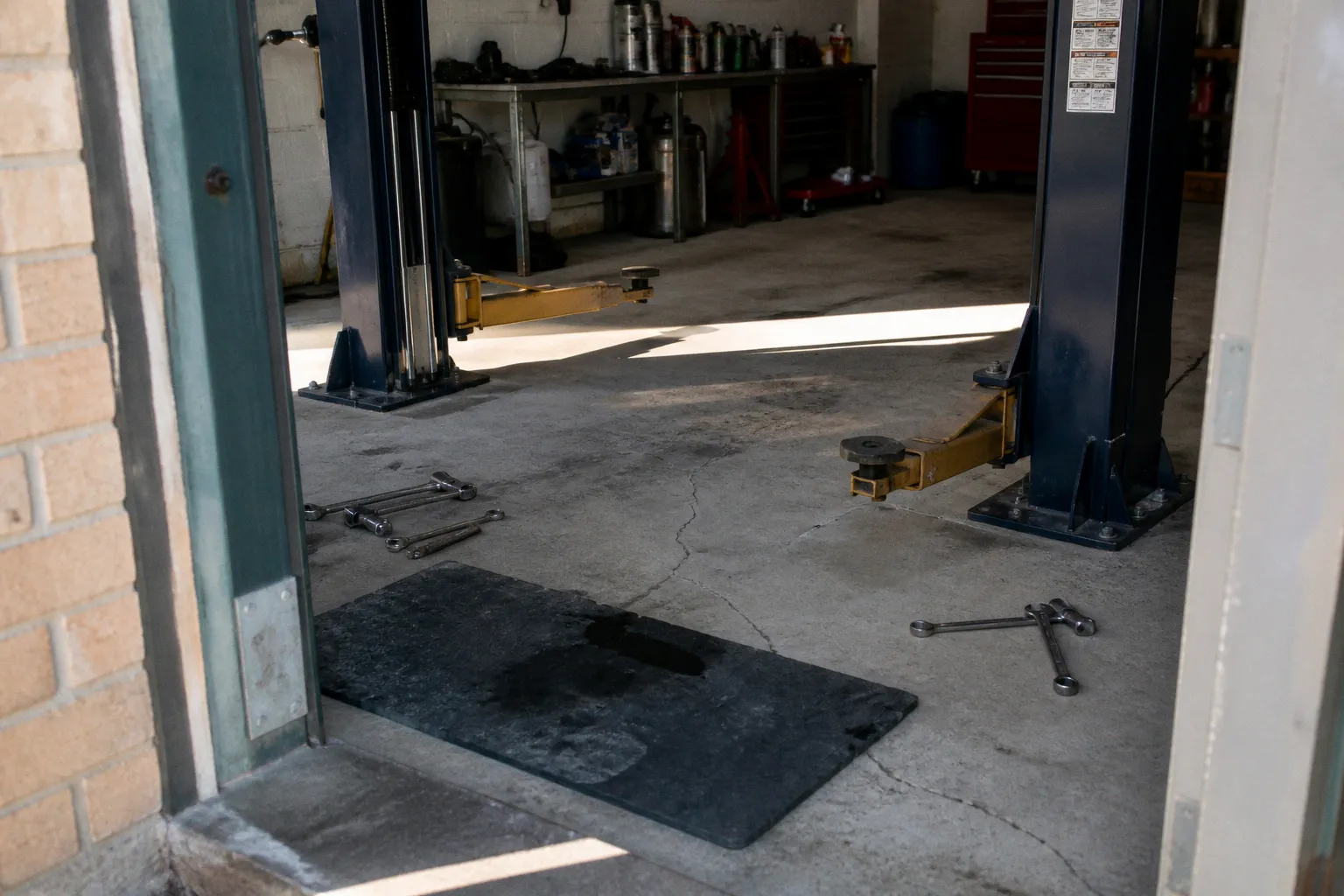
It also exposes every weakness in the garage at once: a slab that is too thin, a ceiling that leaves no working clearance, an undersized electrical circuit, or an installation done with more confidence than measurement.
Compare car rental deals in United Kingdom
See available offersPartner link — DiscoverCars comparisonThat is the real question behind the two post vs four post lift home garage debate. The lift itself is only one part of the system. The concrete, the ceiling, the power supply, the vehicle’s lifting points, and the kind of work you actually perform all decide whether the purchase becomes a useful mechanical tool or an expensive obstruction with hydraulic lines attached.
A two-post lift can be the best piece of equipment in a serious home workshop. It can also be the wrong choice for a garage mainly used to store a second vehicle. We need to look at what each design does to the vehicle, what it demands from the building, and what happens after the first enthusiastic weekend of installation.
The concrete decides before the lift ever moves
A standard residential two-post lift transfers the vehicle’s weight into two narrow areas of the garage floor. The columns are permanently anchored to the slab, and the anchors carry more than the static weight of the car. They also deal with shifting loads as the vehicle rises, as arms are positioned, and as tools or components are removed from one end of the vehicle.
For a typical 9,000- to 10,000-pound-rated two-post lift, manufacturers commonly specify:
- A concrete slab at least 4 to 4.25 inches thick.
- Concrete compressive strength of at least 3,000 PSI.
- A slab cured for at least 28 days if it is newly poured.
- Adequate distance from expansion joints, cracks, edges, and other weakened sections.
- Proper anchor depth and installation according to the lift manufacturer’s instructions.
Those figures are not a suggestion to compare casually against the age of the garage. A floor that looks substantial may be thinner near the edges, may have been poured over an unsuitable base, or may contain a repaired section that does not behave like the rest of the slab. A residential floor is not automatically suitable simply because it supports a vehicle every day.
The load path is short and unforgiving: column, anchor, concrete. If the anchor cannot develop its holding strength because the slab is too thin or weak, the lift has no reserve hidden inside the steel columns. The failure may not announce itself with a dramatic crack on the first day. Movement around the base, anchor loosening, or a column beginning to shift under load is already a serious warning.
What to examine before drilling
Before the lift arrives, we need a reliable picture of the floor rather than a guess made with a tape measure and a few knocks from a hammer. The manufacturer’s installation manual is the starting point, not the final authority. If the slab thickness or strength is uncertain, the sensible path is to have it evaluated by a qualified contractor or concrete-testing professional.
Pay particular attention to:
- Slab thickness: Four inches is a common minimum for standard two-post equipment, but the lift model may require more.
- Concrete strength: The frequently specified minimum is 3,000 PSI, but age alone does not prove that the slab meets it.
- Cracks and joints: A column should not be anchored across a crack, expansion joint, or weak patch.
- Edges and obstructions: The columns need enough clear floor around them for the arms to swing and for you to walk safely.
- Reinforcement and embedded services: Drilling into concealed electrical conduit, plumbing, or radiant heating is not a workshop lesson anyone wants to learn firsthand.
If the garage floor does not meet the specification, the answer is not to use shorter anchors, add washers, or hope that a lower vehicle weight makes the problem disappear. A lift rated for 9,000 pounds still depends on the floor and anchors being installed as a system. In some garages, the practical solution is a properly engineered reinforced footing or a new slab section. That adds cost and disruption, but it is less expensive than repairing a vehicle and a building after a lift failure.
A two-post lift does not stand on the garage floor in the casual sense. It is anchored into the floor, and the floor becomes part of the lifting equipment.
Ceiling height is a working dimension, not a headline number
A standard clear-floor two-post lift typically needs a ceiling height of about 11 to 12 feet. That figure usually accounts for the columns and the overhead crossbar, but it does not mean every vehicle can be raised to a comfortable working height under an 11-foot ceiling.
We need to measure the actual highest obstruction: garage door tracks, openers, lights, ductwork, storage racks, and the door itself when it is fully open. Then we need to allow clearance above the vehicle. A practical buffer of roughly 6 to 12 inches above the highest point of the vehicle is commonly used, though the final requirement belongs to the lift manufacturer and the specific vehicle.
A tall SUV, van, or imported high-roof vehicle changes the calculation quickly. Even a regular passenger car may stop rising long before the lift reaches its rated height if the garage door hardware occupies the wrong section of the ceiling. You may technically be able to lift the car, but not high enough to stand beneath it or remove a transmission comfortably. That is a poor result after pouring concrete, running power, and assembling several hundred pounds of steel.
Baseplate or low-clearance two-post lifts can work in garages with ceilings around 9.5 feet, depending on the model and vehicle. They place more equipment on the floor between the columns, however, and that affects how we move around the car. The baseplate may cover or complicate access to the center of the vehicle, and the hydraulic lines or cables may occupy the same working area where a transmission jack, creeper, or tool cart needs to travel.
The comparison is not simply “high ceiling equals two-post, low ceiling equals four-post.” We need to match the lift geometry to the garage and the work:
| Garage or repair requirement | Two-post lift | Four-post lift |
|---|---|---|
| Wheel removal and suspension work | Excellent; wheels hang free | Requires jacks or additional equipment to unload wheels |
| Transmission and exhaust access | Very good when correctly positioned | More limited because runways remain under the vehicle |
| Oil changes and underbody inspection | Good, though access depends on arm placement | Convenient drive-on access, with runways below |
| Long-term vehicle storage | Not the preferred design | Better suited; vehicle remains supported by its tires |
| Ceiling requirement | Often about 11–12 feet for clear-floor models | Varies, but may suit some lower garages |
| Floor anchoring | Permanently anchored and highly dependent on slab | Often free-standing, though anchoring may still be recommended |
| Footprint and floor obstruction | Clear floor with clear-floor models; baseplate models add a center obstruction | Runways and ramps remain on the floor |
| Typical residential equipment cost | About $2,000–$5,000 | About $3,000–$7,000 |
The four-post lift often wins when the primary job is raising a car for storage or occasional drive-on maintenance. The two-post lift wins when the vehicle needs to be opened up underneath and the wheels need to come off without fighting the equipment.
Two posts and four posts support the vehicle in different ways
The mechanical difference is straightforward, but its consequences are easy to underestimate.
A two-post lift supports the vehicle at selected points on the frame or approved structural lifting locations. The arms swing into position, and the pads contact the vehicle at specific points. Once the vehicle is raised, the wheels hang free. That is exactly what we want for brake work, wheel bearings, control arms, struts, tire removal, and many driveline jobs.
It also means the vehicle’s weight is no longer distributed through the tires and suspension in its normal way. The body and frame are being held at a few concentrated points. The vehicle must be positioned correctly, and the pads must contact the approved lifting locations with enough engagement to remain stable through the entire job.
A four-post lift raises the vehicle by its tires on two runways. The vehicle’s suspension remains loaded in a more familiar way, and the runways provide a broad, stable platform. This is why four-post lifts are often the calmer choice for long-term storage. A car can remain on its tires in the locked position for extended periods without placing the same kind of concentrated support load on suspension and body lift points.
That does not make a four-post lift maintenance-free. The locks, cables, pulleys, ramps, and lifting system still need inspection. The runways also remain between you and parts of the undercarriage. For an oil change, that is usually a tolerable trade. For a transmission removal or a complete suspension rebuild, it becomes a persistent obstruction.
The workbench test
Before deciding is a 2 post lift worth it, list the jobs you actually perform rather than the jobs the lift photographs well.
A two-post lift makes strong sense if your regular work includes:
1. Brake and suspension repairs. The wheels are free, and the hubs can be inspected or removed without supporting the vehicle on separate stands.
2. Exhaust and underbody work. You can walk beneath the vehicle and reach sections that are awkward from a creeper.
3. Transmission and driveline work. The open space between the columns is valuable when a transmission jack, support beam, or large drain pan is involved.
4. Rust repair and structural inspection. A stable, elevated vehicle gives us a much better view of seams, subframes, fuel lines, and floor sections.
5. Frequent access to one vehicle. The installation effort is easier to justify when the lift will be used repeatedly rather than only for winter storage.
A four-post lift is usually more appropriate if your primary needs are:
- Storing one vehicle above another.
- Keeping a seasonal car off the floor.
- Performing oil changes, inspections, fluid service, and light underbody work.
- Driving onto the lift without carefully placing swing arms.
- Moving the lift or using it in a garage where permanent anchoring is difficult.
Neither design eliminates the need for jack stands. A two-post lift must be locked mechanically at the working height, and we still need to use the manufacturer’s safety procedures. A four-post lift may need supplementary jacks when the wheels must be unloaded. The lift changes the work; it does not remove the need to support components properly during disassembly.
Safety lives in the setup, not the weight rating
The large number printed on the lift is useful, but it is not the whole safety story. A 9,000-pound rating does not mean every 8,500-pound vehicle is automatically a suitable load. We need to know where the vehicle’s center of gravity sits, whether the arms reach the approved lifting points, and whether the vehicle remains stable as parts are removed.
Removing a heavy engine, transmission, fuel tank, or axle assembly can change the balance of the vehicle. The car may remain under the rated capacity while becoming less stable on the pads. This is where careful positioning and secondary support matter more than the headline rating.
With a two-post lift, the basic sequence should be deliberate:
- Confirm the vehicle weight and compare it with the lift’s rated capacity.
- Identify the approved lifting points for that vehicle.
- Position the arms symmetrically where possible, with the pads fully seated.
- Raise the vehicle only a short distance first.
- Stop and check that the pads remain centered, the vehicle is stable, and the arms have not shifted.
- Continue upward while listening for unusual movement and watching the contact points.
- Engage the mechanical locks before working beneath the vehicle.
- Keep the area clear of people who are not part of the work.
The phrase “fully seated” matters. A pad resting partly on a pinch weld, a curved suspension arm, or a plastic shield is not a proper support point because it can shear or slip as the load settles. Import cars often have tightly packaged underbodies, battery trays, aerodynamic panels, and manufacturer-specific jack points. We should identify those locations before the vehicle is in the air, not after the arms are already carrying the load.
A lift installed by a professional is not an indulgence when the slab, anchors, columns, and safety locks all have to work together. Installation commonly adds about $700 to $1,500 for a residential two-post lift. That cost buys more than assembly. It may include positioning, anchoring, leveling, hydraulic setup, and a functional check. DIY installation is possible for experienced people with the right equipment and a clear understanding of the manufacturer’s requirements, but it is not a beginner-friendly weekend shortcut. Incorrect anchoring can turn a minor installation error into a catastrophic failure.
Electrical service and installation cost change the equation
Most residential two-post and four-post lifts use a single-phase 220V or 208V circuit drawing roughly 20 to 30 amps. If the garage already has a suitable dedicated circuit, the electrical work may be straightforward. If it does not, we may need a new breaker, conduit, wiring, disconnect, and inspection. A typical installation can add approximately $150 to $700, depending on the distance from the panel and the local electrical conditions.
The motor is only one part of the electrical planning. We also need to consider the garage door opener, compressor, heater, lighting, battery charger, and any welding equipment on the same service. A lift that operates properly by itself may trip the circuit when the compressor starts or a heater is running. An electrician can determine whether the existing panel and service have enough capacity rather than simply fitting a larger breaker.
The broad cost picture looks like this:
| Expense | Two-post lift | Four-post lift |
|---|---|---|
| Residential equipment | About $2,000–$5,000 | About $3,000–$7,000 |
| Professional installation | About $700–$1,500 | About $600–$1,200 |
| Electrical work, if needed | About $150–$700 | About $150–$700 |
| Concrete correction | Highly variable; may be substantial | Often lower anchoring demand, but slab still matters |
| Extra working equipment | Jack stands, pad adapters, transmission support, wheel chocks | Rolling bridge jack or jacks for wheel-off work |
The concrete correction line is the one that can break the original budget. Equipment pricing is visible. A weak slab, misplaced garage door track, or electrical upgrade appears later, after the lift has already become the plan. We should measure and price those issues first.
There are also smaller costs that become obvious only once the equipment is in use: manufacturer-specific pad adapters, drip trays, a transmission jack, better lighting, wheel chocks, a low-profile floor jack, and storage for the arm extensions. None of these is unreasonable, but they belong in the decision. A lift without the tools needed to work safely around it is only a taller place to make the same repair.
The cheapest lift is not the one with the lowest price tag. It is the one that fits the slab, the ceiling, the vehicle, and the work without forcing expensive corrections afterward.
Is a two-post lift worth installing at home?
For a dedicated repair garage, often yes. The access is better, the wheels are free, and the open underside changes how much work we can complete without fighting the floor. Suspension, brake, exhaust, driveline, and rust repairs become more controlled because the vehicle can be raised to a useful height and approached from both sides.
But the value depends on frequency. If you repair one car twice a year and store another for the rest of the time, a four-post lift may serve the garage better. It is easier to drive onto, more naturally suited to long-term storage, and often less demanding when the floor cannot accept permanent two-post anchors. You give up some undercar access, but you gain a stable platform and simpler loading.
The two-post design becomes a poor purchase when:
- The concrete thickness and strength are unknown.
- The slab contains cracks or joints where the columns must go.
- The ceiling leaves no safe clearance above the vehicle.
- The garage door hardware occupies the lift’s required space.
- The main goal is long-term storage rather than repair.
- You are not prepared to install the lift, lock it, and inspect it with discipline.
- The vehicle’s lifting points are damaged, corroded, or difficult to reach.
- The electrical service cannot support the motor without a proper upgrade.
A four-post lift is not automatically safer because it has more columns. A two-post lift is not automatically dangerous because the wheels hang. Safety comes from correct equipment selection, sound concrete, proper anchoring, balanced loading, mechanical locks, and disciplined vehicle support. The design determines what kind of risk we are managing, not whether risk disappears.
The long-term wear is part of the decision
The first month is where most lift purchases look brilliant. The car rises, the wheels come off, and the underside is suddenly visible without a flashlight pressed against your cheek. The more important question comes later: does the lift still suit the way the garage is used after the novelty has worn off?
A two-post lift is built around access. Its strengths are most visible during active repair, when the vehicle is raised, locked, and worked on for a defined period. It is not the preferred arrangement for leaving a vehicle suspended for months. Extended storage on a two-post lift can place stress on suspension components and concentrated lifting points, especially if the vehicle is not positioned and supported exactly as specified.
A four-post lift supports the vehicle on its tires and can keep it locked in position for long-term storage. That makes it the more sensible tool when stacking vehicles, preserving floor space, or keeping a seasonal car elevated through the winter is the central purpose.
We also need to think about the garage as a working environment. A clear-floor two-post lift leaves the center of the garage relatively open when no vehicle is raised, but the columns become permanent landmarks. A baseplate model puts equipment across the floor. A four-post lift creates runways, ramps, and cross-members that can interfere with carts and floor jacks, but it can also provide useful storage underneath when the vehicle is parked.
This is where the choice stops being a catalog comparison. We are deciding how the garage will behave every week.
The practical verdict
Choose a two-post lift when your priority is repair access: wheels off, suspension exposed, exhaust reachable, and driveline work possible without lying flat on the floor. Confirm the concrete specification, measure the complete ceiling and door system, arrange the correct 220V or 208V circuit, and budget for professional installation unless you already have the experience and equipment to anchor it correctly.
Choose a four-post lift when storage, drive-on convenience, and stable long-term support matter more than unrestricted wheel-free access. It will not replace every function of a two-post lift, but it can be the better fit for a mixed-use home garage.
So, is a 2 post lift worth it? It is worth it when the lift will be used as a mechanical workstation and the building can support it without improvisation. If the slab is uncertain, the ceiling is marginal, and most of the planned use is storage, the lower price of a two-post unit will not make it the economical choice.
The steel may last for years. The hydraulic system may do its work quietly. What determines whether the installation remains a good decision is the long-term wear on the whole arrangement: the anchors loaded every time the vehicle rises, the floor space lost to columns and arms, the suspension held in an unnatural position if the lift is used for storage, and the patience required to position every vehicle correctly. We do not get to separate the lift from those conditions. They are the lift.