Essential Equipment for Modern DIY Vehicle Maintenance and Complex Repairs
A 2020 Jeep Compass required removal of the transfer case, full exhaust, and front K-frame before the starter became reachable, according to a Motor1 report on a job performed at GTM Auto Repair in Ann Arbor, Michigan.
Aldous Moorland·updated September 05, 2026
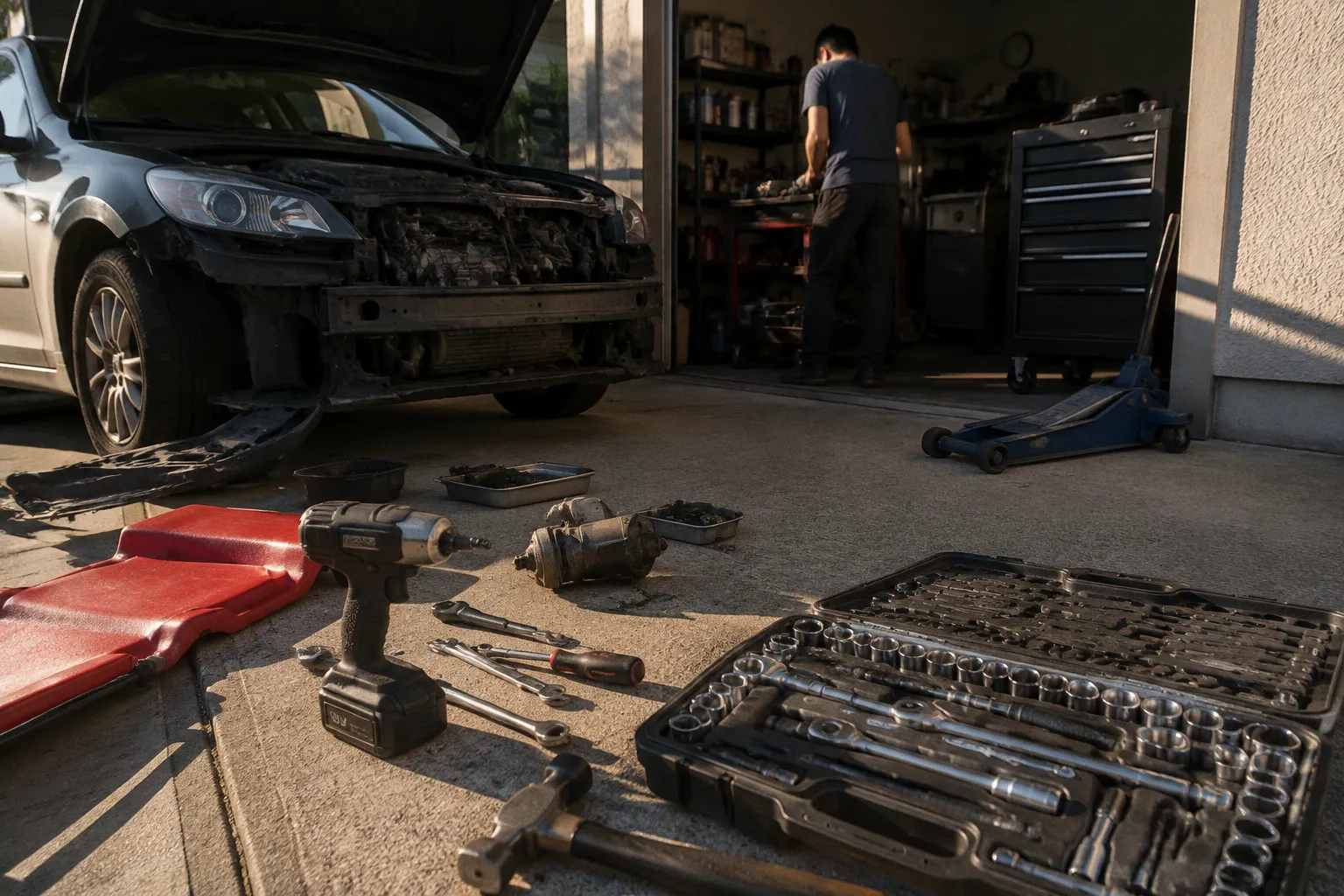
10 Essential Tools Every DIY Auto Mechanic Needs
Total invoice reached $950, split between a $350 dealer-sourced starter and $600 in labor. The case arrived alongside a separate industry signal—Ford's recall of 10,001 model-year 2026 vehicles for improperly manufactured piston domes—reinforcing that modern vehicle architecture has shifted the minimum equipment list well beyond a basic socket set.
Access dictates tool inventory
On the Compass documented in the Motor1 coverage, a top-down approach was identified as technically feasible. The powertrain control module obstructed access from above; its removal would have introduced a new fault surface requiring relearn procedures. The bottom-access path was selected, triggering disassembly of the transfer case, full exhaust system, and front K-frame substructure. Even with those components staged on the shop floor, line-of-sight to the starter remained marginal.
For the DIY mechanic, the procedure inverts the conventional tool hierarchy. Low-profile impact drivers, subframe support fixtures, and replacement exhaust gaskets become prerequisites rather than optional upgrades. If a service procedure cannot be completed from above without disturbing a control module, then module reprogramming capability and a stable memory-saver supply enter the equipment matrix.
Ford piston recall: diagnostic thresholds
Ford recalled 10,001 model-year 2026 vehicles across the Bronco, Explorer, Ranger, Mustang, and Bronco Sport nameplates, per an Autoblog report on the campaign. Defect: improperly manufactured piston domes. Failure mode: loss of drive power.
Observable warning envelope, per the same report:
- Check-engine light illumination
- Engine misfire under load
- Elevated engine noise inconsistent with operating temperature
- Sudden power loss without driver input
Decision logic for the DIY owner: if any two of those four conditions present concurrently, the engine is no longer safe to operate. Long-block replacement enters the repair matrix. Tow routing supersedes any attempted restart cycle.
Baseline verification after repair
Starter-circuit parameters required to confirm a verified repair: battery voltage at rest ≥12.4 V; voltage drop across the positive starter cable ≤0.2 V during crank; voltage drop across the ground path ≤0.1 V at the same moment. Engine mechanical integrity following any long-block work: compression variance between cylinders ≤10%; oil pressure at idle within manufacturer specification at operating temperature. OBD-II readiness: all monitors return to "complete" status following any battery disconnect, with no pending or stored DTCs remaining. Until those gates return nominal values, the vehicle remains unverified.