Hydraulic jack bypass valves: how overload protection works
A floor jack that raises an unloaded saddle but stops under a vehicle is not necessarily suffering from a failed pump. The hydraulic jack bypass valve may be opening because system pressure has reached the safety threshold.
Aldous Moorland·Updated: August 16, 2026·13 min read
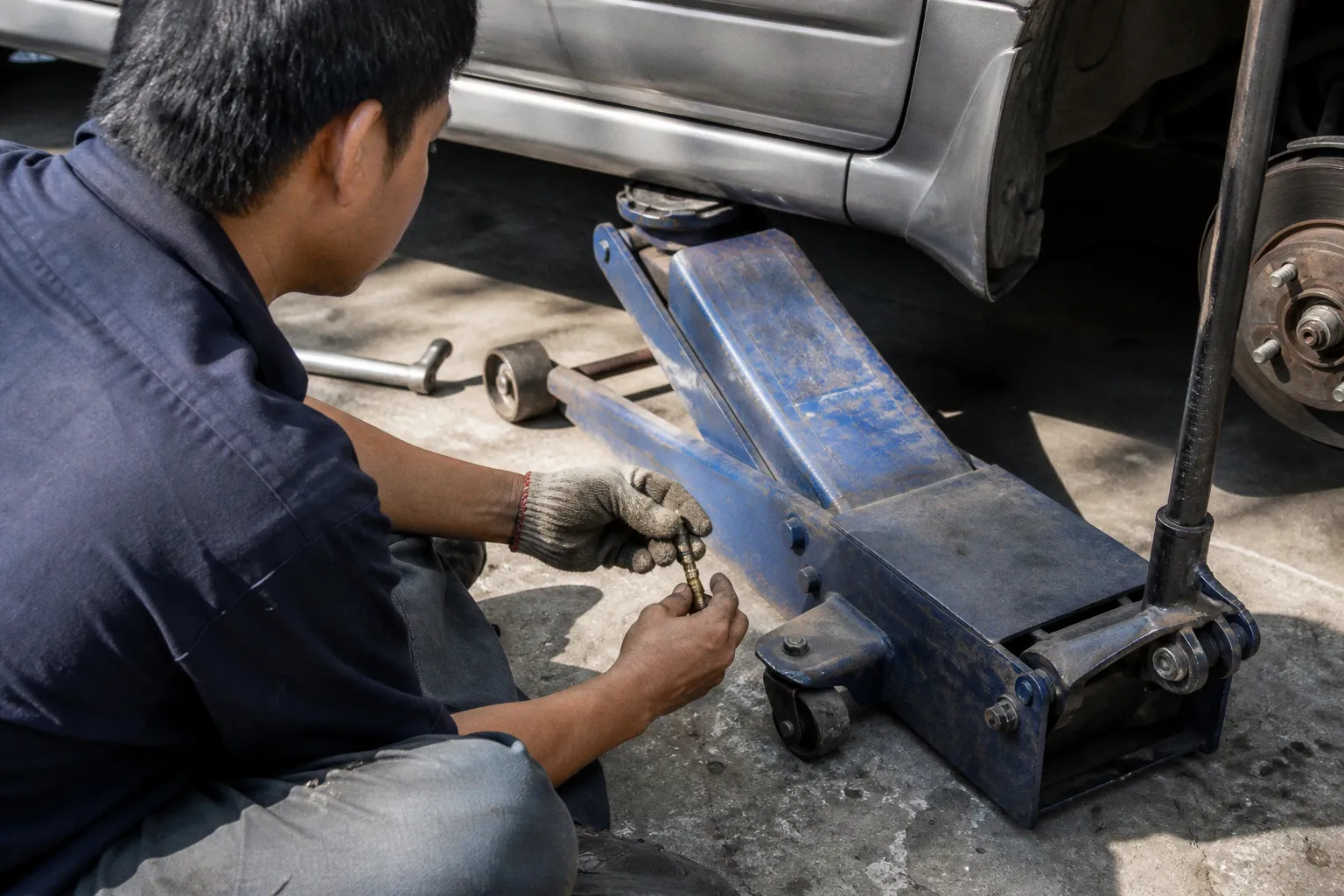
Hydraulic fluid is then redirected to the reservoir. The ram stops extending. The load is not lifted beyond the jack’s rated capacity.
That hydraulic jack bypass valve function is protective, not corrective. It prevents pressure from continuing to rise when the applied load exceeds the jack’s design limit or when the hydraulic system reaches its preset operating boundary. The valve is not a user-adjustable performance control. Its factory setting defines part of the jack’s rated lifting capacity.
The same jack normally contains a separate manually operated release valve. That valve is used to lower the ram. Confusing the two mechanisms leads to incorrect diagnosis and, in some cases, an unsafe alteration of the overload protection system.
The two valves perform different jobs
The term “bypass valve” is used inconsistently in workshop discussions. A floor jack contains at least two functionally distinct hydraulic paths:
- The overload bypass valve, also called a pressure relief valve or safety valve, limits maximum hydraulic pressure.
- The manual release valve opens a controlled return path so hydraulic fluid can flow back to the reservoir during lowering.
Their purposes are opposite.
The overload valve is normally inactive during a load operation within the jack’s rated range. When pressure exceeds the preset threshold, a spring-loaded mechanism opens. Excess fluid is diverted to the oil reservoir. The pump may continue to move, but the main cylinder ram does not develop the additional force required to raise the excessive load.
The manual release valve is operated by the user. When opened, it allows hydraulic oil to return to the reservoir and permits the main cylinder ram to descend in a controlled manner. It is the component associated with lowering the vehicle.
| Component | Activation | Hydraulic action | Primary purpose |
|---|---|---|---|
| Overload bypass valve | Automatic, at excessive pressure | Diverts fluid to the reservoir | Prevents pressure from exceeding the safe operating limit |
| Manual release valve | User-operated | Opens a return path to the reservoir | Lowers the ram and vehicle in a controlled manner |
| Pump circuit | Mechanical pumping action | Moves fluid into the lifting circuit | Raises the ram when pressure and load remain within the rated range |
The release valve does not define the jack’s overload capacity. The overload valve is not a substitute for the release control. A jack that lowers unexpectedly requires a different diagnosis from one that refuses to lift a load.
A bypass valve that opens under overload is reporting a pressure condition. It is not reporting a fuse, a software error, or a control adjustment.
How does a floor jack bypass valve work
A hydraulic jack converts mechanical pump movement into hydraulic pressure. The pump draws oil from the reservoir and directs it into the lifting circuit. Pressure acts on the main cylinder. The cylinder ram extends and the saddle rises.
The overload protection mechanism is spring-loaded. Its internal spring applies a defined force against a valve element. Below the preset pressure, the valve remains closed and the hydraulic circuit can generate lifting force. Above that pressure, the hydraulic force overcomes the spring force. The valve opens. Fluid is returned to the reservoir instead of being used to create additional lifting pressure.
The operating sequence can be stated as a set of logic gates:
1. If the applied load remains within the jack’s rated capacity, pressure remains below the overload threshold and the ram can extend.
2. If the load exceeds the rated capacity, pressure rises toward the preset limit.
3. If the pressure exceeds that limit, the spring-loaded bypass valve opens.
4. If the bypass valve opens, fluid returns to the reservoir and further lifting is prevented.
5. If the load is reduced to an acceptable level, pressure can fall below the threshold and normal lifting may resume, assuming the jack has not been damaged.
This is a pressure-limiting system. It does not measure vehicle mass directly. The valve responds to hydraulic pressure generated by the load, the cylinder geometry, and the condition of the hydraulic circuit.
The protection threshold is not universal. Spring tension, cylinder dimensions, valve design, and manufacturer calibration differ between jack models. A pressure value or spring setting from one model cannot be transferred to another. No universal factory spring tension or PSI rating exists for every floor jack.
Why the jack may lift without a load
An unloaded saddle requires little hydraulic force. The pump can extend the ram even when the jack cannot support a vehicle. This creates a common diagnostic dead end.
The correct interpretation is conditional:
- If the jack lifts without a load but stops under a load, the overload bypass valve may be opening.
- If the rated load is being exceeded, the valve may be functioning correctly.
- If the load is within the rating and the valve still opens, a hydraulic fault or incorrect valve setting becomes possible.
- If the ram lowers while the release valve is closed, the problem is not explained by normal overload protection alone.
Hydraulic oil level, air contamination, worn seals, and damaged internal components can also affect lifting behavior. However, these conditions must not be used as justification for turning the overload valve screw. The valve’s factory calibration remains a safety parameter.
What happens during an overload event
An overload event is a hydraulic pressure event. The jack’s rated capacity is exceeded, or the pressure required for the attempted lift reaches the protection threshold. The valve opens automatically.
The resulting symptoms are specific:
- The handle can still be pumped.
- The saddle may rise without a load but stop under a vehicle.
- The ram may stop extending at a repeatable point under the same load.
- Further pumping does not produce equivalent additional lifting force.
- Hydraulic fluid is redirected internally rather than being used to raise the cylinder.
The protection system is intended to prevent catastrophic failure. Without functional overload protection, excessive pressure can damage the hydraulic circuit. Possible failure modes include blown seals, cylinder wall failure, and a bent lifting arm. The bypass valve prevents pressure from continuing upward into those failure conditions.
This does not mean that the valve can prevent every mechanical hazard. A floor jack remains a lifting device, not a support stand. The overload valve limits hydraulic pressure. It does not stabilize a vehicle, correct an unstable contact point, or compensate for an incorrectly positioned saddle.
The vehicle’s supported structure must remain compatible with the jack’s design. The rated lifting capacity must not be exceeded. Once the vehicle has been raised, proper support equipment must be used before work is performed beneath it. The bypass valve is not a substitute for load support.
The release valve mechanism during lowering
The floor jack release valve mechanism is manually controlled. It is opened to lower the ram. When the valve is closed, hydraulic fluid remains in the lifting circuit and the cylinder can hold pressure. When the valve is opened, a bypass channel is created and oil returns to the reservoir.
The lowering path must be distinguished from the overload path:
- The overload valve opens automatically when pressure exceeds its preset limit.
- The release valve opens because the operator commands lowering.
- The overload valve prevents excessive pressure.
- The release valve removes pressure from the lifting circuit during descent.
A jack that lowers rapidly or fails to hold a load should not be diagnosed by adjusting the overload screw. The release valve, seals, contamination, or internal wear may be involved. The correct fault path depends on the observed behavior.
If the ram descends with the release valve fully closed, the hydraulic circuit is not maintaining pressure as intended. If the ram does not descend when the release valve is opened, the return path may be restricted, the valve may be damaged, or the internal hydraulic condition may be abnormal. These are service conditions. They are not calibration opportunities.
The release control should be operated according to the manufacturer’s procedure. Excessive force should not be applied. A control that has been forced can alter the valve seat or damage the operating mechanism. The pressure relief system should remain untouched unless service is performed by a qualified technician using the manufacturer’s calibration method.
Why the overload valve screw must not be adjusted
Many floor jacks have an external screw, plug, or protected adjustment point associated with the overload valve. Its presence does not make it a routine maintenance control.
Turning the screw changes the tension of the internal spring. That changes the pressure at which the valve opens. The factory lifting capacity can therefore be altered without any visible change to the jack’s body or label.
The logic is direct:
1. The spring preload establishes the valve’s opening threshold.
2. The opening threshold influences the maximum hydraulic pressure.
3. Maximum hydraulic pressure influences the force available at the cylinder.
4. Cylinder force influences the practical lifting capacity.
5. An incorrect spring setting compromises the relationship between the jack’s rating and its protection system.
If the spring is tightened beyond the intended setting, the valve may open at a pressure higher than designed. The jack may appear stronger. The protection margin may have been removed. Seals, cylinder walls, and structural arms may then be exposed to excessive force.
If the spring is loosened, the valve may open prematurely. The jack may stop lifting a load that should be within its rated capacity. Continued adjustment would not constitute diagnosis. It would create an unknown safety condition.
The absence of a universal pressure specification is decisive. A calibration value must come from the manufacturer’s service documentation for the exact model. Generic online instructions cannot establish the correct setting for a different jack.
The overload screw is part of the safety calibration. If its original setting is unknown, the jack’s rated capacity is no longer a verified parameter.
A strict diagnostic path
The fault should be isolated without disturbing the calibrated valve.
1. Confirm the jack’s rated capacity
The applied load must be compared with the jack’s stated rating. Vehicle curb weight is not always the same as the load imposed at the lifting point, but the available facts do not support assigning a universal correction factor. The rating must not be exceeded.
If the vehicle or lifting condition exceeds the rating, the test ends. A bypass valve that prevents further lifting is performing its intended function.
2. Observe unloaded and loaded behavior
The ram should be observed without a vehicle and then under a permitted load.
- If the ram does not extend even without a load, the fault is not limited to overload protection.
- If the ram extends unloaded but stops under an excessive load, overload protection is the primary explanation.
- If the ram stops under a load within the rating, hydraulic condition and valve calibration require inspection.
- If the ram descends while the release valve is closed, pressure retention is compromised.
Repeatable behavior is more useful than force applied to the handle. The point at which pumping stops producing lift should be recorded relative to the load condition.
3. Check the release control
The manual release valve must be fully closed for a lifting test, but it must not be forced. A partially open release path can allow oil to return to the reservoir and imitate a weak pump or defective overload valve.
If the jack lowers only when the release valve is opened, that part of the system is behaving as intended. If it lowers with the control closed, the release circuit or hydraulic sealing system requires service.
4. Inspect for external hydraulic leakage
Oil around the cylinder, pump body, or valve area indicates a possible seal or fitting fault. Leakage reduces the ability of the system to maintain pressure. It does not justify increasing overload spring tension.
A jack with damaged seals or visible hydraulic leakage should be removed from service until repaired. Pressure may be lost internally even when no large external leak is visible.
5. Do not use adjustment as a test
The overload valve must not be turned incrementally to see whether the jack lifts more. That procedure destroys the known relationship between the valve and the rated capacity. If the screw has already been moved, the original factory setting should be treated as unknown. Calibration or replacement is required.
Service and calibration considerations
Calibration is model-specific. Some manufacturer procedures reference a pickup height during testing of approximately 20 to 25 cm, or 8 to 10 inches, above the floor. This range is associated with specific calibration guides. It is not a universal setup value for every hydraulic floor jack.
The test height matters because cylinder position and mechanical geometry can affect the load path. The manufacturer’s complete procedure must be followed, including the specified test load, equipment, valve condition, and adjustment method. A height range alone is not a calibration specification.
The correct service decision depends on the condition:
- If the overload valve operates and the jack is being asked to lift beyond its rating, the jack should not be modified.
- If the valve opens below the rated capacity, the jack should be serviced according to model-specific instructions.
- If the valve screw has been altered and the original setting cannot be confirmed, the jack should not be treated as calibrated.
- If cylinder, seal, arm, or valve damage is present, continued lifting should be stopped.
- If the manufacturer does not provide a field calibration procedure, replacement may be safer than improvised adjustment.
The overload valve is a mechanical safety device. Its reliability is tied to spring condition, valve seating, hydraulic cleanliness, and the structural integrity of the jack. A visible screw does not indicate user serviceability.
The baseline for a verified repair
A repaired jack is not verified because it lifts one vehicle once. Verification requires known parameters.
The following baseline must be available:
- The exact jack model and rated lifting capacity.
- A confirmed, undisturbed or correctly restored overload valve setting.
- A release valve that holds pressure when closed and permits controlled descent when opened.
- No unacceptable external hydraulic leakage.
- A ram that extends under a permitted load without premature bypass activation.
- A ram that does not continue to descend with the release valve closed.
- A calibration procedure consistent with the manufacturer’s instructions.
- A test position within the specified range when the manufacturer requires one, including the referenced 20–25 cm pickup height where applicable.
If the overload valve opens under a load above the rated capacity, the event is not a defect. If it opens below the rated capacity, the valve, hydraulic circuit, or load condition must be investigated. If the valve’s setting has been changed without a documented calibration reference, the capacity must be regarded as unverified.
The hydraulic jack bypass valve function is therefore simple in principle and strict in application: pressure rises, the preset threshold is reached, the spring-loaded valve opens, and oil returns to the reservoir. The manual release valve performs a separate task by providing controlled lowering. Neither mechanism should be adjusted by assumption.
A floor jack is safe only when its pressure limit, structural rating, release function, and hydraulic condition remain known. The final verification is not a higher lift. It is the return to those baseline parameters.