RCAR Report Reveals New Standards for EV Battery Repair and ADAS Claim Processing
The Research Council for Automobile Repairs (RCAR) has released findings drawn from more than twenty insurer-backed automotive research centers. Coverage spans EV battery repairability, repair labor-time calculation methods, and ADAS claim trends.
Aldous Moorland·updated September 21, 2026
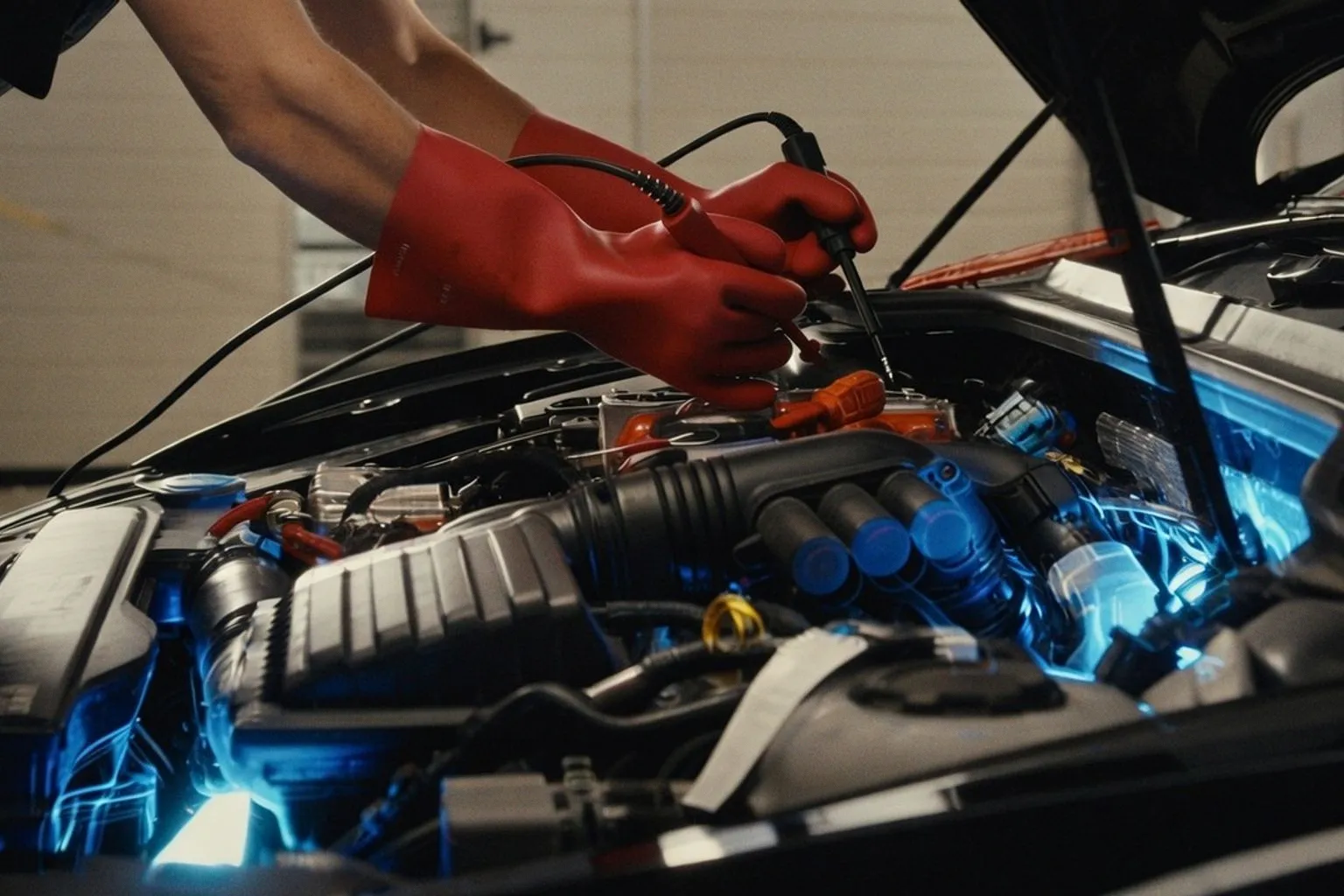
For import shops running diagnostics on modern platforms, the release reframes which procedures now carry the heaviest billing weight and where labor-time assumptions are already obsolete.
Battery repair economics pivot toward the pack
RCAR's working frame treats the high-voltage battery as the primary cost axis in collision and warranty claims. The underlying question across the participating centers: at what point does pack-level repair remain economically viable, and when does the insurer route the file to full replacement? Full methodology and threshold figures are not disclosed in available materials, but the structural shift is the point. Shops equipped for module-level diagnostics retain margin. Shops defaulting every fault to a complete pack swap absorb the loss.
Diagnostic sequence for any EV presenting with a battery-related DTC: verify isolation resistance before connector release, log module state-of-health through OEM scan tool — not a generic OBD-II reader — and record individual cell voltage deltas against the pack's resting baseline. Contactors are checked only after the module map is confirmed. If module voltages fall outside manufacturer tolerance, the estimate defaults to replacement. If they fall inside, the pack is repairable and the claim stays open at a lower payout. That single branching point now defines profitability on a growing share of EV files.
Labor-time methodology under recalibration
RCAR's labor-time review targets the gap between OEM-published time guides and actual hours logged on EV platforms. Legacy flat-rate tables assume ICE architecture: intake, exhaust, cooling circuit, transmission service. EVs strip most of those categories. The replacements — battery conditioning, thermal management loop service, single-speed reducer oil change at roughly 100,000 kilometers, regen-brake inspection — lack equivalent time-history data.
Independent market data reinforces the gap. Norwegian workshops have lost up to half their service hours as electric cars approach full market saturation, with post-sale revenue down 35% in that segment. A Volkswagen importer figure places per-visit revenue 46% below comparable combustion service. Italian customer data shows maintenance savings between 42% and 75% on EV ownership. None of these are repair-shop failures. They are structural voids in legacy time-calculation frameworks.
Practical response for a working import bay: track actual labor hours per EV job for a rolling six-month window. Compare against OEM time-allocation tables. Submit documented deviations to insurer networks. Spain's Real Decreto 281/2021 already mandates a 45-hour high-voltage safety module for certified technicians — a baseline most markets will converge toward as repair frequency shifts.
ADAS claim trends concentrate around calibration
RCAR's third research axis tracks ADAS claim patterns across insurers. The emerging signal: ADAS-related labor is no longer a sub-line item. It is the line item. Cameras, radar units, and ultrasonic arrays mounted behind panels never designed for service removal extend claim duration well beyond traditional bodywork estimates. Any shop without OEM-approved calibration targets, a verified level surface, and controlled lighting cannot complete the file in-house.
Verification baseline after any ADAS-touching repair: pre-scan and post-scan all relevant modules, confirm camera and radar aiming tolerances against manufacturer specification, and document the sequence within the estimate file. If any of those three steps is skipped, the claim remains open regardless of panel fitment quality. The diagnostic data, not the visible bodywork, closes the file.
For shops still routing ADAS calibration to a third party, the labor-time delta now exceeds the cost of bringing the equipment in-house on most claim volumes. RCAR's data points in the same direction.