Diesel parking heaters: is the garage setup worth it?
A diesel parking heater can make a cold garage usable without burning through a tank of fuel every few hours, but the installation has very little tolerance for casual work.
Judson Grier·Updated: August 14, 2026·17 min read
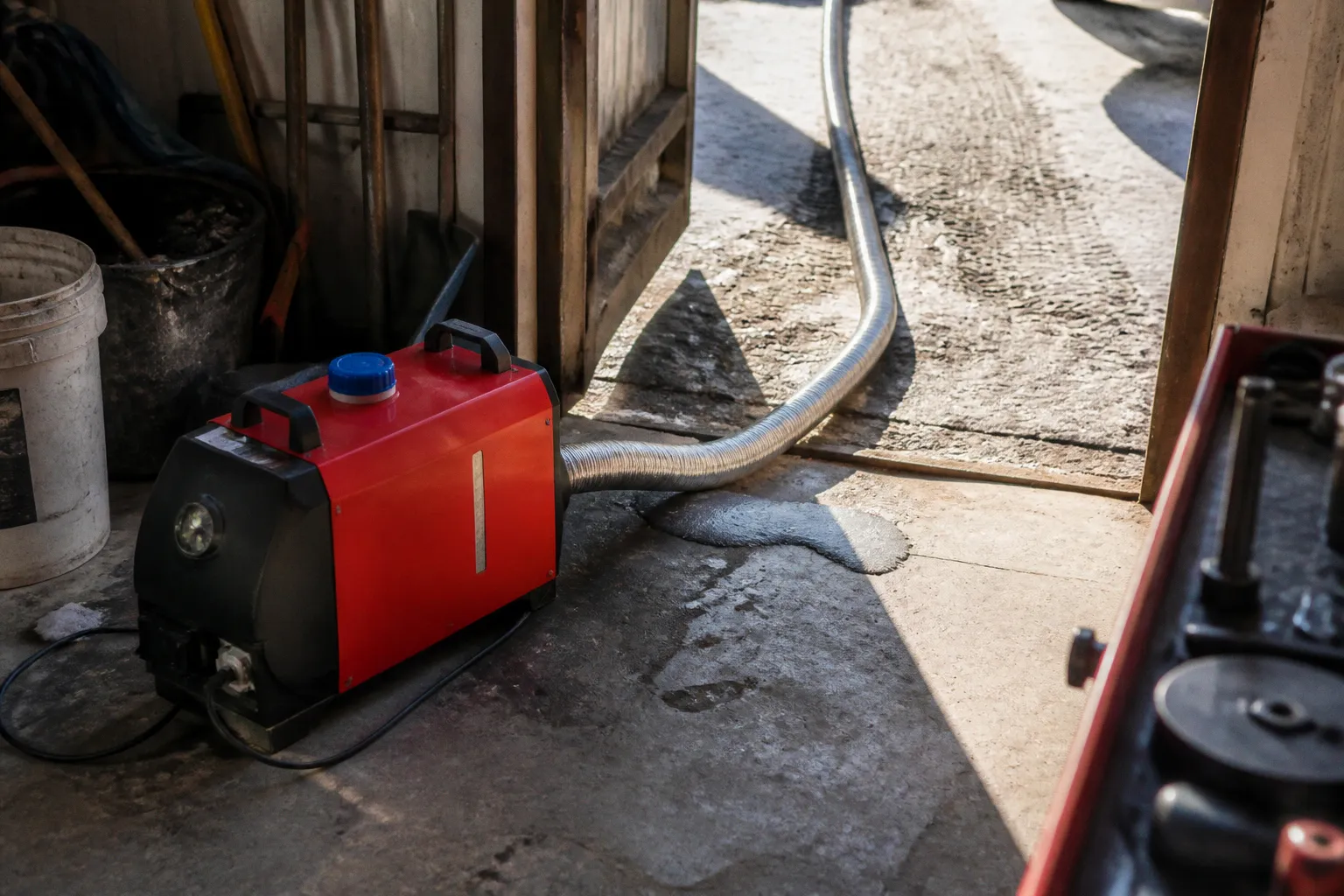
The heater may be small enough to carry in one hand; the exhaust system, 12-volt supply, fuel line, and carbon-monoxide protection are not small matters.
The failure modes are physical. A weak power supply drops voltage while the glow plug is heating. The fuel pump clicks on, but the burner does not establish a clean flame. An exhaust pipe passes through a wall with no proper heat protection. The workshop air feels warm while combustion gases begin collecting somewhere they should never be. We do not get to call that a successful heater installation simply because the fan is blowing hot air.
For a diesel heater for a garage workshop, the real question is not whether the unit produces heat. Most of them do. The question is whether we can supply its startup current, route its exhaust outdoors, protect the wall penetration, monitor the air, and give the heater enough time to warm the space without asking a small appliance to defeat a badly insulated building.
The economics of workshop heating: cheap hardware is not a cheap system
Budget diesel heaters are attractive because the entry price is low. Typical all-in-one Chinese units in the 2 kW to 8 kW range sell for roughly $80 to $200. They often include a fuel tank, metering pump, control panel, wiring harness, ducting, and a basic exhaust arrangement. For a small detached workshop, that can look like a complete heating system in one box.
It is not quite that simple.
The low price usually covers the combustion unit and its accessories, not the quality of the installation around it. A permanent setup may still need a properly sized 12-volt power supply, heavier wiring, fuses, a safe exhaust pass-through, insulated heat shielding, a carbon-monoxide detector, and a way to mount the heater where it will not be struck by a jack handle or soaked by road spray. If the heater is placed in an attached residential garage, local building and fire rules can also affect whether the arrangement is allowed and whether insurance will recognize it. Those requirements vary by location, so we should not treat a temporary internet kit as a universal code-compliant appliance.
Premium units from manufacturers such as Webasto or Eberspächer/Espar commonly cost about $1,000 to $1,500 or more. That price can buy better documentation, more consistent components, stronger support, and a design intended for long service. It does not remove the need for correct exhaust routing or carbon-monoxide detection. A branded heater still burns fuel inside a combustion chamber and still sends combustion products outside through a hot pipe.
| Factor | Budget diesel heater | Premium parking heater |
|---|---|---|
| Purchase cost | Roughly $80–$200 for common all-in-one kits | Roughly $1,000–$1,500 or more |
| Typical output range | Often sold in 2 kW, 5 kW, and 8 kW versions | Commonly selected for vehicle or controlled workshop applications |
| Documentation | Can be brief, inconsistent, or translated poorly | Usually more complete and specific |
| Installation tolerance | Demands careful inspection of wiring, fuel, and exhaust parts | Better component consistency, but still not forgiving of bad installation |
| Long-term support | Parts and controllers may be inexpensive but variable | Higher cost, with stronger brand and service infrastructure |
| Best fit | A careful DIY owner willing to inspect and maintain the system | A permanent installation where support and predictable quality matter |
The most common mistake is comparing only purchase prices. A cheap diesel heater garage installation becomes less cheap when we replace undersized cable, add a real battery or power supply, build a heat-safe wall penetration, and install monitoring. Those additions are not waste. They are the part that keeps the heater from turning a warm workshop into a smoke-filled or contaminated one.
A diesel heater is inexpensive to buy because the burner is inexpensive. The safe installation is where the real work begins.
Powering the heater: the 12-volt startup spike is the first test
A diesel parking heater does not behave like a simple 12-volt fan. At startup, the glow plug draws heavily while the control system brings the burner up to temperature. A typical unit may demand approximately 10 to 15 amps at 12 volts during ignition. Once the flame is established, the continuous draw can fall to roughly 1 to 3 amps for the fan and fuel pump, depending on the operating level and design.
That difference matters. A supply that appears adequate while the heater is running may collapse during startup.
A standard 12-volt, 2-amp wall adapter is not a suitable starting supply for this job. It may power a display or a small fan, but it cannot deliver the current required by the glow plug. When voltage sags, the heater may fail to ignite, shut down with an error, or repeatedly cycle through an unsuccessful start. Repeated failed starts can leave unburned fuel or soot in the combustion chamber, which then makes the next start worse.
We want the supply to remain stable at the heater terminals, not merely at the outlet or battery. That means the wiring run matters. Long, thin cables create voltage drop. Corroded crimp connectors add resistance. A fuse holder with a poor contact can become warm before the heater has done any useful work. The unit may still appear alive while the supply is quietly losing the argument with the glow plug.
For a fixed workshop installation, we should think in terms of a complete low-voltage circuit:
- A power supply or battery capable of handling the initial 10–15 amp demand without a severe voltage drop.
- Cable sized for the length of the run, with the heater’s startup current in mind rather than only its low running draw.
- A fuse placed close to the power source, sized according to the heater manufacturer’s wiring requirements.
- Crimped or secured terminals that cannot loosen under vibration.
- A disconnect or isolator that lets us service the unit without working on a live circuit.
- Protection from metal edges, heat, oil, and moving parts where the cable enters the heater or passes through the workshop.
A vehicle battery can start one of these heaters, but that does not automatically make it a good permanent supply. If the heater runs for hours with the engine off, the battery must replace the energy consumed or eventually fall below a healthy state of charge. A regulated 12-volt power supply can work well in a garage, but it must be selected for the startup load and installed where it will not be exposed to coolant, fuel, grinding dust, or condensation.
The shutdown cycle deserves equal respect. Most diesel heaters should be allowed to complete their controlled cool-down rather than being switched off by cutting the main power. The fan needs to clear heat from the unit and the controller needs to finish its sequence. Pulling power at the wrong time can leave heat concentrated in the burner, encourage deposits, or create a fault on the next start. A master disconnect is useful for servicing; it is not a substitute for the heater’s normal stop command.
Exhaust integrity and carbon monoxide: the line that cannot be improvised
The combustion chamber is sealed from the air being heated. That is the central safety feature of a diesel air heater: the burner heats a heat exchanger, and the workshop air passes over the outside of that exchanger. But “sealed” does not mean “safe if the exhaust is loosely arranged.” The combustion gases still contain carbon monoxide and other products of combustion, and they must be routed directly outdoors.
There is no acceptable indoor exhaust arrangement for a garage workshop. Not a cracked door. Not a hose pointed toward a window. Not a pipe terminating in the corner behind the workbench. The exhaust outlet needs to discharge outside in a location where gases cannot return through doors, windows, vents, or gaps in the building. We also need to think about the vehicle itself: an exhaust outlet positioned close to a car’s intake area can contaminate the cabin or engine bay even when the workshop door is open.
The exhaust pipe becomes hot enough to damage nearby materials. The wall penetration therefore needs more than a drilled hole and a smear of sealant. We need clearance from timber, insulation, plastic siding, wiring, fuel containers, and stored materials. The pass-through should be built around heat-resistant materials and, where required by the installation instructions or local rules, insulated and shielded so the wall does not become part of the heater.
Keep the exhaust run as short and direct as practical. Every bend adds restriction. A sag in the pipe can collect condensation and soot. A loose connection can leak into the building before the gases reach the outside. The joint between the heater and exhaust pipe should be mechanically secure, not merely pushed together and hoped into place.
The intake side also deserves attention. The combustion air inlet must draw from a clean location and remain separate from the exhaust outlet. We do not want the burner inhaling its own exhaust, workshop fumes, fuel vapors, or grinding dust. Nor do we want the combustion intake placed where snow, rain, or debris can block it.
A carbon-monoxide detector belongs in the workshop even when the exhaust appears perfect. It is a second line of defense against a loose fitting, damaged pipe, failed seal, or unexpected airflow pattern. It should be placed according to the detector manufacturer’s guidance and kept operational, with fresh batteries or a reliable power connection. One detector is not a substitute for sound installation, but operating without one removes a useful warning before the problem reaches your lungs.
If a detector alarms, the response is straightforward: shut down the heater if it can be done safely, leave the space, open the area to ventilation from outside, and do not return until the source has been identified. We do not silence the alarm and carry on because the air “seems fine.” Carbon monoxide does not announce itself with a smell.
Fuel consumption is low, but fuel handling still sets the standard
A standard 5 kW diesel heater may consume approximately 0.20 liters per hour on a low setting and up to 0.50 liters per hour at maximum output. Across different heater sizes and operating conditions, published consumption commonly falls somewhere in the broad range of 0.10 to 0.75 liters per hour.
That makes diesel heating economical for many garages, particularly when we only heat the space while working. The heater does not need to run at full output once the room and tools are warm. Running a 5 kW unit continuously at maximum in a poorly insulated garage is usually a sign that the building is losing heat faster than the heater can comfortably replace it.
Fuel quality and storage are part of the same system. The tank should be mounted securely, kept away from hot exhaust components, and positioned so a leak cannot run toward an electrical connection or ignition source. The fuel line should not rub against sharp metal or droop into a pocket where air can collect. The metering pump often produces a distinct clicking sound; that is normal, but the line and fittings still need to remain tight.
In regions where regulations permit it for space heating, red diesel, heating oil, or kerosene may reduce running costs compared with standard automotive white diesel. The legal and equipment requirements differ by location, and not every heater or supplier treats every fuel identically. We should use only fuels permitted for the installation and compatible with the heater, rather than assuming that anything that burns is suitable.
Do not let the low hourly consumption encourage careless storage. A small fuel tank still contains a flammable liquid, and the garage already has enough possible ignition sources: battery chargers, welders, grinders, extension cords, and hot exhaust systems. Keep fuel containers closed, stable, and away from the heater’s hot air and exhaust path.
Diesel heater versus propane garage heating
Propane has a familiar advantage: the fuel system can be simple, and many portable heaters are easy to move around. But portable propane equipment varies widely in whether it is designed for indoor use, whether it produces combustion products in the room, and what ventilation it requires. A “portable” label is not a safety classification.
A vented diesel air heater keeps the combustion circuit separate from the workshop air, which is useful when we are working in an enclosed garage. It also introduces a fuel pump, glow plug, exhaust pipe, and 12-volt electrical system that must all remain healthy. Propane equipment has its own failure points around regulators, hoses, cylinders, and combustion ventilation.
The sensible comparison is not “which fuel is cleaner” in the abstract. It is which complete heating system can be installed and operated safely in the building we actually have. A vented diesel heater with a correct exhaust and CO monitoring is a different machine from an unvented propane heater. We should compare those systems honestly, not line up their fuel prices and ignore the air leaving the burner.
Installation realities: heat output meets the building envelope
The power rating printed on a heater is not a promise that it will warm every garage. A 2 kW unit may suit a small, reasonably enclosed single-car workspace. A 5 kW model provides more useful reserve for a larger area, but that does not mean it will quickly overcome an uninsulated multi-car garage during extreme sub-zero weather. An 8 kW unit can deliver more heat, but more capacity also means greater fuel use, more exhaust flow, and more consequences if the building leaks heat through every surface.
We select the heater around the space, not around the largest number on the product listing.
Before mounting anything, walk the heat path. Where will the warm air discharge? Will it blow directly at a cold metal door and disappear into the panel? Will the outlet be blocked by a toolbox, a vehicle, or a pile of parts? Can the return air circulate back to the heater without pulling in cold air from outside? The fan needs a clear route, and the workshop needs a way for heat to spread rather than collecting in one corner of the ceiling.
Insulation often produces more practical improvement than moving from one nominal heater size to the next. Sealing gaps around doors, reducing uncontrolled drafts, and insulating the ceiling can shorten warm-up time and let the heater operate at a lower setting. We do not need to make a garage airtight, but we should stop paying to heat the driveway through a door seal that has gone flat.
A durable installation usually follows a sequence like this:
1. Choose the mounting location around service access.
Leave room to inspect the fuel line, wiring, air filter, exhaust joint, and intake. A heater buried behind a shelving unit may be out of the way until the first fault, at which point every inspection becomes a partial disassembly.
2. Separate hot, cold, and electrical paths.
Keep the exhaust and hot-air duct away from power cables, fuel lines, plastic storage bins, and painted surfaces. The combustion intake should not share a path with the exhaust outlet.
3. Build the wall penetration as a heat problem.
Treat the exhaust pass-through as a hot mechanical component, not as ordinary plumbing. Use the specified materials, maintain clearance, and protect the surrounding structure from radiant and conducted heat.
4. Secure the fuel system against vibration.
The tank and pump should not hang from a soft line or rattle against the wall. A loose fuel connection can seep for a long time before the smell becomes obvious.
5. Commission the electrical circuit before the first real heating session.
Measure voltage at the heater during startup if you have the equipment to do so. Watch for loose terminals, hot connectors, or repeated ignition failures. A heater that starts once in mild weather has not yet proven the circuit.
6. Run the heater through a complete start, warm-up, and shutdown.
Listen to the pump, observe the exhaust, inspect the wall penetration, and confirm that the cool-down finishes without cutting power. Do this while the installation is still accessible.
The first run may produce a manufacturing smell from paint, oils, or protective coatings. That is not a reason to ignore smoke or exhaust leakage. Ventilate the space during commissioning and stop if anything appears abnormal: fuel odor, visible leakage, excessive smoke that does not clear, unusual fan noise, or a CO alarm.
What long-term ownership actually asks from us
Diesel heaters like operating hot enough to burn cleanly. Frequent short starts and stops, low-output running, contaminated fuel, restricted air paths, and repeated failed ignitions can encourage soot and deposits in the combustion chamber and exhaust. The exact service interval depends on the heater, fuel, duty cycle, and manufacturer instructions, but the mechanical principle is consistent: a burner that never reaches a stable operating condition will not stay clean forever.
That is why we should avoid treating the cheapest setting as automatically the best setting. Low output saves fuel in the short term, but if the heater spends its life barely warm and cycling repeatedly, deposits can accumulate. Letting the unit run long enough to stabilize, then using the proper shutdown cycle, is kinder to the burner than constantly interrupting it.
The exhaust should be inspected periodically for looseness, corrosion, soot marks, and changes in sound. Soot around a joint is evidence that the joint is telling us something. The combustion intake and warm-air filter should remain clear. The fuel line should be checked for hardening, abrasion, and damp fittings. Electrical connectors deserve the same attention, particularly in a garage where humidity, dust, and vibration work together.
The CO detector must remain part of the maintenance routine. Test it, replace batteries when required, and do not install it once and forget it behind a cabinet. Safety equipment that has not been tested is a suggestion, not a protection.
For broader workshop planning, the same rule applies to the rest of the garage: a well-organized DIY mechanic’s workspace makes faults easier to see and service easier to perform. The heater should not be competing with loose fuel cans, tangled extension cords, or boxes stacked against the exhaust line.
So, is a diesel parking heater worth it?
For a garage workshop that needs heat while a vehicle is being diagnosed, serviced, or repaired, a diesel parking heater can be a sensible choice. Fuel consumption is modest, the units are compact, and a vented design avoids filling the room with the burner’s exhaust. A 5 kW heater using roughly 0.20 to 0.50 liters per hour can provide useful heat without the continuous fuel demand of a much larger space heater.
But the bargain depends on our willingness to do the unglamorous work correctly. The power supply must survive the 10–15 amp startup demand. The exhaust must leave the building through a heat-safe, mechanically secure route. The fuel system must be restrained and kept away from heat. A CO detector must be present and working. The workshop envelope still has to retain the heat we paid to produce.
A cheap diesel heater is not plug-and-play equipment simply because it arrives with a tank and a controller. It is a small combustion appliance that happens to use 12-volt power. Once we treat it that way, the decision becomes clearer: buy the unit only if we are prepared to build the installation around safe exhaust, stable voltage, controlled fuel, and ongoing inspection.
The heater can warm the garage. Long-term reliability comes from everything we refuse to overlook around it.