Air compressors: oil-free vs oil-lubricated models
The unlabelled word on most consumer-grade compressor stickers — “oil-free” — is frequently mistaken for a maintenance-free architecture. It is not.
Merritt Vane·Updated: August 19, 2026·21 min read
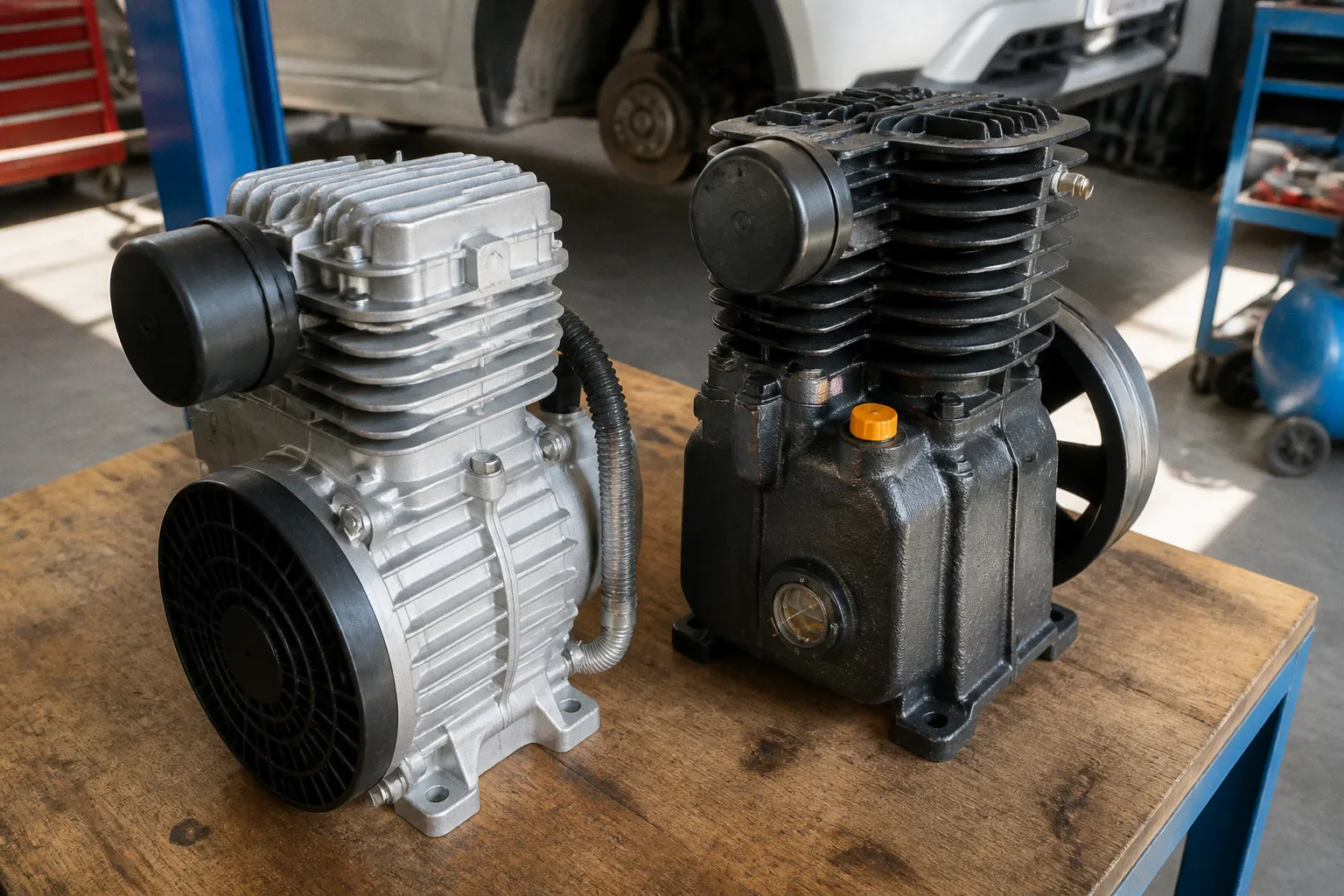
It describes a compression chamber designed to operate without liquid oil inside it, which is a much narrower statement than the marketing usually implies. Inside the cylinder, a low-friction polymer coating, often PTFE-based, or a permanently lubricated seal performs some of the work that liquid lubricant would otherwise do. The pump does not eliminate wear; it trades one set of failure modes for another.
Compare car rental deals in United Kingdom
See available offersPartner link — DiscoverCars comparisonThat distinction matters when equipping a home garage around an import-service workflow. A homeowner who only inflates tires can reasonably prioritize weight, storage, and convenience. The calculation changes when the same compressor is expected to support cylinder leak-down tests, pneumatic brake bleeding, blow-gun cleaning, air-powered seat removal, or repeated use of an impact wrench. At that point, pump architecture starts to determine not only how the machine performs, but how often it needs attention and how long it remains worth repairing.
The Mechanics of Compression: How Lubrication Affects Performance
A reciprocating piston compressor is a remarkably simple device. An electric motor turns a crankshaft, the crankshaft drives a piston up and down inside a cylinder, and intake and discharge valves move air through the pump. The simplicity is deceptive because the piston ring never creates a perfect seal against the cylinder wall, the valves open and close at speed, and every compression cycle converts electrical energy into heat. That heat has to leave the cylinder and valve head somehow. If it does not, the pump’s seals, coatings, valves, and bearings pay the price.
In an oil-lubricated pump, liquid oil performs several jobs at once:
- It creates a lubricating film between moving metal surfaces, reducing direct contact between the piston ring, cylinder wall, crankshaft, and bearings.
- It helps seal microscopic gaps around the piston ring, limiting blow-by and preserving compression efficiency.
- It carries heat away from loaded components inside the crankcase and pump assembly.
- It reduces friction during startup, when the pump has to overcome both mechanical resistance and the pressure remaining in the system.
The oil is not simply “inside the compressor.” It occupies specific areas of the crankcase and lubrication system, while the compression chamber is designed to keep most of that oil out of the discharge stream. That separation is effective, but not perfect. Small amounts of oil can become entrained in the compressed air as aerosol or vapor, particularly when the pump is hot, worn, overfilled, or operated beyond its intended duty cycle.
An oil-free pump replaces the liquid oil film in the compression chamber with a different combination of materials and design choices. A polymer coating may be applied to the cylinder, piston, or ring. Some designs use permanently lubricated bearings or sealed components elsewhere in the drive mechanism. The piston still has to move against resistance, and the ring still has to maintain a seal, but the seal depends more heavily on the condition of the coating and the geometry of the mating parts.
The thermal behavior is different as well. Oil in a lubricated design helps transfer heat through the crankcase and reduce friction at the contact surfaces. An oil-free pump must move that heat through the cylinder and head into the surrounding air. The manufacturer may compensate with larger cooling fins, higher airflow, different materials, or a faster-running pump. In many consumer units, the result is a hotter and higher-pitched operating character, although motor design, piston speed, enclosure shape, and tank resonance matter just as much as the lubrication category.
That is why the label alone cannot tell you whether a compressor is suitable for a garage. Two units may both be described as oil-free while having very different duty-cycle limits, pump speeds, cooling arrangements, and service support. Likewise, an oil-lubricated compressor may be a quiet, slow-running shop machine or a cheaply built unit with poor cooling and limited durability.
Comparing Pump Longevity: 5,000 vs 15,000 Hour Service Lifespans
The clearest difference between the two architectures is usually the expected service life of the compression pump itself. The numbers are planning ranges rather than guarantees, because pump construction, operating temperature, duty cycle, and maintenance can move the result substantially in either direction.
| Parameter | Oil-lubricated piston pump | Oil-free piston pump |
|---|---|---|
| Common service-life planning range | Approximately 10,000–15,000 hours for a well-built unit | Approximately 2,000–5,000 hours for many consumer units |
| Sealing mechanism | Piston ring supported by an oil-lubricated design | Polymer-coated or permanently lubricated ring and cylinder surfaces |
| Heat management | Lubrication reduces friction and helps move heat through the pump assembly | Heat is transferred primarily through the cylinder, head, cooling fins, and airflow |
| Routine service | Oil-level checks, oil changes, air-filter service, drain maintenance | Air-filter service, drain maintenance, cooling and electrical checks |
| Typical end-of-life repair | Rings, valves, gaskets, bearings, or a complete pump rebuild | Often a complete pump replacement, depending on parts availability |
| Operating character | Frequently slower-running and lower-pitched, but model-dependent | Frequently faster-running and higher-pitched, but model-dependent |
| Main operational risk | Running with low, incorrect, or degraded oil | Overheating, coating wear, seal wear, and duty-cycle abuse |
The familiar five-thousand-versus-fifteen-thousand-hour comparison is useful only if it is treated as a broad durability contrast, not as a promise printed into every compressor. A carefully designed oil-free pump may outlast a neglected, poorly cooled oil-lubricated unit. An oil-lubricated pump that is run with the wrong oil, operated on an unstable surface, or left to run continuously beyond its duty cycle can fail much earlier than its owner expects.
Even so, the architecture creates a meaningful difference in how wear develops. In an oil-lubricated pump, the wear items may be replaceable: piston rings, valve plates, gaskets, bearings, or other components can sometimes be serviced without discarding the entire machine. Whether that repair makes financial sense depends on the compressor’s construction and the availability of parts, but the possibility matters in a garage that expects to keep tools for years.
In an oil-free pump, the compression coating and ring are often treated as a matched wear system. Once the coating is badly worn, the pump may lose pressure, take longer to fill the tank, or discharge more air back through the ring. The motor can still sound normal while the compressor becomes increasingly ineffective. A homeowner may interpret the symptom as a failing switch or a small valve problem when the real issue is that the pump can no longer seal the cylinder efficiently.
At ten hours of compressor use per week, a garage accumulates roughly 500 operating hours in a year. That does not mean a unit rated around 5,000 hours will automatically last ten years, or that a 15,000-hour pump will automatically last thirty. Operating hours are affected by the type of work being done. A compressor supplying an impact wrench in short bursts experiences a different thermal load from one running a die grinder, sander, or spray gun continuously. A pump that fills the tank quickly and then rests may age more favorably than one that runs near its limit throughout an entire repair session.
It is also worth noting what “oil-free” does not mean. Internal drive gears, crankcase bearings, and other non-compression mechanisms may still contain factory-applied lubricant. That lubricant is sealed into the relevant components and is not intended to enter the air stream. The term refers to the compression chamber, not to a machine that contains no lubricant anywhere inside its housing.
A piston pump is a wear component with a finite service life; the question is whether that life is consumed through coating degradation on a dry cylinder or through scheduled service on a lubricated one.
Duty cycle is often more important than the headline rating
A compressor’s duty cycle describes how much work it can perform before heat becomes a limiting factor. The exact specification varies by manufacturer, and ratings are not always presented in a way that makes comparisons easy. Still, the practical principle is straightforward: a compressor that spends most of a session running continuously needs more thermal and mechanical reserve than one that only cycles briefly to refill a tank.
For garage work, consider the difference between these uses:
- Tire inflation and occasional blow-gun cleaning place relatively light demands on the pump.
- An impact wrench uses high airflow in bursts, but the tank can provide part of that air between pump cycles.
- A die grinder, air sander, or spray gun can consume air continuously and expose an undersized pump very quickly.
- Leak-down testing requires a stable supply and good connections, but not necessarily the same continuous volume as a pneumatic sander.
- Bead seating and other high-flow tasks can empty a small tank rapidly, forcing the pump to run hard while the operator is still working.
An oil-free compressor may be perfectly sensible for intermittent tasks if it has enough tank capacity and output for the job. The problem begins when its compact size encourages the owner to use it as though it were a larger shop compressor. The machine may complete the task, but only by running hot, cycling frequently, and consuming the wear margin that made it affordable in the first place.
Maintenance Realities for Lubricated Systems
The argument for oil-free in a home shop is, at its core, an argument against maintenance. The argument against oil-lubricated equipment is often the same concern viewed from the other side: oil changes are inconvenient, oil disposal requires care, and a missed oil check can turn into a damaged pump. Whether those concerns dominate the decision depends on how the compressor will actually be used.
An oil-lubricated pump does not require constant attention. Its routine service is familiar to anyone who has maintained a small engine or hydraulic tool:
1. Check the oil level at the interval specified by the manufacturer, with more frequent checks when the compressor is used heavily.
2. Change the oil according to the manual’s time or operating-hour recommendation.
3. Use the specified compressor oil or an approved equivalent rather than treating any available lubricant as interchangeable.
4. Inspect the air filter and replace or clean it as directed.
5. Drain moisture from the receiver regularly, especially when the garage is humid or the compressor undergoes long runs.
6. Look for oil leaks around the crankcase, sight glass, drain plug, and fittings before a small leak becomes a low-oil failure.
The oil specification matters. Compressor oils are selected for the temperatures, loads, and lubrication arrangement of the pump. Automotive engine oil may contain additives that are not appropriate for the compressor’s operating environment, and a lubricant that appears to work during the first few sessions may still produce deposits, foaming, or accelerated wear. The owner’s manual is not being overly cautious when it specifies a particular oil grade; the oil is part of the pump’s design.
The two practical complications are disposal and storage. Used compressor oil should be collected in a sealed container and taken to an appropriate used-oil or household-hazardous-waste collection point, depending on local rules. It should not be poured onto the ground, into a storm drain, or into ordinary household waste. Fresh oil is easier to manage, but it still belongs in a labelled, sealed container away from ignition sources and incompatible chemicals.
Moisture management applies to both compressor types. Compressed air carries water vapor, and that vapor condenses as the air cools inside the tank and downstream piping. A neglected receiver can corrode internally, while water in the airline can damage pneumatic tools, contaminate a paint finish, and make a blow gun less useful than expected. Draining the tank is not a substitute for a dryer when dry air is required, but it is an essential part of ordinary compressor care.
For a mechanic already accustomed to service intervals and consumables — engine oil, filters, brake fluid, and coolant — adding compressor oil to the routine is usually not a serious burden. For a homeowner who wants the compressor to disappear between uses, it may be the wrong architecture simply because the maintenance cadence will be ignored. A lubricated pump does not reward neglect. Running it with low oil can score the cylinder, damage bearings, and turn a routine service item into a major repair.
Oil-free systems remove the oil-change requirement from the compression chamber, but they do not become maintenance-free appliances. The air filter still needs attention, the tank still needs draining, fittings still need inspection, and the cooling passages still need to remain clear. Dust buildup is particularly unhelpful in a garage where sanding debris, brake dust, and general workshop contamination are common. An oil-free compressor that cannot move cooling air will accumulate thermal stress even though its owner never has to check an oil sight glass.
Air Purity and the Challenge of Oil Contamination
The other major difference between the two architectures is the risk and management of oil carryover. An oil-lubricated compressor keeps most of its oil in the crankcase and lubrication system, but a small amount can enter the compressed-air stream as aerosol or vapor. The amount depends on pump design, condition, temperature, oil level, operating speed, and the effectiveness of the separation and filtration system.
For many garage applications, a trace of oil is irrelevant. Tire inflation, an impact wrench, a pneumatic ratchet, a socket blowout, and general debris removal do not require laboratory-grade air purity. In some pneumatic tools, a small amount of appropriate oil introduced through the tool’s own lubrication system is expected. That does not mean uncontrolled compressor oil carryover is desirable, but it does mean that an oil-lubricated pump is not automatically unsuitable for ordinary mechanical work.
Paint and finish work are different. Oil contamination can create fisheyes, adhesion problems, craters, and other defects in primers, base coats, clear coats, and other finishes. Moisture creates its own problems, and the combination of water and oil is especially difficult to manage once it reaches a spray gun. A garage that intends to paint vehicles therefore needs to treat the air system as a complete installation rather than choosing a compressor based only on the pump label.
Oil-free compression can simplify the contamination problem because the compression chamber is not deliberately supplied with liquid oil. It does not eliminate every possible contaminant: the intake air may carry dust, the machine may contain manufacturing residues, and downstream hoses or fittings may introduce their own debris. Dry air is also not guaranteed merely because a compressor is oil-free. Moisture still enters with ambient air and still condenses as the system cools.
An oil-lubricated system can also provide high-purity air when it is correctly specified and equipped. Suitable downstream separation, coalescing filtration, adsorption or other drying technology, and a maintenance and verification program can reduce oil carryover to the level required by the application. Where a process calls for ISO 8573-1 classification, the relevant question is not simply whether the pump is labelled oil-free. The complete air-treatment system has to be designed, rated, installed, and verified for the required class.
That qualification is important when discussing ISO 8573-1 Class 0. An oil-free compressor can be specified as part of a system intended to meet Class 0 oil-purity requirements, but “oil-free” on the pump label is not by itself proof that the air meets that class. Conversely, an oil-lubricated compressor is not categorically disqualified from achieving a specified oil-purity level. It starts with a greater oil-carryover challenge and therefore needs suitable separation, filtration, maintenance, and verification downstream.
For a home garage, the practical comparison looks like this:
| Application | Oil-free approach | Oil-lubricated approach |
|---|---|---|
| Tire inflation and occasional blow-gun use | Simple and convenient if the output is adequate | Equally suitable, with routine oil and tank maintenance |
| Impact wrench or pneumatic ratchet | Works well for intermittent use within the duty cycle | Often preferable for frequent or sustained workshop use |
| Leak-down testing | Clean supply, but tank size and pressure stability still matter | Suitable; filtration is usually not the deciding factor |
| Vehicle spray painting | Reduces oil-carryover risk but still needs drying and filtration | Requires appropriate oil-removal filtration, drying, and verification |
| Air tools sensitive to contamination | Depends on the specific tool and air-treatment setup | May require additional filtration and careful separator maintenance |
| Long repair sessions | Thermal limits must be respected closely | Usually offers greater durability when correctly serviced |
The decision is therefore not about which pump is “pure” at the tank. It is about how much oil carryover the system must control and how elaborate the downstream air treatment needs to be. For occasional mechanical work, the difference may be inconsequential. For paint or other contamination-sensitive processes, it becomes an engineering requirement.
Oil-free compression reduces one source of contamination; it does not replace drying, filtration, or verification when the work demands controlled air quality.
Filtration has to match the job
A basic particulate filter can catch rust, scale, and solid debris, but it is not the same thing as an oil-removal filter. A coalescing filter is designed to capture liquid aerosols and fine oil droplets, while an air dryer addresses moisture. The arrangement and location of these components matter because hot, wet air leaving the compressor behaves differently from air that has cooled in the receiver or pipeline.
A garage preparing air for paint should consider the entire path:
- The compressor intake needs clean, unrestricted air.
- The receiver should be drained and maintained rather than treated as a permanent moisture trap.
- The airline should allow the air to cool before the final filtration stages.
- Filters need to be rated for the contaminants and flow demanded by the application.
- Elements must be replaced or serviced before pressure drop and contamination breakthrough affect the tool.
- The spray gun should receive air through a final-stage filter appropriate to the finish process.
This does not make an oil-lubricated compressor a bad choice for painting. It makes it a system that needs more deliberate air treatment. An oil-free compressor can reduce the burden, but the owner still has to control water, dust, hose contamination, and filter condition.
Selecting the Right Compressor for Your Garage Workflow
The decision is rarely as binary as the marketing presents it. A few principles make the choice clearer.
First, the operating profile matters more than the label. A garage that runs a compressor once a week to top off tires and occasionally blow out an intake places a very different duty cycle on the machine from a garage that uses an impact wrench on every brake job, a die grinder on every rust repair, and an air ratchet on every axle.
Intermittent use stretches the practical life of an oil-free pump because the machine has time to cool between cycles. Sustained near-daily use exposes the durability advantage of a well-built oil-lubricated pump. That does not mean an oil-free model should be run until it overheats, or that a lubricated model can be run indefinitely. The manufacturer’s duty-cycle guidance remains more useful than a generic category claim.
Second, compare delivered airflow rather than relying only on tank size or peak pressure. A large receiver can provide a useful burst of air, but it does not make a small pump capable of continuous high-demand work. For a leak-down tester, the ability to hold a stable pressure may matter more than the same compressor’s performance with a die grinder. For an impact wrench, tank capacity and recovery speed affect how quickly the tool becomes available again after a series of fasteners. For spray work, sustained airflow, drying, and filtration are inseparable from the compressor choice.
A practical comparison should include:
- Delivered air at working pressure: Look for the compressor’s actual output at the pressure relevant to the tool, not only the motor’s advertised horsepower.
- Duty-cycle guidance: A compact unit may be suitable for short bursts but unsuitable for continuous air demand.
- Receiver size: More storage can smooth intermittent work, but it cannot compensate indefinitely for an undersized pump.
- Pump speed and cooling: Faster operation can reduce package size while increasing heat, noise, and wear.
- Serviceability: Check whether rings, valve plates, gaskets, bearings, and filters are available before assuming the pump can be repaired.
- Electrical requirements: A compressor that trips a circuit or requires an inconvenient supply will be used less consistently and may be started under poor conditions.
- Drain and filter access: A machine that makes routine service awkward tends to receive less of it.
- Noise and placement: Motor design, enclosure, piston speed, and tank resonance all matter, so do not assume that oil-free automatically means quiet.
- Ambient conditions: Dust, heat, poor ventilation, and cold starts all affect the machine’s real working life.
Third, the downstream air-treatment train is part of the compressor’s architecture in any meaningful sense. A garage that intends to paint must plan for filtration and drying regardless of which pump it selects. An oil-lubricated system will generally require more attention to oil separation and coalescing filtration, while an oil-free system still needs moisture control and particulate filtration. A garage that does not paint may be able to run a lubricated supply directly to a regulator and tool, provided the tool and application tolerate the air quality.
Fourth, acoustics and thermal environment deserve more attention than they usually receive. Pump noise is influenced by motor design, RPM, piston count, enclosure engineering, vibration isolation, and tank resonance. There are quiet oil-lubricated units and remarkably loud oil-free units, so the architecture does not provide a universal noise answer. What is generally defensible is that many lubricated pumps run at lower temperatures at the cylinder head and may tolerate long working sessions more gracefully. In an uninsulated or poorly ventilated detached garage, that can become a meaningful difference over years of use.
The physical layout of the garage matters too. A compressor pushed into a corner may be convenient for storage but bad for cooling and difficult to drain. A unit placed near a vehicle can expose the intake to dust, solvent vapors, or brake-cleaner overspray. Flexible connections can reduce vibration transmitted into hard piping, while a properly arranged airline can give moisture time to condense before it reaches the final filter. None of these decisions changes the pump category, but they determine how that category behaves in service.
For a DIY mechanic whose work centers on European and Asian import diagnostics, brake work, and general repairs, an oil-lubricated piston pump remains the more durable choice when the compressor is used several afternoons a week. Its maintenance is predictable, its wear can be more serviceable, and its thermal reserve is often better suited to repeated tool use. It is not automatically the best choice for every garage, but it is usually the stronger long-term platform for a workflow built around regular pneumatic work.
For a homeowner whose compressor lives in a workshop closet and comes out twice a month to inflate tires, clean a filter housing, or power a brad nailer, an oil-free unit may be the more considerate tool. It is often lighter, easier to store, and free from oil-level checks. The trade is that the owner must respect its duty cycle and accept that the pump may be treated as a replacement assembly when the compression coating, rings, or valves finally wear.
For a garage that paints, the choice should begin with the finish process rather than the pump label. An oil-free unit may reduce the amount of oil carryover that has to be controlled, but it still needs proper drying and filtration. An oil-lubricated compressor can be used when the air-treatment system is designed for the required purity and maintained accordingly. If a formal air-purity class is part of the process specification, the complete installation must be evaluated and verified; the words “oil-free” and “Class 0” are not interchangeable.
The best air compressor type for a home shop is therefore the one that matches the workflow, the available maintenance discipline, and the required air quality. Oil-free and oil-lubricated designs are not competing answers to one simple question. They are different ways of managing friction, heat, contamination, service, and eventual wear.
Pump life is a function of duty cycle and service, not of marketing category; the right compressor is the one whose maintenance cadence and air-treatment demands the owner will actually observe.