Digital torque wrenches: is the extra cost worth it?
A torque wrench earns its keep at the moment a fastener stops being merely tight and starts carrying a measured load. The difference between a wheel bolt, an aluminum oil-pan drain plug, and a torque-to-yield cylinder-head bolt is not academic.
Judson Grier·Updated: August 15, 2026·16 min read
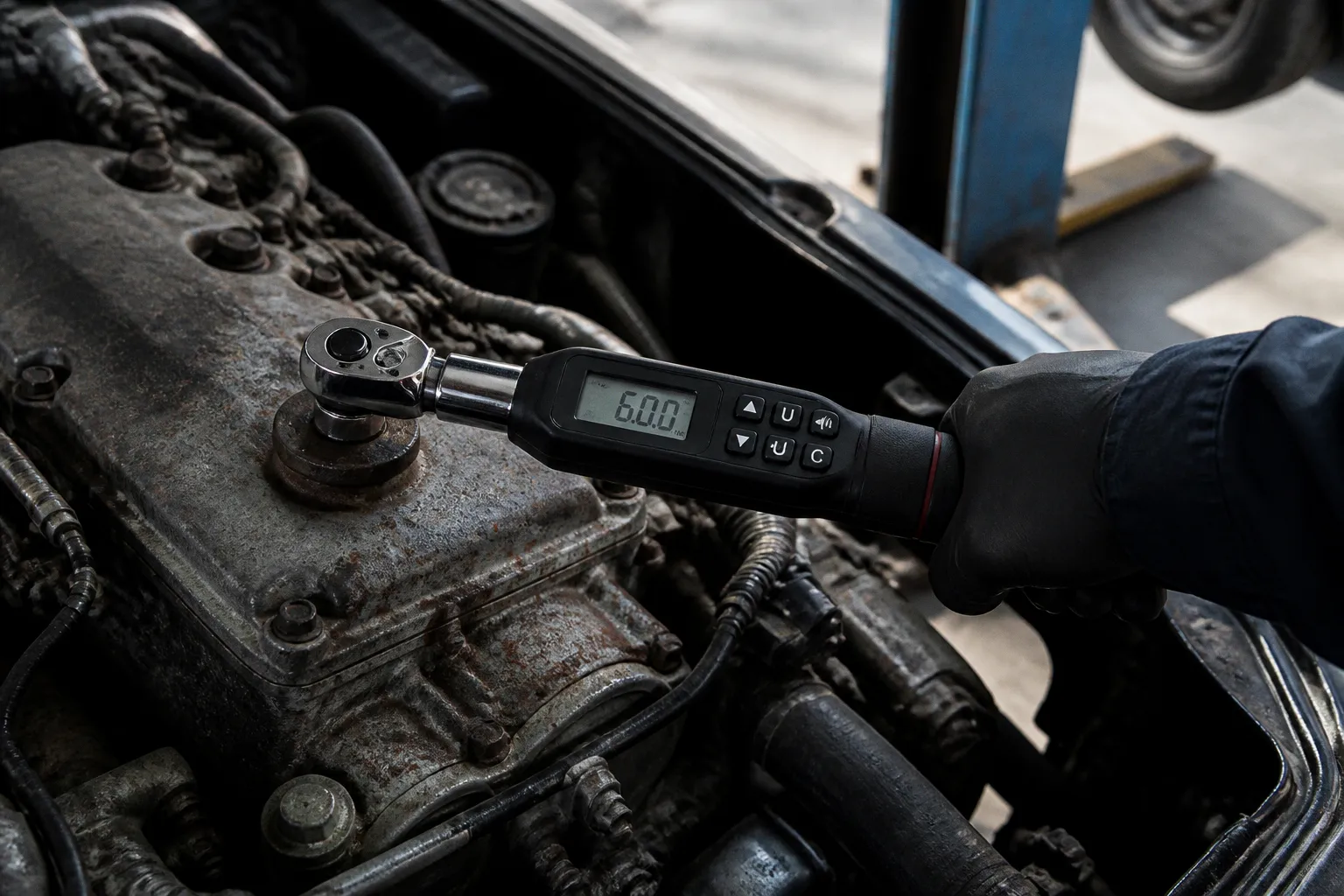
Each fastener stretches, seats, and clamps differently, and the wrench is the part of the job that tells us whether the joint is actually doing what the engineer intended.
Compare car rental deals in United Kingdom
See available offersPartner link — DiscoverCars comparisonA digital torque wrench gives us more information while that load is being applied. It can show the reading on a display, warn us with sound, lights, and vibration, and in many cases measure both torque and angle. A good click wrench is quieter and less complicated, but it can still be accurate enough for most routine garage work. The question in a digital vs. click torque wrench comparison is not whether digital tools are technically more capable. They are. The useful question is whether those extra capabilities will change the work you actually do.
The mechanics of precision: strain gauges versus internal springs
A click-type torque wrench stores force in a spring. As you load the handle, the spring compresses or extends against an internal mechanism. Once the selected torque is reached, the mechanism releases with the familiar click. You feel it through the handle, stop pulling, and the fastener is torqued.
The system is mechanical and relatively direct. There is no display, no battery, and no electronic sensor deciding what to tell you. But the spring has to be treated properly. If the wrench is left set at a high torque value, the spring remains under tension. Over time, that can contribute to deformation and loss of accuracy. We return the setting to the manufacturer’s specified minimum after use because the wrench is a measuring instrument, not just a long ratchet with numbers printed on it.
Digital torque wrenches use strain-gauge sensors connected to electronic processing. The sensor detects the minute flexing of the wrench under load, and the microprocessor converts that strain into a torque reading. There is no internal spring held under tension in the same way as a click wrench, so the tool does not rely on the same mechanical tension memory.
That does not make a digital wrench maintenance-free. Electronics age, batteries go flat, and calibration still matters. The distinction is that the measuring element and the user interface are different. Instead of waiting for a mechanical release, we watch the value climb and receive a warning as we approach the target.
Typical accuracy figures show the gap clearly:
| Wrench type | Typical stated accuracy | What the difference means in the garage |
|---|---|---|
| Digital torque wrench | Around ±1% to ±2% | More precise readings and better control near a narrow target |
| Mid-range click wrench | Around ±3% to ±4% | Adequate for most general automotive fasteners |
| Budget mechanical wrench | Variation can reach ±6% to ±10% | The tool itself may become the largest source of uncertainty |
The figures are useful, but they need to be handled with some restraint. A digital wrench that reads within ±1% does not repair a dirty thread, a corroded bolt, or a damaged clamping surface. Torque is only an indirect way of controlling bolt tension. Friction under the head and in the threads can change the result substantially, which is why service instructions specify thread condition, lubrication, or replacement hardware where necessary.
So the digital advantage is real, but it is not magical. Better resolution at the handle cannot compensate for a fastener that binds before it reaches its seat.
A more accurate wrench gives us a cleaner measurement. It does not make a poor mechanical joint behave like a good one.
Click versus digital torque wrench accuracy in real work
For routine DIY maintenance, the practical gap is often smaller than the specification sheet suggests. Wheel fasteners, brake-caliper bolts, suspension hardware, drain plugs, and many engine-bay fasteners do not automatically require laboratory-level precision. A quality click wrench with accuracy in the ±3% to ±4% range is within a reasonable tolerance for much of this work.
That is why a click wrench remains the best torque wrench type for many home garages. It is easy to store, quick to set, and ready whenever you are. There is no screen to wake up, no battery compartment to corrode, and no audible alarm competing with an impact gun or compressor. You set the scale, pull smoothly, feel the click, and stop.
The important word is quality. A budget wrench with large accuracy variation can undermine the whole exercise. If the tool is difficult to set, the markings are hard to read, or the mechanism releases inconsistently, the problem is not that it is mechanical. The problem is that it is poorly made or poorly maintained.
A digital wrench becomes more useful when the target is narrow or the working conditions make a click difficult to interpret. Consider the difference between these two situations:
1. We are tightening wheel bolts in a quiet garage, with clear access and a conventional torque specification. A click wrench gives us a repeatable process with little fuss.
2. We are working inside a crowded engine bay, wearing gloves, with poor visibility and a specification that requires torque followed by a measured angle. A digital wrench gives us more information and more ways to know when to stop.
Neither tool eliminates the need for technique. We still pull from the handle rather than the head, keep the wrench as close as possible to its intended orientation, and apply load gradually. Extensions and adapters can alter how torque reaches the fastener, particularly when they change the effective lever length or introduce an angle. The display may be precise while our setup is still mechanically careless.
What the accuracy number does not tell us
A manufacturer’s accuracy figure describes the tool under specified conditions. It does not necessarily describe the entire job. We also need to think about:
- Whether the wrench is being used in its calibrated range rather than at the extreme bottom or top of the scale.
- Whether the fastener threads are clean and the contact surfaces are seated correctly.
- Whether the wrench has been dropped, overloaded, or used to break loose fasteners.
- Whether the current calibration is still valid.
- Whether the torque specification is dry, lubricated, or part of a torque-plus-angle procedure.
The last point is especially important on imported vehicles, where service information may distinguish between a standard torque fastener and a torque-to-yield fastener. The tool cannot infer that difference from the bolt. We have to read the procedure.
Real-time feedback: useful information or electronic noise?
A click wrench communicates through one primary signal: the release of the mechanism. It is tactile and unambiguous when we are paying attention. The trouble begins when the click is easy to miss. A gloved hand, a tight space, a noisy workshop, or an awkward pulling position can make the release less obvious.
Digital models typically add several warnings at once. Depending on the design, we may get an audible buzzer, changing LED lights, an LCD display, and vibration in the handle. These signals are not just decorative. They give us a chance to slow down before the target is passed, particularly when the specification is low and the fastener reaches the final few units of torque quickly.
This matters around small fasteners. On a large suspension bolt, the difference between a slow final pull and a slightly hurried one may be easy to feel. On a small aluminum housing bolt, the available margin can feel much narrower. The wrench should not be used as permission to pull faster, but the warning system can help us manage the final part of the load.
At the same time, an alarm is not a substitute for watching the process. Some digital wrenches allow a target to be entered and then signal at a programmed threshold. If we keep pulling after the warning, the tool has done its job and we have ignored it. The electronics cannot release the fastener for us.
The display also helps when unit conversions become inconvenient. Automotive service information may list torque in N·m, lb-ft, or lb-in, while the wrench scale may be most familiar in another unit. Digital tools can convert between units instantly, including kg·cm on models that support it. That avoids mental arithmetic at the point where we are trying to keep the socket square and the fastener aligned.
There is a trade-off. Every additional function adds another setting that can be selected incorrectly. A digital wrench can be left in the wrong unit, an old target value can remain in memory, or a battery can fail halfway through a job. Before using one, we confirm the unit, target, direction, and operating mode. The display is helpful only when we read it.
Torque-to-yield fasteners: where digital tools earn their keep
Some fasteners are tightened by torque and then rotated through a specified angle. The first stage seats the joint and brings the fastener into a known loading range. The angle stage then stretches the fastener by a controlled amount. These are commonly called torque-to-yield, or TTY, procedures, although the exact service method depends on the engine or assembly.
A traditional click wrench can handle the initial torque stage. For the angle stage, we need a separate angle gauge or another method of measuring rotation. That adds a tool, another reference point, and one more opportunity for the setup to move while we work.
A digital torque wrench with angle measurement can combine the two stages. We enter the torque target, apply the specified load, reset or transition as instructed, and then rotate through the required angle while the tool tracks the movement. The tool is not making the procedure foolproof; the bolt still needs to be replaced when the manufacturer specifies single-use hardware, and the threads still need to be prepared correctly. But the measurement is built into the wrench rather than divided between separate instruments.
This is the clearest answer to the question, is a digital torque wrench worth it? If you regularly service engines, cylinder heads, connecting rods, suspension assemblies with torque-plus-angle procedures, or other components that use TTY fasteners, the extra function can justify the cost. The value is not simply higher torque accuracy. It is the reduction in tool changes and the ability to follow a procedure that a basic click wrench cannot measure by itself.
For ordinary lug nuts and oil drain plugs, the answer is less dramatic. A suitable click wrench remains capable of doing the work safely when used within its range and kept in calibration. A digital wrench may make the process more convenient, but convenience is not the same as necessity.
Calibration, storage, and the long-term cost of ownership
The most expensive torque wrench in the world is not accurate if it has been overloaded and never checked. Both mechanical and digital wrenches require periodic calibration checks according to the manufacturer’s standards. Digital electronics do not exempt the tool from this obligation.
For click wrenches, storage is part of calibration discipline. After use, we clean the tool, inspect the ratchet and adjustment mechanism, and return the handle to the specified storage setting. We do not use it as a breaker bar. If a fastener is seized, a separate breaker bar takes that load. Using the torque wrench to break loose hardware can shock the mechanism beyond its intended measurement range.
Digital wrenches need similar mechanical care, plus attention to the electronic side:
- Remove or manage batteries according to the manufacturer’s storage instructions, especially if the tool will sit unused for a long period.
- Keep the display and buttons free of oil, coolant, brake cleaner, and abrasive grit.
- Do not treat water resistance as permission to immerse the tool or leave it in a damp toolbox.
- Protect the wrench from drops; a strain-gauge sensor and electronic board are not improved by impact.
- Check the calibration status before important work rather than assuming the last reading remains valid indefinitely.
Standards such as ISO 6789 and ASME B107.28M provide reference points for torque-tool calibration and performance specifications. For a home mechanic, the practical issue is not memorizing the standard. It is knowing whether the tool’s claimed accuracy is supported by a recognizable specification and whether calibration service is available where you live.
Cost changes the calculation. Quality mechanical click wrenches commonly occupy the roughly $50 to $350 range, with basic budget models at the lower end and better-equipped tools higher up. Digital and electronic torque wrenches commonly cost about $250 to $800 or more, while professional industrial models can run much higher. Professional digital tools may cost two or three times as much as a quality mechanical wrench.
The purchase price is only part of the expense. We also account for batteries, calibration, replacement parts, and the risk that a display or electronic control becomes difficult to repair outside warranty. A mechanical wrench has fewer systems to fail, though its spring and release mechanism still wear and still need checking.
This is where the answer changes depending on the garage. A technician using the wrench every day can justify faster feedback and a broader measurement range. A DIY owner performing several services a year may get more value from buying a reliable click wrench, a separate angle gauge when needed, and spending the remaining money on good sockets and service information.
The tool that sits calibrated, accessible, and correctly sized for the job beats the more advanced tool left in a drawer with a dead battery.
Digital torque adapters: the middle ground
A digital torque adapter fits between a standard ratchet or breaker bar and the socket. It adds a digital readout and, depending on the model, audible or visual warnings without requiring us to buy a complete electronic torque wrench.
This arrangement can make sense when we already own good hand tools. The adapter may provide torque readings at a lower cost than a standalone digital wrench, while preserving the familiar ratchet and socket system. It can also act as a bridge for someone who wants digital measurement but does not yet know whether the full investment is justified.
The compromise is in handling. The adapter adds length between the drive and the fastener, and that can make access more awkward. We have to understand how the adapter is intended to be used, whether it supports the required direction, and how its accuracy is specified. It may also be less convenient in a tight engine bay than a dedicated wrench with an integrated display and handle alerts.
An adapter should not be confused with a calibration device or used casually as a replacement for every type of torque wrench. If the job requires a very specific range, a torque-plus-angle procedure, or a particular clearance around the fastener, the complete tool may still be the cleaner solution.
For general garage work, the choice looks like this:
| Priority | Better fit | Reason |
|---|---|---|
| Low cost, no batteries, quick routine use | Quality click wrench | Simple operation and adequate accuracy for most general automotive fasteners |
| Audible, visual, and vibration warnings | Digital torque wrench | More feedback in noisy or awkward working conditions |
| Torque-plus-angle procedures | Digital torque wrench with angle mode | Measures both stages without a separate angle gauge |
| Existing ratchets and limited budget | Digital torque adapter | Adds electronic readout without replacing the whole tool |
| Maximum simplicity and long storage life | Click wrench | Fewer electronic components and no battery dependence |
| Repeated professional or engine work | Digital wrench, if calibration support is available | Precision and workflow features can repay the premium |
Choosing between digital and click for a home garage
We can narrow the decision by looking at the work rather than the marketing category. Start with the fasteners you actually service and the torque ranges printed in the manuals. A wrench should cover the working range without forcing you to operate at the very edge of its scale.
Then consider the environment. If you work in a quiet, well-lit garage, a click mechanism is easy to use. If you work around running equipment, limited access, or poor visibility, the multiple alerts of a digital model may have practical value. The question is not whether a buzzer sounds impressive. It is whether you can consistently hear or feel the click in your normal working position.
Think about the procedures that defeat a basic click wrench. If your maintenance is mostly wheels, brakes, filters, drain plugs, and ordinary suspension fasteners, a reliable mechanical wrench is usually enough. If your work includes torque-to-yield bolts, precise engine assembly, or specifications spread across several units, the digital features become easier to justify.
Finally, be honest about maintenance. A digital wrench needs batteries, protection from moisture and chemicals, and careful handling. A click wrench needs proper storage, a smooth operating habit, and periodic calibration. Neither one can be thrown into a toolbox under a pile of sockets and expected to remain a trustworthy measuring instrument.
For many DIY mechanics, the strongest setup is not one expensive wrench trying to cover every job. It is a dependable click wrench for routine work, supplemented by a digital torque adapter or angle gauge when a particular repair demands more information. For a garage that regularly reaches into engine internals or follows torque-plus-angle procedures, a digital wrench is a more defensible primary tool.
The verdict: precision is valuable when it changes the procedure
A digital torque wrench is worth the extra cost when its features solve a real problem: missed click signals, cramped access, frequent unit conversions, or torque-to-yield fasteners that require angle measurement. Its typical ±1% to ±2% accuracy is better than the ±3% to ±4% commonly associated with a quality mid-range click wrench, and its feedback can make the final part of a tightening sequence easier to control.
But better accuracy alone does not make it the automatic winner. For routine DIY automotive maintenance, a good click wrench remains accurate enough, easier to maintain, and less expensive. It does not become obsolete because electronic tools have more functions. It simply does a narrower job with fewer complications.
Our choice should follow the fastener and the service procedure. Buy the digital tool when its measurement and feedback will be used. Buy the click wrench when reliability, simplicity, and disciplined technique matter more than a display. Either way, store it correctly, keep it calibrated, and remember what the tool is actually measuring: not tightness, but the controlled force we are asking the joint to carry over years of heat, vibration, corrosion, and repeated load.