Dual-mass flywheel failure: symptoms and diagnostics
A failing dual-mass flywheel usually announces itself through the metalwork before it announces itself through a warning light. At idle, you may hear a dry metallic rattle from the gearbox bellhousing.
Judson Grier·Updated: August 12, 2026·17 min read
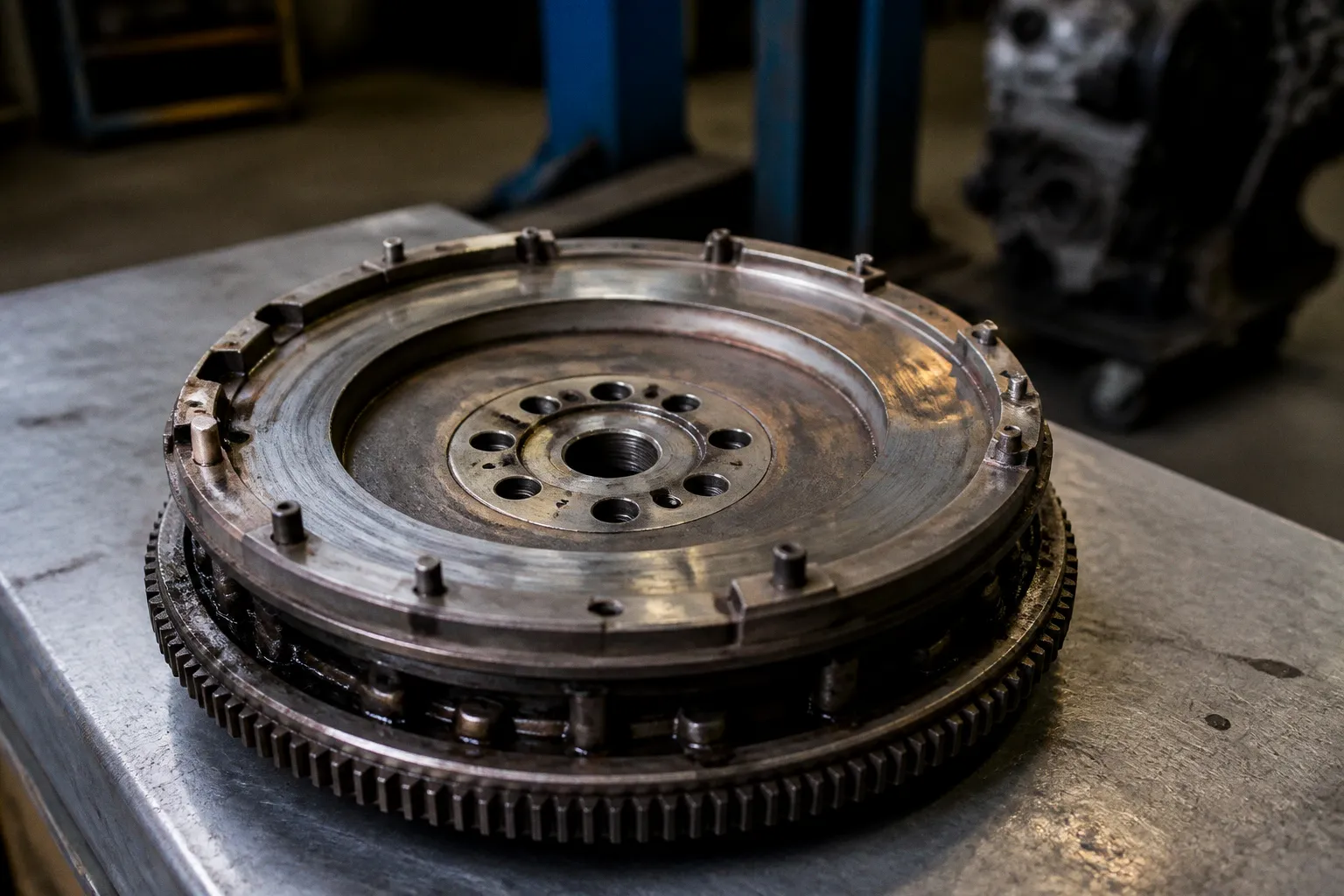
Press the clutch pedal fully, and the noise fades or disappears. When you shut the engine off, the drivetrain may answer with a short clunk, judder, or harsh shudder.
Those are among the most useful dual mass flywheel failure symptoms because they reflect what is happening inside the part: two masses that should move against each other in a controlled way are beginning to lose their damping. The arc springs, friction elements, and internal bearing surfaces no longer absorb the engine’s torsional pulses cleanly. Instead, the movement reaches the clutch and transmission as noise, vibration, and impact.
The difficult part is that a worn dual-mass flywheel can resemble several other faults. A rough-running engine, tired engine mounts, a damaged clutch disc, loose exhaust hardware, or transmission backlash can all make a vehicle feel unpleasant at low speed. We need to separate those faults before removing the gearbox, because replacing a DMF is not a small diagnostic experiment.
Auditory clues: why the gearbox rattles at idle
The classic bad dual mass flywheel noise is a metallic rattle or clatter at idle, apparently coming from the bellhousing. It often becomes more obvious when the engine is warm and the vehicle is sitting in neutral with the clutch pedal released.
Press the clutch pedal all the way down. If the rattle significantly diminishes, that is a meaningful clue. It does not prove the flywheel is condemned by itself, but it tells us that the sound is changing as the clutch and gearbox input shaft are unloaded.
The reason is mechanical. The crankshaft does not turn with perfectly even force. Every combustion event delivers a pulse, followed by a less forceful part of the rotation. In a conventional rigid flywheel, those pulses travel more directly into the clutch and gearbox. A dual-mass flywheel uses a primary mass connected to the crankshaft and a secondary mass connected to the clutch. Between them are springs and damping components designed to absorb the uneven torque.
When the internal springs lose their tension, their guides wear, or the damping grease and friction surfaces deteriorate, the two masses acquire too much freedom. At idle, where the engine’s torsional pulses are particularly noticeable, the parts can move through their excess clearance and strike or chatter against one another.
That is why the sound can be more pronounced at idle than under acceleration. Once engine speed and torque rise, the springs may load in a different way and the loose components may settle temporarily. The noise can become quieter without the underlying wear disappearing.
What the idle test can and cannot tell us
Start with the engine fully warm and the vehicle parked securely. Keep the transmission in neutral and listen from the driver’s seat, then from outside near the bellhousing. Do not put hands, clothing, or tools near rotating parts.
Compare these conditions:
1. Clutch pedal released, transmission in neutral: listen for metallic rattling, irregular chatter, or a light knocking sound.
2. Clutch pedal fully depressed: note whether the noise fades immediately or becomes substantially quieter.
3. A small increase in engine speed: observe whether the rattle changes, disappears, or moves into a different vibration range.
4. Clutch engagement at low speed: feel for judder as the vehicle begins to move, but do not repeatedly abuse the clutch to reproduce the symptom.
The useful observation is not simply “there is a noise.” We want to know whether the noise follows clutch loading and engine speed. A loose exhaust shield may rattle at a particular rpm but will not usually respond so clearly to clutch-pedal position. A release bearing may become noisy when the pedal is depressed, which is almost the opposite pattern.
A bellhousing rattle that disappears with the clutch depressed is a strong lead, not a permission slip to replace parts without measuring the flywheel.
A worn clutch release bearing, pilot bearing, gearbox bearing, or input shaft can still complicate the picture. On some vehicles, gear lash produces a neutral rattle that changes when the clutch is pressed even though the DMF is not beyond its limits. We listen first, but we do not condemn a sealed mechanical assembly by sound alone.
Cabin vibration: when clutch vibration at idle becomes a powertrain problem
Noise is only one side of the failure. The more physical symptom is vibration through the seat, steering wheel, pedals, and floor. The vibration may be strongest at idle, especially with the clutch pedal released, and may change when electrical loads or the air conditioning compressor engage.
A dual-mass flywheel is intended to shift the drivetrain’s troublesome torsional vibration away from the normal operating range. In many applications, it moves the strongest vibration away from roughly 1,200–2,400 rpm, where it would otherwise be felt sharply through the transmission. As the internal damping weakens, that isolation becomes less effective.
You may feel:
- a low-frequency tremor through the seat and floor;
- a pulsing sensation in the clutch pedal;
- a rough engagement as first gear or reverse is selected;
- judder when pulling away gently;
- vibration that becomes more obvious when the engine is lugged at low rpm;
- a heavy shake as the engine passes through idle during start-up or shutdown.
The word “low-frequency” matters here. A DMF problem usually feels like a broad, heavy movement rather than the fast buzz of an electric motor or the sharp vibration of a misfiring cylinder. The cabin seems to move with the engine, and the sensation often changes with clutch position.
Separating DMF vibration from an engine misfire
Before blaming the flywheel, we need to establish whether the engine itself is running evenly. A diesel with an injector imbalance, a petrol engine with an ignition misfire, or an engine with incorrect fuel pressure can send abnormal pulses into the flywheel. The DMF then receives a harsher workload and may rattle, but the original fault is still in the engine.
Look for these differences:
| Symptom pattern | More consistent with engine running fault | More consistent with DMF wear |
|---|---|---|
| Idle quality | Engine speed hunts, misfires, or sounds uneven | Engine may run evenly but the drivetrain shakes |
| Clutch pedal effect | Little change when the pedal is pressed | Vibration or rattle changes noticeably |
| Exhaust note | Irregular combustion sound, smoke, or uneven pulses | Exhaust may remain relatively normal |
| Fault memory | Possible engine or fuel-system codes | No direct OBD-II code for a mechanical DMF |
| Shutdown behavior | Engine may stop roughly because of poor combustion | Distinct metallic clunk or short judder as masses settle |
| Low-speed takeoff | Hesitation or power loss may be present | Engagement may shudder despite normal engine power |
There is no OBD-II fault code specifically for a dual-mass flywheel. It is a mechanical component, not an electronically monitored actuator. A scan tool remains useful for checking misfire, injector, crankshaft-position, or engine-management faults, but a clean scan does not clear the flywheel, and a warning light does not directly identify it.
That point saves time in both directions. We should not wait for a code that will never appear, but we should also avoid treating every vibration with a clean scan as proof of DMF failure.
The shutdown test: the brief clunk that deserves attention
A worn flywheel often makes its most revealing noise in the second after the engine stops. You turn the key off or press the stop button, the engine drops through its final rotations, and the bellhousing produces a metallic clunk, judder, or short burst of clatter.
The engine’s final rotation is not smooth. As combustion stops, the crankshaft slows unevenly and the two flywheel masses settle against the spring and damping system. If the internal clearances have grown, the primary and secondary masses can knock against their stops or move abruptly as the springs lose control.
A healthy vehicle may still produce a small mechanical sound during shutdown. We are looking for a pronounced, repeatable event: a hard clunk, a short metallic chatter, or a shake that is clearly transmitted into the cabin.
Repeat the observation only enough to confirm the pattern. There is no value in performing dozens of shutdowns, especially if the engine is already running roughly. Listen with the bonnet open and from inside the cabin, then compare the result after pressing the clutch pedal. On some vehicles, the clutch position alters how the flywheel and input shaft settle.
Why a slipping clutch does not always smell
Clutch slip is often associated with the smell of overheated friction material. A DMF-related fault can produce a different pattern. If the internal springs or damping elements fail, the flywheel may no longer provide a stable mounting point for the clutch. The result can be engagement instability or apparent slip without the familiar strong burning smell from the clutch facings.
That does not mean every slipping clutch is a flywheel problem. We still need to test for clutch wear, oil contamination, hydraulic faults, and incorrect adjustment where applicable. But if clutch slip, low-speed judder, idle rattle, and shutdown clunk arrive together, the flywheel becomes a serious suspect.
The most useful driving observations are controlled ones:
1. Accelerate in a higher gear at low-to-moderate engine speed. A worn clutch may allow engine speed to rise without a matching increase in road speed.
2. Notice whether the symptom is slip or judder. Slip is a loss of torque transfer; judder is an unstable grab-and-release during engagement.
3. Compare cold and warm behavior. Heat can make worn damping components behave differently, though temperature alone does not establish the fault.
4. Avoid forcing the symptom repeatedly. Deliberate clutch abuse can overheat the friction surfaces and create damage that was not present at the beginning of the test.
The flywheel and clutch work as one load path. If we test one while ignoring the other, the diagnosis becomes incomplete.
Mechanical diagnostics: measuring freeplay and tilting clearance
Once the gearbox is removed, diagnosis becomes more precise. A DMF is a sealed assembly and is not something we rebuild at the workbench with a new spring pack or a bottle of additive. If it exceeds the manufacturer’s limits, replacement is the repair.
Two measurements matter most: rotational freeplay between the masses and tilting clearance, sometimes called rock or radial movement. The exact limits are application-specific. LuK, Sachs, and vehicle manufacturers publish different values according to the flywheel design, bearing type, engine torque, and clutch system. There is no single universal number that condemns every DMF.
Freeplay angle
Freeplay angle is the amount one mass can rotate relative to the other before the springs begin to load. We measure it with the correct fixture or manufacturer-approved method, not by guessing from hand movement.
Some specifications use an angular condemn threshold in the region of 8–12 degrees, but that range should not be treated as a universal rule. The number of spring stages, the flywheel design, and the vehicle application all change the acceptable movement.
A lever test may also reveal whether the internal damping system can complete its intended travel. On a thermally overloaded flywheel, the internal lubricant can harden. When that happens, the assembly may fail to reach the full rotation angle of about 60 degrees in each direction during the specified test procedure.
The feel is important as well. Smooth, controlled spring resistance is different from a loose first section followed by a hard stop. Grinding, binding, or a dead zone indicates that the internal parts are no longer working as designed.
Tilting clearance and axial play
With the flywheel supported correctly, we check how far the secondary mass can rock relative to the primary mass. The allowable tilting clearance depends on the bearing arrangement:
- up to approximately 1.6 mm may be permitted on some ball-bearing designs;
- up to approximately 2.9 mm may be permitted on some plain-bearing designs.
Those figures illustrate why a generic internet tolerance can mislead us. The bearing type changes the measurement. The correct service data for the exact flywheel remains the authority.
Axial movement can also exist by design. Some assemblies allow up to about 2 mm between the primary and secondary masses, while certain plain-bearing designs may allow as much as 6 mm. A mechanic who sees movement and immediately declares the part failed may be measuring a normal characteristic. The direction, amount, and feel of the movement all matter.
We also inspect the friction surface for runout. Some specifications condemn the secondary-mass face when total indicated runout exceeds around 0.3 mm, but again, that figure belongs to particular applications rather than every DMF on the road.
The measurement process should be clean and repeatable:
1. Remove contamination from the flywheel without forcing debris into the assembly.
2. Secure the flywheel so the primary mass cannot move during the test.
3. Fit the correct measuring tool or dial indicator arrangement.
4. Measure rotational play in the specified direction and through the specified procedure.
5. Check rock, axial movement, and surface runout separately.
6. Compare each result with the exact vehicle or component specification.
7. Replace the unit if its movement, noise, binding, heat damage, or surface condition exceeds the permitted limits.
If the flywheel has been overheated, do not rely only on a measurement that happens to fall within tolerance. Heat can damage internal grease and friction elements without leaving the assembly obviously loose in every direction.
Visual inspection: finding heat damage after removal
A removed flywheel often carries the evidence of how it has been treated. Thermal overloading can leave yellowish discoloration below the friction surface, which may point to an overheated axial bearing. The secondary flywheel’s friction surface may show discoloration, blueing, hot spots, or uneven contact.
These marks need to be interpreted alongside the clutch disc and pressure plate. A clutch that has been slipping can heat the flywheel. A flywheel with failed internal damping can create unstable clutch engagement, which then generates more heat. In other words, the visible damage may show the final stage of a chain rather than its first cause.
Inspect for:
- darkened or yellowed areas near bearing zones;
- blue or purple heat marks on the friction face;
- cracks, severe scoring, or localized hot spots;
- grease leakage or signs that internal lubricant has escaped;
- damaged ring-gear teeth;
- unusual contact marks where the two masses have reached their stops;
- excessive movement accompanied by grinding or binding;
- clutch disc contamination or uneven wear.
A small amount of surface color is not enough to condemn the flywheel without context. But pronounced thermal discoloration, a hardened internal feel, and excessive freeplay together make continued service a poor gamble.
Heat does not merely stain a dual-mass flywheel; it can harden the lubricant and change how the springs and damping surfaces control the drivetrain.
The clutch replacement decision belongs here as well. If the gearbox is already out and the clutch has substantial wear, contamination, or heat damage, fitting a new clutch against a questionable DMF leaves us paying for the same labor twice. Conversely, installing a new DMF while reusing a damaged clutch disc can transfer the old problem into the new assembly.
What causes premature DMF wear?
A dual-mass flywheel can last around 150,000 kilometres in some applications, but that is not a promise. Service life depends heavily on engine torque, traffic conditions, towing, vehicle loading, clutch technique, and engine tuning.
Repeated low-rpm loading is particularly hard on the damping system. When we ask a high-torque diesel to accelerate in too high a gear, the engine produces large torsional pulses at low speed. The DMF absorbs those pulses, but it does so under severe load. Chassis vibration, clutch judder, and spring movement accumulate over time.
Common contributors include:
- frequent stop-start driving;
- towing or carrying heavy loads;
- aggressive launches;
- holding the vehicle on the clutch;
- repeated driving below the engine’s comfortable torque range;
- engine remapping that increases torque beyond the original drivetrain calibration;
- a misfiring or unevenly fueled engine;
- oil contamination or incorrect clutch installation;
- continued driving after severe clutch slip.
The solution is not to drive timidly or keep the engine permanently at high rpm. We want the engine operating in a sensible load and speed range, with clean clutch engagement and no unnecessary lugging. A sound engine also matters because every irregular combustion event is another shock sent through the flywheel.
Replacement indicators and the single-mass conversion question
The dual mass flywheel replacement indicators are strongest when several independent symptoms agree:
- metallic idle rattle from the bellhousing;
- noise that fades when the clutch pedal is fully depressed;
- vibration through the cabin at idle;
- low-speed clutch judder;
- a distinct clunk or shake during engine shutdown;
- measured freeplay or rock beyond the exact service limit;
- binding, grinding, or failure to reach the specified rotation angle;
- serious thermal discoloration or visible internal damage.
Replacement cost varies widely by vehicle, access, parts choice, and labor rate. A typical European replacement may fall in the region of €900–€1,800, but the number is not transferable to every import or drivetrain. The transmission design, subframe arrangement, clutch hydraulics, and parts availability can shift the job considerably.
Some owners consider converting to a single-mass flywheel to reduce parts cost or eliminate future DMF wear. That is not automatically an upgrade. The dual-mass assembly was selected to control torsional vibration, gear rattle, and harshness for that engine and gearbox. Removing it can increase noise, vibration, and harshness and may accelerate transmission wear. It can be appropriate in a carefully matched application, but it is not a universal cure for a worn component.
We also need to check the surrounding system before fitting the replacement. Engine mounts that have collapsed, a gearbox mount that has separated, a leaking rear main seal, or an engine that is still misfiring can damage the new parts. A replacement flywheel cannot absorb a problem that remains upstream.
The practical diagnostic sequence
The cleanest approach moves from the least invasive checks toward removal:
1. Confirm the engine is running correctly. Scan for engine faults, check idle stability, and investigate misfire or fueling problems before blaming the drivetrain.
2. Listen at idle with the clutch released and depressed. Record exactly how the sound changes rather than describing it only as “a noise.”
3. Check start-up and shutdown behavior. A heavy clunk or judder during engine stop adds weight to the diagnosis.
4. Road-test for slip and judder. Separate a clutch that slips under load from a clutch that shudders during engagement.
5. Inspect mounts and exhaust components. Loose hardware can imitate bellhousing and low-rpm vibration.
6. Remove the gearbox only when the evidence justifies the labor.
7. Measure the DMF using the correct tool and exact component data.
8. Inspect the clutch, rear main seal area, gearbox input shaft, and mounts while access is available.
9. Replace matched worn components rather than isolating one damaged part from the rest of the load path.
This sequence is slower than throwing parts at the car, but it is faster than removing the transmission twice. We are not trying to prove the most expensive theory first. We are trying to find the point where the engine’s torque stops being controlled and starts arriving at the gearbox as impact.
A dual-mass flywheel does not fail because one sound has reached a magic volume. It fails when its movement, damping, temperature history, and effect on the vehicle no longer remain within the design limits. The useful diagnosis combines what you hear, what you feel, what the scan tool rules out, and what the removed assembly measures like in your hands.
When those pieces agree, replacement is usually the sensible answer. The flywheel is sealed, its internal springs and damping elements are not a roadside service item, and chemical additives cannot restore the geometry or spring control that has been lost. Fit the correct assembly, address the clutch and mounts while the gearbox is out, and correct the driving or engine fault that shortened its life. Otherwise, the new parts will simply begin absorbing the same punishment, one combustion pulse at a time.