Mixing different coolant colors: what are the risks?
Mixing different coolant colors is not, in itself, a chemical diagnosis. Color is a dye; it is not a universal specification, and it does not reliably identify the additive technology inside the bottle.
Merritt Vane·Updated: August 12, 2026·14 min read
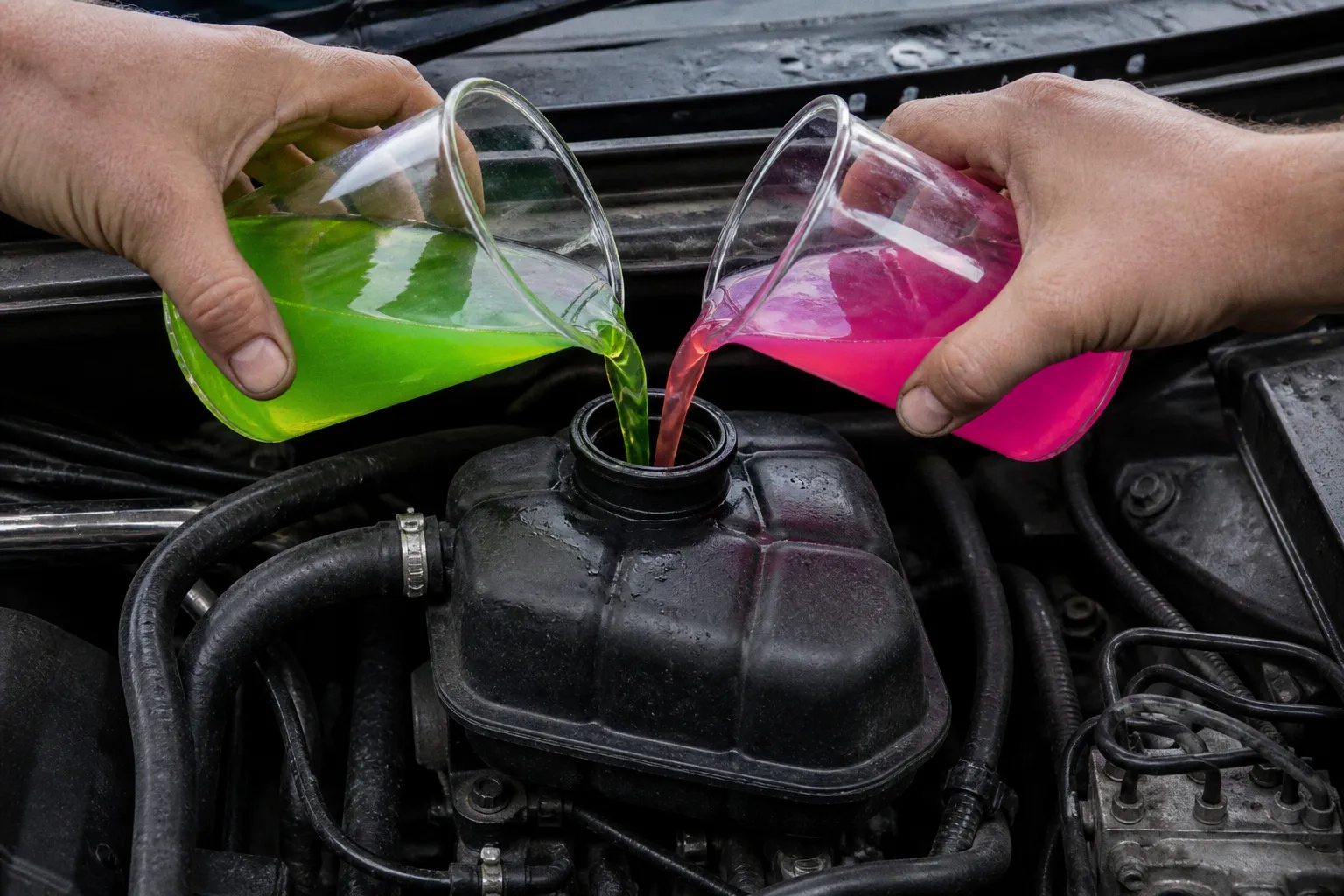
A blue coolant from one manufacturer may be chemically unrelated to a pink coolant from another, while two fluids of the same color may have different corrosion inhibitors and different service requirements.
The risk begins when color is used as a substitute for formulation. Incompatible coolants can neutralize corrosion protection, produce gel-like deposits, restrict narrow cooling passages, and accelerate damage to aluminum cylinder heads, radiators, heater cores, water pumps, and steel components. The resulting failure is rarely theatrical or immediate; it develops through reduced flow, localized overheating, and corrosion that may remain invisible until the cooling system has already lost its margin of safety.
The myth of color-coded compatibility
Coolant color has no internationally consistent meaning. Manufacturers use dyes for product identification, branding, or market differentiation; those dyes do not establish whether two fluids can be mixed. Green is commonly associated with older Inorganic Additive Technology, or IAT, formulations, but green coolant can also appear in products with different chemistry. Orange is often associated with OAT coolants, while blue, pink, yellow, and purple may represent several different formulations depending on the manufacturer and vehicle market.
This is why questions such as “Can you mix blue and pink coolant?” or “Is mixing green and orange antifreeze safe?” cannot be answered from color alone. The relevant comparison is not blue against pink, nor green against orange. It is the compatibility of the additive packages, the vehicle manufacturer’s specification, and the coolant already present in the system.
A coolant contains more than glycol and water. Ethylene glycol or propylene glycol provides freeze protection and raises the boiling point; the additive package controls how the fluid interacts with aluminum, cast iron, steel, solder, elastomers, and other materials. Silicates, phosphates, organic acids, borates, and other inhibitors are selected to suppress particular corrosion mechanisms. Their concentration and interaction are part of the formulation’s design.
A conventional IAT coolant may use inorganic inhibitors that protect metal surfaces rapidly but tend to have a shorter service life. OAT coolant relies primarily on organic acid inhibitors, which react more selectively with corrosion sites and are commonly associated with extended service intervals. HOAT combines organic acids with inorganic inhibitors, often including silicates, to provide a hybrid form of protection; this is particularly relevant in systems containing substantial aluminum components.
The dye tells you almost nothing about those distinctions.
Coolant color is a visual label, not a compatibility standard; the specification on the vehicle or product documentation is the chemical information that matters.
A correct match therefore requires the vehicle manufacturer’s coolant specification or an explicitly documented equivalent. The wording on the container should identify the required standard, approval, or application. “For all vehicles” is not the same as “approved for every cooling system,” and “universal” is not a chemical category with one fixed formula.
What happens when IAT, OAT, and HOAT collide
The effects of mixing coolant types depend on the formulations, their proportions, the operating temperature, and the condition of the existing fluid. There is no single reaction that occurs every time two differently colored coolants meet. That uncertainty is precisely why color-based mixing is poor practice.
One well-established problem involves IAT and OAT chemistry. When silicates from an IAT formulation interact with organic acids in an OAT coolant, the additive balance can become unstable. A thick, gel-like precipitate may form; this material can circulate through the system and settle in passages that were designed for continuous coolant flow rather than suspended solids.
The narrow passages inside a radiator, heater core, cylinder head, and water pump are particularly vulnerable. A deposit does not need to fill the entire system to become consequential. A constriction of approximately 2 mm in a narrow cooling passage can reduce the system’s overall cooling efficiency by as much as 40 percent. The engine may still appear to operate normally under light load, while its cooling reserve has been substantially reduced.
A similar concern applies when propylene glycol products and incompatible organic-acid formulations are mixed. The result can include solidification or gel formation, depending on the specific additive packages and operating conditions. The chemistry is not predictable from the base glycol alone; two products can both be described as “antifreeze” while carrying incompatible corrosion-control systems.
HOAT requires particular care because it is not one uniform recipe. Some hybrid formulations contain silicates; others use different inhibitor combinations, and manufacturer approvals can be highly specific. A coolant marketed as HOAT may be appropriate for one European or Asian vehicle and unsuitable for another despite similar color, freeze protection, or marketing language.
The following comparison is more useful than a color chart:
| Coolant technology | Typical inhibitor approach | Main compatibility concern | Practical implication |
|---|---|---|---|
| IAT | Inorganic inhibitors such as silicates or phosphates | May react poorly with organic-acid packages; service life is often shorter | Common in older systems; do not assume compatibility with modern extended-life coolant |
| OAT | Organic acid inhibitors | Can be destabilized by incompatible inorganic additives or other OAT packages | Requires the correct vehicle specification, not simply an “extended-life” label |
| HOAT | Organic acids combined with selected inorganic inhibitors | Different HOAT products are not automatically interchangeable | Match the exact approval or manufacturer requirement |
| “Universal” or multi-vehicle | Broad application claim, often using a hybrid or P-OAT approach | May dilute or alter the original additive concentration | Useful only where the manufacturer explicitly permits it |
A mixed system may not produce visible sludge at once. The absence of an immediate reaction does not establish compatibility. Some chemical effects become evident only after repeated heat cycles, circulation, evaporation, and exposure of fresh metal surfaces. Deposits and corrosion may develop over weeks or months rather than during the first drive.
The hidden cost of sludge and localized corrosion
A cooling system is a hydraulic circuit with a limited ability to tolerate restriction. The water pump must move sufficient fluid through the engine block, cylinder head, radiator, and heater circuit; the thermostat must regulate flow according to temperature; and the radiator must transfer heat through clean internal tubes and unobstructed external fins.
Gel or sludge disrupts all three functions.
First, deposits reduce the effective cross-section of the passages. This increases resistance to flow and may leave parts of the engine receiving less coolant than others. The temperature gauge can remain deceptively stable because it measures one location, not every combustion chamber, valve bridge, or cylinder-head passage. Under sustained load, towing, high ambient temperature, or turbocharged operation, a localized thermal problem can become visible before the dashboard gauge moves significantly.
Second, sludge can interfere with the water pump. Deposits may restrict the pump inlet, reduce impeller efficiency, or contribute to seal wear. A pump that is turning but not moving the intended volume of coolant creates a diagnostic trap: the component may appear mechanically intact while the system’s actual circulation is inadequate.
Third, the heater core can become restricted. A weak cabin heater is sometimes treated as a comfort problem; in a contaminated cooling system it can be evidence of reduced flow or sediment accumulation. If the heater circuit is the first narrow passage to collect material, the cabin temperature may deteriorate before the engine shows an obvious overheating condition.
The corrosion risk is less visible but equally serious. When incompatible additives neutralize one another, the fluid may lose the protection that prevents electrochemical attack on the metal surfaces. Aluminum cylinder heads can develop localized pitting; iron and steel components can rust; soldered joints and mixed-metal interfaces can suffer from galvanic corrosion. These processes are accelerated when coolant is old, diluted incorrectly, oxygenated, or contaminated with combustion gases.
Aluminum damage deserves particular attention in modern import engines. Cylinder heads, thermostat housings, radiators, and water-pump assemblies often contain aluminum alloys whose corrosion behavior depends heavily on the inhibitor film maintained by the coolant. Once pitting begins, a later refill with the correct fluid does not reverse the material loss. The system may require component replacement rather than another routine drain and refill.
The glycol-to-water ratio also matters. A 50/50 mixture is a common operating standard because it balances freeze protection, heat transfer, and corrosion control. A 50/50 glycol-water mix has a boiling point of approximately 265°F, compared with 212°F for pure water under comparable pressure. Increasing glycol concentration beyond the manufacturer’s recommendation does not simply improve protection; excessive glycol can reduce heat-transfer efficiency and alter flow behavior.
This is why adding an unknown coolant to a partially full system creates two uncertainties at once: the additive chemistry may be incompatible, and the final concentration may be incorrect.
Why “universal” coolant is not automatically universal
Multi-vehicle coolant is designed to cover a broad range of applications, often through a hybrid or P-OAT-based additive system. That can be useful in fleet maintenance, where inventory simplification has practical value. It does not mean that the product is chemically identical to every original-equipment coolant.
When a universal product is added to an existing formulation, the original concentration of corrosion inhibitors is diluted or altered. The resulting mixture may remain fluid and provide reasonable freeze protection, yet offer less reliable corrosion protection than the vehicle manufacturer intended. The problem is not always immediate engine overheating; it may be a shortened service interval, deposit formation, or gradual attack on internal components.
Warranty and service documentation create a second limitation. A product may state that it is suitable for a broad group of vehicles while not carrying the precise approval required by a particular manufacturer. For an import vehicle with a specified coolant standard, the relevant question is whether the product meets that specification—not whether it contains the words “universal,” “all makes,” or “extended life” on the front label.
A universal coolant may be acceptable when the vehicle manufacturer or coolant manufacturer clearly identifies it as a compatible replacement. It is a poor choice when used solely because the correct product is unavailable and the fluid happens to have a similar color.
The same principle applies to service intervals. Some HOAT products are commonly replaced at intervals of five to seven years, but that range is not a universal rule. The interval depends on the formulation, vehicle design, operating conditions, and manufacturer’s maintenance schedule. Mixing a long-life coolant with an older IAT product does not create a long-life coolant; it creates an unknown mixture whose inhibitor performance is difficult to predict.
What to do when the coolant level is low
A low reservoir level creates pressure to act quickly, but the wrong refill can convert a simple leak or evaporation problem into a chemical and mechanical one. First identify whether the engine is cold and whether the loss is external. Never remove a radiator cap or pressurized expansion-tank cap from a hot engine; the fluid may be above its normal boiling point and can escape violently.
If the correct coolant is available, use the specified premix or dilute the concentrate according to the manufacturer’s instructions. Do not infer the required mixture from the color of the fluid in the reservoir. A faded or contaminated coolant may no longer resemble its original dye, and a replacement bottle may use a different dye for the same or similar technology.
If the correct coolant is not available, temporary topping-off with clean water is generally preferable to introducing an unknown or incompatible antifreeze. This is an emergency measure, not a permanent service procedure. Water changes freeze protection and can reduce corrosion protection if left in the system, so the vehicle should receive a proper drain, flush, concentration check, and refill with the specified coolant as soon as practical.
In cold climates, the duration of this temporary measure matters; in hot conditions, the engine’s load and ambient temperature matter. A vehicle driven gently to a repair facility is not equivalent to one operated for weeks with an uncontrolled water-to-glycol ratio. The objective is to prevent chemical mixing while limiting operation until the system can be restored.
After incompatible coolant has already been added, the appropriate response depends on the amount, the distance driven, and the condition of the fluid. A small accidental top-off does not prove that damage has occurred, but it does justify removing uncertainty rather than waiting for symptoms. A workshop may inspect the reservoir and radiator for sediment, test coolant concentration, assess pH and inhibitor condition where suitable, and perform a complete flush. If gel is present, a simple drain may not remove material lodged in the heater core, radiator, thermostat housing, or cylinder-head passages.
A proper correction generally includes:
1. Determine the required coolant specification. Use the vehicle’s service information, not the visible color in the expansion tank.
2. Inspect for the cause of fluid loss. Check hoses, radiator seams, thermostat housing, water pump area, expansion tank, cap, and signs of combustion-gas intrusion.
3. Assess the mixed fluid. Look for clouding, floating particles, sediment, stringy material, or gel-like deposits; these findings indicate that a drain-and-fill may be insufficient.
4. Flush the entire circuit when compatibility is uncertain. The radiator alone is not the whole system; the heater core and engine passages must also be included.
5. Refill with the correct concentration. Confirm the final glycol-to-water ratio with a suitable refractometer or the manufacturer’s prescribed method.
6. Bleed the system correctly. Air pockets can produce localized overheating even after the chemical problem has been corrected.
7. Recheck the level and operating temperature. A stable gauge reading does not replace inspection for leaks, poor heater output, or abnormal pressure.
The safest emergency substitute for an unknown coolant is temporary water, followed by a controlled flush and refill; an unverified “universal” product merely hides the uncertainty inside the cooling system.
How to prevent a compatibility problem
The simplest preventative measure is to record the coolant specification at the time of service. Keep the product name, manufacturer approval, concentration, and service date with the vehicle’s maintenance records. This is especially useful for imported vehicles, where the original specification may be expressed through a manufacturer code rather than a familiar IAT, OAT, or HOAT label.
Do not rely on reservoir color after several years of service. Dye can fade, the fluid can become contaminated, and previous servicing may already have introduced a different formulation. When the history is unknown, treat the existing coolant as an unknown chemical mixture until it has been identified or replaced.
A few operating symptoms deserve attention after coolant has been mixed:
- The cabin heater produces less heat despite a normal engine operating temperature.
- The expansion tank contains brown, cloudy, stringy, or gel-like material.
- The radiator or reservoir develops sediment that returns after cleaning.
- The engine temperature rises under load but appears normal during gentle driving.
- The cooling fan cycles more often than before without a clear change in ambient conditions.
- The water pump becomes noisy or the system develops abnormal pressure.
- Coolant loss continues after an apparent refill.
These symptoms do not prove that incompatible chemistry is responsible; leaks, thermostat faults, blocked radiators, head-gasket problems, and air pockets can produce similar signs. They do, however, justify inspecting the coolant itself rather than replacing components by sequence.
The central distinction is between fluid level and fluid condition. A reservoir filled to the correct mark can still contain the wrong inhibitor package, excessive dilution, suspended solids, or corrosion products. Conversely, a slightly low level may be corrected safely when the correct coolant is known and the cause of the loss is addressed. The mark on the tank describes volume; it does not certify chemistry.
For long-term maintenance, follow the vehicle-specific coolant interval rather than a generic claim printed on a bottle. Some vehicles require a shorter interval because of material combinations, severe operating conditions, or a particular inhibitor system. Others use extended-life formulations, but their service life still depends on maintaining concentration and preventing contamination.
Mixing different coolant colors is therefore not a harmless visual mismatch. It is a decision to combine chemical systems whose inhibitors may support, neutralize, or react with one another inside passages that are difficult to inspect and expensive to replace. The disciplined approach is narrow but clear: identify the required specification, use the correct concentration, avoid unverified top-offs, and flush the system whenever compatibility has become uncertain. In cooling-system maintenance, prevention is not cosmetic diligence; it is the preservation of flow, corrosion resistance, and the thermal margin on which the engine depends.