Why Wheel Bearing Noise Changes When You Turn
A low-pitched hum that rises with vehicle speed and becomes louder during a turn indicates a load-sensitive rotating component. The wheel bearing is a primary suspect. The steering angle alone is not the cause.
Aldous Moorland·Updated: August 12, 2026·15 min read
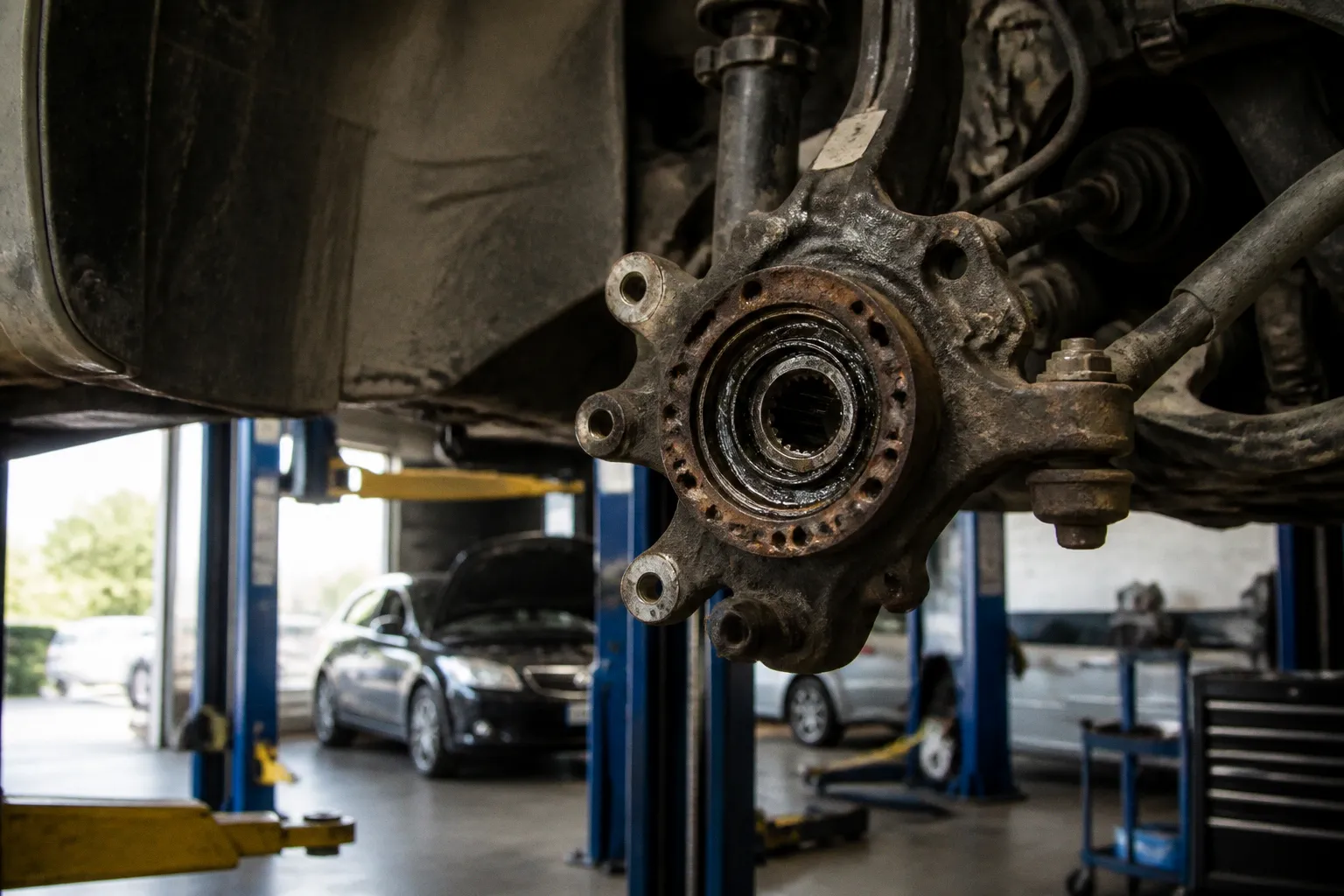
Cornering transfers vehicle mass to the outside wheels, increasing the radial, axial, and lateral forces carried by the loaded hub assembly.
A common diagnostic pattern is direct:
- If the noise increases during a left turn, the right-side bearing is placed under greater load.
- If the noise increases during a right turn, the left-side bearing is placed under greater load.
This pattern is useful. It is not conclusive. Road crown, tire cupping, worn suspension joints, brake drag, and drivetrain resonance can produce similar changes. Wheel bearing noise when turning diagnostics therefore requires a load test, a physical inspection, and, where necessary, measurement with a dial indicator or chassis listening equipment.
The Physics of Weight Transfer and Bearing Load
A wheel bearing supports the hub, wheel, brake rotor, and part of the vehicle's static load. During cornering, the load is no longer distributed equally between the four contact patches.
During a left turn, the vehicle body rolls slightly to the right. The right-side tires carry a greater portion of the vertical load. The right wheel bearings also receive higher lateral and axial forces through the steering knuckle and hub. During a right turn, the load shifts to the left.
The bearing does not need to have visible looseness for this load change to alter its sound. Damage can exist on the raceway or rolling elements while the assembly remains tight enough to pass a basic shake test. A damaged bearing surface can produce a repeating vibration or acoustic signature that becomes louder as the damaged area enters the loaded zone.
A speed-dependent bearing sound typically has four characteristics:
1. It rises with road speed. Engine rpm does not control it. Selecting a lower gear without changing vehicle speed should not materially change the sound.
2. It remains present while coasting. If the noise continues with the transmission in neutral and the vehicle safely rolling, an engine or gearbox source becomes less likely.
3. It changes under lateral load. A gentle steering input can increase or reduce the sound.
4. It has a low-frequency character. Humming, growling, and rumbling are common. Severe damage can produce grinding or a rhythmic metallic tone.
The bearing-side rule is based on load transfer. It must not be treated as a standalone verdict. A road surface can amplify one side of the vehicle. Uneven tire wear can change its contact noise under the same steering input. A worn control arm bushing can alter wheel alignment during the maneuver and create a false bearing pattern.
A cornering noise identifies a load response. It does not, by itself, identify a failed bearing with absolute certainty.
Why the damaged bearing gets louder
A bearing contains rolling elements, raceways, seals, and lubricant. Pitting, brinelling, spalling, corrosion, or lubricant loss changes the contact geometry. Under light load, the defect may generate only a faint hum. When the bearing is loaded laterally, the damaged raceway carries greater contact stress. Vibration amplitude increases.
The sound may not be continuous at low speed. At 30 to 50 mph, the rotating frequency is high enough for a damaged raceway to produce a stable hum or rumble. At lower speeds, the sound may be masked by tire and wind noise. At higher speeds, the bearing can become louder, but a controlled test should not be performed at an unsafe speed or on a congested road.
The noise can also change without a corresponding change in steering angle. A road crown may load one side of the vehicle continuously. A lane change may briefly reverse the load. For this reason, a test performed in both directions is more useful than one isolated turn.
Interpreting Sound Changes During Cornering Maneuvers
The correct road test is progressive. The vehicle is driven on a smooth, low-traffic road. Windows are closed first to reduce wind variation. Audio systems and unnecessary accessories are switched off. A gentle slalom is performed at approximately 20 to 30 mph where conditions permit.
The steering input must remain moderate. An aggressive maneuver introduces tire scrub, suspension movement, and body-roll noise. Those effects reduce diagnostic value and create unnecessary risk.
The observed response can be organized as follows:
| Test condition | Noise response | Diagnostic meaning |
|---|---|---|
| Straight-line acceleration | Hum rises with speed | Rotating component remains suspect |
| Straight-line coasting | Noise remains at the same road speed | Engine load is less likely to be the source |
| Gentle left turn | Noise becomes louder | Right-side bearing may be more heavily loaded |
| Gentle right turn | Noise becomes louder | Left-side bearing may be more heavily loaded |
| Light brake application | Noise changes immediately | Brake drag or rotor-related noise requires inspection |
| Steering input with little speed change | Noise changes sharply | Load-sensitive hub, tire, or suspension source is likely |
| Rough pavement only | Noise follows road texture | Tire pattern or suspension noise becomes more likely |
The response should be compared at similar speeds. A left turn at 25 mph and a right turn at 40 mph do not provide a valid comparison. Sound pressure rises with speed, and the test becomes contaminated by tire and wind noise.
Applying the left-turn/right-turn rule
If the vehicle produces a hum in a straight line and the sound increases during a controlled left turn, the right hub becomes the first inspection target. The outside right wheels are loaded during the turn.
If the sound increases during a controlled right turn, the left hub becomes the first target.
If the sound becomes quieter during a left turn, that does not prove the left bearing is defective. It may indicate that the left-side bearing is being relieved of load during the maneuver, but the sound source can still be a tire, a brake shield, or a drivetrain component responding to suspension geometry. Quietness under load is not a clearance.
If the sound changes in both directions, the vehicle may have more than one worn bearing. It may also have directional tire wear, loose suspension hardware, or a resonant vibration transmitted through the subframe.
The strongest pattern is a repeatable change under lateral load combined with a road-speed-dependent hum and confirmatory hub inspection. A single pass around one bend is weak evidence.
Beyond the Hum: Identifying Advanced Bearing Failure Symptoms
Wheel bearing noise often begins as a subdued hum. It can be mistaken for normal tire noise, particularly on imported vehicles fitted with aggressive all-season or winter tread patterns. As the damage progresses, additional symptoms may develop.
Humming, growling, and rumbling
A smooth hum that rises in pitch with speed indicates a rotating source. A rough growl suggests surface damage or lubricant degradation. The sound may be transmitted through the steering knuckle and subframe, making the affected side difficult to identify from inside the cabin.
The sound can be loudest at a particular speed range. This does not mean the bearing damage exists only at that speed. Body panels, floor structures, and suspension components can amplify specific frequencies. On certain import platforms, the cabin insulation and steel subframe geometry create resonant peaks in the 35 to 55 mph range that mimic or mask bearing tone.
Grinding
A harsh metallic grinding sound indicates a more advanced condition. It can also be produced by a brake shield contacting the rotor, a seized caliper, or a failed CV joint. The source must be separated by inspection rather than by sound description alone.
If grinding is present with abnormal heat at one wheel, brake drag becomes a direct suspect. After a short drive with minimal braking, the wheel temperatures should be compared without touching the rotor or caliper. A significant temperature difference requires brake inspection. Infrared measurements are preferable to hand comparison, especially on rear hubs where heat soaks into the parking brake hardware and produces false readings.
Clicking and rhythmic rotation noise
A rhythmic click during a tight turn is more commonly associated with an outer CV joint than with a conventional wheel bearing. A bearing can produce clicking when severely damaged, but the test must distinguish between:
- Clicking only under power and steering lock, which points toward a CV joint.
- Humming at constant road speed, which points toward a bearing or tire.
- Scraping that changes with brake application, which points toward a brake assembly.
- A repeated thump matching wheel rotation, which can indicate tire damage, tread separation, or a distorted rotor.
On FWD import vehicles with unequal-length axle shafts, the left and right outer CV joints behave differently under steering. A click that appears only on full lock to one side and disappears within ten degrees of returning toward center is almost never a wheel bearing.
ABS and traction-control warnings
Modern hub assemblies often contain an integrated wheel-speed sensor or a magnetic encoder ring. Bearing damage can alter sensor air gap, encoder alignment, or signal stability. The first visible symptom may therefore be an ABS, traction-control, or stability-control warning rather than audible noise.
Diagnostic trouble codes must be read before parts are removed. A wheel-speed sensor code does not automatically mean the sensor itself has failed. The bearing, hub flange, wiring, connector, and encoder ring must be inspected.
A scan tool capable of displaying live wheel-speed data can be used during a road test. At a steady speed, all four wheel-speed values should remain closely aligned. A signal that drops to zero, oscillates, or deviates from the other three wheels identifies a circuit or mechanical problem. The exact acceptable deviation depends on the vehicle and scan tool resolution. No universal threshold should be invented.
Hands-On Diagnostic Procedures: From Shake Tests to Dial Gauges
A road test identifies behavior. It does not measure bearing clearance. The vehicle must then be inspected on a level surface with correct lifting equipment.
The wheel is raised and supported according to the vehicle manufacturer's lifting points. The parking brake is released only when required for the test, and the opposite wheels are secured. A vehicle supported only by a jack is not a diagnostic platform.
The 12-and-6 o'clock test
The tire is gripped at the 12 and 6 o'clock positions. Force is applied alternately inward and outward. Any visible movement or audible knock requires investigation.
The result is not binary.
- If movement is present, the bearing, ball joint, suspension joint, hub flange, or mounting hardware may be loose.
- If movement is absent, the bearing is not cleared.
- If movement is present only with the brake pedal released, rotor-to-pad movement or caliper hardware may contribute.
- If the movement changes when the brake pedal is lightly pressed, the source may be in the hub or bearing rather than the steering linkage.
A second test can be performed at the 3-and-9 o'clock positions. Movement here is more strongly associated with tie-rod ends, steering rack components, or lateral suspension joints, although a loose bearing can also respond.
The tire should be observed while the wheel is rocked. If the wheel and hub move together relative to the steering knuckle, the hub or bearing is suspect. If the hub remains fixed while the knuckle or steering linkage moves, the defect lies elsewhere.
Rotating the wheel by hand
With the wheel off the ground, the tire is rotated slowly. A rough bearing may produce a coarse texture, notch, or rumble. This test has limited sensitivity because the unloaded bearing may feel smooth even when it produces noise under road load.
Brake pad contact can mask the result. On vehicles with electronic parking brakes, the caliper may remain applied or partially applied. The wheel should not be judged without accounting for brake drag.
A comparison with the opposite wheel is useful. Both sides should be tested under the same conditions. A small difference in resistance is not automatically a failure, particularly when brake hardware, tire size, and drivetrain layout introduce normal variation.
Dial-indicator measurement
A dial indicator provides a more controlled measurement of axial movement. The magnetic base is fixed to a rigid suspension or knuckle surface. The indicator tip is placed against the hub or rotor at a suitable radius. The hub is pushed and pulled along its axis, and total indicator movement is recorded.
Typical manufacturer limits for maximum allowable axial end play commonly fall between 0.1 mm and 0.3 mm. The specification for the exact vehicle controls the diagnosis. A sealed hub assembly, a serviceable tapered roller bearing, and a preloaded bearing arrangement do not share one universal limit.
The measurement must be interpreted with the brake system in mind. Rotor movement, loose caliper hardware, incorrect wheel installation, and a bent hub flange can distort the reading. If the rotor is used as the measurement surface, lateral runout can be confused with bearing end play.
A result above specification is a mechanical defect until proven otherwise. A result below specification does not eliminate a noisy bearing. Bearing raceway damage can produce a clear hum while axial clearance remains within specification.
Electronic listening equipment
A mechanic's stethoscope can be used with the wheel lifted and rotated, but the test requires care. Rotating components can catch clothing, cables, or the probe. The instrument should be kept clear of the tire, rotor, and driveshaft.
Electronic chassis ears provide better comparison. Sensors can be attached near the left and right steering knuckles, rear axle carriers, or suspension arms. The vehicle is then driven while the channels are compared. The loudest sensor does not automatically identify the damaged bearing because vibration travels through subframes and control arms. A repeatable increase at one knuckle under load is stronger evidence than a single peak.
Sound-level measurements above approximately 75 dB are commonly treated as problematic in bearing diagnostics, but the value is meaningful only when the microphone position, vehicle speed, road surface, and background noise are controlled. Decibels without test conditions are not a diagnosis.
No play does not mean no bearing damage. A bearing can be noisy, thermally unstable, and structurally degraded while the shake test remains negative.
Differentiating Bearing Growls from Tire and Drivetrain Noise
The largest diagnostic error is replacing a hub because the tire is producing a similar low-frequency sound. The second is replacing a tire because a bearing is transmitting vibration through the body. Separation requires a sequence of controlled changes.
Tire pattern noise
Cupped or scalloped tread blocks produce a rhythmic hum that varies with road surface. The sound may change when the vehicle is driven on smooth asphalt versus coarse pavement. It can also change when the tire is loaded during cornering, which makes it resemble bearing noise.
The tread should be inspected by hand. A cupped tire has repeating high and low sections across the tread. The edges of individual blocks may feel sharp in one direction and smooth in the other. Tire pressure must be corrected before the diagnosis, because underinflation can alter both sound and steering response.
If the tires are rotated according to the vehicle's directional and wear restrictions and the noise follows the tire position, the tire is the source. This method is not available for all tire types. Directional tires, staggered fitments, and vehicles with irregular wear may limit rotation options.
On many imported sport-compact vehicles, the rear pair wears faster than the front pair. A noise that disappears after a front-to-rear rotation, or after fitting a known-good spare to one position, is tire-related rather than bearing-related.
Brake drag and rotor contact
A bent dust shield can create a light scrape that changes with wheel speed. A seized caliper can create a continuous friction sound, heat, odor, and accelerated pad wear. A rotor with excessive runout can push the pads apart and produce pedal pulsation, but it does not normally create the smooth, rising hum associated with a wheel bearing.
After a short drive with minimal braking, each wheel's temperature should be measured at the hub center rather than at the rotor face. Hub-center temperature reflects bearing and brake drag combined, while rotor-face temperature is dominated by pad contact. A hub that runs more than 20°C hotter than its counterpart on the same axle indicates friction inside the assembly, which can be brake drag, a seized bearing, or both.
Drivetrain resonance
Differential whine, transmission bearings, and exhaust shielding can all produce low-frequency sounds that respond to throttle rather than to road speed. A noise that changes with engine rpm but not with vehicle speed is drivetrain-related. A noise that changes only with road speed, in any gear, is hub or tire-related.
A failing intermediate shaft bearing on a RWD platform, or a failing transfer-case bearing on an AWD platform, can mimic a wheel bearing. The test is to put the vehicle on a lift, run the drivetrain in neutral with the wheels off the ground, and listen at each hub with a mechanic's stethoscope. A bearing that produces no noise when unloaded and free-spinning should not be condemned on the road-test result alone.
Putting the pieces together
A confident bearing diagnosis combines three layers of evidence: a road-test pattern that follows load transfer in a repeatable way, a physical inspection that finds either roughness, looseness, or thermal abnormality at the same hub, and a measurement that falls outside the manufacturer's specification when one is available. Any one layer can be misleading. Together, they separate a tired tire from a dying bearing.
The most common failure mode in the workshop is not a missed diagnosis. It is a correct diagnosis on the wrong wheel because the mechanic trusted the first turn direction without testing the other. Both directions must be driven at matched speed and similar surface conditions. The bearing that is quiet under load is not necessarily the healthy one.