Clutch slip tests: how to diagnose a failing clutch
A clutch slip test manual transmission diagnosis begins with one measurable fault: engine speed rises without a proportional increase in vehicle speed. The engine is producing torque.
Aldous Moorland·Updated: August 12, 2026·14 min read
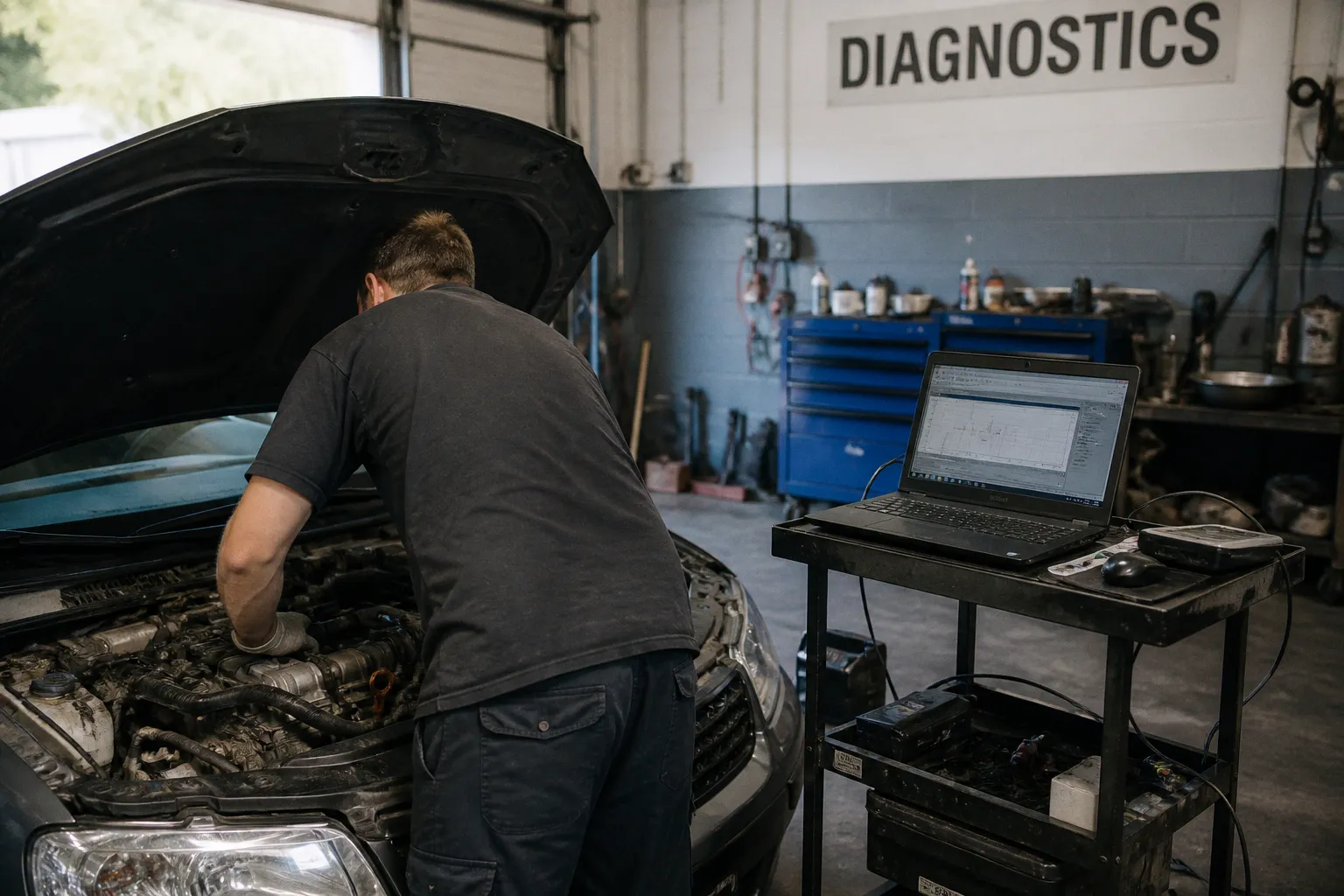
The clutch is failing to transmit it through the friction surfaces into the gearbox input shaft.
The fault is not confirmed by pedal position alone. A high biting point, burning odor, poor acceleration, or a change in engine RPM can indicate clutch wear, but each symptom has alternative causes. Confirmation requires a controlled load test and a distinction between slip, clutch drag, and hydraulic failure.
Two tests provide the primary evidence:
1. A stationary high-gear stall test.
2. A road test performed under high load.
Both tests should be brief. The clutch is not designed to be held in a prolonged slipping state for diagnosis. Excessive heat can damage the friction plate, pressure plate, and flywheel.
Stationary stall testing: the high-gear engagement method
The stationary test uses the engine’s torque against a high transmission ratio. With the vehicle held stationary and a high gear selected, a healthy clutch should transfer enough torque to stall the engine rapidly as the pedal is released.
The test is performed as follows:
1. The vehicle is placed on level ground with adequate clearance.
2. The parking brake is applied firmly.
3. The engine is started and brought to normal operating temperature if practical.
4. Third or fourth gear is selected. On some vehicles, a higher gear can be used if the transmission design permits it.
5. Engine speed is raised to approximately 2,200 rpm.
6. The clutch pedal is released slowly and in one controlled movement.
7. The result is observed immediately.
If the engine stalls promptly, the clutch is transmitting sufficient torque to overcome the selected gear load under the test conditions.
If the clutch remains engaged without stalling the engine, or if the engine speed falls slowly while the vehicle attempts to move, slip is indicated. The friction surfaces are not locking together with sufficient force.
A clutch that does not stall the engine in a controlled high-gear release is not transferring torque correctly. The RPM result is the measurement. Pedal travel is only supporting evidence.
The test must not be extended after the fault becomes apparent. If the engine continues running and the clutch is allowed to slip for several seconds, heat rises rapidly at the friction interface. The test should be terminated by depressing the clutch pedal and returning the transmission to neutral.
What the stationary test can and cannot prove
The stationary test confirms a torque-transfer problem. It does not identify the failed component with complete precision.
A slipping result can be produced by:
- A worn friction plate with insufficient remaining friction material.
- Reduced clamping force from a fatigued pressure plate.
- Oil contamination on the clutch disc.
- A damaged or overheated flywheel surface.
- Incorrect clutch adjustment on systems with an adjustable cable or linkage.
- Hydraulic system faults that prevent full clamp or produce abnormal pedal movement.
The test does not establish remaining clutch mileage. It also does not separate friction-material wear from oil contamination without inspection and disassembly.
Repeated testing has no diagnostic advantage. Once a clear failure is observed, further heat generation only increases component damage.
Road-load diagnostics: identifying RPM spikes under acceleration
A road test provides a more representative load condition. The clutch is assessed while torque is being transmitted through the drivetrain rather than while the vehicle is stationary.
A suitable procedure is:
1. The vehicle is driven at a steady speed of approximately 30–40 mph, or about 40 km/h, where traffic and road conditions permit.
2. A high gear is selected. Fourth, fifth, or sixth gear may be appropriate depending on the transmission and vehicle speed.
3. The accelerator is applied decisively, ideally on a safe, straight section of road.
4. Engine RPM and vehicle acceleration are compared.
5. The throttle is released as soon as the result is clear.
A healthy clutch produces a linked response. Engine speed rises, torque reaches the gearbox, and vehicle speed increases in the same progression.
A slipping clutch produces a discontinuity:
- RPM rises sharply.
- Vehicle speed does not increase at the same rate.
- The mismatch may disappear when throttle is reduced.
- The symptom is often stronger in a high gear or during an uphill acceleration event.
This is the core answer to the question of how to check if clutch is slipping: load the clutch in a high gear and observe whether engine speed separates from road speed.
The RPM spike is not the same as normal engine acceleration. During normal acceleration, both variables rise as a coupled system. During slip, engine speed increases first because the engine is no longer mechanically locked to the vehicle through the clutch.
Why high gears expose the fault
High gears impose a greater torque demand on the clutch at low and moderate road speeds. The engine must produce substantial torque to accelerate the vehicle, while the selected ratio provides less mechanical multiplication than a low gear.
If the clutch’s available holding force is marginal, the higher load exposes the fault. A clutch can feel acceptable during gentle acceleration in second or third gear and still slip in fourth, fifth, or sixth under full throttle.
This is not a contradiction. It is a load threshold.
If the clutch holds below the threshold, no slip will be observed. If the required transmitted torque exceeds the available friction capacity, the disc begins to rotate at a different speed from the flywheel and pressure plate. The result is the measurable RPM spike.
A road test is not a speed contest
The vehicle does not need to reach high speed. The relevant condition is high engine load in a high gear, not maximum road velocity.
Testing should be stopped if:
- RPM rises without matching acceleration.
- A strong friction odor appears.
- The clutch pedal changes position or resistance.
- Traffic conditions prevent stable observation.
- Wheel slip or traction-control intervention could confuse the result.
A road test should not be performed on a wet surface if wheel spin is possible. Tire slip also produces a rise in engine RPM without the expected increase in vehicle speed. The clutch is implicated only when the vehicle remains traction-limited by the drivetrain and the symptom is repeatable under controlled conditions.
Pedal feel, biting point, and the supporting symptoms
A clutch slip test is stronger when the dynamic result agrees with the mechanical signs. Pedal position and feel do not prove slip by themselves, but they can indicate where the investigation should continue.
The most significant pedal symptom is a high biting point. This occurs when clutch engagement is felt near the top of pedal travel rather than near the middle or lower portion. A high engagement point can indicate that the friction plate is heavily worn and approaching the end of its usable service life.
It is not conclusive on every vehicle. Adjustable clutch cables and mechanical linkages can alter the engagement position. Hydraulic systems can also change pedal behavior when air, leakage, or component wear is present.
The following pattern is more informative than any single symptom:
- High biting point.
- RPM flare during fourth- or fifth-gear acceleration.
- Reduced acceleration on an incline.
- A friction odor after load.
- No equivalent wheel-spin event.
- A stationary high-gear test that fails to stall the engine promptly.
When several of these conditions occur together, clutch slip becomes the primary diagnosis.
Slipping symptoms versus ordinary clutch behavior
A manual clutch is expected to slip briefly during takeoff and gear changes. That is its operating function. The fault exists when slip continues after the clutch should be fully engaged.
Normal behavior:
- Engine RPM rises smoothly with vehicle speed.
- No unexplained RPM flare occurs at steady throttle.
- The engagement point remains consistent.
- Acceleration does not deteriorate sharply under load.
- No persistent friction odor is produced.
Abnormal behavior:
- Engine RPM increases while the vehicle speed lags.
- The symptom is stronger at full throttle or uphill.
- Slip becomes more frequent as the clutch warms.
- Engagement occurs only near the top of pedal travel.
- The vehicle loses acceleration despite a stable engine response.
The temperature effect matters. Friction capacity can decrease as the clutch assembly heats. A marginal clutch may pass a light, cold test and slip after several load events. That does not mean the test result is inconsistent. It means the available friction margin has changed.
Distinguishing clutch slip from mechanical drag
Clutch slip and clutch drag are opposite failure modes.
Slip occurs when the clutch remains partially connected under load. Engine torque is not transmitted completely to the gearbox. RPM rises without proportional vehicle acceleration.
Drag occurs when the clutch fails to disengage fully with the pedal depressed. The disc continues to transmit rotational force to the transmission input shaft. Gear engagement becomes difficult, reverse may grind, and the vehicle can attempt to move with the pedal fully down.
The diagnostic direction is therefore different:
| Condition | Clutch state | Main observation | Primary load or test |
|---|---|---|---|
| Clutch slip | Disc cannot hold torque when engaged | RPM rises without matching vehicle speed | High-gear acceleration or stationary stall test |
| Clutch drag | Disc does not separate fully when disengaged | Gear engagement remains difficult; input shaft keeps rotating | Pedal-down engagement and spindown observation |
| Hydraulic fault | Release or clamp movement is incorrect | Poor pedal feel, low fluid, leakage, difficult shifting | Fluid and cylinder inspection |
| Wheel spin | Tire loses traction | RPM rises with reduced road contact and possible traction-control activity | Surface and tire-grip evaluation |
A clutch drag diagnosis can be supported by transmission spindown time. After the clutch pedal is depressed, the transmission gears should stop rotating within approximately 5 seconds under the stated diagnostic condition. If rotation continues beyond that point, the clutch may not be fully releasing.
The five-second figure is not a substitute for vehicle-specific service data. It is a practical limit for identifying abnormal continued rotation. Oil viscosity, temperature, transmission design, and input-shaft inertia affect the exact behavior. The result becomes significant when it is combined with gear engagement difficulty or reverse-gear noise.
Why drag can be mistaken for slip
Both faults can produce poor acceleration and difficult driving. The distinction is the position of the clutch pedal when the symptom occurs.
If the symptom appears with the pedal released and the engine under load, slip is considered.
If the symptom appears with the pedal fully depressed and a gear is selected, drag is considered.
If both symptoms are present, the clutch assembly or hydraulic release system may have more than one fault. A disc can be worn enough to slip and warped enough to drag. A release bearing, pressure plate, pilot bearing, or hydraulic cylinder can also produce combined symptoms.
The transmission should not be condemned solely because gear selection is difficult. The clutch release mechanism must be evaluated first.
Slip is a failure to hold. Drag is a failure to separate. The same pedal cannot be used as evidence for both unless its position is recorded.
Hydraulic system failures and their effect on clutch performance
Hydraulic clutch systems use a master cylinder, hydraulic fluid, a line or hose, and a slave cylinder to move the release mechanism. A defect in this chain changes clutch operation without necessarily damaging the friction plate first.
External leakage can be found around:
- The clutch master cylinder.
- The slave cylinder.
- Hydraulic line connections.
- The flexible hose.
- The area where fluid enters the bellhousing.
A low fluid level or visible leakage can produce poor pedal feel and difficulty shifting. In some systems, incomplete hydraulic movement can prevent correct clutch engagement or release. The resulting pedal position may be abnormal, and the driver may describe the condition as clutch slipping even when the friction disc is not the only fault.
The diagnostic sequence should be conditional.
If the fluid level is low
The source of fluid loss should be located before the system is refilled and bled. Fluid does not disappear as a normal operating condition. Repeated topping-up without identifying the leak leaves the fault active.
If the level is low and the clutch pedal feels soft, inconsistent, or slow to return, hydraulic operation should be treated as defective until proven otherwise.
If the master cylinder leaks
A master-cylinder leak can reduce the hydraulic stroke reaching the slave cylinder. In some cases, fluid is visible inside the vehicle near the pedal or on the firewall side of the assembly. The exact location depends on vehicle design.
If the master cylinder bypasses internally, the pedal may move without maintaining pressure. Release travel becomes insufficient. Gear engagement can become difficult. The friction plate may not fully separate.
If the slave cylinder leaks
A slave-cylinder leak reduces release travel at the transmission. External fluid may be visible near the cylinder or hydraulic connection. On internal slave-cylinder designs, leakage may collect inside the bellhousing and contaminate the clutch disc.
Oil or hydraulic fluid on the friction surface can reduce the coefficient of friction. In that condition, a clutch slip test may fail even when the friction material thickness appears acceptable. The cause cannot be confirmed from RPM behavior alone. Bellhousing inspection is required.
If the hydraulic system passes inspection
The clutch assembly should then be assessed mechanically. The high-gear stall result and the road-load RPM pattern should be compared. If both tests show slip, a worn or contaminated clutch assembly becomes more likely.
Adjustment must also be considered on vehicles equipped with a cable or mechanical linkage. A high biting point can be created or altered by adjustment. The pedal position must not be interpreted as absolute proof of disc wear.
A disciplined diagnostic sequence
The most reliable manual transmission clutch test is not a single maneuver. It is a sequence designed to exclude competing explanations.
1. Record the symptom with the pedal released.
If RPM rises under high load while vehicle speed lags, slip is suspected.
2. Check for traction loss.
If the road surface is wet or loose, repeat only under conditions where tire slip is unlikely. Traction-control activity must not be mistaken for clutch failure.
3. Inspect hydraulic fluid and visible components.
Low fluid, wet cylinder bodies, damp connections, and inconsistent pedal pressure require hydraulic diagnosis before a clutch replacement is approved.
4. Observe the engagement point.
A high biting point supports a worn-clutch diagnosis, but adjustment must be excluded where applicable.
5. Perform one controlled stationary test.
Use a high gear and approximately 2,200 rpm. A healthy clutch should stall the engine promptly as the pedal is released. Stop the test immediately if it does not.
6. Perform one controlled road-load test.
At approximately 30–40 mph, select a high gear and apply strong acceleration. A repeatable RPM spike without matching speed increase confirms torque-transfer loss.
7. Check for drag separately.
With the pedal depressed, assess gear engagement and transmission spindown. Continued rotation beyond approximately 5 seconds indicates incomplete disengagement.
8. Inspect before replacing.
If slip is confirmed, the cause may be friction wear, pressure-plate weakness, flywheel damage, or contamination. The test identifies the operating fault, not every physical source.
This order prevents a common diagnostic error: replacing the clutch based on a difficult gear change when the hydraulic system has failed, or condemning the transmission when the clutch is not releasing.
What the final repair must prove
A clutch replacement is not verified by a softer pedal or a different engagement point. The repair is verified by restored torque transfer and correct release.
After the repair, the following baseline conditions should be present:
- At approximately 2,200 rpm in a stationary high-gear test, the engine should stall promptly when the clutch is released in a controlled manner.
- At approximately 30–40 mph in fourth, fifth, or sixth gear, engine RPM should rise in step with vehicle speed under strong acceleration.
- No RPM spike should occur without corresponding acceleration.
- The clutch should engage consistently rather than only at the extreme top of pedal travel.
- Gear selection should be clean with the pedal fully depressed.
- Transmission spindown should remain within approximately 5 seconds under the applicable test condition.
- Hydraulic fluid should remain at the specified level, with no active leakage.
- No persistent friction odor should be produced after normal load.
If these parameters are met, the clutch is transmitting and releasing torque as required. If one parameter fails, the repair has not been fully verified. The next diagnostic branch is determined by the failed measurement: RPM mismatch indicates continued slip; difficult engagement and excessive spindown indicate drag; fluid loss or inconsistent pedal pressure indicates hydraulic failure.
The useful result of a clutch slip test is not a guess about mileage remaining. It is a controlled answer to a narrower question: does the clutch hold engine torque when engaged, and does it release that torque when the pedal is depressed. For a manual transmission, those are the two baseline functions. Every further repair decision should be based on which one has failed.