Should You Rebuild or Replace Your Turbocharger?
The first sign is not always a sound, and it is not necessarily a plume of smoke.
Judson Grier·Updated: August 04, 2026·19 min read
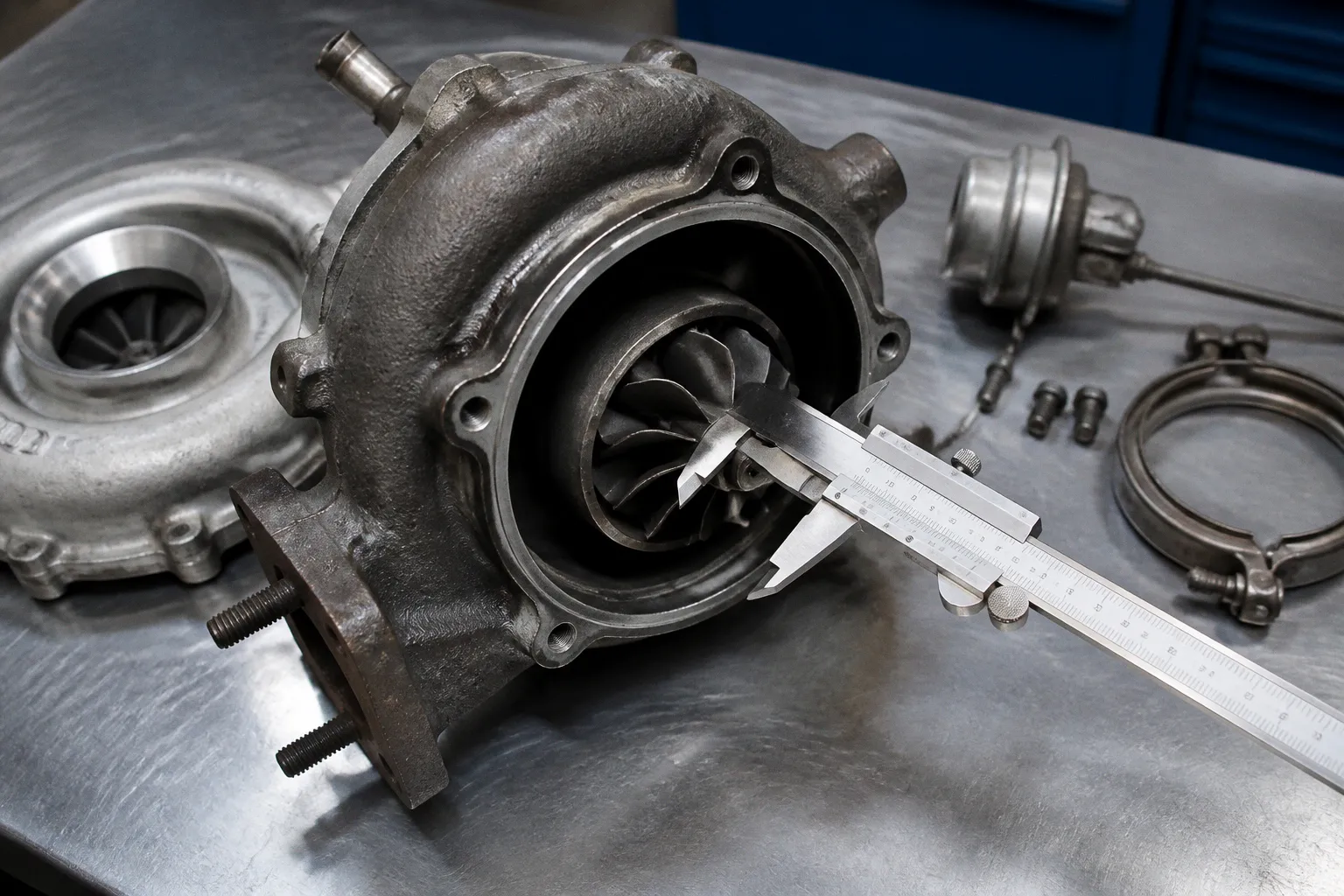
Sometimes it is a change in how the engine makes power: the car that used to pull cleanly through the upper half of the rev range now feels flat, inconsistent, or reluctant under load. Sometimes it is a new whistle, a boost-control fault, or oil consumption that has become difficult to explain.
A pale, emulsified film under the oil filler cap does not belong on the turbocharger symptom list by itself. That “chocolate milk” residue is more commonly caused by condensation from short trips or, when it is persistent and accompanied by coolant loss, possible coolant contamination. It does not identify a failed turbo seal. The turbo needs to be diagnosed through its own oil supply and drain system, compressor and turbine sides, shaft condition, boost control, and the symptoms the engine is producing as a whole.
That distinction matters because a turbocharger can be expensive to replace, but it is also easy to blame for an engine problem that started somewhere else. The real question in a turbocharger rebuild vs replacement decision is not simply whether the unit is old or noisy. It is whether the damage is limited to serviceable parts, whether the underlying cause has been corrected, and whether a professional rebuild still makes financial sense.
Reading the Symptoms Before the Wrench Comes Out
A turbocharger does not fail in one universal pattern. It can suffer from oil starvation, contaminated oil, a restricted oil drain, excessive crankcase pressure, foreign-object damage, bearing wear, actuator problems, or thermal damage to the housings. Some failures overlap in their symptoms, while others point more strongly toward a particular subsystem.
We start with what you can feel from the driver's seat, but we do not treat that first impression as a diagnosis.
A sudden loss of engine power under load is one of the more common failed turbocharger symptoms. The throttle feels lazy past a certain point, the vehicle struggles on a grade, or boost arrives late and then falls away. That can happen when the turbo is mechanically damaged, but it can also come from a split charge pipe, a leaking intercooler, a wastegate that is not moving correctly, a stuck VGT mechanism, a faulty boost-control solenoid, or an ECU strategy that has reduced boost after detecting another fault.
That is why the first inspection should include the entire air path. Look at the compressor inlet, charge pipes, intercooler connections, vacuum lines, electronic actuator wiring, and exhaust connections. A turbocharger cannot build the pressure the engine is requesting if the pressure is escaping through a hose or a cracked plastic fitting.
What different kinds of smoke can and cannot tell you
The color of the smoke is useful, but only in context.
Blue or blue-grey smoke suggests that the engine is burning oil. A turbocharger can be the source, especially when the smoke appears with a corresponding change in boost behavior, oil in the charge system beyond the light film normally found in many engines, or evidence of compressor- or turbine-side leakage. But worn piston rings, valve-guide wear, a blocked crankcase-ventilation system, and excessive crankcase pressure can produce similar results.
Smoke that appears after a long period of idling and then clears under acceleration can point in a different direction from smoke that follows sustained boost. Smoke during deceleration, smoke during startup, and smoke under heavy load each deserve their own interpretation rather than one automatic conclusion.
Black smoke generally means the engine is receiving more fuel than the available air can burn cleanly. On a diesel, that may be connected to insufficient boost, a boost leak, a control problem, restricted airflow, or fueling faults. On a gasoline engine, the diagnosis may involve mixture control, ignition, or sensor inputs as well as the turbocharger. Black smoke does not prove that a wastegate or VGT mechanism has failed.
White smoke is also not a turbocharger verdict. It can indicate coolant entering the combustion process, unburned fuel, condensation, or oil vapor under certain conditions. Persistent white smoke with coolant loss requires cooling-system and engine diagnosis before anyone condemns the turbo.
The same caution applies to the oil filler cap. A little moisture under the cap after repeated short journeys is not evidence of turbo failure. If the residue remains after the engine has been fully warmed several times, or if the cooling system is losing coolant, the investigation should move toward crankcase ventilation, head-gasket and cylinder-head concerns, and possible coolant contamination. The turbo may still need inspection, but the cap itself cannot identify the fault.
Oil consumption is a warning sign, not a verdict
The often-quoted figure of 0.5 liters per 1,000 km can be useful as a warning threshold, particularly when consumption has changed sharply. It is not a proof of turbocharger leakage. Oil use above that level may be caused by the turbo, but it can also come from piston rings, valve guides, external leaks, a faulty PCV or crankcase-ventilation system, or an engine that is operating under conditions that increase consumption.
The sensible approach is to establish how much oil the engine is actually using, confirm that the measurement is reliable, and then inspect the systems that could be responsible. Check for external leaks first. Inspect the crankcase-ventilation circuit and measure crankcase pressure where appropriate. Examine the intake tract and intercooler for oil accumulation, but remember that a light oil film can be normal on some turbocharged engines. A large quantity of pooled oil is more concerning, particularly if it is accompanied by smoke or an abnormal increase in oil use.
Oil staining on the compressor wheel or inside the compressor housing can support the case for further turbo inspection. It does not tell us, by itself, which seal or sealing path has failed. Oil may be entering through the compressor side, coming from the bearing housing, being pushed through a restricted drain, or appearing because crankcase pressure is preventing the turbo from draining correctly. On the turbine side, residue can also be difficult to interpret without examining the shaft, bearing housing, exhaust path, oil feed, and drain.
Noise and shaft movement
A healthy turbo can make a quiet hiss or a restrained whistle as airflow increases. A new siren-like noise, a metallic scrape, or a rising whine deserves attention. Still, the sound should be matched to operating conditions:
- A whistle that changes with boost may come from a boost leak, intake restriction, or compressor damage.
- A grinding or scraping sound may indicate wheel-to-housing contact, bearing wear, or foreign-object damage.
- A noise that follows engine speed but not boost may be coming from an accessory, belt, exhaust shield, or another rotating component.
- A flutter or repeated surge can be related to compressor operating conditions, control faults, or airflow restrictions rather than a single failed seal.
With the intake removed, a technician can inspect the compressor wheel and check shaft movement. A small amount of movement may be allowed in a dry journal-bearing turbo and may feel different once oil pressure is present. Excessive radial or axial movement, rough rotation, contact marks, chipped blades, and evidence of the wheel touching the housing are more serious. The inspection must be performed with the engine off and with the intake protected from contamination; a finger test is not a substitute for measuring the unit against the manufacturer's specifications.
Symptoms can tell us that the turbo system is in trouble. They rarely tell us, on their own, which component failed or whether the turbo is rebuildable.
The 60–70% Rule: When the Math Makes the Decision
Before we talk about bench work, we have to talk about arithmetic. The reason many turbocharger rebuild-versus-replacement decisions end in the same place is that a professional overhaul only makes sense when enough of the original unit is still serviceable.
A practical rule is to compare the complete rebuild cost with the price of a new or reputable remanufactured unit. If the professional rebuild approaches roughly 60% to 70% of a comparable replacement, replacement usually becomes the stronger financial choice. That is not a law of mechanics, and it is not a guarantee that the cheaper option will last. It is a way to account for labor, balancing, warranty coverage, parts availability, and the risk of discovering additional damage after teardown.
A standard turbocharger repair or rebuild may land somewhere between $300 and $800, parts and labor included, when the housings, wheels, shaft, and other major components are usable. A complete replacement can run $2,000 or more, depending on the vehicle, access, gaskets, oil lines, coolant lines, programming, and labor. An everyday import turbocharger on a 2.0-liter four-cylinder may sit somewhere in that broad range, but the vehicle and turbo design determine the actual quote.
The important word is complete. A quote that says “rebuild” but excludes the oil feed line, actuator testing, balancing, cleaning of the intercooler, or correction of the original failure is not a true comparison.
Ask the shop what the estimate includes:
- Teardown and inspection of both housings and the rotating assembly.
- Cleaning and inspection of the oil feed and drain paths.
- New bearings, seals, thrust components, and gaskets where applicable.
- Measurement of the shaft, bearing bores, and wheel-to-housing clearances.
- High-speed balancing of the rotating assembly.
- Testing or replacement of the wastegate or VGT actuator.
- A warranty that states what is covered and what caused it to become void.
- Diagnosis of the original oil-starvation, contamination, boost, or ventilation problem.
The math changes quickly when one major part is no longer serviceable. A shop may quote $1,400 for a unit that needs a new cartridge, actuator, housing work, and several hours of labor. If a remanufactured turbo is available for $1,600 with a meaningful warranty, the apparent savings have disappeared. A turbo rebuild kit versus a new turbo is not a comparison between a box of parts and a complete bolt-on unit. It is a comparison between the final, tested result of each repair path.
The 60–70% threshold is not a magic number. It is a reminder to compare finished, warranted repairs rather than the cheapest line item on two different estimates.
Structural Damage: Where Rebuilding Stops Being an Option
The housings are the bones of the turbo. The turbine housing lives next to the exhaust manifold and absorbs repeated cycles of intense heat followed by cooling. Cast iron handles sustained temperature well, but thermal cycling creates stress around the scroll, wastegate port, mounting flange, and other changes in shape or thickness. Small surface marks are not automatically fatal; an open crack in a critical area can be.
A cracked turbine housing may be repairable in some industrial or specialist contexts, but a high-temperature turbocharger application leaves little room for an uncertain repair. Welding cast iron requires the right process, preparation, filler, heat control, and post-repair inspection. Even then, the repaired housing may not restore the original geometry or durability. For a road-car turbo, a replacement housing or replacement turbo is often the safer and more economical route. A casual weld, pin, stitch, or high-temperature paste is not an acceptable substitute for a properly inspected component.
The compressor housing must also be checked for cracks, distorted mounting surfaces, damaged threads, and corrosion around connections. A housing that has only cosmetic oxidation may be reusable. A housing that has been distorted by wheel contact or has lost material at the bore may not be.
The wheels are less forgiving. A compressor or turbine wheel that has contacted its housing will show rub marks at the blade tips or shroud. It may also have bent blades, nicks from foreign-object damage, erosion, or a missing section. Once the rotating assembly has been damaged, the shaft and wheels cannot simply be cleaned and returned to service. The rotating assembly may require replacement or specialist assessment, followed by high-speed balancing.
The same applies to a scored shaft. A shaft with light marks might be measured against the manufacturer's limits, but deep scoring, overheating, wear at the bearing journals, or damage at the thrust surfaces can make the shaft unusable. In that case, the rotating assembly or cartridge may need to be replaced. It is not accurate to describe every scored shaft as a reusable cartridge.
| Damage Found at Teardown | Rebuild Viable? | What the Inspection Usually Means |
|---|---|---|
| Worn seals and bearings, with shaft and housings within specification | Often | A conventional overhaul may be possible after measurement and balancing |
| Light shaft marking within service limits | Possibly | Reuse depends on exact measurements, surface condition, and the builder's assessment |
| Deeply scored or heat-damaged shaft | Often no | The shaft or complete rotating assembly may require replacement |
| Carbon-clogged VGT vanes with usable housing and mechanism | Sometimes | Cleaning, calibration, or actuator work may restore operation |
| Cracked or distorted turbine housing | Usually no | Replacement is generally safer than an uncertain high-heat repair |
| Compressor or turbine wheel rub damage | No as-is | The damaged wheel or rotating assembly must be replaced and balanced |
| Sheared turbine blade or missing fin | No as-is | Continued use risks rapid imbalance and secondary housing damage |
| Failed electronic actuator | Depends | Test the actuator separately; replacement may change the entire repair calculation |
A turbo that has swallowed a bolt, broken air-filter material, or fragments from an upstream component needs more than a new wheel. The intake tract must be inspected for the source of the debris, and the intercooler may need cleaning or replacement. On the exhaust side, a failed turbine wheel can send material downstream into the exhaust system. Replacing the turbo without finding that source is how a second failure gets scheduled before the first repair is finished.
Why DIY Rebuilds Almost Always End Badly
We understand the temptation. A rebuild kit can contain bearings, seals, thrust parts, piston rings, and gaskets for a few hundred dollars. The photographs make the job look orderly: remove the compressor wheel, replace the bearing, install the seals, tighten everything, and put it back in the car.
The missing step is usually the one that decides whether the turbo survives.
A turbocharger's rotating assembly must be dynamically balanced using specialized equipment. The shaft, turbine wheel, compressor wheel, nut, and related components rotate at speeds that can exceed 150,000 rpm. At those speeds, an imbalance too small to feel by hand can create enough force to move the shaft, heat the bearings, damage the thrust system, and eventually send the wheel into the housing.
A careful workbench assembly with a dial indicator can identify obvious runout. It cannot replace high-speed balancing. A professional VSR or equivalent balancing machine spins the assembled cartridge at operating speed, measures vibration, and allows the builder to correct the rotating assembly before it goes back into the vehicle. That work is not an optional refinement. It is part of the repair.
The cartridge also has to be assembled with the correct clearances, orientation, torque, lubrication, and end-play. Some turbo designs use sealing arrangements that look simple but depend on precise surfaces and oil-drain conditions. Replacing a seal without checking the bearing housing, shaft journals, thrust components, and oil passages can leave the original failure untouched.
The cause of the failure matters just as much. A replacement bearing will not survive if the oil feed line is restricted. A new cartridge will not solve excessive crankcase pressure. A clean compressor wheel will not prevent another failure if the air filter is collapsing or the intake has allowed debris through. Before installation, we want to know:
1. Was the turbo starved of oil, or was the oil contaminated?
2. Is the oil feed line clean and correctly specified?
3. Is the drain unrestricted and routed without a low spot?
4. Is the crankcase-ventilation system working?
5. Is the intake free of debris and loose hose material?
6. Has the intercooler been inspected for pooled oil or fragments?
7. Are the boost-control hoses, solenoids, wastegate, or actuator functioning?
8. Has the engine's oil and filter been replaced with the correct specification?
VGT and VNT mechanisms need their own caution
Variable geometry systems use adjustable vanes and a control mechanism to change exhaust flow through the turbine. Depending on the application, the mechanism may be operated by vacuum, an electronic actuator, or a combination of mechanical and electronic control. The clearances are small, carbon can restrict movement, and the actuator may need calibration after installation.
A vane mechanism that is out of position can cause underboost, overboost, slow response, or intermittent limp mode. It may contribute to surge on some systems, but the exact behavior depends on the turbo, engine calibration, actuator strategy, and operating conditions. It is not accurate to promise one universal sequence in which a misindexed vane always causes surge, timing reduction, and a cylinder-like misfire.
The correct repair is component-specific. The vanes, unison ring, lever, stops, and actuator need to be inspected for free movement and correct indexing. On electronically controlled systems, the actuator may require a sweep test, position verification, or adaptation procedure with a scan tool. If the actuator is healthy but the vane ring is carbon-bound, cleaning may be possible. If the housing is worn, distorted, or cracked, cleaning will not make it serviceable.
Dynamic balancing is not optional, and neither is correcting the reason the first turbo failed. A new cartridge installed into a sick oil or air system is only a delayed repeat failure.
Variable Geometry and Performance Systems: The Price Floor Moves Up
Once we leave the world of a basic fixed-geometry turbocharger, the financial calculation changes. VGT and VNT units use adjustable vanes to alter the effective exhaust flow across the rpm range. They offer better response and broader operating efficiency, but they add a mechanism, an actuator, calibration requirements, and more opportunities for wear.
A VGT rebuild may cost around $2,500 when parts are available and the actuator is healthy. A new VGT unit can run from $4,500 to $7,500, depending on the application and the amount of labor required. Those figures are not interchangeable quotes: one shop may be pricing a cartridge and calibration, while another is quoting a complete assembly with an actuator, gaskets, oil lines, and warranty.
The actuator deserves separate attention. Electronic actuators can fail through corroded position sensors, burned motor windings, stripped gears, or water intrusion. A vacuum actuator may suffer from a split diaphragm, a leaking hose, or a control fault elsewhere in the system. If the actuator is marginal, the rebuild estimate should include testing and possible replacement. Otherwise, the vehicle may leave the shop with a mechanically renewed turbo that still cannot control boost.
Twin-turbo systems make the decision more complicated again. BMW, Mercedes-Benz, Audi, and other manufacturers use different arrangements, including parallel and staged systems. One turbo may provide low-speed response while another contributes at higher engine speed, or both may work together across the range. A complete twin-turbo repair can involve two cartridges, two actuators, shared oil and coolant plumbing, heat shields, exhaust connections, and difficult access.
A complete twin-turbo replacement can reach up to $6,000 in parts and labor. A rebuild that includes both cartridges and both control systems may approach the same territory. Replacing only the visibly failed turbo may be reasonable in some applications, but not when the second unit has similar mileage, shared contamination, or evidence that the original failure affected both sides. The correct choice depends on inspection and the manufacturer's service strategy, not on the assumption that two turbos must always be replaced as a pair.
| System Type | Typical Rebuild Range | Typical Replacement Range | Main Decision Lever |
|---|---|---|---|
| Standard fixed-geometry | $300–$800 | $2,000+ | Condition of the cartridge, housing, and wheel |
| VGT / VNT diesel or gasoline application | Around $2,500 | $4,500–$7,500 | Actuator condition, calibration, and parts availability |
| Twin-turbo system | $3,500–$5,000 | Up to $6,000 | Shared wear, access, and whether both units need work |
| Modified performance turbo | Highly variable | Highly variable | Build quality, balancing, compatibility, and warranty |
Performance turbos need an additional layer of skepticism. A larger compressor wheel, upgraded center cartridge, hybrid housing, or altered wastegate can change the airflow range and control requirements. A rebuilt turbo may be mechanically sound but poorly matched to the engine calibration. Conversely, a new unit may still fail if the oil system, fuel system, or boost control has not been prepared for the modification.
The cheapest import car turbo replacement cost is rarely the full cost of a reliable repair. Include installation hardware, oil and coolant service, cleaning of the intercooler and intake, actuator setup, diagnostic time, and the possibility of replacing a contaminated oil feed line. A warranty is valuable only if the installer follows its requirements and the original cause of failure has been corrected.
Closing the Loop: Long-Term Wear and the Decision You'll Live With
A turbocharger, when it is healthy, is one of the more durable systems in an import powertrain. Factory units can run for the life of an engine when they receive clean oil, unrestricted oil flow, clean intake air, sound boost plumbing, and sensible operating conditions. When one fails, the visible damage is often only the final stage of a problem that began somewhere else.
We lean toward rebuilding when the damage is contained to serviceable components: the housings are intact, the wheels are undamaged, the shaft and bearing surfaces can meet specification, and the actuator or wastegate is known to be healthy. Even then, the work belongs with a specialist who can measure the parts and dynamically balance the finished rotating assembly.
We lean toward replacement when the turbine housing is cracked, a compressor or turbine wheel has suffered contact damage, the shaft is deeply scored or heat-damaged, the actuator is unreliable, or the complete rebuild quote is approaching the price of a warranted replacement. A turbo rebuild kit is not a shortcut around damaged hard parts. If the cartridge or rotating assembly needs replacement, the kit is only one small part of the estimate.
Before the vehicle leaves the shop, the original failure must be addressed. Replace contaminated oil and the filter. Verify the oil feed and drain. Check crankcase ventilation. Inspect the air filter, intake, charge pipes, and intercooler. Test the wastegate or VGT control. Confirm that the engine is not consuming oil for a reason unrelated to the turbo. On a diesel or a modified gasoline engine, verify that the control system is commanding and measuring boost correctly.
The blue smoke, the whistle, or the sudden loss of power is an invitation to investigate, not a license to name the failed seal from the driver's seat. Take the symptoms seriously, compare the complete repair costs, and let the teardown determine whether the turbo is a rebuild candidate. When the wheels, shaft, housings, and control system have been properly assessed, the choice between rebuilding and replacing becomes much less mysterious—and considerably less expensive than guessing.