How many lumens does a mechanic work light need?
A mechanic leaning over an open hood on a dim Saturday afternoon will, more often than not, solve the lighting problem by purchasing whatever handheld LED is brightest on the shelf.
Merritt Vane·Updated: August 13, 2026·7 min read
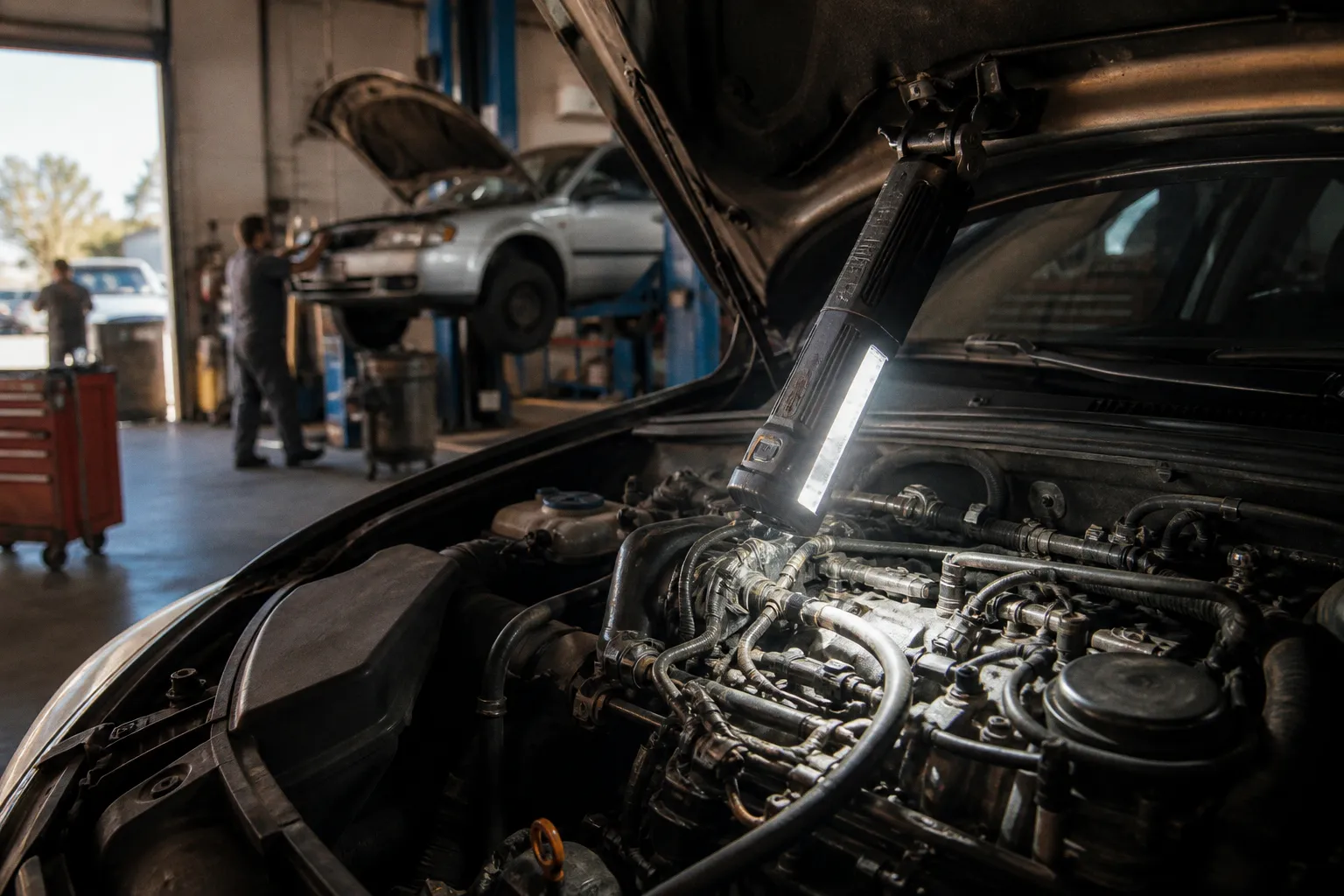
The result is predictable: a beam so aggressive it bleaches the silver traces on aluminum back into featureless white, while the actual fault — a hairline crack in a coolant reservoir, a faint electrolyte residue on a battery terminal — remains invisible because the eye, overwhelmed by glare, can no longer discriminate fine contrast. Lumen count, treated as the sole metric of usefulness, is one of the most persistent misconceptions in the garage. The honest answer to the question of how many lumens a mechanic work light needs is not a single number; it is a calibrated range dictated by the photometry of the task and the geometry of the surfaces being inspected.
A brighter lamp does not yield a better view; it yields a brighter view — and the two are not the same thing.
The Physics of Visibility: Why More Lumens Isn't Always Better
Luminous flux, measured in lumens, describes the total quantity of visible light a source emits in all directions; it says nothing about how that light is distributed, what wavelengths dominate its spectrum, or how the human visual system will respond to it at the working distance. Two lamps rated at 2,000 lumens can produce radically different working conditions depending on their beam angle, color temperature, and color rendering index. This is the same principle by which a cloudy 5,000-lumen overcast sky offers far better task visibility than a 5,000-lumen bare bulb mounted three feet from the workpiece — diffuse, broadband illumination resolves contrast; concentrated, narrow-band illumination crushes it.
For the mechanic, the practical consequence is straightforward: at the typical working distances encountered in a garage — between 15 centimeters for close inspection and roughly two meters for general bay lighting — the eye's pupil adapts to the ambient luminance and stops gathering additional photons long before the lamp's rated output has been fully exploited. Excess lumens beyond this adaptation threshold register as disability glare rather than as improved detail recognition; they raise the overall scene luminance without contributing to the contrast signal the visual cortex actually needs to distinguish, say, a corroded ground strap from a clean one. The optimum, then, is a function of task geometry, not of marketing literature.
Underhood Illumination: Balancing Flood Coverage and Glare
The engine bay presents a particular photometric challenge: a concave cavity lined with reflective cast aluminum, polished brackets, and dark plastic housings, into which the mechanic must project light at a steep angle from below. A lamp with a wide flood pattern and a luminous flux in the typical range of 800 to 1,800 lumens — a deliberately modest figure compared with the 5,000-lumen tripod lights favored by enthusiasts — generally outperforms a brighter but narrower source, because the broad flood fills the cavity uniformly and limits the formation of the sharp shadows that obscure fasteners recessed behind pulleys and brackets.
Color temperature matters here more than raw output. A neutral-white source in the 4,000 to 5,000 K range renders the subtle yellow-brown of oxidized copper and the chalky white of corroded aluminum with sufficient fidelity to be diagnostically useful; a cool-blue 6,500 K source, while visually striking, compresses these distinctions into a narrower band of the visible spectrum and makes early-stage corrosion harder to read. Color rendering index, often abbreviated CRI and ideally above 80 for mechanical work, governs how accurately the lamp reproduces the spectral fingerprint of these surface contaminants — a property entirely independent of lumen count, and routinely sacrificed by manufacturers chasing higher output figures on the spec sheet.
| Application | Typical lumen range | Preferred color temperature | Beam character |
|---|---|---|---|
| Underhood (corded bar/underhood light) | 800–1,800 lm | 4,000–5,000 K | Wide flood, low glare |
| Undercar (creeper/standing light) | 1,200–3,000 lm | 5,000–6,000 K | Asymmetric flood, angled upward |
| Focused inspection (handheld, close range) | 200–500 lm | 4,500–5,500 K | Tight spot or adjustable focus |
| General bay/ambient | 3,000–6,000+ lm | 5,000 K | Diffuse, broad coverage |
Precision Diagnostics: Lumen Requirements for Focused Inspection
When the task shifts from gross assembly to close inspection — reading a stamped part number through a smear of oil, tracing a vacuum line for a hairline crack, evaluating the color of brake dust to gauge pad wear — the relevant metric is no longer scene luminance but task luminance at the specific working distance. A handheld inspection light delivering 200 to 500 lumens, properly focused and held 10 to 20 centimeters from the subject, routinely outperforms a 2,000-lumen flood light for these tasks because the eye can resolve fine contrast at high local luminance without the pupillary constriction that suppresses detail perception under flood conditions.
The same logic governs work on electrical connectors and printed circuit boards in modern import vehicles, where identifying a single discolored pin among twenty requires the lamp to deliver a narrow, high-CRI beam rather than a broad wash. In these contexts, beam angle and spectral fidelity dominate the lumen figure; an overpowered lamp simply washes the diagnostic signal into the background.
Undercar Work: Managing Shadows and High-Contrast Environments
Working beneath a vehicle on a creeper introduces an inverted geometry: the mechanic looks upward into a cavity where the oil pan, exhaust shielding, and subframe members conspire to create hard-edged shadows that shift with every movement of the head. A flat-flood work light placed beside the vehicle, delivering roughly 1,200 to 3,000 lumens across an asymmetric beam, allows the mechanic to illuminate the broader undercarriage without producing the hot spots and reflective glare that a direct upward-aimed source would generate on polished exhaust components.
The high-contrast environment under a car — dark structural steel against brighter aluminum, wet road film against dry metal — punishes lamps with poor spectral rendering. A source with a CRI below roughly 70 flattens these differences and makes it more difficult to distinguish, for instance, fresh oil seepage from the residual staining of an older leak. Lumen output is necessary but not sufficient; without reasonable color fidelity, the mechanic ends up with a brightly lit but diagnostically mute scene.
Undercarriage work is solved not by brighter lamps but by lamps positioned to fill the cavity rather than strike it directly.
Color Rendering Index and Beam Spread: The Hidden Factors of Garage Lighting
Two specifications separate a usable mechanic light from a merely bright one, and neither appears in the headline lumen figure. The first, color rendering index, quantifies how faithfully the lamp reproduces the full visible spectrum relative to a reference source; values of 80 or above are typically sufficient for mechanical diagnosis, while values below 70 begin to suppress the chromatic cues a mechanic relies on to read surface condition. The second, beam spread, determines how the emitted flux is distributed across the working area; a 120-degree flood and a 30-degree spot delivering identical lumens produce entirely different diagnostic environments.
For a well-equipped garage serving European and Asian imports, a layered approach generally works better than a single high-output fixture: a diffuse 5,000 K overhead source in the 3,000 to 6,000 lumen range for ambient visibility, supplemented by task-specific fixtures calibrated to each application. A 1,000 to 1,800 lumen underhood bar with high CRI handles engine-bay diagnosis; a 1,500 to 3,000 lumen asymmetric undercar light handles creeper work; a 300 to 500 lumen high-CRI handheld covers focused inspection. The aggregate output is substantial, yet no single source is overdriven into the glare regime where it ceases to serve the eye.
The practical takeaway, then, is to stop shopping by lumen count alone. Identify the working distance, the beam geometry, and the chromatic demands of each task; match the lamp to those constraints; and treat the lumen figure as a rough budget rather than a verdict. Done correctly, a garage lit by three well-chosen fixtures outperforms one relying on a single 10,000-lumen brute — and the mechanic's eyes, spared the cumulative fatigue of unnecessary glare, will still be sharp enough to catch the next intermittent fault long after the lamp has done its job.