Is a dropped clay bar safe to reuse on car paint?
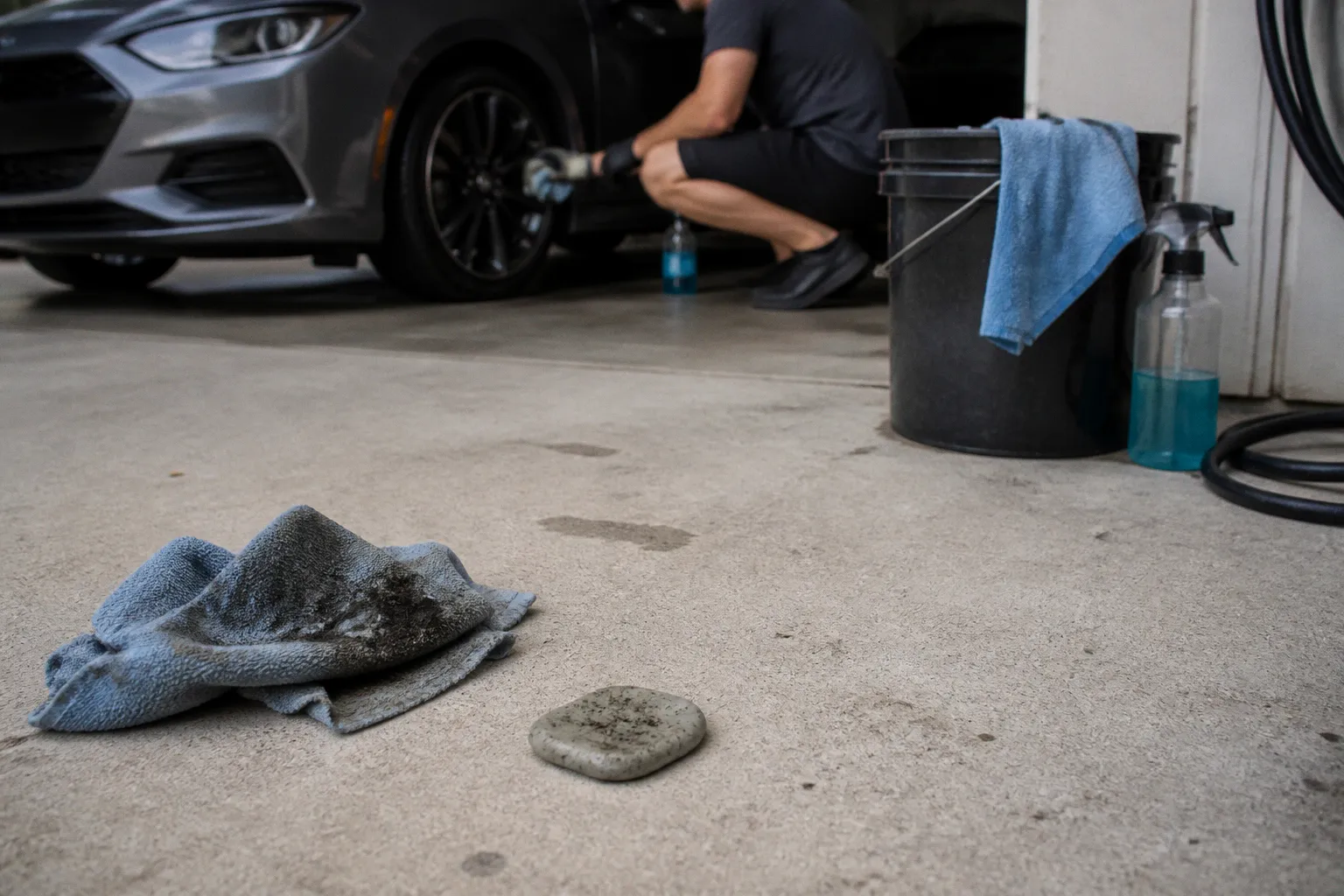
When a traditional detailing clay bar falls onto a garage floor, driveway, or shop surface, the question is not whether the tool is dirty; it is whether the contamination can be undone.
Merritt Vane·Updated: August 18, 2026·9 min read
The Chemistry of a Compromised Tool
The answer, from a materials standpoint, is essentially no — and understanding why requires looking past the visible surface of the bar into the polymer matrix beneath.
The misconception that a dropped bar can be salvaged by rinsing, spraying, or kneading is one of the more persistent chemical errors in consumer detailing. It persists because the contamination is invisible, the tool still looks usable, and the instinct to recover a moderately expensive product is strong. None of these reasons alter what has actually occurred at the material level.
The Physics of Embedded Contamination: Why Clay Traps Grit
A detailing clay bar is not an absorbent sponge. It is an engineered elastomer — typically a synthetic resin such as polybutadiene, formulated to be mildly tacky so that it can shear bonded contaminants out of automotive clear coat. That same tackiness, which makes the bar effective on paint, is precisely what makes it dangerous after a drop. When the polymer meets a hard surface such as concrete, asphalt, or tile, grit, sand, mineral dust, and metal particles press into the elastomer under the bar's own weight and become mechanically trapped inside its volume.
The contamination is not superficial. Once a particle of quartz, silicon carbide, garnet, or iron oxide has been pushed even a fraction of a millimeter into the polymer, the elastic resin closes around it as the bar flexes; the particle becomes a permanent inclusion until the clay is either physically cut open or discarded. A rinse cycle cannot reach what water cannot penetrate, and the polymer is hydrophobic by design — water beads off the working surface rather than entering the matrix.
This is why the professional rule — "If clay touches the ground, it goes in the trash" — is not marketing caution. It is a direct consequence of how the material behaves. A dropped bar has effectively been converted into a very fine abrasive; the grit is simply hidden inside the polymer instead of bonded to a paper backing.
A dropped clay bar is contaminated through its working volume, not across its surface; no rinse cycle can reach what water cannot enter.
The Myth of Cleaning: Why Rinsing and Kneading Fail
The instinct to rinse a dropped bar under a tap, spray it with detail spray, or knead it between the palms is understandable, and each of these methods produces a visually reassuring result. The bar emerges looking clean. None of them, however, restore it to a paint-safe state.
Kneading is the most deceptive of the three. The grey smear of embedded grit that appears during working looks like contamination being expelled; in practice, it is contamination being redistributed. The abrasive particles move from one region of the polymer to another, and the bar returns to the user's hand looking uniform and ready for use. The grit is still inside. The next pass over paint will press those particles against the clear coat under load, where they will produce fine swirl marks — or, with harder minerals, measurable linear scratches.
Rinsing fails for a structural reason: the elastomer does not absorb water, and any particle embedded below the working face is physically inaccessible to the rinse stream. A microfiber wipe with lubricant achieves the same cosmetic effect without addressing the internal contamination.
There is one operation that genuinely does reduce the load: physically cutting away the outer layer of the bar with a clean blade. Slicing off the contaminated surface exposes fresh polymer beneath, and the trimmed portion can be discarded. For a 200-gram bar, this typically means losing most of the piece — which brings the user back to the original question of whether the savings justify the risk of working with the remainder.
Professional Detailing Standards for Surface Safety
Professional detailers operate under a stricter standard than most DIY owners, and for a defensible reason: their work is judged under inspection lighting where a single deep scratch across a hood becomes a warranty issue. Industry practice treats any clay bar that has contacted a non-paint surface as retired from clear coat work, whether the contact was a brief tap on a shop floor or a full drop from hand height.
The standard is calibrated to the substrate rather than to the tool. Clear coat — typically a 40 to 60 micron acrylic or polyurethane layer over the basecoat — is harder than the polymer of a clay bar but softer than many of the minerals commonly found on a garage floor. A single pass of contaminated clay can therefore cut into the clear coat at a depth the eye does not immediately register but that is plainly visible under direct sunlight or a swirl-finding lamp.
The most useful comparison for a home detailer is medical rather than mechanical. A clay bar that has touched a non-sterile surface is treated the way a surgical instrument would be: the object is not visibly dirty, it is functionally compromised, and the cost of continuing to use it is borne by the substrate — not the tool. The substrate is the more expensive of the two, and the calculation should be made on those terms.
Strategic Prevention: Cutting Clay Bars to Minimize Waste
Because the discard rule is so absolute, experienced detailers preempt the problem by working with smaller pieces. A standard 200-gram clay bar is typically divided into quarters before the first session; each quarter is sufficient to decontaminate a passenger vehicle's horizontal surfaces and small enough to hold securely in the palm.
The strategy is risk management rather than chemical economy. Working with smaller pieces reduces the weight and leverage available to pull the bar from a soapy grip, and it limits the consequence of any single accident. A full 200-gram bar that slips from the hand is a total loss. A 50-gram working piece that drops is a 25% loss. The arithmetic, for anyone who details their own vehicle regularly, favors the smaller working size — particularly because smaller pieces conform to the hand more readily and are less likely to be dropped in the first place.
The first and last minutes of a detailing session are when most drops occur: when the bar is first unwrapped and pressed into service, and when the user is reaching across a panel to bag the used clay for disposal. Cutting the bar into quarters, lubricating the panel generously, and storing the working pieces in an airtight container with a light mist of detail spray between uses are the three habits that bring drop rates close to zero over time.
Repurposing Dropped Tools: When to Downgrade Instead of Discarding
The "trash" rule applies strictly to clear coat. It does not apply to every surface on the vehicle. A dropped traditional clay bar — one that has absorbed grit and would scar paint — can often be downgraded to less critical surfaces where minor scratching is acceptable or invisible.
Glass is the most common destination. Automotive glass is significantly harder than clear coat and tolerates embedded abrasives that would mark paint; the same mild cutting action that would produce swirls on a hood simply polishes a windshield. The same logic applies to alloy wheels, particularly painted or clear-coated faces, with the caveat that polished or chrome finishes should be avoided. Interior hard plastics, under-hood components, and exhaust tips round out the list of downgraded surfaces where clay can still deliver cleaning value without producing visible defects.
Synthetic clay tools behave differently. Clay mitts and synthetic clay towels carry a polymer layer bonded to a microfiber backing; when dropped, the contamination is concentrated on the working face rather than distributed through a volume. In some cases, an aggressive rinse under running water and a visual inspection under a bright lamp can reduce the surface load enough to make the tool usable on glass or wheels. Even with synthetic media, the conservative practice is to retire the tool from paint work and downgrade it — the bonded polymer layer cannot be sectioned and inspected the way a traditional bar can, and the cost of a replacement mitt is modest compared to the cost of compounding out scratches from a contaminated pass.
| Tool type | Drop behavior | Safe disposal path |
|---|---|---|
| Traditional clay bar (full) | Embedded grit throughout polymer; cannot be rinsed | Discard entirely, or downgrade to glass, wheels, exhaust tips |
| Traditional clay bar (cut quarter) | Same contamination profile as full bar | Discard only the dropped piece; remaining quarters unaffected |
| Clay mitt (synthetic) | Surface contamination on polymer face | Rinse, inspect, downgrade to glass or wheels |
| Clay towel (synthetic) | Same as mitt; bonded polymer layer | Rinse, inspect under bright light, downgrade to non-paint surfaces |
The principle is identical across all four categories: a dropped tool is a compromised tool for paint work, and the only safe response is to remove it from paint duty. The decision is not whether to discard but where the tool may still be used.
The Safe Practice Going Forward
Clay decontamination is unusual among detailing operations in that the consequence of a single mistake is permanent. A polish can correct most swirl marks; a compound can address deeper scratches; but the clear coat removed by either cannot be replaced. Every pass of contaminated clay is a pass that thins the protective layer that the rest of the routine — the sealant, the wax, the ceramic coating — presumes is intact.
The discipline that follows from this is conservative. Keep the bar in its wrapper between uses. Store working pieces in an airtight container with a light mist of detail spray to prevent the polymer from drying out and fragmenting. Divide larger bars into working quarters before the first session. If a drop occurs — and at some point over years of detailing, a drop will occur — the bar goes to glass or wheels, and a fresh piece is unwrapped for paint.
The cost of a replacement bar is lower than the cost of correcting a hood. The discipline of replacement is the only discipline that guarantees the clear coat remains at the standard the rest of the detailing routine assumes it has.
The clear coat is the substrate every other detailing step presumes is intact; a single pass of contaminated clay compromises the foundation, not the finish.