Ceramic coatings: how they chemically bond to paint
A water contact angle of 100°–115° is not produced by wax-like surface coverage alone. It is the visible result of a chemical and structural change at the paint surface.
Aldous Moorland·Updated: August 19, 2026·15 min read
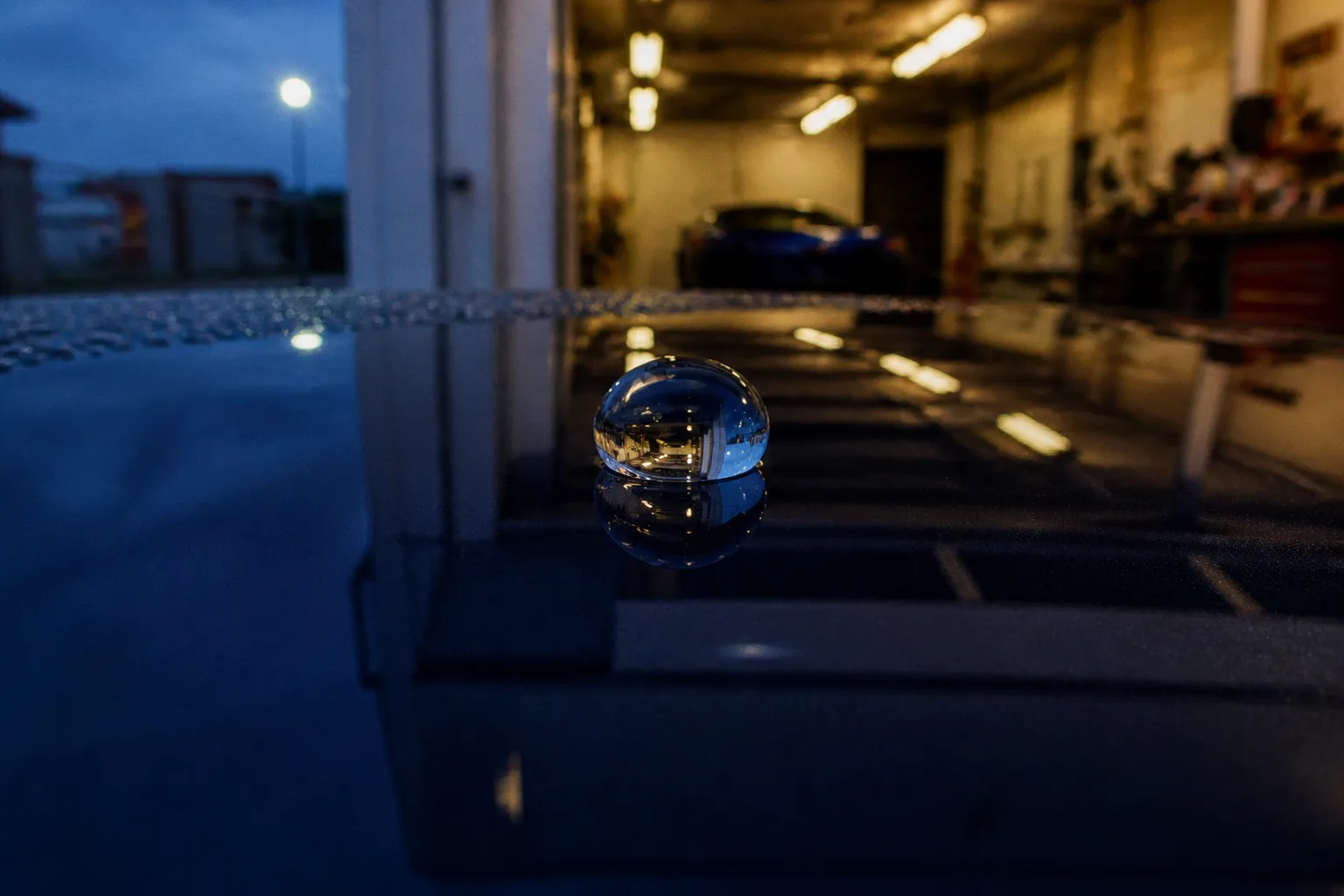
In a ceramic coating bonding process, silicon dioxide nanoparticles, polydimethylsiloxane resin, solvent carriers, and silane coupling additives are arranged into a cross-linked film that attaches to the clear coat through covalent Si–O–Si bonds.
The cured layer is thin. Typically 1–3 microns. It is not a second sheet of glass placed on top of the vehicle. It is a semi-permanent polymer-silica matrix fused to the upper chemistry of the clear coat. That distinction determines how the coating behaves during washing, curing, chemical exposure, and removal.
The molecular architecture: SiO₂, PDMS, and the carrier solvent
A modern ceramic coating is a reactive liquid formulation. The bottle does not contain a finished glass film. It contains the chemical components required to create one after application.
The principal active material is silicon dioxide, or SiO₂, commonly supplied in nanoparticle form. These particles contribute the inorganic component of the cured matrix. The formulation also contains polydimethylsiloxane, or PDMS, a silicon-based resin that provides film formation and flexibility during the transition from liquid to solid.
The resin is carried in solvents. This is necessary because the coating must be spread into a continuous film before the cross-linking reaction advances too far. Once the liquid has been levelled across the paint, the carrier solvents begin to leave the film. The remaining reactive materials become concentrated at the interface and throughout the coating layer.
The functional components can be separated by role:
| Component | Function in the coating | Relevance to bonding |
|---|---|---|
| SiO₂ nanoparticles | Provide the inorganic silica phase | Participate in the glass-like cross-linked matrix |
| PDMS resin | Forms the silicon-based polymer structure | Helps create the continuous cured film |
| Silane coupling additives | Carry reactive silane functional groups | Enable adhesion and Si–O–Si molecular linkages |
| Solvent carriers | Keep the product spreadable during application | Evaporate as the film sets and cures |
| Clear-coat hydroxyl groups | Reactive sites on the paint surface | Participate in the interfacial cross-linking reaction |
The formulation is therefore not equivalent to carnauba wax or a conventional sealant. A wax can form a layer that is later softened, dissolved, or removed by chemical action. A cured ceramic coating is produced by a reaction at the clear-coat interface.
The word ceramic also requires control. The cured material has a silica-rich, glass-like character, but it is not a thick ceramic panel. At 1–3 microns, the coating remains a thin hybrid layer. Its mechanical performance is governed by the chemistry of the formulation, the condition of the clear coat, the quality of the cure, and the thickness of the deposited film.
The label may state a 9H hardness rating. That rating refers to the pencil hardness test scale. It does not refer to the Mohs mineral hardness scale. It also does not mean that the paint becomes immune to scratches, stone impacts, or abrasive contact.
The coating does not merely sit on the paint. After curing, part of the coating is chemically integrated with the clear-coat surface.
The covalent bonding mechanism: how ceramic coating bonds to paint
The relevant surface is the clear coat, not the metal panel beneath it. The clear coat contains chemical groups capable of participating in the coating reaction. Among them are hydroxyl groups, written as –OH.
The ceramic coating contains silane coupling additives. These compounds include silane functional groups represented as –Si–O–R. The exact catalyst percentages and solvent ratios vary by manufacturer and are not generally disclosed. The reaction sequence, however, can be described without proprietary formulation data.
Stage one: wetting and surface contact
The liquid coating must first make continuous contact with the clear coat. Any residue between the two surfaces becomes an interruption in the reaction zone.
The relevant contaminants include:
- residual polishing oils that occupy the paint surface;
- detergent or alkaline cleaner residue;
- traffic film and embedded mineral deposits;
- moisture trapped in the clear coat or on the panel;
- dust and particles that create local gaps in the film.
The coating can only react where its silane-bearing components reach the clear-coat chemistry. A visually clean panel is not automatically a chemically prepared panel. Surface preparation exists to remove barriers between the reactive liquid and the hydroxyl-bearing clear coat.
If contamination remains, the defect is not necessarily visible as a dramatic failure. It may appear as incomplete levelling, irregular water behaviour, weak local adhesion, or premature breakdown in isolated zones. The failure is spatial. The coating is not uniformly attached because the interface was not uniformly available.
Stage two: hydrolysis and activation of silane groups
Silane coupling additives contain bonds that can be converted into reactive silanol species under the appropriate conditions. These activated groups can interact with hydroxyl groups on the paint surface.
The chemistry is commonly represented in simplified form:
Paint surface –OH + coating silanol → Paint surface –O–Si–
This notation is not a complete formulation equation. It identifies the important interfacial event: the coating’s silicon-containing chemistry forms a covalent connection with oxygen-bearing groups at the clear-coat surface.
The reaction is not a mechanical hook. It is not the same as a wax filling microscopic irregularities. The adhesion comes from molecular-level bonding between the coating and the upper chemistry of the paint.
Stage three: cross-linking inside the coating
Bonding does not stop at the paint interface. Reactive groups also connect with one another within the coating.
The resulting structure contains Si–O–Si linkages. These bonds connect silicon-containing units into a three-dimensional network. The PDMS resin contributes to the continuous polymer structure, while the silica phase contributes to the inorganic, glass-like character of the cured film.
A simplified representation is:
Coating –Si–OH + HO–Si–coating → coating –Si–O–Si–coating + water
The actual reaction pathway depends on the formulation, environmental conditions, and catalyst system. The simplified equation is useful because it shows the logic: reactive silanol groups condense and create siloxane bridges.
The final matrix is therefore made of two connected regions:
1. an interfacial zone where the coating bonds to the clear coat;
2. a bulk coating network where silicon-containing molecules cross-link with one another.
The first region provides attachment. The second gives the film its continuity and resistance. A product with a chemically strong bulk network but poor interface preparation can still fail. The reverse is also true: a well-prepared interface cannot compensate for incomplete curing of the film above it.
If–then logic of adhesion
The bonding process can be reduced to several diagnostic conditions:
- If the clear coat is contaminated, then the reactive groups encounter a barrier and local bonding becomes inconsistent.
- If the surface is properly prepared and the liquid contacts the clear coat continuously, then silane groups can react at the interface.
- If the coating remains undisturbed while the network develops, then cross-linking proceeds through the film.
- If the film is exposed to damaging conditions before sufficient cure, then its final resistance may be reduced.
- If the cured film is later removed, then physical abrasion is required because chemical washing does not reverse the covalent network.
This is the ceramic coating curing chemical reaction in practical terms. The process is not complete when the surface appears dry.
Surface energy and the physics of water behaviour
Hydrophobicity is often described visually. Water forms beads. Dirt releases more easily. Rinsing becomes faster. These observations are real, but the governing property is surface energy.
An untreated clear coat typically produces water contact angles in the range of 70°–90°. A cured ceramic coating can produce contact angles between 100° and 115°. The larger angle indicates lower surface energy and reduced wetting. Water contacts less of the surface and forms a more compact droplet.
The sequence is straightforward:
1. Silica and silicon-based resin form the cured surface.
2. Cross-linking changes the chemical character of that surface.
3. Surface energy is reduced.
4. Water spreads less readily.
5. Droplets become more rounded and easier to move with gravity or airflow.
The contact angle does not measure coating thickness. It does not directly measure scratch resistance. It does not prove that the entire panel has bonded uniformly. It measures the geometry of a water droplet at the surface.
A high contact angle can also be affected by contamination. Road film, detergent residue, mineral deposits, and maintenance products can alter water behaviour without changing the underlying coating chemistry. A panel may lose clean beading while the bonded layer remains present. Conversely, strong beading in one area does not prove that the coating thickness and adhesion are uniform across the entire vehicle.
This distinction matters during maintenance. Hydrophobic behaviour is a surface signal, not a complete condition report.
Why low surface energy changes washing behaviour
When water wets a surface less aggressively, less liquid remains as a continuous film. Dirt particles can also have less intimate contact with the paint, particularly when the contamination is loosely attached and the washing process supplies sufficient lubrication.
The coating does not make contamination impossible. It does not eliminate abrasion. A dry towel dragged across a dirty panel can still create defects in the clear coat and in the coating layer. The reduction in surface energy changes the release behaviour of contamination; it does not remove the need for controlled washing.
The same limitation applies to chemical resistance. A cured coating is resistant to normal exposure within the limits of its formulation and cure. It is not chemically indestructible. Exact resistance depends on the product chemistry, the contaminant, concentration, contact time, temperature, and the condition of the film. No proprietary catalyst ratio or solvent composition can be inferred from the presence of SiO₂ alone.
Hydrophobicity is a measurable consequence of lower surface energy. It is not a certificate of perfect adhesion or permanent protection.
The curing timeline: from liquid film to molecular hardness
Curing occurs in phases. The first phase is visible. The later phase is molecular.
Initial surface curing takes approximately 24–48 hours. During this period, the film develops enough structure to become set at the surface. That does not mean the coating has reached maximum hardness or chemical resistance.
Full molecular cross-linking requires approximately 2–3 weeks. During this period, the internal network continues to develop. The silane-derived bonds and the silicon-based matrix become more complete, increasing the final hardness and resistance of the cured layer.
The timeline can be expressed as follows:
| Cure stage | Approximate duration | What changes |
|---|---|---|
| Liquid application | During installation | The coating is spread across the prepared clear coat |
| Initial surface cure | 24–48 hours | The outer film sets and becomes less vulnerable to disturbance |
| Continued cross-linking | After the first 48 hours | Molecular connections continue through the coating matrix |
| Full cure | 2–3 weeks | Maximum hardness and chemical resistance are approached |
The interval between surface set and full cure is not an administrative detail. It is the period in which the coating is most likely to be affected by unsuitable exposure.
If the film is disturbed before the initial cure is complete, surface texture or local distribution can be altered. If the vehicle is exposed to harsh contamination before the network reaches full cross-linking, the film may not develop its intended resistance. Exact environmental limits differ by product. The chemical principle remains constant: the coating is not at its final state immediately after application.
The curing process also explains why appearance alone is an unreliable indicator. A surface can look clear and uniform while the internal network is still developing. Visual transparency is not equivalent to maximum molecular hardness.
The role of the clear coat during cure
The paint is not an inert platform. Its surface chemistry determines which reactive sites are available. Clear coats differ in composition, age, oxidation state, prior polishing history, and contamination load. These variables affect the interface.
A coating cannot create new clear-coat thickness. It cannot restore paint that has already been removed by excessive abrasion. It cannot convert an unstable or failing clear coat into a sound substrate. The coating reaction takes place at the surface that exists.
Preparation therefore has two separate purposes:
- the surface must be clean enough for chemical contact;
- the clear coat must be stable enough to serve as the substrate.
These are different conditions. A chemically clean panel with failing clear coat remains a poor base. A structurally sound panel covered with polishing residue is also unsuitable until the residue is removed.
Film thickness, hardness, and the limits of protection
A cured ceramic coating layer is typically 1–3 microns thick. This is enough to modify the surface chemistry and provide a continuous protective film. It is not enough to absorb every form of impact or prevent all mechanical damage.
The film can reduce the direct exposure of the clear coat to environmental contamination. It can improve water behaviour. It can provide a harder and more chemically resistant surface than the untreated condition. None of these properties makes the vehicle paint scratch-proof.
Several damage mechanisms remain outside the realistic function of the coating:
- stone chips with sufficient impact energy;
- sharp abrasive contact;
- improper washing technique;
- deep scratches that penetrate the coating and clear coat;
- mechanical damage that reaches the colour coat or substrate;
- corrosion originating beneath damaged paint.
A 9H pencil hardness claim should be interpreted narrowly. It indicates performance in a defined pencil hardness test. It does not establish Mohs hardness. It does not mean that a 9H-rated coating can resist every object harder than a pencil or every impact encountered on the road.
The coating also does not replace rust prevention. Corrosion protection depends on the integrity of the paint system, seam protection, drainage, underbody treatment, and the removal of damage before moisture reaches the metal. A thin bonded surface layer can preserve the outer finish. It cannot stop corrosion that has already developed beneath a breached coating system.
Why chemical washing cannot remove a cured coating
Before cure, coating residues can be levelled or removed because the formulation remains chemically active and partially solvent-borne. After full cross-linking, the situation changes.
The cured matrix contains covalent Si–O–Si bonds. These bonds connect the coating into a stable network and anchor it to the clear-coat surface. Rain cannot wash it away. Routine detergents and chemical degreasers cannot simply dissolve the bonded layer as they would soften or strip a wax.
This is a direct consequence of the bonding mechanism:
- If the coating were only a weakly attached surface deposit, then solvent or detergent action could remove it more readily.
- If the coating has fully cross-linked and bonded to the clear coat, then removal requires disruption of the solid network.
- If the network must be disrupted, then physical abrasion becomes the practical removal method.
- If machine polishing is used, then material is removed from the coating and potentially from the clear coat beneath it.
The final condition is critical. Polishing is not a neutral eraser. It cuts the upper surface. If the coating has partially failed, the remaining film may be uneven. If the clear coat is already thin, aggressive correction reduces the remaining paint system. Removal should therefore be treated as a material-removal operation, not as a chemical wash step.
A coating that has lost visible hydrophobicity is not automatically gone. Contamination can mask the low-energy surface. Maintenance residue can change droplet behaviour. The condition must be evaluated by surface inspection and, where required, controlled correction. The presence or absence of beading alone is not sufficient to determine whether the bonded matrix remains.
The practical meaning of the chemistry
The ceramic coating bonding process chemistry produces three separate outcomes:
1. Chemical attachment. Silane functional groups react with hydroxyl groups at the clear-coat surface and create covalent interfacial bonds.
2. Network formation. Si–O–Si linkages connect the coating components into a cross-linked silica and silicon-based matrix.
3. Surface modification. The cured layer lowers surface energy and increases the water contact angle from the untreated range of 70°–90° to approximately 100°–115°.
Each outcome has a different diagnostic meaning.
Chemical attachment explains why a fully cured coating cannot be removed by ordinary washing. Network formation explains why the coating develops hardness and chemical resistance over time rather than instantly. Surface modification explains water beading and easier release of some contamination.
Confusing these functions creates false expectations. Beading is not impact protection. A 9H pencil rating is not a mineral hardness value. A 1–3 micron film is not a substitute for paint repair. Full cure is not achieved when the panel first appears dry.
The correct baseline after repair is exact:
- the coating layer should be continuous across the prepared clear coat;
- the initial surface cure should be allowed to proceed for 24–48 hours;
- full molecular cross-linking should be allowed to develop over 2–3 weeks;
- the final film should be understood as approximately 1–3 microns thick;
- water behaviour should be interpreted through contact angle and surface condition, not visual beading alone;
- maximum hardness and chemical resistance should be evaluated only after the full cure interval;
- removal should be performed by controlled physical abrasion, with the clear coat treated as finite material.
That is the complete distinction between a surface product and a bonded coating. The chemistry is not decorative language. It determines application, cure, maintenance, failure analysis, and removal.