Clay Bar Grades: How to Choose the Right Strength
If washed paint still feels rough under a plastic bag, the contamination has bonded to the surface. Shampoo has removed soluble dirt. It has not removed industrial fallout, tree sap residue, road tar, or overspray.
Aldous Moorland·Updated: August 12, 2026·18 min read
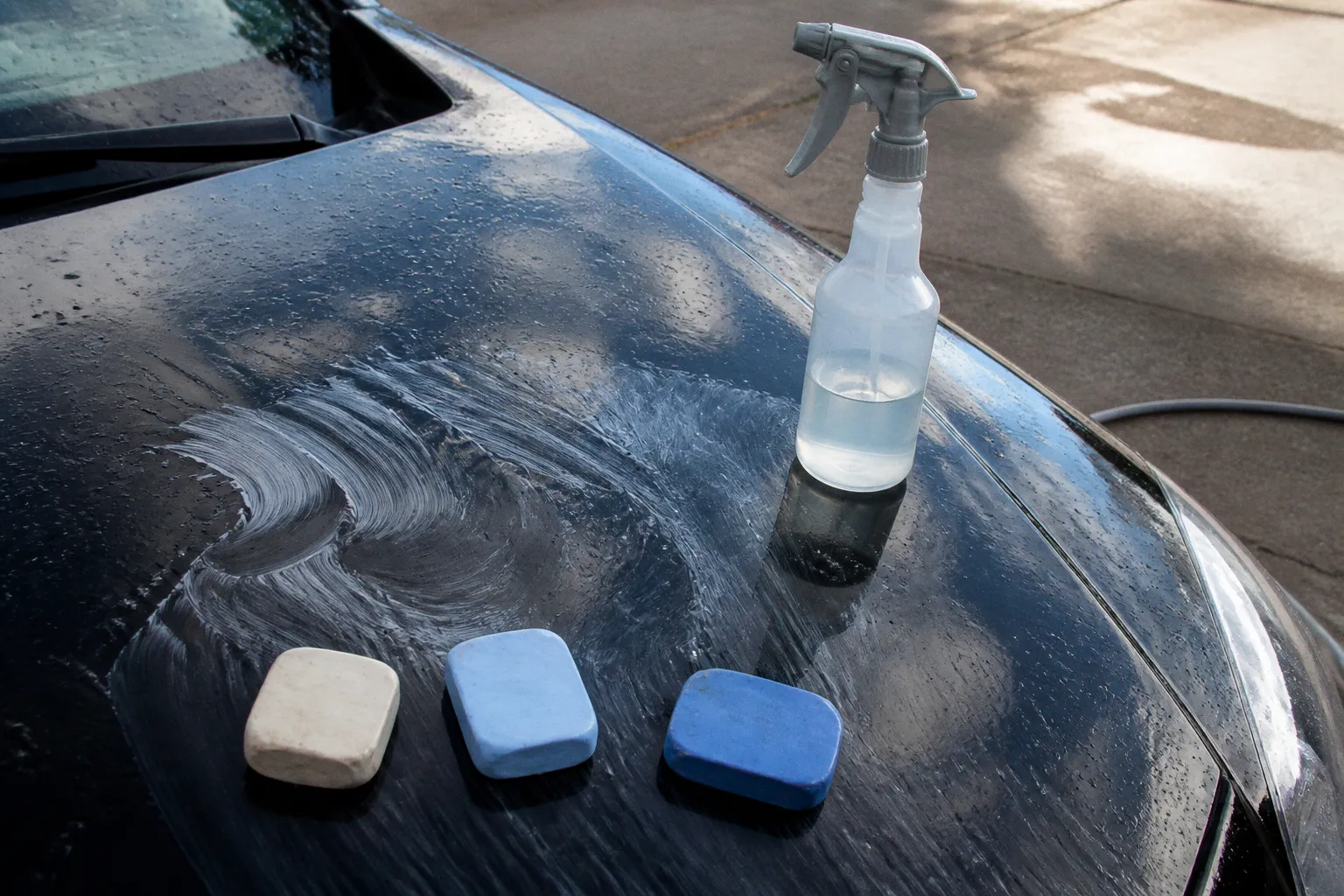
The next decision is not which clay bar has the most cutting power. It is which clay bar grade removes the contamination with the smallest correction burden afterward.
Clay bar grades are divided into three functional groups: fine, medium, and heavy. The difference is created by abrasive particle size, polymer density and flexibility, and surface tackiness. The color of the bar is not a reliable classification. There is no universal color standard between manufacturers.
The correct selection depends on four variables:
- The hardness and sensitivity of the paint system.
- The severity and type of bonded contamination.
- Whether the vehicle has a ceramic coating.
- Whether polishing is planned after decontamination.
A clay bar is not a neutral cleaning tool. It is a mechanical abrasive system used against a clear coat. The surface condition must be diagnosed before the bar is selected.
The science of clay: polymers, tackiness, and abrasives
A detailing clay bar contains an elastic polymer binder with abrasive particles dispersed through it. When the bar is moved across lubricated paint, the polymer conforms to the surface. Contaminants protruding above the clear coat are captured by the tacky material and removed through controlled shear.
The process has two simultaneous effects:
1. Bonded contamination is detached from the paint.
2. The surface is exposed to friction and abrasive contact.
The first effect is required. The second must be limited.
A fine-grade bar uses the least aggressive formulation. It has lower cutting behavior and lower risk of visible micro-marring. A medium-grade bar provides more contamination removal capacity but can leave a light haze or fine scratches, particularly on soft clear coats. A heavy-grade bar has the highest cutting power and the highest probability of surface marring.
The grades are therefore not equivalent versions of the same product. They represent different positions on a control curve:
| Clay bar grade | Primary use | Contamination level | Risk to paint | Polishing after use |
|---|---|---|---|---|
| Fine | Light bonded residue and maintenance decontamination | Low | Lowest | Often unnecessary, but inspection is required |
| Medium | Road film, sap residue, tar traces, bug contamination | Moderate | Moderate | Commonly required for maximum clarity |
| Heavy | Severe industrial fallout and overspray | High | Highest | Normally required |
The terms “fine,” “medium,” and “heavy” describe the working behavior of the clay, not a universal laboratory specification. Manufacturers can use different abrasive loads, polymer structures, and tack levels within the same category. Exact abrasive particle sizes are not standardized across brands.
That creates a practical limitation. Product packaging cannot replace a surface test. A bar marked “medium” from one manufacturer may not behave identically to another medium-grade bar. The grade is the starting parameter. The paint response is the verification parameter.
The correct clay grade is the least aggressive grade that removes the measured contamination.
Abrasive load is only one variable
Abrasive particle size affects cutting behavior, but it is not the only factor. Polymer density changes how the bar conforms to the surface. A denser bar can place more contact pressure against contamination. A softer, more flexible polymer can reduce localized loading but may become more tacky under heat.
Surface tackiness also matters. A highly tacky bar can remove contamination efficiently, but it can increase drag if lubrication is insufficient or if the panel is warm. Increased drag changes the result from controlled cleaning to uncontrolled surface marking.
The same clay grade can therefore produce different results under different conditions:
- A fine bar on cool paint with adequate lubricant produces low-friction contact.
- The same bar on hot paint with inadequate lubricant can stick and leave marks.
- A medium bar on hard clear coat may finish acceptably.
- The same medium bar on soft Japanese paint may create visible micro-marring.
- A heavy bar on glass or a metal wheel can be appropriate.
- A heavy bar on a sensitive clear coat can create a polishing requirement immediately.
No grade should be used dry. Plain water is not a suitable substitute for a dedicated clay lubricant. Water does not provide the same lubricity, film stability, or controlled slip. The bar must glide. If it grabs, chatters, or squeaks, the contact conditions are already incorrect.
Diagnostic precision: the plastic bag test
The plastic bag test is a simple surface roughness check. It does not identify the chemical composition of the contamination. It identifies whether the washed surface contains raised bonded material that can be felt through a thin plastic film.
The test should be performed after the vehicle has been washed and rinsed. The panel must be cool. Loose grit must have been removed. A disposable plastic bag is placed over the hand, and the fingers are moved lightly across the paint.
Without the plastic barrier, the fingertips can mask small irregularities. The bag increases sensitivity. Contaminants catch against the thin film and produce a granular or sandpaper-like sensation.
The procedure is controlled as follows:
1. Wash the vehicle using a suitable car shampoo.
2. Rinse all loose dirt from the panel.
3. Dry the surface or allow it to reach a stable, water-free condition.
4. Place a clean plastic bag over the hand.
5. Move two or three fingers across several areas of the panel with minimal pressure.
6. Compare the hood, roof, horizontal surfaces, doors, and rear quarter panels.
7. Record where roughness is present and where the surface is smooth.
The test should not be performed with heavy pressure. Pressing harder creates a false result by forcing the plastic against ordinary paint texture. The goal is to detect raised contamination, not to inspect the clear coat by force.
A rough result on the roof and hood is common. Horizontal surfaces receive more fallout, airborne industrial residue, pollen, and environmental deposits. A smooth door does not prove that the entire vehicle is clean. Each panel should be assessed separately.
Interpreting the result
The bag test produces three useful outcomes.
Smooth surface after washing.
Mechanical decontamination may not be required. If the paint is already clean and the planned process is not polishing or coating, clay should not be introduced without a reason. Every contact step carries some risk.
Light, isolated roughness.
A fine-grade clay bar is the first option. Small contaminated areas can be treated locally instead of claying the entire vehicle. This reduces contact time and preserves the existing surface condition.
Continuous or severe roughness.
A medium-grade bar may be justified for normal road contamination. Heavy-grade clay should be reserved for severe deposits such as industrial fallout or paint overspray, and only when the next correction step is accepted.
The tactile result must be combined with visual inspection. Orange or brown specks may indicate embedded fallout. Sticky dark residue may indicate tar. A rough but visually clean panel may contain fine industrial particles. No single symptom identifies the required clay grade with certainty.
Fine-grade clay: preserving soft paint and ceramic coatings
Fine clay is the default preservation tool. It is used when the contamination is present but the paint system should be disturbed as little as possible.
This grade is appropriate for:
- New or recently corrected vehicles.
- Soft clear coats.
- Japanese paint systems known to mark easily.
- Ceramic-coated vehicles requiring careful surface maintenance.
- Light bonded residue after a proper wash.
- Vehicles where no polishing step is scheduled afterward.
Fine clay has the lowest marring risk among the three main grades. That does not mean zero risk. A contaminant trapped in the bar can become a hard contact point. Excessive pressure can increase friction. Inadequate lubricant can create drag. The paint can still be marked by an incorrectly controlled process.
Ceramic coating changes the decision. A coating is not an invisible force field. It can resist chemical and environmental attack, but it can still be mechanically abraded or marred. Heavy clay should not be selected simply because the vehicle has a coating and the surface feels rough. The coating may be the layer being damaged.
Fine clay is better suited to maintenance decontamination because it removes the light contamination that remains after washing while limiting the amount of surface correction required. If the bag test detects only mild roughness and the paint is otherwise clear, this is the correct starting point.
Operating method
The panel should be divided into small working areas. A section approximately the size of a forearm is sufficient for controlled inspection. The surface is saturated with clay lubricant. The bar is moved with straight or overlapping passes and light hand pressure.
The bar should not be forced to remove contamination in one pass. If resistance remains, more lubricant is applied and the area is reassessed. If the contamination does not release, the process is stopped. A stronger grade may be required, but the decision should be made only after the panel has been inspected and the correction plan has been defined.
The bar must be folded frequently. Once the working face shows visible contamination, it is folded inward to expose clean material. If the bar is dropped, it should be discarded. Reusing dropped clay transfers abrasive grit directly to the paint.
Fine clay is especially valuable when the planned finish is a sealant or coating applied without machine polishing. In that situation, visible marring cannot be assumed to disappear during the next step. The lower-risk grade is preferable even if more working time is required.
Medium-grade clay: the daily driver standard
Medium clay is the balanced option. It is commonly used on daily-driven vehicles with moderate bonded contamination: tree sap residue, road tar traces, bug deposits, and environmental fallout that remains after washing.
This grade provides more cutting capacity than fine clay. It also introduces a measurable correction risk. Light micro-marring is common enough that polishing should be considered part of the process, not an unexpected failure.
The typical decision is conditional:
- If contamination is moderate and polishing is planned, medium clay is acceptable.
- If contamination is moderate but the paint is soft and polishing is not planned, fine clay should be attempted first.
- If the test area remains rough after correct fine-clay use, the panel should be inspected before moving to medium.
- If the contamination is severe overspray or industrial fallout, medium may be insufficient and repeated passes may increase damage without solving the problem.
Medium clay is often the most efficient grade for a full correction detail. The bar removes bonded material faster than fine clay. The resulting micro-marring is then addressed by machine polishing. This is not a defect in the method. It is the expected trade-off between decontamination speed and surface preservation.
The mistake occurs when medium clay is used on every vehicle because it is considered the “standard.” Standard does not mean universal. A daily driver with hard clear coat and heavy contamination may tolerate it well. A lightly contaminated vehicle with soft paint may not.
Fine versus medium clay bar
The comparison should be made against the actual correction plan.
| Condition | Fine clay | Medium clay |
|---|---|---|
| New vehicle with light roughness | Preferred | Excessive |
| Soft Japanese clear coat | Preferred starting grade | Use only with correction planned |
| Ceramic-coated paint | Preferred | Use cautiously; coating condition must be considered |
| Moderate tar and fallout | May require more passes | More efficient |
| No polishing after claying | Lower-risk option | Can leave unacceptable marring |
| Full machine correction scheduled | Suitable for light contamination | Often the efficient choice |
A test spot resolves uncertainty. One section is clayed with fine material and inspected under strong light. If the contamination is removed and the finish remains clear, escalation is unnecessary. If roughness remains, the next grade can be tested on a separate section.
A test spot also exposes product behavior. Some medium bars release contamination quickly but leave noticeable haze. Others produce more drag. The result is judged by the paint, not by the label.
Medium clay is not a finish grade. It is a controlled compromise between removal speed and the correction required afterward.
Heavy-duty clay: industrial fallout and overspray
Heavy clay is a specialist tool. It is intended for severe contamination that remains bonded after washing and cannot be removed efficiently with a fine or medium bar.
Typical use cases include:
- Paint overspray.
- Severe industrial fallout.
- Dense bonded particles on hard exterior surfaces.
- Heavy contamination on glass.
- Contamination on metal wheels where subsequent polishing or refinishing is acceptable.
The risk to automotive clear coat is high. Heavy clay will almost always create visible marring on paint. A machine-polishing stage should be planned before the bar is placed on the panel.
The relevant question is not whether heavy clay can remove the contamination. It can. The relevant question is whether the paint can be restored after removal. If machine polishing is unavailable, the heavy grade is normally the wrong choice for painted panels.
Glass and metal surfaces can tolerate more aggressive treatment than clear-coated paint, depending on their condition and finish. A heavy bar may be suitable for bonded deposits on windshield glass or metal wheels. The surface must still be lubricated, and the material must be inspected for damage before use. Coated wheels, polished metal, anodized trim, and delicate finishes require separate caution.
Heavy-duty clay bar and paint damage
Heavy-duty clay bar paint damage is not limited to visible scratches. The surface can develop uniform haze, directional micro-marring, and localized marks where contamination increased pressure. Under diffuse light, the panel may appear acceptable. Under a focused inspection lamp or direct sunlight, the loss of clarity becomes obvious.
Three conditions increase the risk:
1. High contact pressure. The bar is pressed against the panel to accelerate removal.
2. Low lubrication. The bar drags instead of gliding.
3. Contaminated working face. Removed particles are redistributed across the clear coat.
The process must be stopped if the bar begins to stick, if the lubricant flashes dry, or if the panel becomes warm. Heat reduces working control and increases product tack. The surface should be cooled before the operation continues.
Heavy clay should also not be used as a substitute for chemical decontamination. Iron fallout removers and tar removers can reduce the mechanical load when they are compatible with the surface and used according to their instructions. Chemical treatment does not eliminate the need for inspection, but it can reduce the number of abrasive passes required.
Overspray presents a different problem. The material may be distributed across the panel as a dense field of raised particles. A heavy bar can level the surface rapidly, but the paint will require correction afterward. If the overspray is severe, a professional assessment may be more efficient than repeated aggressive passes.
How to choose clay bar grade
The selection can be reduced to a sequence of decision gates.
1. If the washed panel is smooth in the plastic bag test, stop.
No clay is required for that panel. Mechanical decontamination should not be performed without bonded contamination to remove.
2. If the panel is lightly rough, use fine clay first.
The lowest-risk grade should be tested on a small section. Adequate lubricant and low pressure are mandatory.
3. If fine clay removes the contamination without visible haze, continue with fine clay.
More aggressive material would add risk without adding useful capacity.
4. If fine clay fails against moderate road contamination, test medium clay.
This is appropriate when the paint condition and correction plan permit light micro-marring.
5. If contamination is severe industrial fallout or overspray, define the correction step before using heavy clay.
If polishing cannot be performed, heavy clay should generally not be used on clear-coated paint.
6. If the vehicle has a ceramic coating, begin with the least aggressive option.
A coating can be damaged by mechanical abrasion. The surface should not be escalated based on roughness alone.
7. If the bar drags, stop and correct the contact conditions.
Add lubricant, reduce panel temperature, and replace or fold the contaminated section of clay.
8. If a test spot shows marring, record it as an expected correction requirement.
Do not continue across the vehicle until the final polishing process has been confirmed.
The grade should be selected per panel when necessary. The roof may require medium clay while a door needs only fine clay. Applying one aggressive grade to the entire vehicle is faster only when the paint can tolerate the added contact. It is not the most controlled method.
Clay bar grade versus surface type
Paint is not the only surface that may require mechanical decontamination. Glass and metal wheels can accept a different risk threshold, but surface construction still matters.
- Clear-coated paint: Fine is the safest starting grade. Medium requires inspection and often polishing. Heavy normally requires polishing.
- Soft paint: Fine clay and reduced pressure are preferred. Medium can create visible marring quickly.
- Hard paint: Medium may be efficient for moderate contamination. A test spot remains necessary.
- Ceramic coating: Fine is the controlled option. Aggressive clay can reduce surface clarity or damage the coating.
- Glass: Medium or heavy clay can be appropriate for bonded deposits when the glass is properly lubricated.
- Metal wheels: Heavy clay can be useful for severe contamination, but polished, anodized, or coated finishes must be treated as separate materials.
Lubrication, pressure, and contamination control
The grade is only one part of the system. Process control determines whether the bar performs as intended.
The panel is kept wet with a dedicated clay lubricant. Coverage must remain continuous. A dry patch creates a local increase in friction and can produce marring even with fine-grade clay.
Pressure is kept low. The bar should be guided across the surface rather than pushed into it. Resistance is diagnostic. If the bar catches, the contamination is still present or the lubrication film is inadequate. More force is not the correct first response.
The working face is inspected repeatedly. A clay bar collects the material it removes. If the same contaminated face is kept against the panel, removed grit becomes a new abrasive source.
The material is folded into itself when contamination appears. It is discarded when it can no longer be folded to expose clean clay. It is also discarded after contact with the ground. The cost of replacing a small clay bar is lower than the cost of correcting transferred grit across a painted panel.
The vehicle should be washed again after claying if the lubricant or removed contamination leaves residue. A panel wipe may be required before polishing or coating, depending on the products used. The surface must be clean enough for inspection. A lubricant film can conceal haze and make the finish appear clearer than it is.
Why polishing after clay is often necessary
Claying removes contamination. It does not restore optical clarity. Those are separate operations.
Fine clay may leave the surface visually clear, particularly on hard paint with light contamination. Medium clay can leave light micro-marring that becomes visible under focused lighting. Heavy clay will normally require machine polishing to remove the resulting haze and marks.
The correction stage should be selected after the panel has been inspected:
- If the finish is clear and free of visible marring, polishing may be unnecessary.
- If a light haze is present, a finishing polish may be sufficient.
- If the panel has visible scratches or stronger marring from heavy clay, a more corrective compound may be required.
- If the clear coat is thin or already heavily corrected, aggressive polishing may not be appropriate.
A ceramic coating should not be applied over a hazed surface. The coating will preserve the optical defect rather than conceal it reliably. The same applies to sealants and high-gloss finishing products. Surface preparation is judged before protection is installed.
The most efficient workflow is not necessarily the one with the strongest clay. It is the one that reaches the required finish with the fewest irreversible contacts. Chemical decontamination, targeted clay use, and localized polishing can reduce total abrasion.
The final verification
The repair baseline is visual and tactile.
After the selected clay grade has been used:
- The plastic bag test should produce a smooth, consistent result across the treated panel.
- No bonded roughness should remain in the corrected area.
- No visible haze, directional marring, or isolated scratches should be present under strong inspection light unless polishing is scheduled.
- The panel should be free of lubricant residue and loose abrasive contamination.
- The paint should be cool and dry before final assessment.
- Any ceramic coating or existing protection should be evaluated for altered clarity or behavior.
If the surface remains rough, the cause must be isolated. The contamination may be chemically bonded, the selected grade may be insufficient, or the lubricant may have prevented effective contact. If the surface is smooth but hazed, the decontamination step has succeeded and the correction step is now required.
Clay bar grades for car paint correction are not selected by color, price, or the claim of maximum cleaning power. They are selected by measured contamination and the paint’s tolerance for abrasion. Fine is the controlled starting point. Medium is the practical grade for moderate contamination when polishing is available. Heavy is reserved for severe deposits and surfaces where the resulting correction can be accepted.
The correct baseline is simple: washed panel, confirmed roughness, adequate lubricant, minimal pressure, clean working face, and a finish verified under inspection light. Anything more aggressive must earn its place through the test result.