Does rain ruin a fresh ceramic coating?
Rain exposure time is one of the variables that most often decides whether a ceramic coating reaches its promised performance. A coating does not simply “dry” in the way a wax or a conventional sealant does.
Merritt Vane·Updated: August 12, 2026·16 min read
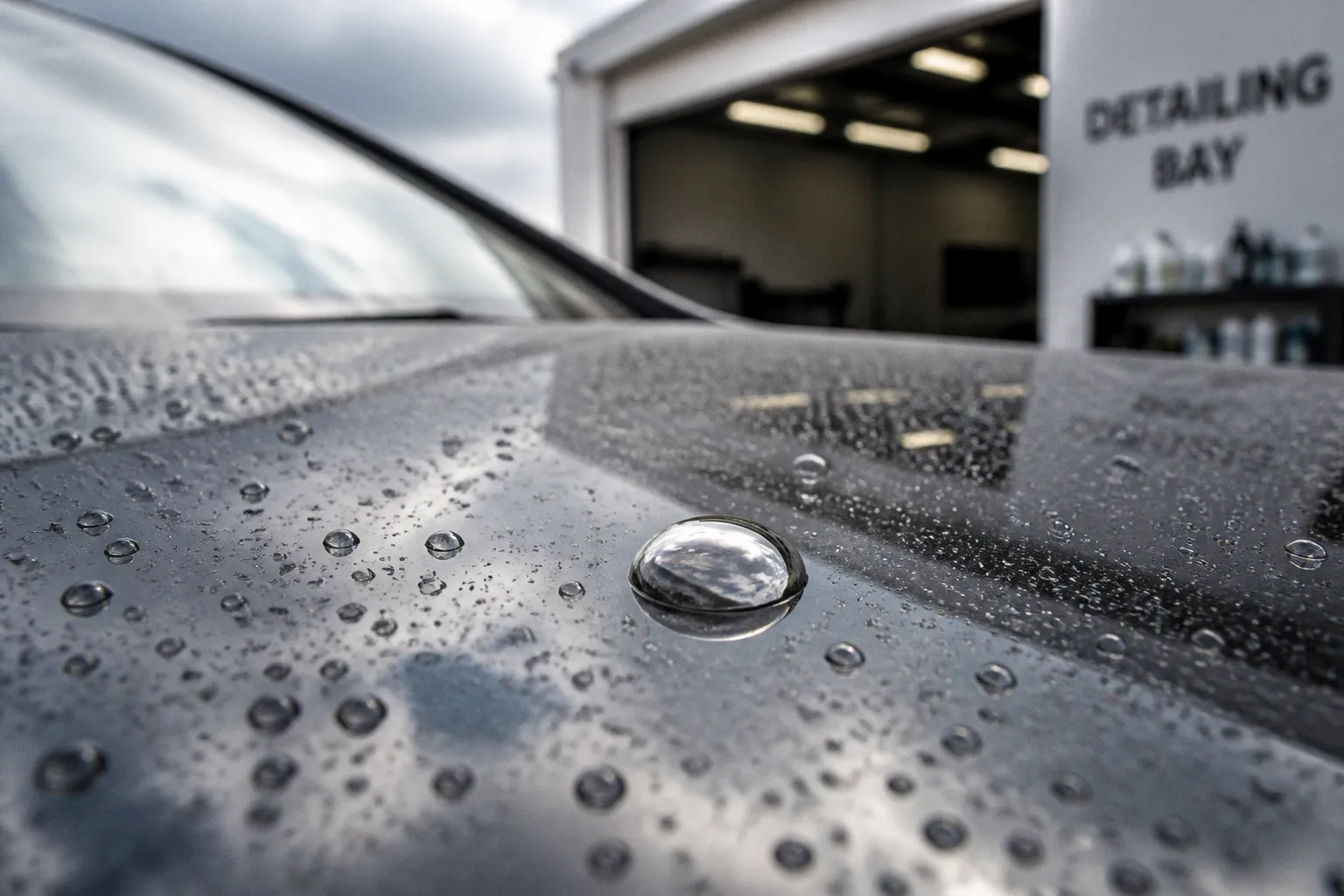
It cures through a chemical reaction, and during the early part of that process the film may look finished while its bond to the clear coat is still developing.
Rain during that period does not usually wash the product off the paint. The greater risk is more subtle: water can interfere with the developing film, leave mineral deposits behind, or expose weaknesses that only become obvious later as uneven water behavior, reduced gloss, or isolated areas that no longer perform like the rest of the panel. Whether the coating can be recovered depends on when the water arrived, how long it remained, the conditions during curing, and the instructions for that particular product.
There is no universal answer to the question of how long a ceramic coating must stay dry. The familiar twenty-four- or forty-eight-hour rule is useful as a warning, not as a substitute for the manufacturer’s cure schedule.
The Critical 48-Hour Curing Window: Why Moisture Matters
The first day or two after application are commonly treated as the critical ceramic coating rain exposure time because the coating is still moving through its most sensitive stage. During application, the liquid product spreads across the clear coat as a mixture of silica-based precursors and solvents. As the solvents evaporate, the reactive components begin forming a bonded network across the surface.
That network is what eventually gives the coating its hardness, chemical resistance, gloss retention, and water behavior. But it does not appear at full strength the moment the installer levels the panel and removes the residue. The surface may feel dry while the chemistry underneath is still developing.
This is also why the relationship between humidity and liquid water is easy to misunderstand. Many moisture-cured coatings need ambient moisture to support the reaction. That does not mean that a newly applied coating benefits from rain. Controlled humidity in the air is one thing; droplets, streams, and standing water on the surface are another. Liquid water can interfere with the film in ways that ordinary atmospheric moisture does not.
Early rain can create several problems at once:
- It may disturb residual material before the coating has fully bonded and settled.
- It can leave minerals behind as droplets evaporate, particularly if the vehicle is exposed to hard water or contaminated runoff.
- It may produce uneven curing across a panel if some areas remain wet while others dry.
- It can make later inspection more difficult by adding water spots to a surface that was already in a chemically delicate state.
- It may expose application marks or high spots that would otherwise have been corrected during the normal post-application inspection.
The important distinction is between a risk and a guaranteed failure. Rain exposure does not automatically mean that the coating has been destroyed. It means that the coating has experienced conditions outside the controlled cure environment, and the result needs to be assessed rather than guessed.
The composition of the water matters, too, but it should not be reduced to a single pH number. Rainwater can carry airborne contaminants, while roof runoff and roadside spray can add dust, oils, minerals, and other residues. Different coating formulations also respond differently to early contamination. A mildly contaminated droplet may leave a removable deposit on one product and create a more persistent mark on another. Without knowing the product chemistry and the exposure conditions, it is not responsible to promise that any particular type of rain will or will not permanently etch the finish.
A fresh ceramic coating is not waterproof in the finished sense. It is still becoming the surface that will later repel water.
The damage can also be delayed. A vehicle may look acceptable once it dries, yet show uneven beading or isolated dull spots after several washes. That does not prove that rain alone caused every later defect, but it is a reason to inspect the vehicle carefully and compare the affected areas with panels that stayed dry.
Distinguishing Between Surface Hardening and Chemical Bonding
The word “cured” hides several different stages. A coating can be touch-dry without being fully bonded, and it can be resistant to a brief accidental splash without being ready for normal washing or chemical exposure.
Surface hardening is the stage most owners can observe. The panel no longer feels wet, residue can be removed, and the finish appears glossy. Chemical bonding is less visible. It is the continuing development of the network that anchors the coating to the clear coat and gives it its final resistance.
Those stages overlap, and their timing depends on the product and the environment. A useful way to think about the process is this:
| Stage | What may be happening | Practical meaning |
|---|---|---|
| Initial set | Solvents are evaporating and the film is beginning to harden | Avoid touching, wiping, or exposing the surface to liquid water |
| Early cure | The coating is becoming more stable, but the bond and internal network are still developing | Accidental moisture may be recoverable, but prolonged wetting remains a concern |
| Water-ready stage | The product has reached the manufacturer’s stated level of resistance to ordinary water exposure | Follow the product’s specific restrictions; this is not necessarily permission to wash |
| Full or near-full cure | Remaining reactive components have completed the relevant part of the reaction | Normal maintenance becomes appropriate according to the care instructions |
Some products are designed to tolerate water sooner than others. Temperature, humidity, airflow, film thickness, preparation quality, and the number of layers can all influence the cure. A coating applied in a cold, damp garage will not necessarily follow the same curve as the same product applied in a warm, controlled workshop. A thick application or an unevenly leveled area may also remain more vulnerable than a properly prepared and evenly buffed panel.
This makes rigid advice dangerous. “Keep it dry for twenty-four hours” may be the minimum on one technical data sheet and insufficient on another. Likewise, a forty-eight-hour ceramic coating cure time before rain may be a sensible conservative target without being a universal chemical deadline.
The safest reference is the product documentation supplied by the manufacturer or installer. It should state when the vehicle may be exposed to water, when it may be washed, whether a maintenance product is required, and whether temperature changes the schedule. If those instructions are not available, a longer dry-storage period is the more sensible choice.
A vehicle that becomes wet near the end of the initial cure window should not be treated as automatically safe simply because the surface has hardened. The risk may be lower than it was immediately after application, but the coating can still be affected by prolonged rain, repeated wetting, water pooling, or contamination trapped beneath drying droplets.
Immediate Steps to Take If Your Fresh Coating Gets Wet
The first response should be calm and conservative. The reflex to strip the coating immediately is usually unnecessary, but so is the opposite assumption that a wet vehicle is completely unaffected.
Start by recording the circumstances:
1. How long after application did the water arrive? A brief mist shortly after application presents a different problem from several hours of steady rain.
2. Was the vehicle moving or parked? Road spray can contain more contamination than clean rainfall, and airflow can spread water unevenly across the panels.
3. Did water remain on the paint? Beads that evaporate quickly are not the same as standing water trapped in mirrors, trim, panel gaps, or roof channels.
4. Was the water clean? Rain, sprinkler water, roof runoff, and wash water can leave very different residues.
5. What does the product instruction say? The coating’s own documentation should determine the next step whenever it gives a specific procedure.
If the vehicle is wet, move it into a dry, sheltered area if doing so will not create additional contamination. Avoid rubbing the panels simply to make them look dry. During the early cure, wiping can create marring, move partially cured material, or leave fibers and debris in the film.
A blower is generally preferable to contact drying, provided it produces clean, filtered air. It can remove water from the paint and from difficult areas such as emblems, mirrors, grilles, and panel seams without dragging a towel across the surface. If a towel is necessary, use a clean, soft, lint-free microfiber and blot rather than scrub. The aim is to remove standing water, not to polish the vehicle.
Do not reach immediately for a water-spot remover, panel wipe, solvent, abrasive polish, or quick-detailing spray. Any of these may be appropriate later, but introducing a chemical while the coating is still curing can create a second problem. The correct response depends on the manufacturer’s guidance and on what the inspection shows once the vehicle is dry.
Inspect after the surface has dried
Look for differences between panels:
- isolated rings or spots that remain after gentle drying;
- streaks or areas with noticeably different gloss;
- patches where water behavior is irregular;
- visible high spots, hazing, or leveling marks;
- contamination trapped around trim and edges;
- areas that appear to have lost the uniform finish present before the rain.
A water spot is not automatically coating failure. It may be a mineral deposit sitting on top of the film. It may also be residue from the surrounding environment rather than damage to the coating itself. Conversely, the absence of a visible spot does not prove that the early exposure had no effect.
If a mark remains, allow the product to reach the cure stage specified by its manufacturer before attempting correction unless the installer directs otherwise. A light finishing polish may remove a superficial deposit or correct a localized defect, but polishing also removes material. On a partially cured coating, it can make the situation worse. If correction is needed, the usual professional approach is to assess the affected section, correct only what is necessary, and reapply coating where the original layer has been removed or compromised.
A water spot is evidence, not a verdict. Dry the surface, inspect the pattern, and only then decide whether it needs cleaning, polishing, or re-coating.
The owner should also photograph the affected panels and contact the installer promptly. A time-stamped record of when the coating was applied, when the vehicle became wet, and what the weather was like can be more useful than an argument based on appearance alone. The installer may know how that specific formula behaves and may have a prescribed recovery process.
The Danger of Early Chemical Exposure and Washing
Rain is not the only concern during the cure. Washing too soon can be more damaging than a short, unplanned exposure to clean water because washing adds pressure, friction, surfactants, detergents, and often contaminated towels.
A fully cured coating is built to tolerate normal vehicle-cleaning chemistry within the limits set by its manufacturer. A fresh coating may not yet have the same resistance. Shampoos and pre-wash products are designed to loosen and carry away oils and dirt. On a curing film, that chemical and mechanical action can disturb the surface, alter the way it levels, or leave an uneven finish.
The same caution applies to products marketed as gentle:
- pH-neutral does not mean harmless to every uncured coating.
- A quick detailer may contain solvents, gloss agents, or lubricants that are not approved for the early cure period.
- Iron removers, tar removers, alkaline pre-washes, and acidic cleaners should not be used unless the product instructions specifically allow them.
- A pressure washer can force water into trim, seams, badges, and partially cured edges.
- A wash mitt can turn an invisible residue into visible marring when the coating has not reached its final hardness.
Many installers recommend avoiding chemical washing for several days, and some coating systems specify a longer period before the first maintenance wash. Those recommendations are product-specific rather than universal. The right ceramic coating cure time before rain, first wash, and chemical decontamination should come from the technical data sheet or the installer who applied the product.
During the restricted period, prevention is better than improvisation. Keep the vehicle indoors if possible, away from construction dust, tree sap, bird activity, irrigation spray, and direct contact with dirty covers. If a fresh contaminant lands on the vehicle, do not leave it in place simply because the coating is new. At the same time, do not attack it with a strong chemical without checking the instructions.
For a soft contaminant such as fresh bird droppings, a clean microfiber lightly dampened with plain water may be the least aggressive option, followed by careful air drying. Place the towel over the contamination briefly to soften it rather than dragging a dry towel across the panel. If the material has dried hard or the contamination is extensive, contact the installer before attempting removal.
The principle is straightforward: minimize both dwell time and intervention. Early exposure is a reason to handle the surface carefully, not an invitation to keep touching it.
Mitigation Strategies: Using Boosters for Environmental Protection
Boosters and top coats can be useful, but they are not universal insurance policies and they do not erase the base coating’s cure requirements. A booster may add temporary water behavior, lubrication, or environmental resistance. It may also be intended only for use after the base layer has reached a specified stage. Compatibility, application timing, and solvent content vary widely.
Some coating systems include a dedicated top coat as part of the original installation. Others recommend a spray sealant or maintenance product later. In some cases, the manufacturer allows the product to be applied shortly after the base coating; in others, adding another formulation too soon can interfere with leveling or curing. The difference is not cosmetic. A booster must be chemically compatible with the coating beneath it and used at the point specified by the manufacturer.
That is why there is no responsible universal schedule such as “apply the first booster within four to six hours.” The correct timing may depend on the exact coating, the temperature and humidity, whether the product is a professional or consumer system, and whether the booster is part of a tested two-product application. Applying it too early may interact with the still-soft base layer. Applying it later may be perfectly acceptable if the base coating is intended to cure without an added layer. The instructions decide.
A booster can help protect a curing coating from environmental exposure, but it should be described as mitigation, not a guarantee. It may reduce the amount of contamination that reaches the base layer or make later cleaning easier. It does not ensure that rain will have no effect, and it does not mean that the underlying coating can continue curing “undisturbed” under every weather condition. Water can still enter from exposed areas, collect at edges, or carry contaminants beyond the protection provided by the booster.
When a compatible booster is specifically approved, a sensible process looks like this:
1. Apply and level the base coating exactly as directed, including the stated flash time and removal procedure.
2. Confirm whether the manufacturer requires a waiting period before any top coat or booster is applied.
3. Use only the named or approved maintenance product, rather than substituting a generic spray sealant.
4. Apply a thin, even layer under the temperature, humidity, and ventilation conditions stated in the instructions.
5. Keep the vehicle dry for the remaining period specified for the complete system.
6. Do not assume that a booster changes the first-wash or full-cure schedule.
7. Reapply it only at the interval recommended for that product and only after the base coating has completed its initial cure.
The same caution applies to claims about sacrificial layers. A booster may take some of the environmental load, but its performance depends on film thickness, coverage, compatibility, and the nature of the contamination. It is a useful additional layer of control, not a guaranteed barrier between rain and the curing coating.
Prevention as the Final Answer
The practical answer to “what happens if ceramic coating gets wet?” is less dramatic than either extreme. A fresh coating that gets wet is not automatically ruined, but early moisture can create a real risk of uneven curing, mineral spotting, or reduced performance. The earlier and longer the exposure, the more carefully the vehicle should be assessed. The later the exposure, the less vulnerable the coating may be, but no particular hour should be treated as a universal safety line.
The best protection is still a dry, controlled cure period. Before applying the coating, check the weather forecast and make sure the vehicle can remain sheltered for the full period specified by the product. A covered parking space is not always enough if the garage is damp, dusty, or exposed to temperature swings. Keep the surface clean before application, avoid unnecessary contact afterward, and make plans for unexpected moisture rather than relying on a last-minute chemical fix.
A useful set of preparation questions is simple:
- Can the vehicle remain dry for the manufacturer’s stated water-exposure period?
- Is the application area warm and stable enough for the product?
- Is the coating being applied in the film thickness and number of layers specified?
- Is there an approved top coat or booster, and when is it allowed?
- What is the procedure if rain or condensation arrives early?
- When is the first wash permitted, and which chemicals are approved?
- Who should inspect the vehicle if spots or uneven gloss appear?
The answer to the primary question is therefore conditional. Rain does not automatically ruin a fresh ceramic coating, but it can compromise a coating that has not completed the relevant stage of its cure. The exact ceramic coating rain exposure time depends on the formulation and the conditions, not on a slogan repeated across every product label.
Ceramic coatings are thin reactive films, not magic glass. They need time to bond, level, and develop the properties that justify the installation. Give the coating the dry storage and careful handling its manufacturer requires, and an occasional weather problem becomes something that can usually be assessed and managed. Ignore that window, wash too early, or trust a booster as a guaranteed shield, and the owner may spend far more time correcting the finish than was ever saved by rushing the cure.