Modern Automotive Electronics: Navigating Complex Systems and Component Shortages
According to TimesTech, modern vehicles now operate as continuous electronic loops: sensors collect data, controllers process it, networks transmit commands, and actuators perform the required action.
Aldous Moorland·updated August 13, 2026
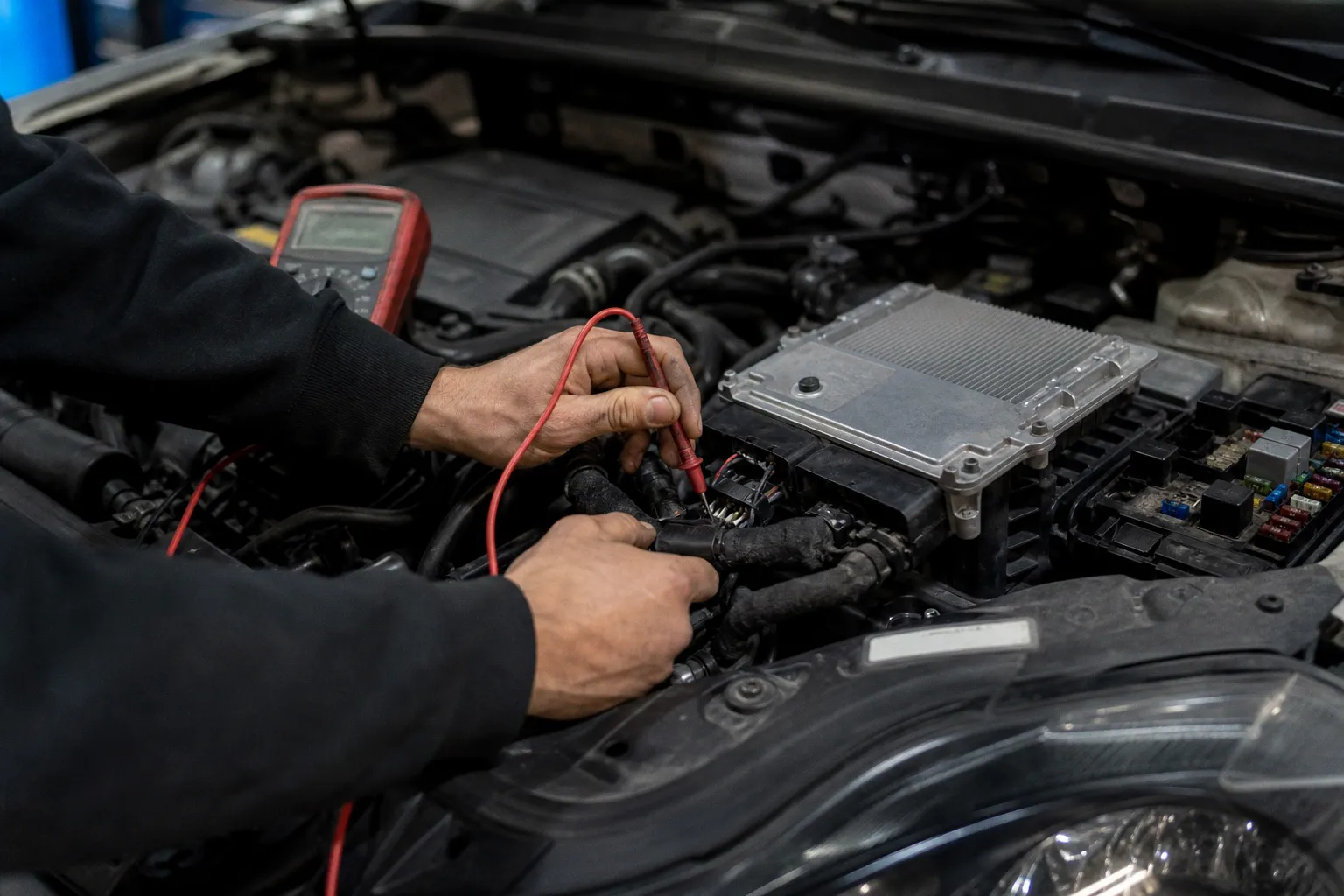
That architecture covers engine management, braking, stability control, airbags, lighting, climate control, infotainment, driver assistance and battery systems. For import owners, the practical consequence is direct: many apparent mechanical faults can begin as signal, communication, power or software faults.
The second pressure point is supply. TechBullion reports that 2026 shortages are concentrated in specific manufacturer part numbers rather than entire component categories. Automotive-grade semiconductors, power-management ICs, high-performance memory and networking devices remain exposed to demand from advanced automotive electronics, AI infrastructure and data centers. A replacement ECU or module can therefore become a sourcing problem before it becomes a workshop problem.
The fault path is a chain, not a single part
An ECU is not an isolated black box. It contains a processor or microcontroller, memory, communication interfaces, input and output circuits, and embedded software. Its result depends on every stage before the command reaches the controlled component.
If a sensor value is incorrect, the controller may calculate the wrong response. If the sensor value is valid but the communication path fails, the receiving module may not obtain it. If both are correct, the output circuit or actuator remains a possible failure point. The diagnostic sequence is therefore:
- verify the sensor input;
- verify the signal reaching the ECU;
- verify ECU processing and communication;
- verify the commanded output;
- verify the physical response.
The same logic applies across vehicle systems. Wheel-speed sensors provide rotation data. Cameras and radar identify objects. Steering-angle, acceleration, pressure, temperature, battery-voltage and current signals describe vehicle state. The controller then compares those inputs with programmed logic. Electronic stability control, for example, can compare wheel-speed information with steering and vehicle-motion data when determining whether stability has been lost.
A warning lamp identifies a system boundary. It does not, by itself, identify the failed component.
AI and autonomous functions increase the number of dependencies
TimesTech describes automotive electronics as a sensing, processing, communication and control cycle. Advanced driver-assistance systems use that cycle to issue warnings and, where the vehicle permits, apply braking or assist with steering. Driver-monitoring systems, electronic braking, tire-pressure monitoring, airbags and stability control add further electronic layers.
The relevant distinction is assistance versus replacement. The source states that these technologies do not eliminate the need for driver attention. More sensors and more processing do not remove the requirement for valid inputs, stable power and functioning communication networks.
For diagnostics, this means that an ADAS fault should not be reduced to a camera fault without verification. The camera or radar may be operating correctly while the fault exists in another input, controller, network connection or power circuit. The same applies to EV systems. Battery, inverter, thermal and charging management are electronically linked, and their operation affects range and operating costs.
A module replacement performed without checking the complete signal path can produce a second fault: the original problem remains, while the vehicle gains a compatibility, configuration or sourcing issue.
Component sourcing is now part of repair planning
TechBullion reports that availability must be assessed at exact manufacturer-part-number level. Category-level assumptions are insufficient. Two similar components in one product family may have different lead times and prices. Product Change Notifications and end-of-life announcements also create risk for mature or legacy components.
For import repair, the part number on the module is therefore a diagnostic parameter, not clerical information. It should be recorded before an order is placed. If an alternative component is considered, electrical, mechanical, thermal and reliability requirements must be verified before installation. A cross-reference is not proof of compatibility.
Expanded sourcing channels create another risk. TechBullion warns that non-traditional procurement can increase exposure to counterfeit or improperly handled components. That risk is material in automotive electronics because a component can pass a basic visual inspection and still fail under electrical, thermal or reliability load.
The repair baseline is exact and limited: the correct manufacturer part number, valid sensor inputs, stable battery-voltage and current data, intact controller communication, correct ECU processing, and confirmed actuator response. If those parameters are not verified in sequence, the diagnosis remains incomplete.