Polyurethane bushings: is the harsh ride worth it?
A suspension bushing rarely announces its failure with a dramatic snap. More often, the rubber has been shearing back and forth for years, separating from its sleeve, softening around the edges, and…
Judson Grier·Updated: August 12, 2026·15 min read
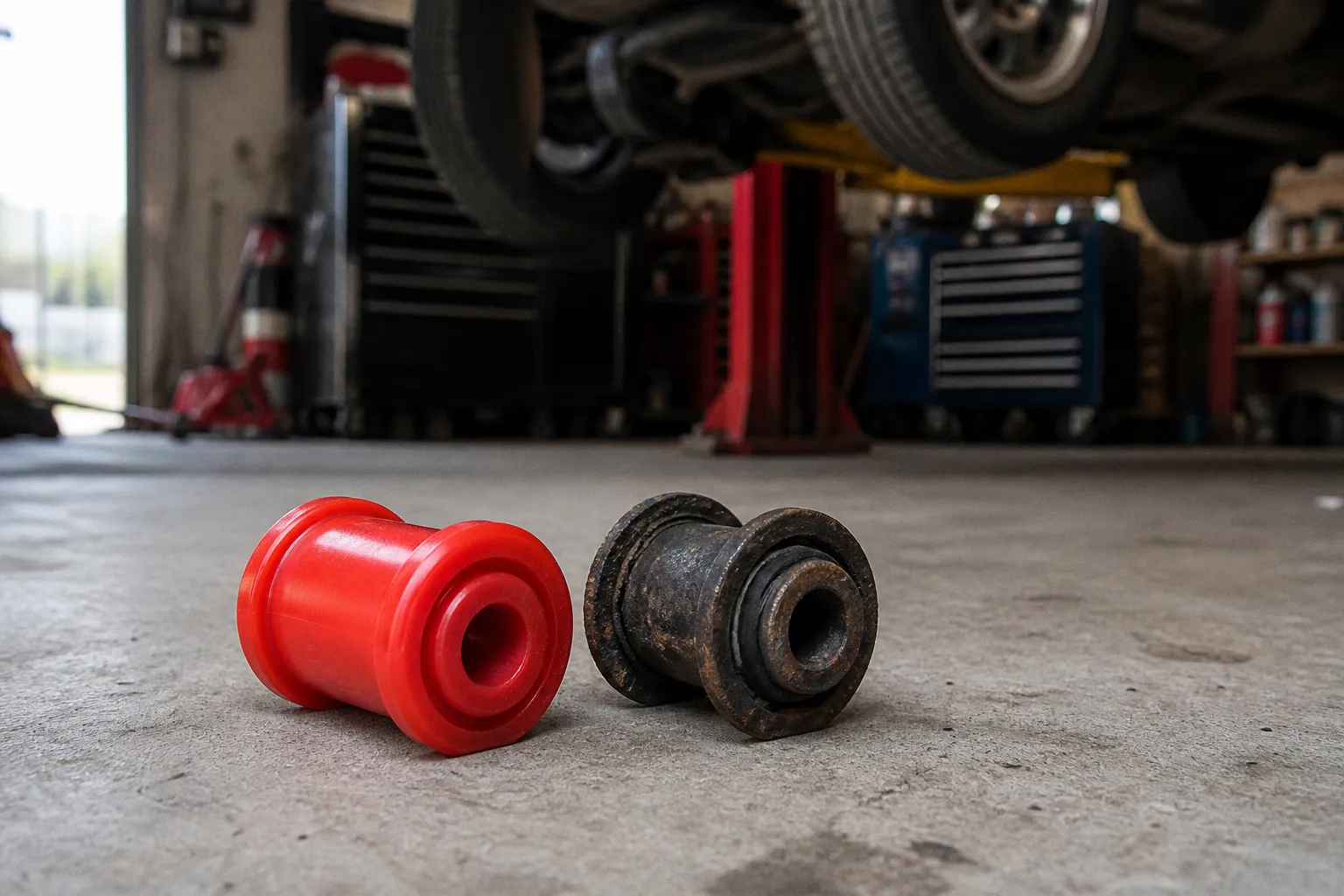
A suspension bushing rarely announces its failure with a dramatic snap. More often, the rubber has been shearing back and forth for years, separating from its sleeve, softening around the edges, and allowing the control arm to move farther than the suspension geometry intended. The steering begins to feel delayed. The car wanders under braking. A familiar road develops a new series of knocks.
Compare car rental deals in United Kingdom
See available offersPartner link — DiscoverCars comparisonThat is usually when polyurethane bushings enter the conversation. They are stiffer, more resistant to tearing, and often much more durable than the rubber pieces they replace. They can also transmit every coarse patch of asphalt into the cabin with a clarity you did not ask for.
So, are polyurethane bushings worth it for a daily driver? Sometimes. The answer depends less on the material’s reputation than on where you install it, which hardness you choose, and whether the rest of the suspension is healthy enough to benefit from the change.
The physics of stiffness: rubber versus polyurethane
A factory rubber bushing is not simply a cushion placed between two metal parts. It is a controlled suspension joint. The inner sleeve is bonded to the rubber, and the rubber twists, compresses, and shears as the control arm moves through its travel.
That bonded construction matters. In many original-equipment applications, the bushing is designed to flex without the inner sleeve freely rotating inside the rubber. The movement is spread through the rubber body, which filters vibration while still allowing the arm to articulate.
Over time, the rubber loses some of its elasticity. Heat, road salt, oil contamination, ozone, and repeated loading all work on the material. The bushing may crack, deform, or separate from the sleeve. Once that happens, the suspension has gained movement that the engineer did not put there.
Polyurethane changes the balance. It is generally harder and more resistant to tearing than rubber, and it usually locates the suspension more firmly. Typical OEM rubber bushings fall around 50A to 60A on the Shore hardness scale. Aftermarket polyurethane commonly ranges from 75A to 95A.
That difference is not a marketing detail. A 75A bushing does not respond to a bump the way a 55A rubber bushing does. It deflects less under the same load, so the control arm, sway bar, steering rack, or differential mount stays closer to its intended position. The result can be sharper response and more stable alignment under braking and cornering.
But the same stiffness changes where the road’s energy goes.
Rubber absorbs a significant amount of small, fast movement before it reaches the body shell. Polyurethane absorbs less of it. Instead of allowing the bushing to deform quietly, the force travels through the mount and into the chassis. You feel it as additional noise, vibration, and harshness—NVH.
Polyurethane does not remove suspension forces. It gives them fewer places to disappear.
The comparison is easiest to understand when separated into the jobs we actually ask the bushing to perform:
| Characteristic | OEM rubber bushings | Polyurethane bushings |
|---|---|---|
| Typical hardness | About 50A–60A | Commonly 75A–95A |
| Ride isolation | Better at filtering road texture | More road texture reaches the cabin |
| Alignment stability | Allows more deflection as it ages | Holds geometry more firmly |
| Resistance to tearing and ozone | Can crack, rot, or soften over time | Higher tensile strength and tear resistance |
| Routine lubrication | Usually not required | Required with a compatible grease |
| Steering response | More filtered and compliant | Sharper and more immediate |
| Installation tolerance | Often forgiving of minor movement | More sensitive to fit, alignment, and lubrication |
| Best use | Quiet daily comfort and factory behavior | Precision, heavy use, towing, or selective chassis upgrades |
Neither column is universally better. A bushing is a compromise between isolation and control, and polyurethane moves that compromise toward control.
What the change feels like on an ordinary commute
The phrase “harsh ride” covers several different sensations. It can mean a single hard impact over a pothole, but it can also mean a constant increase in small vibrations: tire texture through the steering wheel, a dull tremor over concrete joints, or a faint squeak each time the suspension settles after a turn.
On smooth pavement, polyurethane may feel like an improvement. The steering can become more direct because the control arm or steering rack is not winding up as far before the vehicle responds. During braking, the car may feel more settled. Through a long corner, the chassis can seem less vague because the suspension geometry is moving less under load.
Rough roads are where the bill arrives.
A rubber bushing can absorb a portion of the rapid, low-amplitude movement produced by broken asphalt and expansion joints. A stiffer polyurethane bushing passes more of that movement into the chassis. The cabin may not become dramatically louder in any measured, universal way—there is no single decibel increase that applies to every vehicle—but the character of the noise changes. The car feels busier. The suspension may sound more mechanical because more force reaches the mounting points.
The rest of the vehicle determines how noticeable this becomes. A heavy sedan with well-isolated subframes may tolerate polyurethane better than a small hatchback with stiff springs and thin sound insulation. A vehicle already fitted with performance dampers and low-profile tires has less isolation left to give. Add high-durometer bushings, and the combination can become tiring even if every individual part is technically functioning correctly.
We also need to separate a bushing upgrade from a worn suspension repair. Polyurethane bushings will not make a tired shock absorber control the wheel properly. They will not restore a cracked control arm, compensate for a bent wheel, or cure a loose ball joint. If the spring, damper, tire, or alignment is already compromised, the new bushing can make the vehicle feel more aggressive without making it more correct.
That distinction saves a great deal of wasted labor. A firmer connection is useful only when the parts on either side of it are doing their jobs.
Where polyurethane earns its place
The best polyurethane installations are selective. We do not need every flexible point in the chassis to become rigid. Some locations benefit from firm control, while others need to articulate smoothly and isolate vibration.
Sway bar bushings
Sway bar bushings are one of the most reasonable places to start. The bar’s job is to resist differences in wheel movement from side to side. If its mounting bushings allow excessive movement, the bar takes longer to engage, and the vehicle can feel soft or delayed during initial turn-in.
A stiffer bushing at the sway bar mount can sharpen that first response without replacing every control-arm bushing on the vehicle. The change may still add some noise, especially if the bar twists against a dry or poorly fitted bushing, but the NVH penalty is often more manageable than it is with high-durometer bushings throughout the suspension.
The key is correct sizing. A bushing that is too tight, poorly lubricated, or forced onto a bar with corrosion can bind rather than flex. Binding changes the way the bar loads the suspension and can create the very squeak or uneven response the upgrade was meant to eliminate.
Steering rack mounts
Steering rack bushings are another location where increased stiffness can make sense. If the rack shifts on its mounts, the steering wheel may move before the rack transfers that movement into the tie rods. The driver experiences this as looseness or delay.
A firmer mount keeps the rack more stable against the subframe. That can improve steering precision without directly stiffening every point that controls wheel travel. The tradeoff is that steering kickback and road texture may become more apparent through the wheel.
This is often a useful compromise on a vehicle that feels vague but is otherwise comfortable. It does not turn a road car into a track car. It simply reduces an avoidable layer of movement.
Control arms and radius arms
Control-arm bushings require more caution. These joints do not merely locate the arm; they allow it to move through a specific arc while managing braking, cornering, and vertical suspension loads.
A polyurethane bushing can hold the arm more firmly and resist the alignment changes that occur under load. That may help a vehicle that sees heavy towing, repeated hard braking, or demanding road use. But high stiffness can also restrict the articulation the suspension needs, particularly on vehicles designed for uneven terrain or long wheel travel.
This is where a 75A or 85A compound may be excessive for a daily-driven import. If the bushing cannot twist as the arm moves, the load may be forced into the bushing’s sleeve, mounting hardware, or neighboring components. The suspension is not a collection of independent parts; when one joint stops yielding, another part often receives the movement.
For four-wheel-drive vehicles and trucks, the question is even more specific. A bushing that improves axle location on the road may reduce compliance off-road. If the vehicle spends more time crossing ruts than taking highway ramps, maximum hardness is not automatically an upgrade.
Subframe and differential mounts
These locations can produce a large change in feel because they connect major assemblies directly to the body. Firm mounts may reduce drivetrain movement and make gear changes or throttle transitions feel more immediate. They can also transmit a great deal of vibration at idle and under load.
For a commuter, this is usually a decision made with open eyes rather than a first repair. If the original mount is damaged, replacing it with a quality rubber part may restore the vehicle without adding constant cabin vibration. Polyurethane makes more sense when the owner has a specific problem—excessive movement, repeated mount failure, or heavy use—not simply a general desire for a “tighter” car.
A sensible upgrade strategy is therefore:
1. Repair failed suspension components with the correct replacement first. Do not use stiffness to conceal looseness elsewhere.
2. Choose one axle or one function at a time. A sway bar or steering rack upgrade is easier to evaluate than a complete chassis conversion.
3. Avoid mixing random hardness levels without a reason. The vehicle’s balance can change when the front and rear respond differently.
4. Inspect tires, dampers, ball joints, and alignment after the installation. New bushings can expose problems that were previously masked by movement.
5. Drive the car on the roads you actually use. A modification that feels excellent on smooth pavement may become unpleasant over your normal commute.
The maintenance reality: polyurethane is not fit-and-forget
One of the persistent misunderstandings about polyurethane bushings is that their durability makes them maintenance-free. It does not.
Rubber bushings are often bonded and designed to operate without periodic lubrication. Polyurethane bushings commonly work around a sleeve or between moving surfaces, so friction must be controlled. Manufacturers often recommend re-lubrication at roughly five-year intervals or when squeaking begins, though the actual service interval depends on the design, exposure, and use.
The grease must also be compatible with the material. Silicone-based or lithium-based synthetic waterproof greases, often with PTFE additives, are commonly specified for polyurethane applications. Petroleum-based grease and some anti-seize compounds can cause the polyurethane to swell, deform, or harden into ridges. Once the surface has been damaged, adding more grease will not restore the bushing.
WD-40 is not a substitute for proper bushing lubricant. Neither is whatever chassis grease happens to be open on the workbench. The chemistry matters because the bushing is the working surface, not just a passive spacer.
When a polyurethane bushing begins to squeak, the noise usually tells us that the interface is moving without enough lubrication, that the bushing is misaligned, or that dirt has entered the contact area. Spraying the outside of the bushing may quiet it for a short time, but that rarely addresses the wear surface. The correct repair generally requires disassembly, cleaning, inspection, and application of the specified grease to the surfaces that actually move.
A proper inspection looks for:
- Polished or dry contact areas where the grease has been displaced.
- Deep grooves, ribs, or ridges worn into the polyurethane.
- Swelling or distortion around the sleeve.
- Cracks caused by incorrect lubricant or excessive preload.
- Corrosion on the metal sleeve or mounting surface.
- Uneven witness marks showing that the bushing is not seating squarely.
The fit should be deliberate. A split bushing must close correctly around the bar or sleeve, and a two-piece design should not be crushed into place with the hardware misaligned. If the sleeve is rusty, undersized, or damaged, the new bushing cannot hold the joint properly no matter how expensive the kit was.
Installation torque deserves the same care. Many suspension fasteners are tightened with the vehicle at normal ride height, or with the suspension supported so the bushing is in its neutral position. If we lock a bonded rubber bushing at full droop, it can be preloaded when the car returns to the ground. Polyurethane designs vary, but the manufacturer’s procedure still takes priority over habit. The suspension needs to move through its working range, not fight an installation error at every bump.
The squeak is usually the symptom we hear. The real failure is often dry contact, incorrect grease, or a bushing that never seated squarely.
Choosing comfort, dynamic, or performance hardness
Hardness numbers are useful only when they are connected to a location and a purpose. A higher number is not a universal measure of quality.
Many manufacturers group polyurethane compounds into broad categories such as Comfort, Dynamic, and Performance:
| Compound category | Typical hardness | Where it makes sense | Likely tradeoff |
|---|---|---|---|
| Comfort | Around 65A | Daily drivers, lightly modified vehicles, locations where isolation matters | Less control than harder compounds |
| Dynamic | Around 75A | Mixed street use, steering or sway bar applications, balanced handling upgrades | More NVH without maximum track-level stiffness |
| Performance | Around 85A | Track use, heavy towing, repeated high-load driving | Noticeably harsher ride and more transmitted vibration |
| Extremely rigid race compound | Around 75D | Dedicated competition applications | Poor match for normal street comfort and suspension articulation |
These categories are not universal standards, so the manufacturer’s application notes still matter. One company’s “dynamic” bushing may not behave exactly like another company’s 75A product. Shape, wall thickness, sleeve design, preload, and mounting location all influence the final result.
For most daily drivers, the lower end of the polyurethane range is the more defensible starting point. A 65A compound is intended to preserve more ride quality. A 75A compound offers a firmer compromise. Moving toward 85A should be based on a real operating requirement rather than the belief that harder automatically means better.
The same compound can also feel different at different locations. A 75A sway bar bushing may be tolerable, while a 75A control-arm bushing near the cabin may produce a level of vibration you notice on every trip. The distance from the mounting point to the body, the direction of movement, and the frequency of the loads all matter.
This is why replacing every bushing with the hardest available material is a blunt solution. The chassis has different jobs at different joints. We want the bushing to resist unwanted deflection while still allowing the intended movement.
When rubber remains the better engineering choice
There is no mechanical prize for making a daily driver unpleasant.
If the vehicle is used mainly for commuting, carries passengers, travels on broken pavement, or already has firm springs and low-profile tires, fresh OEM-style rubber may be the better solution. New rubber often restores the steering and braking behavior that was lost to age without adding cabin fatigue.
Rubber is also a good choice when the suspension design depends on progressive compliance. Some control arms need to change angle smoothly as the wheel moves. Some mounts are meant to isolate a known vibration from the body. Replacing those parts with polyurethane can shift the load path into the subframe and cabin without creating a meaningful improvement in control.
The condition of the original part matters as well. A worn 50A rubber bushing and a fresh 65A polyurethane bushing are not the only two options. High-quality rubber replacements, updated OEM designs, or application-specific bushings may provide the right balance of durability and isolation.
Polyurethane is strongest as a targeted tool:
- Use it where suspension movement is clearly reducing steering or alignment control.
- Choose a moderate compound when the vehicle remains a street car.
- Reserve very hard bushings for vehicles that genuinely operate under high loads.
- Treat lubrication as part of ownership, not as an emergency repair.
- Replace worn neighboring components before judging the upgrade.
A bushing upgrade should leave the suspension more coherent, not simply more rigid.
The long-term cost of a sharper chassis
Polyurethane bushings can last a very long time because they resist tearing and are less vulnerable to the rot, cracking, and ozone damage that age rubber. That durability is real, but it is conditional. The material still needs correct lubrication, proper seating, and a mounting environment that matches its design.
The long-term question is not just whether the bushing survives. It is whether the complete vehicle remains better to live with. A small increase in steering precision may be worth some additional road texture. Constant squeaking is not. Neither is a harsh response that makes you avoid rough roads, carry less cargo, or regret the modification each morning.
For a daily-driven import, the most reliable path is usually selective replacement with a Comfort or Dynamic compound, installed only at the locations where the factory bushing’s deflection is causing a measurable problem. Sway bar and steering rack mounts often offer a reasonable balance. Control arms, subframes, and drivetrain mounts demand a clearer reason and a closer look at the vehicle’s intended use.
So, is the polyurethane bushings daily driver worth it question settled? Not by a simple yes or no. Polyurethane is worth it when we need firmer location, better alignment stability, or greater resistance to repeated loading—and when we accept the extra maintenance and NVH that come with that control.
The best suspension is not the hardest one. It is the one that keeps the wheel where it belongs, lets the joint move where it must, and does not make every mile feel like a teardown that never ends.