Tire cupping: why worn shocks cause uneven tread wear
A tire with cupping does not wear in a continuous band. It develops repeated scooped sections across the tread, often 3 to 4 inches apart. The pattern may be felt as alternating high and low spots.
Aldous Moorland·Updated: August 12, 2026·13 min read
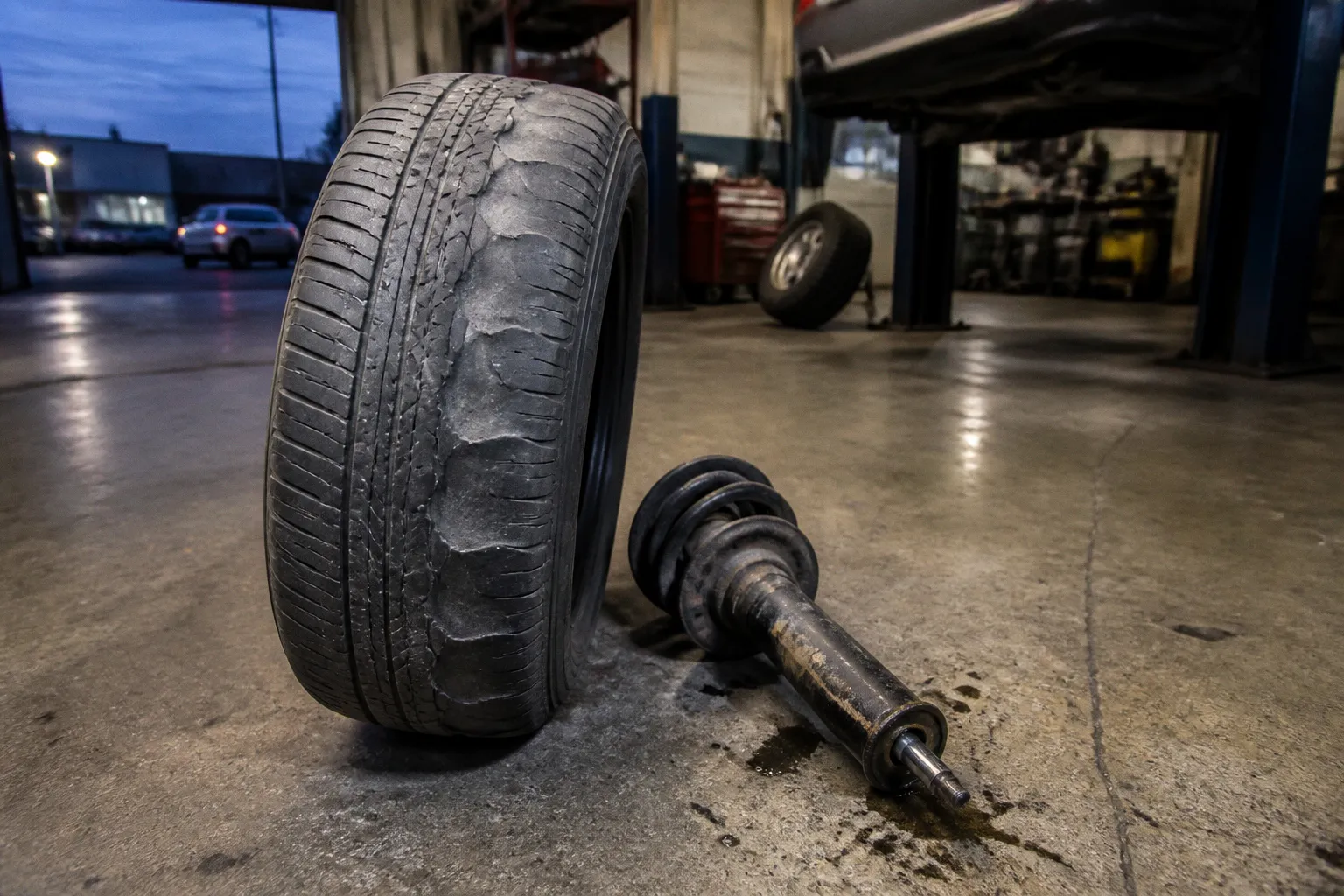
At speed, the result is a rhythmic hum, thump, or drone that rises with road speed.
The root fault is often uncontrolled wheel movement. A worn shock absorber or strut no longer suppresses the suspension’s oscillation after a bump. The tire loses consistent contact with the road, loads and unloads in cycles, and removes rubber from localized tread sections. That is why bad shocks cause tire cupping even when the tire itself is correctly inflated and the wheel appears visually straight.
The tire is not creating the problem. It is recording a suspension problem.
The physics of scalloping: why tires lose contact
A tire must remain loaded against the road surface. The contact patch changes shape as the wheel moves, but the load should remain sufficiently stable for the tread to roll rather than skip.
The spring supports the vehicle. The shock absorber or strut controls the spring’s movement. These functions are separate.
When the wheel encounters a bump, the spring compresses. It then attempts to extend. Without adequate damping, the wheel continues moving after the original road disturbance has passed. The suspension may compress and rebound several times before returning to a stable position.
The tire follows that movement. During one part of the cycle, vertical load increases. During another, load falls sharply. If the tire unloads enough, the tread contact becomes weak or intermittent. When the tire strikes the pavement again, friction rises at a small section of the tread. Repetition creates a series of depressions.
This is the shock absorber dampening physics behind scalloping:
1. A road impact compresses the spring.
2. The spring releases stored energy.
3. Damping resistance fails to control rebound.
4. The wheel moves through repeated oscillations.
5. Vertical tire load changes rapidly.
6. Localized friction removes rubber from separate tread sections.
The wear is not random. It corresponds to the frequency and amplitude of the wheel’s movement. A tire can remain round while its tread develops a repeating pattern of low spots. The wheel may also remain balanced on a machine while the vehicle produces cupping under real suspension load.
Cupping is a tread record of wheel movement. The damaged rubber is the result, not the source.
A worn damper does not need to produce a visible fluid leak to be defective. Internal valve wear, degraded oil, seal deterioration, or loss of gas pressure can reduce damping without leaving a clear external trace. A dry shock body is not proof of correct operation.
The expected service range provides a first diagnostic boundary. Shock absorbers commonly remain effective for approximately 50,000 to 60,000 miles. Struts often operate for approximately 60,000 to 90,000 miles. These are not guaranteed replacement intervals. Vehicle mass, road surface, climate, load, tire construction, and driving conditions alter the result.
If the vehicle has exceeded these ranges and a cupping pattern is present, damper performance moves high on the fault list.
Identifying the tire cupping wear pattern
Cupping is identified by shape, repetition, and tactile variation. A visual inspection should be followed by a hand inspection across the tread.
The vehicle should be parked on a flat surface. The tread should be clean enough for the block edges to be seen. A hand should be moved across the tread in both directions. A cupped tire will often feel smooth in one direction and stepped or sawtoothed in the other.
The following signs support a cupping diagnosis:
- Repeated scooped depressions appear around the circumference of the tire.
- The low spots occur at regular intervals rather than as one isolated damaged area.
- The tread blocks show uneven height from one section to the next.
- A rhythmic humming or droning increases with vehicle speed.
- A steering wheel vibration may appear within a specific speed range.
- The noise remains present when the engine speed changes but road speed remains constant.
- The pattern is more pronounced on one axle or one corner of the vehicle.
Road noise must be separated from bearing noise. A damaged wheel bearing can produce a similar drone. The distinction is made through behavior. Bearing noise often changes when the vehicle is gently loaded left or right in a controlled road test. Cupping noise usually follows tire rotation speed and can be confirmed through tread inspection.
A simple diagnostic sequence is more reliable than replacing parts by noise alone.
If/then diagnosis
1. If the tread contains repeated scooped sections, then inspect the suspension before fitting a replacement tire.
The damaged tire may be the visible endpoint of a damper, alignment, balance, or tire-pressure fault.
2. If the cupping is concentrated on one wheel, then compare that corner with the opposite side.
Check the shock or strut, spring seat, top mount, control arm bushings, ball joint, wheel bearing, and tire pressure.
3. If both tires on one axle show similar cupping, then inspect axle-level causes.
Damper wear, incorrect alignment, incorrect rotation history, or a common tire-pressure error becomes more likely.
4. If the steering wheel vibrates at a narrow speed range, then verify wheel balance and radial runout.
A balance fault can create a force that contributes to uneven wear. It cannot be excluded from a cupping diagnosis.
5. If the noise changes with engine rpm rather than road speed, then the tire is not the primary suspect.
Driveline, engine, or accessory noise should be isolated separately.
6. If the tire pressure has been incorrect, then correct it before judging the suspension response.
Underinflation and overinflation alter the contact patch and can accelerate irregular wear.
The tread pattern supplies direction. It does not identify every failed component by itself.
The hidden dangers of ignoring worn dampers
Cupping is not limited to noise and cosmetic tread damage. A tire with alternating high and low contact sections has less consistent road contact. Braking, cornering, and wet-road behavior are affected by the same vertical load instability that created the wear.
Testing conducted by Tenneco Automotive found that a vehicle with worn shocks required 13.1 feet more braking distance than the same vehicle equipped with new shocks. The exact result varies with vehicle design, speed, tire condition, road surface, and brake system. The mechanical conclusion remains direct: damping affects tire contact, and tire contact affects stopping performance.
The braking system cannot compensate for a tire that is repeatedly unloading. Brake pad friction may be correct. Rotor thickness may be within specification. Hydraulic pressure may be stable. If the wheel is not held firmly against the pavement, the available braking force is not converted efficiently into deceleration.
The same issue appears during cornering. A worn strut allows greater body and wheel movement. The outside tire is loaded while the inside tire may unload. If the tread is already cupped, the available grip becomes less predictable. On wet pavement, the irregular contact pattern adds another variable to water evacuation.
Secondary component wear also increases. Repeated uncontrolled movement transfers force into parts that were not designed to absorb endless oscillation:
- Wheel bearings receive fluctuating radial loads.
- Control arm bushings are compressed and released more aggressively.
- Ball joints experience repeated changes in angle and force.
- Coil springs are subjected to higher movement cycles.
- Strut mounts and bearing plates receive additional impact.
- Tire sidewalls and belt structures experience irregular loading.
- Alignment angles can change as worn joints develop excess play.
This creates a feedback loop. A worn damper produces wheel bounce. Wheel bounce damages the tire and loads suspension joints. Joint movement changes wheel control. The altered wheel motion accelerates further tread wear.
Replacing the tire alone breaks none of these links.
Beyond shocks: other causes of uneven tread wear
Worn shocks and struts are common causes of tire cupping, but they are not the only causes. A correct diagnosis must account for alignment, balance, pressure, tire construction, and service history.
Wheel alignment
Camber, caster, and toe determine how the tire meets the road.
Excessive toe causes the tread to scrub laterally. The tire is forced to travel at an angle relative to the vehicle’s direction. This can create feathering, diagonal wear, and edge damage. Camber loads one side of the tread more heavily than the other. Caster affects steering self-centering and dynamic wheel behavior.
Alignment does not restore damaged tread. If a tire is already cupped, correcting toe or camber prevents the new tire from receiving the same damage. The existing low spots remain.
Alignment should be measured after suspension components are checked. A machine can report a numerical angle, but the angle may shift when a worn bushing or ball joint moves under load. A printout made with loose hardware is not a stable repair result.
Wheel and tire balance
An imbalanced assembly generates centrifugal force as speed increases. The force can excite suspension movement and contribute to irregular wear. A missing wheel weight, deformed wheel, damaged tire belt, or excessive radial runout can produce a similar symptom.
Balance should be verified with the correct wheel and tire assembly. The machine’s displayed imbalance is not the only variable. The tire bead must be seated correctly. The wheel must be centered on the balancer. Hub-centric and lug-centric mounting errors can create an apparent balance fault after the wheel is reinstalled on the vehicle.
If balancing corrects a vibration but the cupping pattern continues, the suspension still requires inspection.
Tire pressure
Pressure changes the shape and stiffness of the contact patch. Incorrect pressure can make an existing suspension fault more destructive.
The cold inflation pressure specified for the vehicle should be used. The number molded into the tire sidewall is generally a maximum pressure reference, not the vehicle’s operating target. Pressure should be measured cold, before driving has heated the tire.
If the vehicle carries varying loads, the manufacturer may specify separate front and rear pressures. A single pressure value applied to every position can be incorrect.
Tire rotation
Rotation does not repair cupping. It can alter the rate at which the noise develops and distribute wear between axles. A 5,000-mile rotation interval is commonly used as a maintenance reference, provided the tire design and vehicle manufacturer allow that rotation pattern.
Directional tires, staggered wheel sizes, and asymmetric fitments limit the available rotation options. The pattern must match the tire construction and wheel arrangement. Moving a tire to an unauthorized position can create handling or clearance problems.
Suspension geometry and component play
A control arm bushing may appear intact while allowing excessive movement under braking or acceleration. A ball joint may have no obvious visual damage but exceed its allowable play. A bent wheel carrier, damaged subframe, or incorrect ride height can also alter the tire’s dynamic path.
The inspection should be performed with the vehicle supported according to the service procedure. Some joints show play only when loaded. Others must be unloaded before movement becomes visible. A generic shake test is not a substitute for the manufacturer’s inspection method.
The following fault map separates common tread patterns:
| Tread pattern | Likely mechanical direction | Required verification |
|---|---|---|
| Repeated scooped depressions around the tire | Weak damping, balance fault, alignment issue, or tire-pressure error | Damper response, wheel balance, alignment, pressure history |
| Feathered tread blocks | Excessive toe or lateral scrub | Alignment angles and steering linkage play |
| Wear on one shoulder | Camber, inflation, or suspension geometry fault | Camber, ride height, pressure, component condition |
| Center tread wear | Excessive inflation or load-related pressure error | Cold pressure against vehicle specification |
| Both shoulders worn | Insufficient inflation or overload | Cold pressure, load, tire size |
| One isolated flat section | Lockup, severe impact, or localized tire damage | Tire internal condition, brake drag, road-impact history |
No pattern should be treated as a part number. It is a diagnostic clue.
The reality of cupped tires: why replacement is mandatory
Cupped tread cannot be rebuilt by alignment, balancing, rotation, or shock replacement. Rubber that has been removed from the tread cannot be returned to its original profile through normal service.
The damaged tire may continue to operate if tread depth, casing condition, speed rating, and legal requirements remain acceptable. That does not make the wear reversible. The tread surface will continue to generate noise and may provide less uniform contact. Replacement becomes necessary when the tire reaches an unsafe condition or no longer meets the required service standard.
The sequence matters.
1. The cupped tire is identified and its condition is recorded.
2. Tread depth and wear severity are measured across the tire.
3. The shock absorber or strut is tested or replaced if damping is inadequate.
4. Alignment, balance, pressure, and runout are verified.
5. Loose or damaged suspension components are repaired.
6. The tire is replaced when its condition requires removal.
7. The vehicle is road-tested and the new tread is monitored.
Replacing the tire first can be reasonable if the casing is unsafe. It is not a complete repair. If the damper or alignment fault remains, the replacement tire becomes the next wear surface.
When one shock or strut has failed, replacement strategy depends on vehicle design, mileage, axle condition, and manufacturer procedure. Dampers on the same axle often require comparison because a large performance difference between left and right sides can produce uneven handling. The decision should be based on measured condition and axle symmetry, not only on the presence of one visible leak.
How the repair is verified
A repair is not complete when the new tire is installed. It is complete when the mechanical conditions that created the wear have returned to baseline.
The following values should be available after service:
- Cold tire pressure set to the vehicle manufacturer’s specification.
- Wheel balance within the equipment’s accepted limit.
- Radial and lateral runout within the vehicle or wheel manufacturer’s limit.
- Alignment angles within specification, including individual toe and camber values.
- No unacceptable play in ball joints, tie-rod ends, wheel bearings, or control arm bushings.
- Shock absorbers or struts with adequate damping response and no installation error.
- Correct ride height, spring seating, and upper mount orientation.
- No brake caliper drag or wheel rotation resistance outside specification.
- No abnormal tire noise or steering vibration during the road test.
A road test should use a known route with smooth and coarse pavement if possible. Noise that changes with road surface may be tread-related. Noise that follows vehicle speed on several surfaces requires further tire, bearing, or driveline isolation. Steering vibration should be correlated with speed, not engine rpm.
A tread-depth gauge should be used at multiple points around the circumference and across the tread width. Rechecking after several thousand miles reveals whether the wear pattern has stabilized. A new tire that begins developing repeating low spots has already supplied the next diagnostic signal.
A new tire is not proof of a repaired suspension. It is only a new measurement surface.
The exact baseline for a reliable repair
The fault path is direct.
If repeated scooped tread sections are present, inspect damping. If damping is inadequate, repair the damper or strut fault. If damping is acceptable, inspect balance, alignment, pressure, runout, and suspension play. If the tread has already been removed, do not represent adjustment as restoration. Replace the tire when its condition requires it.
The target state is not simply a quiet ride. It is stable wheel control, correct geometry, controlled tire loading, and predictable braking contact.
The verification baseline is equally direct: correct cold pressure, balanced assembly, measured alignment within specification, no abnormal component play, controlled rebound, no brake drag, and no recurrence of rhythmic tread height variation.
That is how tire cupping is resolved. The tire is replaced when necessary. The suspension fault is corrected first in mechanical terms, then confirmed through measured parameters.