ProBYTE Update Expands Denso Diesel ECU Tuning and Diagnostic Capabilities
K-LINE CAN access on Toyota and Lexus Denso Diesel Gen1 ECUs has been pushed through ProBYTE, per ECUTools.
Aldous Moorland·updated August 26, 2026
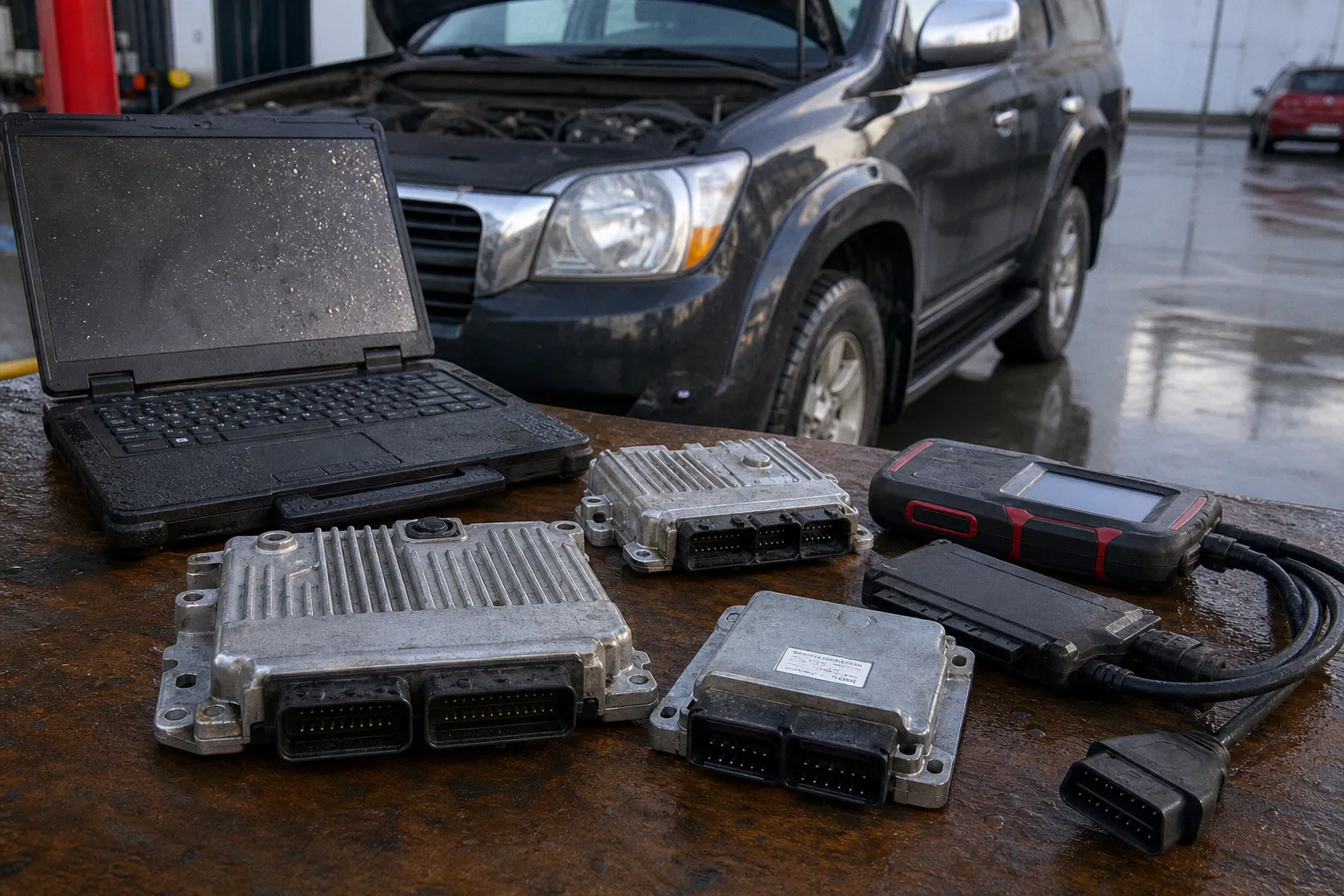
EGR off, DPF off, and DTC off routines are now executable against the Gen1 control layer. Three concurrent firmware packages — DashCoder 4, Xhorse 2026, and PCMflash Module 101 — widen the available repair surface across Asian, American, and European import lines.
ProBYTE Module: Denso Gen1 Diesel
The module addresses the Denso Diesel Gen1 ECU family through K-LINE CAN. Three emission-system functions unlock post-flash: EGR deactivation, DPF regeneration bypass, and DTC erasure. The package targets Toyota and Lexus diesel platforms running the Gen1 architecture. Pre-flash verification of K-Line and CAN bus integrity is required; any communication fault must be resolved before the module is deployed to avoid ECU lockout.
Adjacent Toolchain Updates
DashCoder 4 Update Paket 08/2026, per IOBD, delivers BCM coverage for Chevrolet platforms, RH850 procedures for Haval, Ford, Suzuki, and Toyota vehicles, and memory routines across 24CXX, 24XXX, 24C32, 93CXX, 95XXX, 95CXXX, and HC11 chip families. Dashboard repair, cluster EEPROM work, and mileage correction workflows now extend across American, European, Japanese, Korean, and Chinese import models.
Xhorse's 2026 package, reported by VXDAS, introduces OBD key programming for BMW BDC3/U modules and expands electric vehicle and motorcycle coverage. BDC3/U access addresses the all-keys-locked state that previously forced module replacement on BMW import variants.
PCMflash Module 101, per Caracal Tech, opens bootloader mode on Marelli 11GC and 11GDB control units. Bench-level read, write, and checksum correction are enabled for Chinese-market petrol applications equipped with these Marelli variants. ECU recovery no longer requires OBD-side workaround for shops running Marelli-equipped imports.
Pre-Deployment Verification
Bus integrity is confirmed before any module is flashed. The K-Line and CAN lines are checked for stable communication with the target ECU. If the ECU fails to respond or returns bus errors, the underlying fault is diagnosed and repaired first. Flashing onto a compromised bus corrupts the new module and returns the ECU to a no-communication state. The flash procedure is re-attempted only after bus integrity is restored and a clean diagnostic handshake is logged.