Rust prevention sprays: why oil-based formulas stop corrosion
Rust begins where water remains in contact with metal long enough for an electrochemical reaction to continue. The visible result may be a brown edge on a seam, a blister under paint, or a flaking section of an underbody coating.
Aldous Moorland·Updated: August 16, 2026·15 min read
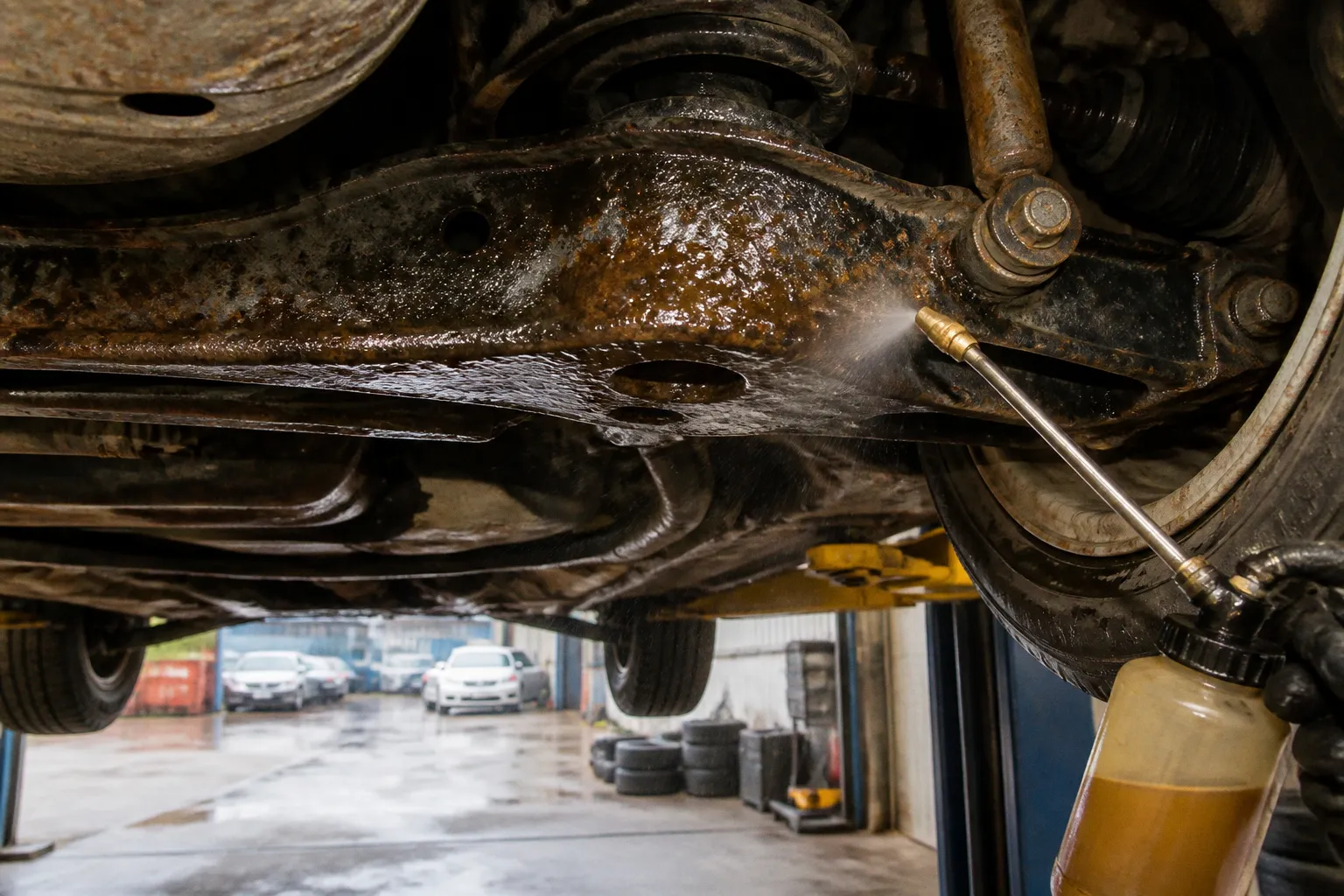
The active damage starts earlier. Moisture is already occupying the interface between steel, oxygen, and contaminants.
An oil-based rust prevention spray attacks that interface directly. It does not convert corrosion into an inert ceramic layer. It displaces water, excludes air, wets the metal surface, and leaves a soft hydrophobic film that can migrate into seams and cavities. That mechanism makes it different from hard paint, rubberized undercoating, and cavity wax products that depend on a more stable deposited layer.
The relevant search question is not simply which rust prevention spray is thickest. It is whether the product can reach the corrosion, remove the moisture film, remain in place, and be renewed before road spray and washing remove it.
How rust inhibitors work at the metal surface
Steel corrosion requires an electrolyte. In vehicle applications, the electrolyte is commonly a thin film of water carrying dissolved salts, dirt, and other contaminants. The film can be almost invisible. Its electrical conductivity is sufficient to support localized corrosion in seams, welds, folded flanges, fastener interfaces, and stone-damaged areas.
An oil-based rust prevention formula uses surface-active chemistry to interrupt that process. Polar molecules, including sulfonate-type compounds, are attracted to the metal surface. Their hydrophobic hydrocarbon groups orient away from the metal and away from water. The result is an adsorbed barrier.
The process is physical and interfacial. Water is displaced from the metal. It is not chemically destroyed. The spray does not make moisture disappear through a reaction. It separates the water film from the steel and reduces further access by air and liquid water.
This distinction matters. A product that merely leaves an oily residue on a clean panel is not necessarily providing the same protection as a purpose-formulated corrosion inhibitor. The useful behavior depends on several linked properties:
- Surface wetting. The liquid must spread across steel instead of forming isolated droplets.
- Water displacement. The formulation must migrate beneath or through an existing moisture film.
- Creep. The product must travel into overlaps, seams, welds, and cavities after application.
- Adhesion. The residual film must remain attached when exposed to vibration and temperature change.
- Self-healing. Minor scratches or thin spots must be capable of being re-covered by surrounding fluid.
- Controlled persistence. The film must remain soft without drying into a brittle shell.
A hard coating works by creating a fixed physical layer. An oil-based inhibitor works more like a mobile boundary condition. It continues to move slowly after application. That movement is the reason it can reach areas that a brush or rigid coating cannot physically contact.
The useful action is not “covering rust.” It is removing the water interface and maintaining a soft hydrophobic barrier where steel remains exposed.
Why soft oil films reach places hard coatings miss
Automotive bodies are not flat plates. They contain folded seams, boxed frame rails, spot-welded overlaps, drain channels, subframe cavities, and narrow interfaces around brackets. Corrosion often advances inside those structures before it becomes visible from below.
A rigid undercoating can protect a clean, prepared surface. Its weakness appears when the surface is contaminated, damp, or already corroded. If the coating fails to bond uniformly, a gap remains. If the coating later cracks or chips, water can enter through the damaged area. The rigid film may then slow evaporation and conceal the progression of rust underneath.
Oil-based formulas remain soft. They do not depend on a single brittle shell. Their creeping action allows the fluid to migrate into tight areas and wet metal that could not be reached with a roller, brush, or conventional spray pattern.
This is especially relevant in the following locations:
- Door bottoms and folded hem flanges.
- Rocker-panel seams and pinch welds.
- Subframe junctions and suspension mounting areas.
- Frame rails with access openings.
- Welded overlaps around wheel arches.
- Fastener heads and threaded interfaces.
- Brake and fuel-line clips where bare steel contacts another material.
- Existing surface rust on underbody panels.
- Drain channels and enclosed body cavities.
The same behavior creates a practical limitation. A creeping oil film does not stop at the intended target. It can reach rubber components, wiring looms, brake parts, exhaust surfaces, and painted areas. Application must therefore be controlled by location, pressure, nozzle selection, and masking.
Coverage is not the same as saturation. A cavity that is visibly wet at the access point may still contain dry internal surfaces. A probe tube, wand, or fan nozzle may be required to distribute the product along the full seam. The objective is not to create a thick puddle. It is to establish a continuous film on the metal surfaces most exposed to trapped moisture.
Oil-based rust prevention versus hard and rubberized undercoating
The two approaches solve different problems. Oil-based rust prevention is active and mobile. Hard or rubberized undercoating is primarily a fixed barrier. Neither should be treated as a universal substitute for surface preparation or structural repair.
| Property | Oil-based rust prevention spray | Hard or rubberized undercoating |
|---|---|---|
| Physical state after application | Soft, non-hardening film | Rigid or semi-rigid deposited layer |
| Water behavior | Displaces moisture from the metal interface | Attempts to exclude water through coverage |
| Movement into seams | High, because the fluid creeps | Limited after the coating sets |
| Behavior over existing surface rust | Can penetrate through surface rust and displace trapped moisture and oxygen | May seal over contamination or damaged rust if preparation is inadequate |
| Damage response | Film can remain self-healing around minor scratches | Cracks, chips, or lifted edges can expose and conceal corrosion |
| Service requirement | Film wears thin and requires renewal | May last longer as a physical layer but can fail locally without obvious external evidence |
| Best use | Cavities, seams, mixed-condition metal, annual corrosion control | Properly prepared, accessible surfaces where a fixed protective layer is appropriate |
| Main risk | Overspray, migration, contamination of friction surfaces | Moisture entrapment beneath damaged or poorly bonded coating |
The failure mode is more important than the marketing label. A soft inhibitor generally becomes less effective by thinning and washing away. The loss is visible as reduced film coverage and can be corrected with reapplication.
A damaged rubberized coating can fail less transparently. The outer surface may remain intact while corrosion continues underneath a lifted edge or a pinhole. Inspection then becomes more difficult. The coating itself is not proof that the steel beneath it is dry or stable.
This is why oil-based products are particularly useful on older vehicles with established surface oxidation, complex underbody geometry, and seams that cannot be cleaned to bare metal without disassembly. They are not structural restorers. They are moisture-control products.
Severe scaling, perforation, cracked suspension mounts, and weakened frame sections require metal repair. No rust prevention spray restores lost steel. A product that penetrates surface corrosion can slow the active process. It cannot reverse section loss.
Application is a contamination-control operation
The application procedure determines whether the chemistry reaches steel or merely coats dirt. The vehicle must be inspected before spraying. Existing underbody material must be classified.
There are three different surfaces:
1. Sound painted or plated metal. The protective finish is intact. Oil can be applied to seams, edges, fasteners, and exposed interfaces without removing the original coating.
2. Surface rust. Oxidation is present, but the panel remains structurally continuous. Loose scale and dirt should be removed. The remaining corrosion can then be treated with a creeping inhibitor.
3. Structural corrosion. Metal is perforated, deeply delaminated, or mechanically weakened. Spraying may provide temporary moisture control but does not constitute a repair.
Water and loose contamination should be removed before application. The surface does not need to be polished to bare steel across the entire underbody. That would be unnecessary and could remove intact factory protection. It does need to be free of mud, loose scale, heavy salt deposits, and standing water.
The sequence should follow the geometry:
1. Inspect access and drainage
Cavities need entry points and drainage paths. Factory drain holes must not be sealed. If a cavity cannot drain, adding a liquid barrier can preserve the very moisture that corrosion control is intended to remove.
The condition of plugs, grommets, clips, and access covers should be recorded. A missing plug can admit road spray directly into a rocker panel or frame rail. The spray is not a substitute for restoring that seal.
2. Remove loose material
Loose rust scale is mechanically unstable. It can separate from the panel and carry the protective film with it. Dirt also blocks wetting. A non-destructive brush, compressed air, or low-aggression cleaning method can be selected according to the surface.
High-pressure washing requires caution. Water can be driven deeper into seams and cavities. Drying must be completed before the inhibitor is introduced.
3. Mask friction and thermal zones
The product must not be placed on brake friction surfaces, brake-pad contact areas, tire tread, or other components where a low-friction film can create a safety defect.
Exhaust components are separate from corrosion-prone body seams because their operating temperature can degrade the film and create smoke or odor. Heat shields, catalytic converters, mufflers, and other high-temperature parts should be excluded unless the product documentation explicitly permits the application.
Electrical connectors require controlled application. A non-conductive oil film does not create a short circuit in the manner of a conductive liquid, but it can alter contact conditions if introduced between terminals. The relevant electrical quantity is voltage drop across the connection. A properly functioning connection should remain near its baseline, with a drop on the order of 1/100th of a volt or less under the specified load. That measurement is taken with the circuit energized. It is not inferred from the connector’s appearance.
4. Select the delivery pattern
A broad spray is suited to exposed seams and panel faces. A wand or extension tube is suited to rails, rockers, doors, and boxed sections. The nozzle should be matched to the cavity rather than used indiscriminately.
The film should be continuous but not excessively pooled. Excess material can drain onto surfaces that should remain dry. It can also collect dust and road grit, producing an abrasive paste around moving or serviceable components.
5. Allow migration and inspect the result
Creeping products continue moving after spraying. The vehicle should be inspected after the initial application period for runoff, blocked drains, and contamination of nearby components. Any product on brake or tire surfaces must be removed before the vehicle is operated.
A visible oily sheen is not the final verification. The relevant result is coverage of exposed and vulnerable metal, especially at seams, overlaps, and cavity interiors. If the product remains only on the exterior face while the seam stays dry, the application has not achieved its purpose.
The electrical boundary must remain measurable
Rust prevention work often reaches areas adjacent to wiring. The oil itself may be electrically non-conductive. That does not make every application electrically neutral.
A connector is a mechanical and electrical interface. Its performance depends on terminal force, contact cleanliness, plating condition, wire crimp integrity, and the absence of unwanted material between the mating surfaces. Oil placed around the outside of a sealed connector may protect the housing and nearby fasteners. Oil placed between terminal contacts can change the interface.
The correct diagnostic method is direct measurement:
- Record the circuit voltage with the system operating.
- Measure voltage drop across the connector or ground path under load.
- Compare the result with the known baseline for that circuit.
- If the drop approaches or exceeds the expected limit, inspect the terminals mechanically.
- Restore the connection before applying external corrosion protection.
The spray should not be used to compensate for a poor crimp, oxidized terminal, broken ground strap, or water-damaged connector. Those are electrical faults. They require repair and verification.
The same rule applies to battery terminals, chassis grounds, and exposed fasteners. A corrosion inhibitor may reduce water access around the connection. It does not replace correct clamping force or a clean conductive contact surface. The conductive path must remain metal-to-metal at the intended contact area. Protection belongs around the interface, not between surfaces that must carry current.
Reapplication is part of the system
Oil-based protection is not permanent. Road spray, salt, dust, detergents, abrasion, and repeated washing reduce film thickness. The film can also migrate away from exposed edges over time. Annual reapplication is the standard maintenance interval recommended for continuous protection, with inspection determining whether particular areas require earlier attention.
The interval should not be interpreted as a fixed guarantee. Severe winter salt exposure, frequent high-pressure washing, off-road use, and damaged seams increase the rate of film loss. The exact service life under extreme conditions is formulation- and environment-dependent.
A practical maintenance inspection should focus on changes, not just presence:
- Has the film disappeared from exposed leading edges?
- Are seams still visibly wet with inhibitor?
- Has fresh orange corrosion appeared around fasteners or welds?
- Are drain holes open?
- Has road dirt formed thick deposits that conceal the metal?
- Has a hard coating cracked or lifted over previously treated rust?
- Has the product migrated onto brakes, tires, belts, or hot exhaust components?
- Are cavity plugs and grommets still installed?
A renewal coat should not be applied over thick accumulated contamination. The surface should be cleaned enough to expose the areas that need treatment. Otherwise, the new fluid may saturate dirt while leaving the steel interface poorly protected.
Annual renewal is not evidence that the product failed. It is the operating requirement of a soft film exposed to water, abrasion, washing, and road salt.
Cavity protection and underbody treatment are not identical
The same oil-based chemistry can be used in several areas, but the delivery problem changes with the geometry.
Cavity wax rust protection is intended for enclosed or semi-enclosed body sections. It must be delivered through access holes and distributed along internal surfaces. A long wand is often more important than spray volume. The product must reach the upper, lower, and overlapping faces of the cavity without blocking drainage.
Undercoating rust prevention concerns exposed lower surfaces. These surfaces receive direct impact from water, stones, salt, and dirt. A creeping oil film can protect seams and existing surface rust, but the exposed area must be inspected more frequently because mechanical wear is greater.
Door and hatch treatment requires attention to hem flanges and drain paths. Excess product can collect at the lower edge and mix with dirt. Drainage must remain open.
Frame and subframe treatment requires a distinction between surface corrosion and structural damage. Oil can penetrate existing surface rust. It cannot restore thickness to a perforated rail or replace a weakened mounting section.
Fastener treatment can slow corrosion around bolts and brackets. It can also contaminate threads or interfere with later torque measurements if applied without a service plan. Components intended for a precise friction condition should be handled according to the vehicle repair procedure.
The product must therefore be selected and applied by location. A broad claim such as “spray the entire underside” is technically incomplete. The underside contains brake systems, exhaust systems, suspension joints, electrical connections, drain openings, and painted structural surfaces. Each has a different tolerance for contamination.
Where oil-based sprays should not be treated as a cure
Oil-based rust prevention is effective against moisture-driven oxidation. It is not a cure for every defect associated with corrosion.
It should not be used to conceal:
- Perforated body panels.
- Cracked or weakened suspension mounts.
- Corroded brake pipes with reduced wall thickness.
- Structural frame damage.
- Rust that has lifted paint over a large hidden area.
- Blocked cavity drains.
- Water leaks from seals, windshields, sunroofs, or body plugs.
- Electrical faults caused by damaged terminals or ground paths.
The source of water must also be corrected. If a door seal leaks, the inhibitor may slow the resulting corrosion but the cavity will continue receiving moisture. If a windshield or roof seam allows water into the cabin, an interior treatment does not solve the leak. If a rocker panel retains water because its drain is blocked, additional spray can worsen retention.
Rust control is therefore a sequence:
1. Stop the water entry or retention.
2. Remove loose contamination.
3. Assess whether the metal is cosmetic or structural.
4. Repair weakened metal.
5. Apply a compatible corrosion inhibitor to remaining sound and surface-rusted areas.
6. Keep drains, friction surfaces, electrical contacts, and hot components free of contamination.
7. Inspect and renew the film at the required interval.
Skipping the first four steps turns corrosion protection into concealment. The film may look complete while the metal continues to deteriorate underneath.
The baseline that confirms the repair
A rust prevention spray has done its job when the metal interface remains isolated from persistent moisture and the protected areas can be inspected and renewed without introducing new defects.
The verification baseline is physical and electrical:
- Seams and cavities show continuous inhibitor coverage.
- Surface rust is not covered by loose scale or mud.
- Drain holes remain open.
- No product is present on brake friction surfaces, tire tread, or other critical friction interfaces.
- Exhaust and high-temperature components remain free of treatment unless explicitly approved.
- Electrical connectors remain mechanically secure.
- Loaded-circuit voltage drop remains at the established baseline, with approximately 0.01 volt or less where that is the specified acceptable condition.
- No new water path remains active.
- The film is scheduled for inspection and annual renewal.
The correct rust prevention spray is not the one that forms the hardest shell. It is the one that maintains the correct boundary between steel, water, and oxygen while reaching the seams that rigid coatings leave untreated. Its advantage is controlled mobility. Its limitation is the same: mobility requires inspection, clean application, and renewal.
Corrosion control is not a one-time layer. It is a measured maintenance process. When the water path is corrected, the metal is assessed honestly, the inhibitor is applied only where it belongs, and the electrical and mechanical baselines remain unchanged, oil-based protection performs its intended function.