Spongy Brakes After Bleeding: How to Clear ABS Air
A soft brake pedal after bleeding does not prove that air remains in the four brake lines.
Aldous Moorland·Updated: August 18, 2026·17 min read
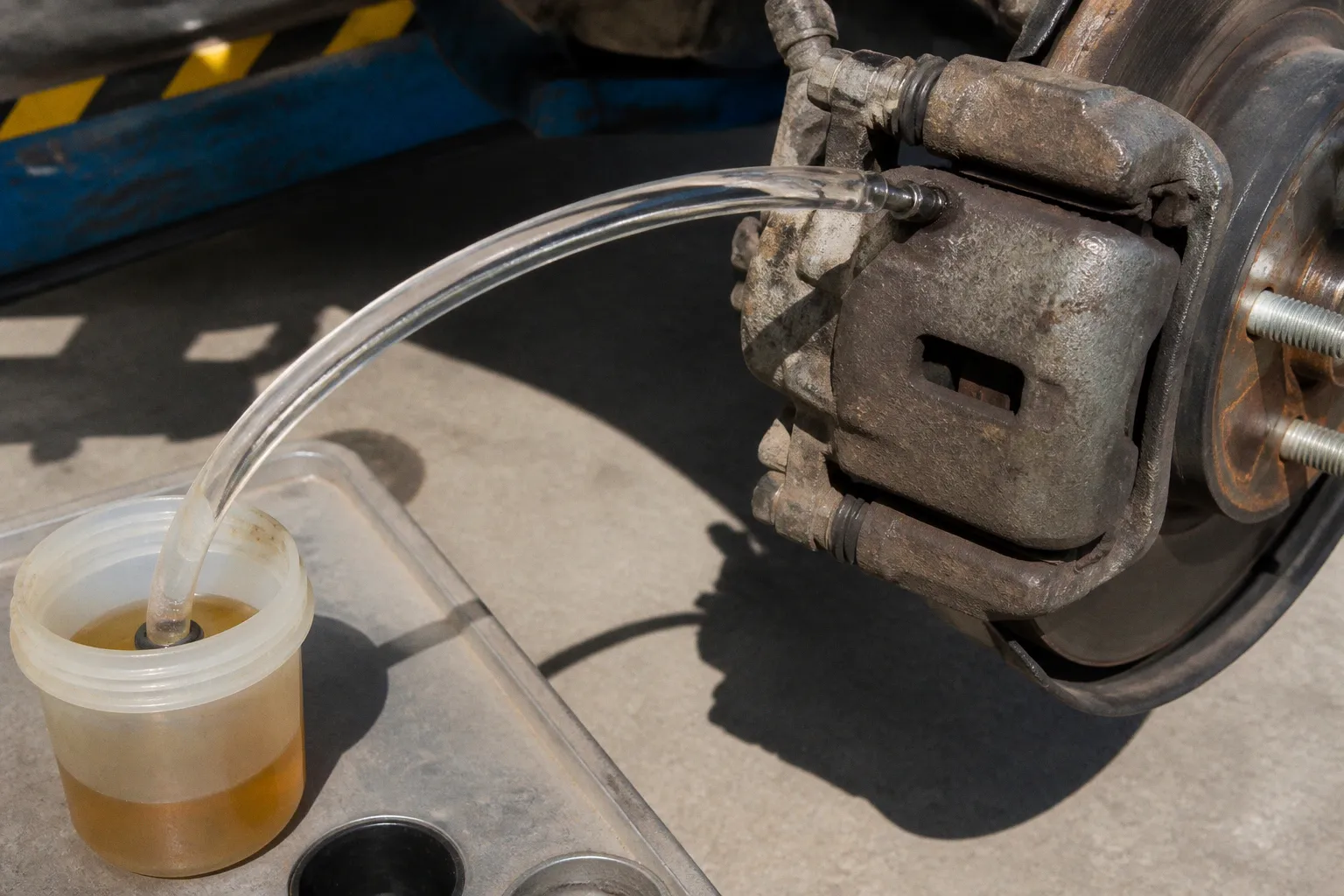
On a modern vehicle, air can remain inside the ABS hydraulic control unit, where solenoid valves, accumulators, narrow passages, and the pump assembly isolate sections of the circuit during normal bleeding.
If the pedal remains compressible after clean fluid reaches each caliper, the next diagnostic step is not repeated pedal pumping. The ABS hydraulic unit must be evaluated and, when required, cycled with a bi-directional scan tool during a second bleeding operation.
The fault path is conditional:
- If air is present in the caliper circuit, corner bleeding can remove it.
- If air is trapped inside the ABS hydraulic control unit, standard bleeding may not reach it.
- If the calipers are installed on the wrong sides, the bleeder screws remain below the trapped air pocket.
- If the master cylinder seals have been damaged, bleeding cannot restore pedal height.
- If the fluid contains excessive moisture, the system may develop vapor under heat even after the pedal initially feels firm.
Why traditional bleeding fails to clear the ABS block
A conventional hydraulic brake system is comparatively direct. The master cylinder generates pressure. Fluid travels through rigid lines and flexible hoses. The caliper pistons move. The bleeder screws provide access to the fluid column.
An ABS-equipped system adds a hydraulic control unit between the master cylinder and the wheel circuits. The unit contains electrically controlled valves, internal passages, accumulators, and an electric pump. During ordinary braking, the valves remain in positions determined by the control strategy. During conventional bleeding, they may not open the passages needed to evacuate air from the unit.
This creates a diagnostic dead end. Fluid can appear clean and bubble-free at the caliper while air remains upstream inside the ABS block.
The result is a pedal that may show one or more of the following characteristics:
- The pedal travels farther than before the repair.
- Initial pressure produces little resistance.
- The pedal becomes firmer after several rapid applications.
- The pedal feels acceptable with the engine off but becomes softer after the engine starts.
- The pedal improves temporarily after bleeding and returns to a low position after driving.
- No ABS warning lamp is present.
The absence of a warning lamp does not eliminate hydraulic air. The ABS controller can operate without detecting a sensor or electrical fault while the hydraulic unit still contains compressible gas.
The difference between static bleeding and ABS cycling
During static bleeding, fluid is moved through the circuits by one of three methods:
1. Manual pressure bleeding. The brake pedal is used to pressurize the master cylinder.
2. Pressure bleeding. A pressure bleeder applies force at the reservoir.
3. Vacuum bleeding. Fluid is drawn through a caliper bleeder screw.
Each method can evacuate air from accessible passages. None should be assumed to purge a closed ABS modulator.
An automated ABS bleed procedure changes the hydraulic state of the unit. A bi-directional scan tool commands the ABS controller to operate its pump and open or close selected solenoid valves. Fluid is then moved through passages that remain static during ordinary bleeding.
The scan tool is not merely reading a trouble code. A basic code reader may display ABS faults, chassis data, or sensor information. It cannot necessarily command the pump or solenoids. The required function is an active test or service routine with bi-directional control.
A clean stream at the caliper does not prove that the ABS hydraulic unit is free of air.
The exact automated sequence is vehicle-specific. Wheel order, valve timing, pump activation, and the requirement for a second conventional bleed vary by manufacturer. No universal corner sequence should be treated as an OEM procedure.
First eliminate mechanical traps
Air is compressible. A caliper installed incorrectly can produce the same pedal symptom as air trapped in the ABS block.
The bleeder screw must be positioned at the highest point of the caliper’s internal piston bore. If the calipers are swapped from side to side, the bleeder screws can face downward. Fluid may exit during bleeding, but the air pocket remains above the bleeder port. The system then appears to bleed correctly while the pedal remains soft.
This fault is common after a caliper replacement, a suspension disassembly, or work involving both front corners. It must be checked before any scan-tool procedure.
Caliper orientation test
The following logic applies:
1. Inspect each caliper.
2. Confirm that the bleeder screw is above the brake hose connection and above the piston cavity.
3. If the bleeder screw is below the piston cavity, the caliper is on the wrong side or incorrectly positioned.
4. Correct the installation.
5. Bleed the affected circuit again.
6. Reassess pedal travel before moving to ABS cycling.
A bleeder screw that can be opened does not automatically make the caliper correctly serviceable. Its position is the relevant parameter.
The same principle applies to replacement calipers with different casting geometry. The left and right units may appear physically interchangeable while their internal port positions are not.
Inspect the components that create pedal movement
A low or soft pedal can be produced by more than trapped air. The following components require separate evaluation:
- Brake caliper piston installation.
- Caliper slide movement.
- Pad seating against the rotor.
- Flexible brake hoses.
- Master cylinder sealing.
- Brake fluid condition.
- ABS hydraulic control unit.
- Rotor and hub runout that can push the pads back.
A seized or poorly lubricated caliper slide can prevent the pad from remaining correctly aligned. A flexible hose with internal structural failure can expand under pressure. Excessive rotor runout can move the caliper piston back into the bore, increasing pedal travel on the next application.
These conditions are not corrected by commanding the ABS pump.
Master cylinder seal damage during manual bleeding
Manual pedal bleeding has a specific risk on older or heavily used vehicles. The pedal may be pushed farther than its normal operating range. The master cylinder piston then travels across an unused section of the bore. Corrosion or ridge buildup can damage the internal piston seals.
The symptom can resemble trapped air:
- The pedal is low.
- Repeated applications may temporarily change pedal height.
- External fluid leakage may be absent.
- The system may not retain pressure with the pedal held.
- Additional bleeding does not produce a stable improvement.
The test must be performed without inventing a conclusion from one observation. If the pedal sinks under constant force, isolate the hydraulic circuits according to the service procedure for that vehicle. A master cylinder fault requires controlled confirmation. The ABS module should not be condemned because a manual bleed produced no result.
Pressure should not be held indefinitely with excessive force. The objective is to identify whether pressure is maintained, not to deform seals or components.
Brake fluid moisture and pedal compressibility
Brake fluid is hygroscopic. It absorbs moisture over time. When moisture content exceeds approximately 3.5%, the boiling point drops significantly. Under heavy braking, water-contaminated fluid can produce vapor. Vapor is compressible. The pedal then becomes longer or softer.
This is a different failure mode from a static air pocket. The pedal may feel acceptable during a cold inspection and deteriorate after repeated high-energy braking. A vehicle that has been driven through sustained braking loads requires fluid condition to be considered separately from ABS bleeding.
The relevant fluid designation must also be confirmed. DOT 3, DOT 4, and DOT 5.1 are glycol-based specifications with different performance characteristics. DOT 5 silicone fluid is a separate chemistry and must not be treated as an interchangeable substitute. The correct specification is determined by the vehicle manufacturer and the existing system design.
A complete fluid exchange can remove contaminated fluid from the accessible system. It does not guarantee that air has been removed from an ABS hydraulic unit unless the unit is cycled through the specified service routine.
The correct ABS brake bleeding procedure
The procedure below is a diagnostic framework. The actual sequence must be matched to the vehicle’s service information.
1. Establish the baseline before opening the system
Record the initial condition:
- Pedal height at rest.
- Pedal travel under moderate static pressure.
- Whether the engine is running or stopped.
- Whether the pedal firms after several applications.
- Fluid level and visible contamination.
- ABS warning lamp status.
- Brake fluid specification.
- Recent parts replaced.
If the pedal is soft only after the engine starts, the vacuum brake booster is changing the pedal assist. That does not identify the hydraulic fault by itself. A booster can alter effort and travel perception while the hydraulic system remains defective.
If the pedal is low with the engine off and remains low after repeated applications, hydraulic travel is more likely. The master cylinder, air, caliper movement, hoses, and pad clearance remain in the diagnostic path.
2. Confirm the mechanical installation
Inspect all four corners.
Check that:
- Bleeder screws point upward at the caliper piston cavity.
- Brake hoses are not kinked or twisted.
- Calipers are correctly mounted.
- Pads sit correctly in their abutments.
- Slide pins move as specified.
- No fitting or hose is leaking.
- Reservoir level is sufficient for the entire operation.
Bleeder screws are commonly 8 mm or 10 mm, but the size is not universal. The correct flare-nut wrench should be used where the fitting design requires it. An open-ended wrench can round a corroded bleeder screw and create a second repair.
3. Perform a conventional bleed if the system has been opened
A pressure bleeder provides more consistent fluid movement than uncontrolled pedal pumping. It also avoids repeated full-stroke travel in a worn master cylinder. Pressure must remain within the vehicle manufacturer’s permitted range. Excessive pressure can damage the reservoir, seals, or fittings.
If manual bleeding is used, the pedal should not be driven aggressively to the floor on a worn system. The master cylinder risk is mechanical, not theoretical.
Fluid should be monitored at the reservoir throughout the process. If the reservoir empties, air is introduced into the master cylinder and the entire procedure becomes longer.
The first phase should continue until clean fluid without visible bubbles reaches the caliper. This confirms that the external circuit has been flushed. It does not confirm that the ABS block is clear.
4. Connect a bi-directional scan tool
The scan tool must communicate with the ABS controller and provide an active hydraulic bleed function. The following capabilities are relevant:
- ABS module identification.
- Pump motor command.
- Solenoid valve actuation.
- Automated bleed or hydraulic unit bleed routine.
- Vehicle-specific instruction display.
- Ability to clear or recheck ABS-related diagnostic information.
A code reader that only retrieves and clears faults is insufficient for this operation. Communication with the vehicle is not the same as control of the hydraulic actuator.
Battery voltage should be stabilized before the routine begins. The ABS pump can draw significant current. Low system voltage can interrupt the procedure or produce misleading communication faults. The exact voltage threshold is vehicle-specific and should not be guessed.
5. Run the automated ABS bleed routine
The scan tool will direct the operator through a sequence. The pump cycles. Solenoid valves change state. Fluid is expelled through the selected caliper while the reservoir remains supplied.
The procedure is not complete when the tool reports that the pump has operated. The calipers must be bled as instructed during or after the cycling sequence. In many systems, the automated routine is followed by conventional corner bleeding. The sequence is determined by the ABS hydraulic layout.
A practical logic gate is:
- If the scan tool cannot access the ABS module, stop and identify the communication problem.
- If the tool accesses the module but has no active bleed function, use a tool with the required capability or follow an approved alternative.
- If the routine completes and bubbles are expelled, continue with the specified final bleed.
- If the routine completes without bubbles and the pedal remains soft, stop repeating the same process. Inspect mechanical causes.
- If the pump will not run, check the stored fault, supply voltage, actuator circuit, and service conditions before assuming trapped air.
6. Complete the final bleed and verify
After the automated routine, the system must be returned to a stable hydraulic state. Fluid level is corrected. Bleeder screws are tightened to the vehicle-specific torque. Leaks are inspected. The pedal is evaluated under controlled conditions.
The repair is not verified by pedal feel alone. The following should be checked:
1. No external leakage is present.
2. The pedal does not sink under steady pressure.
3. Pedal travel is stable over repeated applications.
4. The ABS warning lamp performs its normal self-check and does not remain illuminated.
5. The fluid reservoir level remains stable.
6. Brake force is consistent during a controlled road test.
7. No new ABS, traction-control, or brake-system fault is stored.
The exact pedal height and travel specification must come from the vehicle manufacturer. A generic millimeter value would create false precision.
Reverse bleeding and other purging methods
Reverse bleeding moves fluid from the caliper toward the master cylinder reservoir. Fluid is introduced through the bleeder port, and trapped air is pushed upward. Buoyancy assists the movement because air naturally seeks a higher position in the fluid path.
This method can be useful when air is trapped at a high point in a caliper or line. It is also useful after a component has been completely emptied. It does not replace the automated ABS routine when the ABS block has closed internal passages.
Reverse bleeding logic
- If air is located in the caliper or a high section of the external line, reverse bleeding can move it toward the reservoir.
- If air is isolated by ABS solenoid valves, reverse pressure may not pass through the required circuit.
- If the master cylinder reservoir is contaminated or overfilled, reverse bleeding can force fluid beyond the intended level.
- If the fluid type is incorrect, moving more of it through the system does not correct the chemical error.
Equipment must be clean. The fluid used for reverse bleeding must meet the required specification. Contaminated tools can introduce particles into the caliper bleeder or hydraulic circuit.
A pressure bleeder and reverse-bleeding apparatus should not be combined without understanding the path of pressure. Hydraulic components are designed for particular directions and pressures. The procedure must not be improvised around a blocked bleeder or seized fitting.
Comparing the likely causes
| Condition | Typical pedal behavior | What conventional bleeding can do | Required next action |
|---|---|---|---|
| Air in an external brake line | Soft or extended travel; bubbles may appear at the bleeder | Usually removes accessible air | Continue correct bleeding and inspect for the source of air entry |
| Air trapped in the ABS hydraulic unit | Pedal remains soft after clean fluid reaches calipers | May not open internal passages | Use the vehicle-specific bi-directional ABS bleed routine |
| Caliper installed with bleeder below piston cavity | Persistent softness after apparently successful bleeding | Cannot remove air above the bleeder | Correct caliper orientation, then bleed again |
| Master cylinder seal damage | Pedal may sink or fail to hold pressure | Does not repair internal seals | Test and replace or rebuild the master cylinder as specified |
| Moisture-contaminated brake fluid | Pedal may degrade when fluid temperature rises | Can exchange contaminated fluid | Flush with the correct fluid and inspect system condition |
| Caliper, pad, hose, or rotor movement | Variable or excessive pedal travel | Does not correct mechanical displacement | Inspect component movement, hose expansion, and rotor condition |
This table is not a parts-replacement sequence. It is a separation of failure modes. The same symptom can be produced by different mechanisms.
When the pedal remains soft after ABS cycling
If the automated ABS bleed has been completed, the final corner bleed is clean, and the pedal remains soft, the diagnosis must move away from the assumption that air is the only cause.
Inspect for external leakage
A hydraulic leak may be small enough to escape attention while still allowing pressure loss. Inspect:
- Caliper bleeder screws.
- Hose-to-caliper connections.
- Rigid line fittings.
- ABS hydraulic unit ports.
- Master cylinder-to-booster interface.
- Reservoir and master cylinder seals.
Any wetness requires correction before pedal evaluation continues. A system cannot be diagnosed accurately while fluid is being lost.
Check for hose expansion
Old flexible hoses can expand under pressure. The outside may appear intact. The internal reinforcement may still allow measurable volume change. The pedal then moves farther because part of the master cylinder displacement expands the hose rather than applying force at the caliper piston.
A hose fault is not resolved by ABS cycling. Replacement must follow the correct routing and retaining method. A twisted hose can restrict return flow or fail under steering movement.
Check caliper piston retraction and pad clearance
Excessive piston retraction increases the volume required for the next brake application. Causes include rotor runout, hub runout, loose wheel bearing adjustment, caliper bracket movement, or damaged hardware.
This is where chassis inspection becomes part of brake diagnosis. Brake pedal travel cannot be separated from the mechanical relationship between the hub, rotor, caliper, pads, and suspension.
A wheel bearing with excessive play can move the rotor laterally and push the pads back. The first pedal application then restores contact. The symptom may be described as a soft pedal even though the compressible element is not air.
Test master cylinder pressure retention
A master cylinder that cannot maintain hydraulic pressure may produce a sinking pedal. If the pedal position changes under constant force, the internal seals and circuit isolation must be evaluated.
The ABS hydraulic unit can also create internal pressure loss, but it should not be replaced without testing. Stored ABS codes, actuator response, pressure behavior, and the vehicle-specific service procedure determine the next step.
Fluid selection and service limits
Brake fluid service is not a generic chemical exchange. The specification on the reservoir cap or in the service information controls the choice.
DOT 3, DOT 4, and DOT 5.1 are separate performance classifications. Their boiling points and viscosity behavior differ. Compatibility must be confirmed before mixing or refilling. DOT 5 silicone fluid is not a substitute for glycol-based fluids in systems designed for DOT 3, DOT 4, or DOT 5.1.
A fluid flush should be considered when:
- The fluid is visibly dark or contaminated.
- The moisture level approaches or exceeds approximately 3.5%.
- A component has been replaced and the circuit was exposed to air.
- The vehicle has experienced repeated high-temperature braking.
- The maintenance interval specifies replacement.
The fluid reservoir must not be allowed to empty during bleeding. Air entering the master cylinder adds a new problem and may require a separate master-cylinder bleeding procedure.
Old fluid should be collected and disposed of according to local requirements. Brake fluid damages painted surfaces. Spills should be removed with the method approved for the affected material.
The final verification baseline
A completed repair has a defined endpoint. The exact numerical limits are vehicle-specific, but the baseline must include the following conditions:
- Correct fluid specification.
- Correct fluid level.
- Correct caliper orientation.
- No leaks.
- No damaged or twisted hoses.
- No abnormal caliper or pad movement.
- No unresolved ABS actuator or communication fault.
- ABS hydraulic unit cycled by a compatible bi-directional scan tool when required.
- Final bleeding completed in the specified sequence.
- Pedal travel stable under repeated applications.
- Pedal pressure retained during a stationary hold.
- Warning lamps operating normally.
- Controlled road test completed without pull, vibration, or loss of braking response.
If any baseline item is absent, the repair remains unverified.
Spongy brakes after bleeding on an ABS-equipped vehicle are not solved by repeating an inaccessible operation. The diagnostic distinction is exact: external air is removed through the open hydraulic circuit; internal ABS air requires valve and pump activation; a mechanical fault requires mechanical correction; a damaged seal requires component repair.
The correct endpoint is not a pedal that feels better for one application. It is a hydraulic system that holds pressure, produces stable pedal travel, and passes the manufacturer’s ABS and brake-system verification parameters.