Struts vs shocks: how to identify your suspension setup
A vehicle that pulls after a suspension repair, develops uneven front-tire wear, or shows a changed steering position may have an alignment problem. It may also have a misidentified suspension component.
Aldous Moorland·Updated: August 20, 2026·16 min read
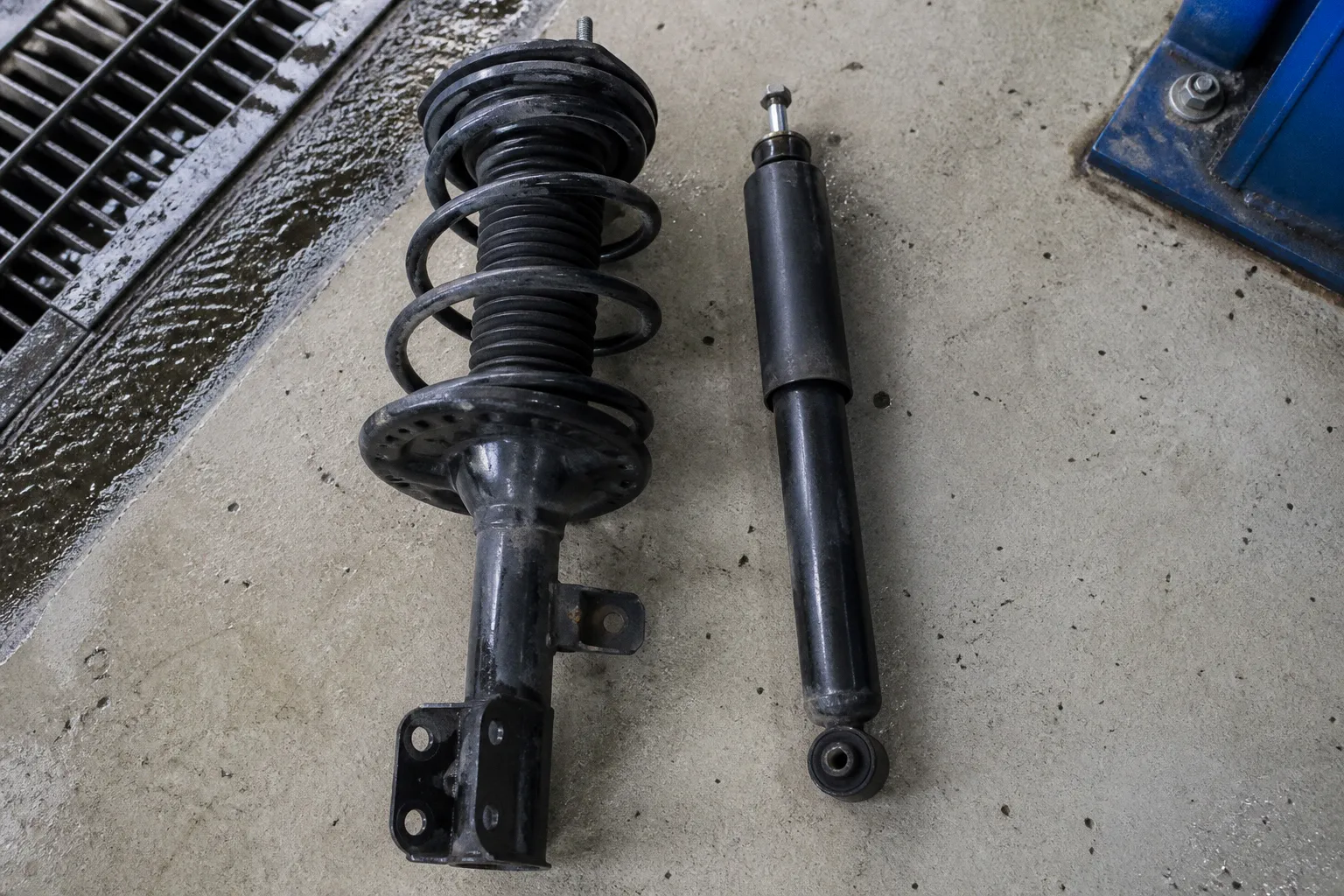
The difference between shocks and struts is not terminology. It determines whether the removed part was only a damper or a load-bearing steering component.
Compare car rental deals in United Kingdom
See available offersPartner link — DiscoverCars comparisonA shock absorber controls spring movement. A strut does that and also forms part of the vehicle’s structure. On a strut-equipped corner, the assembly carries load, locates the wheel, and provides the steering pivot. If the wrong component is ordered, the repair stops before installation. If a strut is replaced without alignment verification, the vehicle may leave the workshop with altered camber or caster.
The first diagnostic rule is exact:
One wheel position uses either a shock absorber or a strut. It does not use both as separate suspension components on the same corner.
The terminology creates confusion because “shock” is often used as a generic word for any damper. That shortcut is acceptable in casual conversation. It is not acceptable when identifying parts, planning a repair, or evaluating alignment.
Structural anatomy: why a strut is not only a shock absorber
A shock absorber is a standalone, non-structural damping unit. It is installed between suspension members or between the axle assembly and the vehicle body. Its function is controlled resistance to suspension movement.
The spring stores and releases energy. Without damping, that energy produces repeated bounce. The shock absorber restricts the movement. It controls how quickly the suspension compresses and extends, keeping the tire in contact with the road and limiting body movement.
The shock does not support the vehicle’s static weight in the same structural sense as a strut. It is not the steering pivot. It does not replace an upper control arm.
A strut integrates several functions into one assembly:
- The damper controls spring oscillation.
- The coil spring supports vehicle load.
- The housing or body forms part of the suspension structure.
- The upper mounting area provides a steering pivot.
- The assembly replaces the function of the upper control arm in the relevant suspension layout.
This is the defining difference between shocks and struts. Both dampen spring movement. Only the strut is a load-bearing structural member in this configuration.
On modern front-wheel-drive passenger vehicles, the MacPherson strut is the most common front suspension design. The steering knuckle is connected to the strut assembly. The upper end is attached to the body through a mount and bearing arrangement. When the steering wheel is turned, the assembly pivots at its upper mounting point.
The result is a component with two separate failure consequences. A weak damper changes ride control. A damaged or incorrectly installed strut can also affect steering geometry, structural location, and alignment.
The component names are not interchangeable
A strut contains a shock absorber or damping cartridge in its design. That does not make every shock absorber a strut.
The distinction can be stated as a function test:
1. If the component is removed and the suspension still retains its primary structural support and steering pivot, it is functioning as a standalone shock absorber.
2. If removal eliminates the main structural member that locates the wheel and supports the suspension assembly, it is a strut.
3. If the part carries the spring and forms the upper steering connection, it is a strut assembly, even if its internal damper resembles a conventional shock.
Coilover terminology creates another failure point. A coilover shock has a spring mounted around the damper body, but it is not automatically a structural strut. A coilover can be a non-structural damping unit with an integrated spring. If removed, the vehicle rests on its bump stops, but the steering system can still retain its primary pivot and structural arrangement.
The name describes the layout. The mounting points and load paths determine the function.
The role of standalone shock absorbers in suspension damping
A standalone shock absorber is installed where the suspension’s structural work is handled by other components. The spring may sit separately on the control arm or axle. The upper and lower control arms may locate the wheel. Ball joints and steering links may provide the pivoting movement.
In that arrangement, the shock controls motion but does not define the wheel’s basic position. Its failure is therefore read through damping symptoms rather than immediate changes in steering geometry.
Common bad shock absorber symptoms include:
- Repeated bouncing after a bump.
- Excessive body movement during braking.
- Excessive squat under acceleration.
- Increased roll during cornering.
- Reduced tire contact over uneven surfaces.
- Irregular tread wear caused by uncontrolled wheel movement.
- Fluid leakage from the damper body.
- A dull impact or repeated suspension noise when the unit reaches the end of its travel.
None of these symptoms, taken alone, identifies the component with certainty. A worn bushing, damaged spring, loose mounting point, failed ball joint, or incorrect tire pressure can create similar behavior. The diagnostic sequence must separate damping failure from structural or alignment failure.
If a corner oscillates after a compression event, damping is suspect. If the steering wheel is off-center after a suspension impact, alignment or a damaged locating component is also suspect. If the tire shows an irregular wear pattern, the damper must be inspected, but the toe and camber conditions must not be ignored.
A shock absorber is not expected to hold the vehicle at its designed ride height. The spring performs that task. If ride height is low on one side, the spring, spring seat, mounting hardware, or body structure must be inspected. A new shock alone will not correct a collapsed coil spring.
Visual identification: how to tell if you have shocks or struts
The most reliable method is not the shape of the part. It is the position of the part in the suspension architecture.
A strut is commonly identified by a coil spring wrapped around its body and an upper mount attached to the vehicle body. The lower portion is connected directly to the steering knuckle or hub carrier. On a MacPherson front suspension, the strut rotates with the steering movement.
A standalone shock may also appear with a coil spring nearby. The spring can be mounted around the damper in some designs. It can also be positioned separately on the control arm or axle. The presence of a coil spring around a damper is therefore not sufficient evidence.
The following comparison separates the functions.
| Parameter | Strut assembly | Standalone shock absorber |
|---|---|---|
| Structural role | Load-bearing suspension member | Non-structural damping unit |
| Steering role | Acts as a steering pivot in the applicable layout | Does not act as the steering pivot |
| Spring relationship | Commonly integrates the coil spring and damper | May be separate from the spring or paired without structural integration |
| Wheel location | Contributes directly to wheel and suspension geometry | Controls movement without providing the primary structural location |
| Upper attachment | Commonly mounted to the body through a strut mount | Attached to a suspension member or body mounting point |
| Alignment effect | Replacement can change camber and caster relationships | Replacement normally does not replace the primary steering pivot |
| Removal consequence | Structural support and steering location are affected | Suspension remains structurally located by other components |
The front axle should be inspected separately from the rear axle. A vehicle can use struts at the front and standalone shocks at the rear. It can also use different layouts across model years, trim levels, drivetrains, or chassis codes.
The correct question is not, “Does this car have shocks or struts?” The correct question is, “What component is installed at this wheel position on this exact chassis?”
That distinction matters when selecting parts. Vehicle make and model are not always sufficient. Production year, drivetrain, body style, and suspension package can change the assembly. Exact identification may require the VIN or chassis code.
A practical identification sequence
The inspection can be reduced to controlled decision points.
1. Locate the damper at the wheel position.
Identify whether the cylinder is connected directly to the steering knuckle or hub carrier.
2. Follow the upper mounting point.
If the upper end is attached to the body through a mount that permits the assembly to pivot during steering, the unit is functioning as a strut.
3. Check for a separate upper control arm.
A conventional upper control arm may indicate that the damper is not replacing that structural function. This is not conclusive by itself, but it establishes the suspension layout.
4. Trace the spring load path.
Determine whether the spring load is carried through the damper assembly or through a separate control arm, spring seat, or axle component.
5. Confirm the lower connection.
A direct connection to the steering knuckle is characteristic of many strut layouts. A separate shock attached to a control arm does not perform the same structural role.
6. Verify the exact vehicle configuration.
If the layout is not visible, parts catalog data must be checked against the VIN or chassis code. Production variation is not a defect in the diagnostic process. It is a property of vehicle design.
A photograph of the wheel well can be useful. It is not a substitute for identifying the load-bearing and steering functions.
Alignment implications after strut replacement
Strut replacement is an alignment event. The reason is mechanical, not procedural.
The strut is connected to the steering knuckle and body. Its position influences the relationship between the wheel, steering axis, and vehicle body. Camber and caster angles are typically set or adjusted through the strut body assembly or its mounting position, depending on the design.
Even when the replacement part matches the original specification, the final installed position can differ within the available mounting clearance. Fastener seating, mount orientation, knuckle position, and component tolerances all affect the result.
If a strut is removed, the following sequence is required:
- The assembly is installed with the spring and mount correctly oriented.
- The upper and lower fasteners are seated and tightened to the vehicle manufacturer’s specified procedure.
- The vehicle is returned to its normal loaded position.
- Wheel alignment is measured.
- Camber, caster, and toe are compared across the axle and against the specified range.
- Steering-wheel position is verified during the final road check.
The alignment requirement is not eliminated by replacing only one side. In fact, a one-sided repair can make a comparison more necessary. The new strut may restore ride control on one corner while the opposite side remains worn. The alignment equipment will show the geometric result. Visual inspection alone will not.
A standalone shock absorber replacement has a different alignment relationship. Since the shock is not the primary steering pivot or structural wheel locator, its replacement does not normally change alignment in the same direct manner. It can still expose a pre-existing problem. It can also be installed with loose hardware, damaged bushings, or incorrect mounting orientation. A post-repair inspection remains necessary. The structural alignment risk is lower, but it is not zero.
A strut replacement is not complete when the fasteners are tight. It is complete when the suspension geometry has been measured and verified.
Camber controls the inward or outward tilt of the wheel when viewed from the front. Caster describes the steering-axis angle when viewed from the side. Toe describes the direction in which the tires point relative to the vehicle centerline. A strut assembly can affect camber and caster directly. Toe may change as a consequence of altered steering geometry or disturbed suspension relationships.
Tire wear provides secondary evidence. Inner-edge wear can be associated with excessive negative camber. Feathering across the tread can indicate toe error. Cupping or scalloped wear can indicate uncontrolled damping, but it can also result from imbalance, worn bushings, or incorrect inflation. The tread pattern must be read with measured alignment data, not treated as a single-code diagnosis.
Shocks vs struts ride quality: what the driver can actually detect
Ride quality is controlled by the spring and damper as a system. The spring determines the basic load response and ride height. The damper controls how quickly movement occurs. The strut adds structural and steering functions to that damping package.
A weak shock absorber allows more wheel and body movement. The vehicle may feel loose over undulating pavement. Braking may produce more nose dive. Cornering may produce more roll. The tire may lose consistent contact on a rough surface.
A weak strut produces the same damping symptoms because it contains a damper. It can also create additional symptoms if the mount, bearing, spring seat, or structural housing is worn. Steering may become noisy or uneven. A spring may not rotate correctly with the assembly. The upper mount may bind or transmit impact noise into the body.
The diagnostic logic should be separated by symptom:
- If the vehicle bounces repeatedly after one compression event, inspect damping performance and mounting condition.
- If the vehicle pulls or the steering wheel is displaced, measure alignment and inspect steering and suspension joints.
- If a clunk occurs while turning, inspect the strut mount, bearing, spring seating, and adjacent links.
- If ride height is uneven, inspect springs and spring seats before attributing the condition to the damper.
- If the tire shows cupping, inspect damping, wheel balance, tire pressure, bushings, and alignment as a combined system.
- If fluid is visible on the damper body, distinguish active leakage from a light film of contamination. The unit must be assessed as a damper, not condemned by appearance alone.
- If the vehicle remains unstable after a new damper is fitted, the fault is not proven to be in the damper. Geometry, tires, bushings, and steering components must be checked.
A road test should be controlled. The same road surface should be used for comparison when possible. Steering input, braking input, vehicle loading, and tire pressure should not be allowed to change between observations. The purpose is not to produce a subjective verdict. It is to isolate whether the movement is spring-driven, damper-controlled, or caused by a loose locating component.
Maintenance intervals and suspension wear
Suspension dampers do not have a universal replacement mileage. Their service life depends on road surface, vehicle load, corrosion, temperature, tire condition, and operating history. A vehicle used on damaged pavement will impose higher movement and impact loads than the same model used on smooth roads.
An inspection interval is more useful than a fixed replacement promise. Haynes recommends inspecting shocks and struts at roughly every 6,000 miles or with every tire rotation. That interval allows leakage, damaged mounts, uneven tire wear, and obvious changes in ride control to be identified before the symptom becomes structural damage.
Under normal driving conditions, many manufacturers estimate a service life of at least 50,000 miles. This is an expected minimum, not an automatic replacement command. A damper at 50,000 miles may remain serviceable. A damper at a lower mileage may be damaged by impact, corrosion, or a failed mount.
Inspection should include the complete assembly:
- Damper body and piston-rod area.
- Upper mount and bearing.
- Coil spring and spring seat.
- Dust boot and bump stop.
- Lower mounting bolts.
- Steering knuckle connection.
- Control-arm bushings and ball joints.
- Tire tread condition.
- Wheel alignment readings where wear or handling symptoms are present.
The same inspection logic applies when planning a suspension strut replacement cost. The part price is only one variable. A strut assembly may require a mount, bearing, spring seat, dust boot, bump stop, or spring depending on condition and design. Labor changes with access, corrosion, spring compression requirements, and whether the complete assembly or only the damper cartridge is being replaced. Alignment is a separate operation when the strut position influences geometry.
A low quoted replacement figure may represent only the damper. A higher figure may include the complete loaded assembly, new mounting hardware, and alignment. These are not equivalent repairs. The scope must be identified before the numbers are compared.
Loaded assembly versus component replacement
A complete loaded strut assembly contains the spring and associated upper hardware already assembled. It reduces spring-compressor operations during installation. A component replacement uses the original spring and may reuse or replace the mount, bearing, seat, boot, and bump stop according to condition.
Neither method is universally correct.
If the spring is within specification and the mounting hardware is sound, component replacement may be appropriate. If the spring is corroded, sagging, cracked, or the upper mount is damaged, replacing only the damper leaves a worn component in the assembly.
The assembly must not be treated as a single disposable object without inspection. It must also not be reduced to the damper cylinder when the spring and mount are already compromised.
For standalone shocks, similar logic applies to mounting bushings and hardware. A new damper with a crushed bushing or damaged mounting eye will not produce a correct repair. The damping element and its attachment points must be evaluated together.
Verification after the repair
The final check should use fixed parameters. The suspension setup must first be identified at each wheel position. The repair must then be judged against the functions of that specific component.
For a strut-equipped position, the verification baseline is:
1. The correct strut assembly is installed for the exact vehicle configuration.
2. The spring and upper mount are oriented correctly.
3. The structural and steering connections are fully seated.
4. No abnormal movement is present at the mount, knuckle, or adjacent joints.
5. Ride height is consistent across the axle unless the design specifies otherwise.
6. Camber, caster, and toe are measured after installation.
7. The steering wheel is centered during the road check.
8. Tire wear is monitored after the geometry is confirmed.
For a standalone shock position:
1. The correct non-structural damper is installed.
2. The spring remains correctly seated in its separate support.
3. Upper and lower mounting points are secure.
4. No active leakage or abnormal free play is present.
5. Bounce, roll, squat, and tire contact behavior are reassessed.
6. Any pre-existing alignment or tire defect is separated from the damper result.
The inspection interval remains approximately every 6,000 miles or at each tire rotation. Under normal conditions, the expected minimum service life is at least 50,000 miles, but measured condition remains decisive.
The difference between shocks and struts is therefore a difference in load path, steering function, and alignment consequence. Both control spring movement. A strut also supports and locates the suspension. That is the diagnostic boundary.
If the wheel position is structural, alignment verification is part of the repair. If the component is a standalone damper, the primary task is damping and mounting inspection. Identification must be made from the suspension architecture and exact chassis configuration, not from the generic word “shock.”