Transmission fluid color: what your dipstick reveals
Transmission fluid does not usually fail in one dramatic moment. It spends months absorbing heat, carrying clutch material, lubricating gearsets, and being sheared through narrow hydraulic passages.
Judson Grier·Updated: August 20, 2026·14 min read
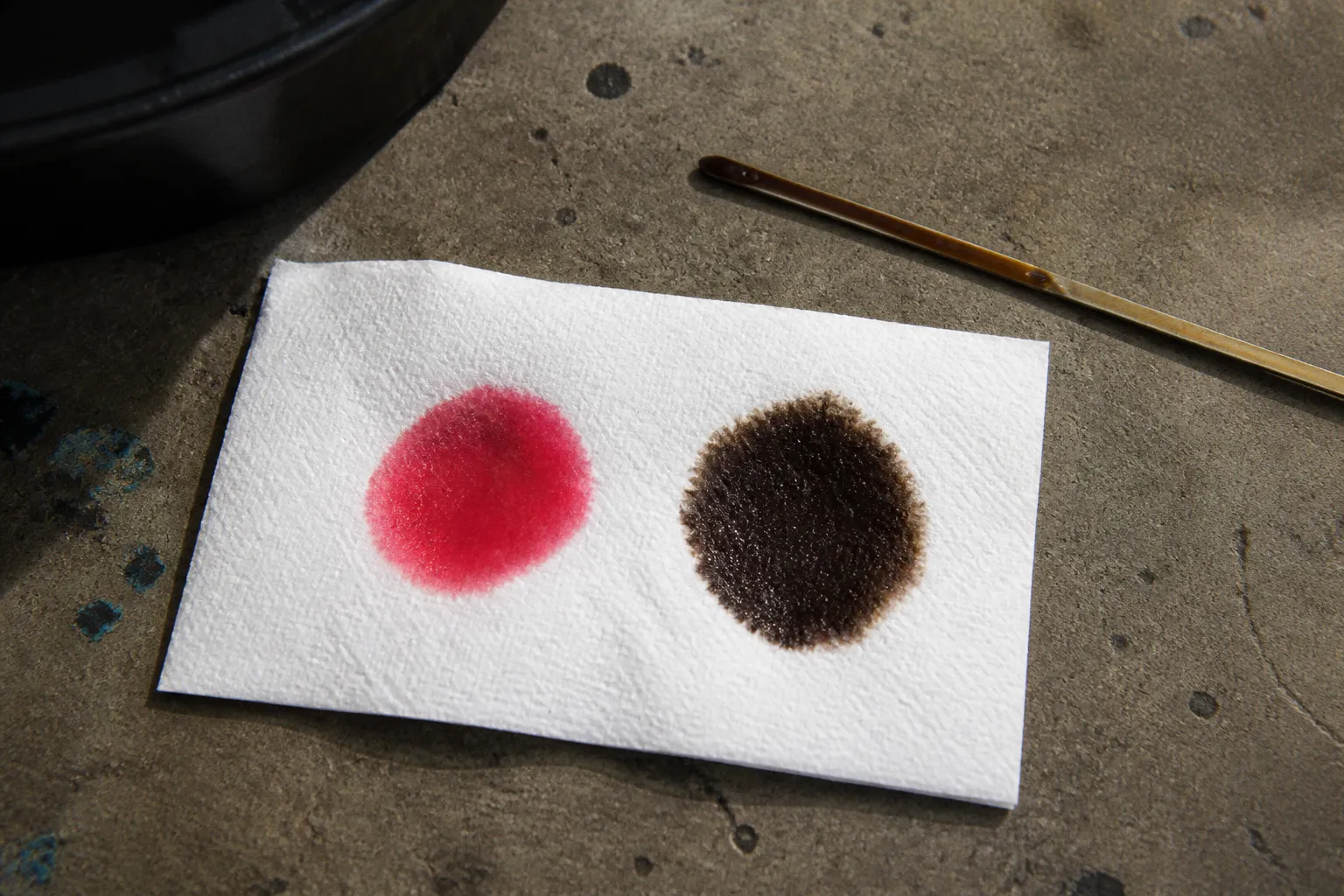
By the time a transmission begins to shift hard or flare between gears, the fluid may already have changed from bright red to brown, carrying the evidence of that work on the dipstick.
The color is useful, but it is not a verdict by itself. A proper transmission fluid color chart meaning depends on the shade, smell, level, service history, and the way the vehicle shifts. We need to read those clues together, because fluid can darken from ordinary aging, from overheating, or from contamination—and those are very different mechanical problems.
Why fresh automatic transmission fluid is red
Manufacturers commonly dye automatic transmission fluid a bright translucent red or pink. The dye makes a leak easier to identify under the vehicle and gives us a quick visual reference during inspection. Fresh fluid usually looks clean and transparent rather than opaque, with enough color to stand out on a white paper towel.
That red color is not what makes the fluid lubricate or control hydraulic pressure. The working parts are the base oil and additive package: friction modifiers, detergents, anti-wear compounds, seal conditioners, and other chemicals matched to a particular transmission. The dye is primarily an identification aid.
This distinction matters when we compare different vehicles. A conventional automatic may use red ATF, while a continuously variable transmission can use a fluid that appears clear, greenish, amber, or otherwise unlike standard automatic transmission fluid. Manual gearboxes often use gear oil rather than ATF, and its appearance follows a different set of expectations.
So the first question is not simply, “Is the fluid red?” It is, “Is this the correct fluid for this transmission, and what did it look like when it was new?”
A fluid that was originally amber should not be judged by the same color standard as a bright-red ATF. Before interpreting the dipstick, identify the transmission type and confirm the specified fluid. Mixing fluids because the color looks similar is a reliable way to create a more expensive problem.
Color gives us a direction. Smell, level, shifting behavior, and service history tell us where that direction leads.
Reading the color from fresh red to worn brown
Automatic transmission fluid changes color as it works. Heat and oxidation gradually alter the fluid, and suspended wear material can make it look darker. A fluid inspection is therefore less about finding a single perfect shade and more about recognizing the progression.
| Fluid appearance | What it commonly suggests | What to do next |
|---|---|---|
| Bright, translucent red or pink | Fresh or recently serviced ATF in a conventional automatic | Confirm level and service history; no concern from color alone |
| Dark red but still fairly clear | Normal aging, heat exposure, or extended service interval | Compare with the manufacturer’s maintenance schedule and inspect the smell |
| Light brown or reddish brown | Oxidation and accumulated use; fluid may be losing protective capacity | Plan a service and investigate operating conditions |
| Dark brown or black | Severe oxidation, overheating, or heavily degraded fluid | Stop treating this as a cosmetic change; diagnose the cause and service promptly |
| Pink, milky, or frothy | Possible engine coolant contamination | Avoid continued driving until the cooler and transmission are examined |
| Cloudy fluid with metallic debris | Possible internal wear, clutch damage, or component failure | Inspect the pan, magnet, filter, and transmission operation |
The transition from bright red to dark red is not automatically alarming. Heat cycles naturally push fluid toward a deeper color, particularly in vehicles that work hard in traffic, tow, climb regularly, or operate in high ambient temperatures. Dark red transmission fluid may still be serviceable, but it deserves context.
Light brown fluid is where the fluid’s history starts to show more clearly. It has likely spent enough time at operating temperature for oxidation to become visible. That does not prove that the clutches are damaged or that the transmission is near failure. It does suggest that the additive package has been doing its job for a long time and that postponing maintenance has less margin than it did when the fluid was new.
The harder line is dark brown or black fluid accompanied by a burnt odor. In that condition, the fluid has generally seen excessive heat or prolonged oxidation. The fluid can no longer protect surfaces and control friction as reliably. Seals may have hardened, friction modifiers may have degraded, and clutch material may be suspended in the oil.
Why color alone cannot diagnose a transmission
A transmission can contain dark fluid and still operate normally after a long service interval. It can also contain fluid that looks reasonably clean while suffering from a low level, incorrect pressure, worn solenoids, or mechanical damage. The fluid’s appearance is one measurement, not the entire diagnostic picture.
We should pair the visual inspection with:
- Odor: A sharp burnt smell points toward overheating and degraded friction material, especially when the fluid is very dark.
- Clarity: Healthy used fluid may be darker but should not look like opaque paint or foamy coffee.
- Debris: Fine friction material can collect in the pan, while larger metal particles suggest more serious internal wear.
- Level: Low fluid can create delayed engagement, slipping, pump noise, and erratic hydraulic pressure.
- Shift behavior: Harsh engagement, delayed reverse, gear flare, shudder, and slipping tell us how the transmission is responding under load.
- Service history: A fluid change at the correct interval means something different from the same color in a vehicle with no documented service.
The fluid color chart is therefore a sorting tool. It helps us decide whether we are looking at ordinary aging, a maintenance issue, or a condition that needs immediate diagnosis.
Burnt fluid is a heat problem before it is a fluid problem
When fluid turns dark brown or black and smells burnt, replacing the fluid may be necessary, but it may not be sufficient. The fluid became overheated for a reason.
The transmission may have been working against excessive load. A cooler may be restricted. An integrated radiator transmission cooler may be leaking. The vehicle may have spent long periods slipping its clutches, or the hydraulic system may not have maintained enough pressure to apply them firmly. In each case, the heat is produced by friction, and friction is what eventually shears through the fluid’s protection.
This is why a simple drain-and-fill can be either sensible maintenance or an incomplete repair. If the transmission is shifting normally and the fluid is merely aged, fresh fluid can restore part of its protection. If the transmission is already slipping and the old fluid smells burnt, the new fluid may expose the same mechanical weakness rather than cure it.
The sequence matters:
1. Inspect the fluid color, odor, and level.
2. Note whether the transmission slips, shudders, delays engagement, or shifts harshly.
3. Look for external leaks around the pan, axle seals, cooler lines, and case.
4. Check the pan and magnet during service for abnormal debris.
5. Scan for transmission-related fault codes where the vehicle supports that diagnosis.
6. Determine whether overheating or internal wear caused the fluid to deteriorate.
There is no magic-bottle repair for overheated friction material. Additives cannot rebuild a worn clutch pack, restore a damaged valve body, or reverse a failed cooler. They may alter shift feel temporarily, but that is not the same as restoring the surfaces and clearances inside the unit.
What burnt transmission fluid symptoms usually accompany the odor
The smell of burnt transmission fluid is more useful when it arrives with a change in vehicle behavior. Watch for a combination of symptoms rather than relying on one sensation:
- The engine speed rises during an upshift while vehicle speed does not follow immediately.
- Reverse engagement takes several seconds or requires extra throttle.
- The transmission shudders during light acceleration or when locking the torque converter.
- Shifts become harsh after the vehicle warms up.
- A gear works when cold and begins slipping once the fluid reaches operating temperature.
- The transmission enters a restricted operating mode or stores a fault code.
- The fluid level drops repeatedly because a leak is allowing the pump to draw air.
A burnt smell without any shift complaint still deserves service planning. A burnt smell with slipping or delayed engagement deserves diagnosis before further driving, because continued heat can turn a repairable hydraulic or cooling issue into clutch and hard-part damage.
Pink or milky fluid points toward contamination
Pink, milky, or frothy transmission fluid is a different warning from ordinary darkening. It can indicate that engine coolant has entered the transmission circuit, often through a failed internal cooler integrated into the vehicle’s radiator.
Coolant contamination changes the fluid’s appearance because water and glycol do not belong in the ATF system. The mixture can become cloudy, foamy, or strawberry-milkshake-like. The transmission’s clutch packs and bearings are then exposed to a fluid that no longer provides the intended friction control or lubrication.
This condition should not be treated as a routine fluid change. The source of the contamination must be found first. Depending on the vehicle, that may mean testing the radiator cooler, inspecting cooler lines, checking the cooling system, and verifying whether the transmission fluid has entered the engine coolant.
If contamination is confirmed, the repair often involves more than draining the pan. The failed cooler must be isolated or replaced, and the transmission circuit may require repeated fluid exchange, filter replacement, and further inspection. The torque converter and cooler lines can retain contaminated fluid even after a single drain.
A low fluid level is dangerous, but contaminated fluid can be just as destructive while appearing to be full. Do not keep driving simply because the dipstick shows the correct mark.
The accurate way to inspect automatic transmission fluid
Transmission fluid expands significantly as it heats. That is why reading the dipstick cold can give us a false low level and lead to overfilling. The correct procedure varies by manufacturer, so the service instructions for the specific transmission remain the authority, but the general inspection has a consistent mechanical logic.
Prepare the vehicle
Park on level ground. A slope changes the fluid’s position in the pan and can distort the reading. Bring the engine and transmission to the operating condition specified by the manufacturer. Some vehicles require a particular fluid temperature, and that temperature may be measured through scan-tool data rather than guessed from the engine temperature gauge.
Set the parking brake and keep the vehicle secure. If the procedure requires the engine to remain running, keep clear of moving belts, fans, and hot exhaust components.
Cycle the selector
With the brake applied, move the selector through the specified gear positions—commonly P, R, N, and D—pausing briefly in each range. This fills the hydraulic circuits and clutch passages so the level reflects the operating state of the transmission rather than fluid settled only in the pan.
Return the selector to the position specified by the service instructions. On many conventional automatics that is Park, but not every design uses the same procedure.
Make a double-pull reading
Remove the dipstick, wipe it clean, reinstall it fully, and pull it again. Place a drop on a white paper towel rather than judging only the metal markings. The towel shows color, transparency, and contamination more clearly.
Look for:
- The level relative to the correct hot or operating-temperature range.
- A clean red or dark-red stain versus opaque brown or black fluid.
- A sharp burnt odor.
- Foam or bubbles that may indicate aeration or an incorrect level.
- Metallic glitter or unusual particles.
- Pink or milky coloration that suggests coolant contamination.
Do not top off automatically because the reading appears low. Confirm that the vehicle is level, the engine is in the required state, the selector was cycled correctly, and the correct dipstick procedure was followed. Overfilling can whip the fluid into foam, and aerated fluid cannot maintain hydraulic pressure consistently.
If the level is low, add only the specified fluid in small amounts and recheck. A low level is not a maintenance condition to ignore; it is often evidence of a leak.
Sealed transmissions change the inspection routine
Many modern import vehicles do not have a traditional transmission dipstick. These are often called sealed transmissions, although they are not literally free from service requirements. They use a level plug, overflow tube, or temperature-dependent fill procedure instead of a dipstick.
The transmission must usually be at a specified temperature, on a level lift, with the engine running and the selector operated through its ranges. Fluid is added through a service port until it reaches the correct overflow condition. Without the correct temperature and position, the technician can either underfill or overfill the unit.
This is not a good place for guesswork. A sealed transmission may require a scan tool to read fluid temperature, a pump or adapter to add fluid, and a procedure that is specific to the transmission code. A vehicle that looks like it has no maintenance point may simply have a less forgiving one.
The same caution applies to CVTs. Their fluid may not be red, and conventional ATF may damage the belt-and-pulley system. Use the exact fluid specification, not a universal substitute chosen by color or marketing language.
How often should the fluid be replaced?
A common baseline for automatic transmission fluid replacement is roughly 60,000 to 100,000 miles, but the correct interval depends on the vehicle manufacturer, transmission design, fluid specification, and operating conditions. Some vehicles specify a shorter interval for severe use; others call for inspection rather than a fixed replacement schedule.
Severe use includes more than towing. Frequent stop-and-go driving, mountainous routes, high ambient temperatures, repeated short trips, and prolonged low-speed maneuvering can all add heat. Import vehicles with complex automatic transmissions, CVTs, or tightly packaged cooling systems may have maintenance requirements that do not resemble older four-speed automatics.
A service interval is not a substitute for inspection. If the fluid is low, burnt, contaminated, or accompanied by shift problems, mileage does not protect the transmission. The condition in the pan matters more than the number on the odometer.
We also need to distinguish a drain-and-fill from a complete fluid exchange. A simple drain removes only the fluid that leaves the pan, while fluid remains in the torque converter, cooler, and passages. A service procedure may include a filter, pan cleaning, gasket replacement, and a measured refill. The right method depends on the transmission and its service instructions.
The dipstick does not tell us whether a transmission will live forever. It tells us how much heat, wear, and neglect the fluid has already carried.
What to do after the inspection
If the fluid is bright red or dark red, clear, correctly leveled, and free of a burnt odor, the next step is usually to compare its condition with the documented service interval. That is not a reason to postpone service indefinitely; it is a reason to plan it without panic.
If the fluid is light brown, arrange a service and pay attention to the vehicle’s operating conditions. Ask whether the transmission has been used for towing, whether the cooler is functioning, and whether the fluid specification has been followed in previous work.
If the fluid is black and burnt, diagnose before assuming that a fluid exchange will solve the problem. Inspect the pan, scan the control system, test for leaks and cooling faults, and evaluate the shift behavior while the transmission is cold and warm.
If the fluid is pink, milky, or frothy, limit operation and look for coolant contamination immediately. The longer the mixture circulates, the more surfaces and friction materials it can damage.
Transmission fluid color is one of the few clues we can read without dismantling the unit. Used properly, it gives us an early warning: not a dramatic prediction, but a physical record of what the transmission has endured. We read that record, correct the heat or leak that wrote it, and service the fluid before ordinary wear is allowed to shear into a larger repair.