Vancouver Wildlife Watching Prices: How Tour Rates Are Set
Wildlife Watching in Vancouver prices are not fixed by distance alone. The same Salish Sea route can produce different ticket rates depending on vessel type, departure point, tour duration, seasonal…
Aldous Moorland·Updated: September 04, 2026·12 min read

Wildlife Watching in Vancouver Prices: How Tour Rates Are Set
Wildlife Watching in Vancouver prices are not fixed by distance alone. The same Salish Sea route can produce different ticket rates depending on vessel type, departure point, tour duration, seasonal demand, passenger category, and added protection against cancellation.
 Vancouver
Tickets and prices
Wildlife Watching in Vancouver
Cruise · 5 hours
fromCAD254.88
Check availabilityOfficial ticket · Half-day
fromCAD229
Check availabilityThe useful distinction is not between a “cheap” and “expensive” whale-watching ticket. It is between different operating products. A shared semi-covered vessel, an open Zodiac, a full-day expedition, and a private charter do not carry the same cost structure. Comparing them as if they were interchangeable produces the wrong conclusion.
For the 2026 season, standard shared tours sit in the lower and middle bands of the market. Full-day trips cost more because fuel use, crew time, and route exposure increase. Private boats operate under a separate calculation: the quoted amount is tied to the vessel and group capacity, not multiplied in the same way as an individual ticket.
Standard tour pricing depends first on the vessel
The primary variable in Vancouver wildlife tour costs is the boat.
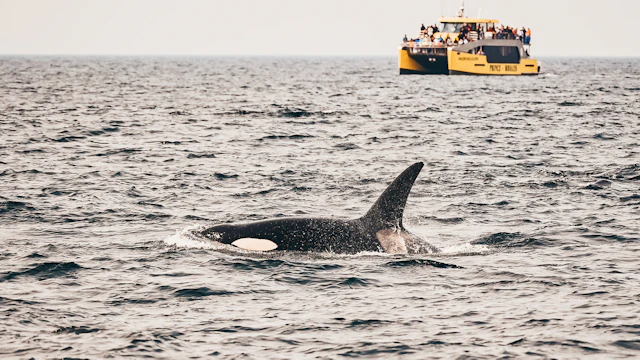
A semi-covered catamaran or similar vessel carries more passengers and provides protection from wind and spray. Its operating cost is distributed across a larger group. An open Zodiac carries fewer people, requires more specialized equipment, and exposes passengers directly to weather and sea conditions. That configuration commonly carries a premium.
The route may be similar. The product is not.
A standard shared excursion generally lasts between three and five hours. Departures operate from Vancouver locations and from Steveston Village, with route access into the Salish Sea and the Gulf Islands. A longer expedition adds more navigation time and a wider search area. That increases the probability of encountering whales, but it also increases fuel consumption and crew hours.
The pricing logic can be reduced to several gates:
1. If the boat is shared, the cost is calculated per passenger.
2. If the vessel is open-air and low-capacity, a higher rate is expected even when the departure time and route appear comparable.
3. If the tour runs for a full day, the rate moves into a different class because the boat remains in service for substantially longer.
4. If the departure falls within the peak operating window, seasonal demand can influence the ticket rate.
5. If the booking is private, the base cost is assigned to the charter rather than to a standard seat.
This is why a search for a Vancouver whale watching tour should begin with the vessel description, not the headline rate.
The ticket does not price only the sighting. It prices the boat, the operating window, the search radius, and the risk carried by the operator.
Covered vessel versus Zodiac boat
The practical difference between vessel types is not cosmetic.
A semi-covered boat is the more stable choice for passengers who require weather protection, have limited mobility, or are not prepared for sustained exposure to wind. A Zodiac provides a lower seating profile and a closer-to-the-water experience. It also imposes stronger restrictions. Some operators limit Zodiac access by age, and the minimum passenger age can differ from the semi-covered option.
| Parameter | Semi-covered vessel | Open Zodiac |
|---|---|---|
| Weather protection | Partial protection from wind and spray | Minimal protection |
| Passenger capacity | Typically higher | Typically lower |
| Price position | Standard or mid-market | Frequently carries a premium |
| Access requirements | Broader passenger suitability | Age and mobility restrictions may apply |
| Ride character | More stable and enclosed | More exposed and responsive to sea state |
| Best use case | General sightseeing and mixed-age groups | Passengers prioritizing proximity and speed |
The wrong selection creates avoidable cost. If a passenger cannot use the Zodiac because of age, mobility, or weather tolerance, the lower capacity does not create value. If a group wants maximum exposure and accepts the restrictions, the premium may be justified.
The departure point changes the operating equation
Vancouver whale-watching tickets are sold from more than one departure area. Granville Island and Steveston Village are not interchangeable starting points.
Steveston provides direct access to the southern metro Vancouver waterfront and commonly serves routes toward the Gulf Islands and the broader Salish Sea. A departure from central Vancouver can be more convenient for visitors already staying near downtown, but convenience does not indicate a shorter wildlife route. The relevant calculation is the time spent reaching productive habitat after departure.
A ticket should therefore be evaluated against the full itinerary:
- transport time to the dock;
- check-in requirement;
- boarding location;
- expected tour duration;
- return time;
- parking or local transit cost;
- exposure to weather during the transfer and the wildlife-search phase.
A lower headline rate can become a higher total outing cost if the dock requires a long transfer, paid parking, or a separate connection. Conversely, a Steveston departure may reduce time on land while increasing the logistical burden for visitors without a vehicle.
The search term “marine wildlife tour Vancouver” often hides this distinction. A city-based departure and a Richmond-area departure may both be marketed as Vancouver tours while serving different travel patterns.
Taxes, assurance, and conservation fees are separate line items
The displayed ticket rate is not always the final amount charged at checkout.
A 5% goods and services tax is added to base ticket rates. It is a standard component of the final transaction and should not be treated as an optional surcharge. Other additions depend on the operator and the booking conditions.
The most relevant variable is Ticket Assurance. One major operator applies a fee equal to 10% of the ticket price for this option. The benefit is flexibility outside the standard 48-hour non-refundable cancellation cutoff. Without that protection, a cancellation or change inside the restricted period can result in the loss of the fare.
The decision is conditional:
- If the travel date is fixed and weather disruption is acceptable, Ticket Assurance may add cost without producing practical value.
- If the itinerary depends on flights, ferries, or multiple hotel changes, flexibility has a measurable function.
- If the passenger is booking during a high-demand period, the ability to shift dates may protect access to the tour.
- If the operator already provides a separate whale-sighting return policy, that policy should not be confused with cancellation protection.
These are different mechanisms. Ticket Assurance concerns the booking. A whale-sighting guarantee concerns the wildlife outcome. One does not replace the other.
The conservation surcharge is also separate. Major operators collect a passenger fee allocated to marine research and chinook salmon recovery. The money supports work connected to the endangered Southern Resident killer whale population and the ecosystem on which it depends.
This charge is not equivalent to a service fee. It is tied to conservation activity. The amount is small relative to the total booking, but its presence changes the interpretation of the final ticket total: part of the payment supports the operating company, part covers tax or optional protection, and part is directed toward conservation work.
Why private charters appear expensive
Private charter rates cannot be compared directly with individual shared-tour tickets.
A private boat is reserved for the group. The cost is assigned to the vessel, crew, fuel, and charter duration. A typical private trip lasts between three and four hours and may accommodate a group of up to six passengers under the base configuration. Larger groups require a different boat or a custom arrangement.
The correct comparison is not:
private charter rate versus individual ticket rate.
It is:
total charter cost divided by the number of passengers actually using the boat.
At full capacity, the per-person calculation can move closer to the upper end of the shared-tour market. At low occupancy, it will not. A private charter is purchased for control, privacy, departure flexibility, and group continuity. It is not automatically a better wildlife-viewing product.
A private booking can be rational when:
- the group has a fixed schedule that does not match public departure times;
- passengers require a customized pace or route;
- privacy is more important than minimizing cost;
- the group includes photographers carrying substantial equipment;
- the passengers want to avoid a large shared vessel;
- the charter can be filled near its practical passenger capacity.
It becomes inefficient when two or three passengers reserve a boat designed for a larger group without using the additional control. The wildlife encounter itself remains dependent on animal movement, sea conditions, and search time. A private vessel does not guarantee a closer approach or a longer sighting.
Exact custom pricing for groups above the standard charter capacity should be treated as an operator-specific quotation. It is not a stable market figure.
Full-day expeditions are a different product
A full-day wildlife tour is not simply a standard tour with several extra hours added.
The route can extend farther into the Salish Sea. The search area can include more of the Gulf Islands. The vessel remains operational for most of the day, which changes fuel use, provisioning, crew scheduling, and passenger requirements. The rate therefore moves into a higher tier.
The benefit is route flexibility. If the first search area produces no result, the crew has more time to reposition. The drawback is exposure. A passenger who tolerates a three-hour trip may not tolerate a full-day period on open water.
Food, clothing, motion sensitivity, and transfer time become operational variables. A full-day expedition should not be selected solely because it appears to offer more wildlife for the same visit. It offers more search time, not a guaranteed greater encounter.
The role of seasonal demand
The peak daily operating window runs from June 1 through September 20. During this period, operators commonly run multiple departures and maintain more active schedules. Demand also rises with visitor volume and favorable travel conditions.
Seasonal pricing has two effects:
1. Rates can vary between otherwise similar departures.
2. The less expensive or more convenient departure may sell out first.
The practical solution is not to wait for a universal “best price.” It is to compare date flexibility against availability. A passenger with fixed dates should select the vessel and departure first. A passenger with several available days can compare schedules, boat classes, and cancellation terms before committing.
The same logic applies to wildlife tour tickets purchased through booking platforms. Availability today or tomorrow may exist for some products while another vessel class is closed. “Available” does not mean “identical.”
Sighting guarantees protect the ticket, not the day
Major Vancouver operators report whale-sighting success rates in the range of 95% to 98%. That is a high operating figure. It is not a guarantee of a particular species, distance, duration, or photographic result.
The Salish Sea contains moving animals. Orcas may be absent from one search zone and present in another. Humpback whales may surface briefly or remain outside the most accessible route. Weather can restrict visibility. Marine traffic and conservation rules can limit vessel positioning.
When whales are not seen, operators commonly provide a non-expiring return voucher. The voucher protects the value of the original ticket by allowing a future trip. It does not normally create a cash refund. Fuel surcharges may still apply when the voucher is used.
That condition must be read literally.
- If whales are seen, the original tour is complete even if the encounter is brief.
- If no whales are seen, a return voucher may be issued under the operator’s conditions.
- If a passenger cannot return, the voucher has limited practical value.
- If a fuel surcharge applies to the second trip, the replacement outing is not necessarily cost-free.
- If the passenger expected a specific species, the sighting policy may not cover that expectation.
A guarantee of wildlife presence is not technically possible. A voucher is a commercial remedy for an unsuccessful search, not a biological promise.
A sighting guarantee compensates for a failed result. It does not control the animals, the weather, or the distance maintained by the vessel.
What should be compared before booking
The most useful comparison is a parameter table, not a single ticket number. The following variables determine whether one Vancouver marine safari rate is genuinely lower than another:
- Vessel class: semi-covered catamaran, open Zodiac, or private boat.
- Tour duration: standard shared trip, extended outing, or full-day expedition.
- Departure location: central Vancouver or Steveston Village.
- Passenger restrictions: age limits, mobility requirements, and seating conditions.
- Included items: photographs, onboard commentary, and equipment access.
- Tax treatment: whether the displayed rate excludes the 5% GST.
- Optional protection: Ticket Assurance and its cancellation terms.
- Conservation charge: whether the passenger fee is listed separately.
- Return policy: voucher conditions if whales are not sighted.
- Fuel treatment: whether a later voucher trip can carry a fuel surcharge.
- Availability: whether the selected boat is operating on the required date.
The phrase “free photos” should also be read in context. Complimentary images can improve the value of a tour, but they do not change the vessel, the route, or the sighting probability. They are an included output, not a substitute for suitable operating conditions.
The exact baseline for a rational comparison
A reliable decision can be made if the following parameters are recorded before payment:
1. Base ticket category.
2. Vessel type.
3. Departure dock.
4. Tour duration.
5. Passenger age classification.
6. GST treatment.
7. Conservation fee.
8. Ticket Assurance status.
9. Cancellation cutoff.
10. Whale-sighting voucher terms.
11. Possible fuel surcharge on a return trip.
12. Weather and mobility restrictions.
If any of these values is missing, the displayed rate is incomplete.
The final cost of Wildlife Watching in Vancouver is therefore a system output. The inputs are vessel, duration, departure, passenger category, season, tax, optional protection, and conservation charges. Private charters add capacity and occupancy to the calculation. Sighting guarantees add a conditional return mechanism, not a refund.
The correct baseline is simple: compare equivalent products, read the conditions attached to the guarantee, and calculate the final charge after mandatory additions. A lower number is meaningful only when the boat, route, duration, and protections are the same.
Practical info
Currency: CAD
Driving: on the right
Emergency number: 911