ARTIS Micropia tickets: Is the museum experience worth it?
A visit to ARTIS-Micropia can be over before you have fully adjusted to what you are looking at.
Judson Grier·Updated: September 12, 2026·14 min read
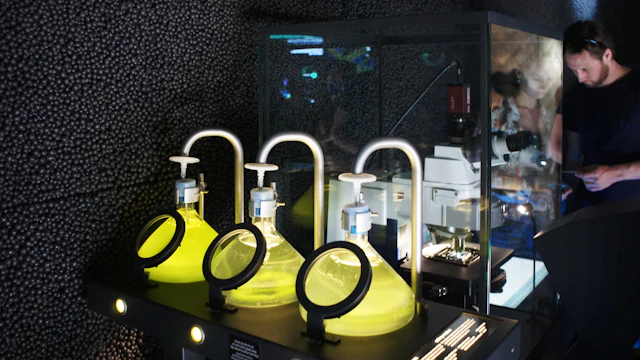
The museum is compact, most visitors spend about one to one and a half hours inside, and much of the experience is built around things that are too small to see without help: bacteria, fungi, algae, viruses, and the organisms living on and inside the human body.
 Amsterdam
Tickets and prices
ARTIS Micropia
Entry ticket · Microbe museum
from€18
Check availabilityCombo ticket · Zoo & microbe museum
from€39
Check availabilityOfficial ticket · Ages 0 to 2
That makes the ticket decision slightly different from buying admission to a large natural-history museum. You are not paying for a full day of galleries. You are paying for a carefully engineered encounter with the living systems that usually disappear into the background of daily life. Whether that feels worthwhile depends on how much you value close observation, interactive displays, and a subject that is more physical than picturesque.
For most curious adults, families with older children, and anyone interested in biology, the answer is yes. But we should understand what the ticket gives us, how to enter without taking the wrong route, and when a combination ticket or museum pass makes more sense.
Micropia is separate from ARTIS Zoo
The first practical point is the one that causes the most unnecessary confusion: ARTIS-Micropia has its own entrance on Artisplein, the public square by ARTIS Royal Zoo. You do not need a separate ARTIS Zoo admission ticket simply to visit Micropia.
That matters because visitors often treat the two attractions as one controlled entrance system. They are close together, but the access arrangements are separate. If your plan is only to visit the microbe museum, go directly to the Micropia entrance rather than joining the queue for the zoo.
The museum is in Amsterdam’s Plantage district, in the area around Plantage Kerklaan. Once inside Artisplein, the entrance is straightforward to find. There is no mechanical trick to it, but the same rule applies as in a workshop: start with the correct access point and the rest of the job becomes easier. Start at the wrong one and you spend time solving a problem that was never part of the repair.
Micropia opened on September 30, 2014, and was officially opened by Queen Máxima. Its purpose was unusually specific from the beginning: to create a museum devoted entirely to microorganisms. That focus has not been diluted into a general science attraction with one room about microbes. The museum keeps returning to the same question from different angles: what is alive around us, and what do we fail to notice because our eyes are the wrong instrument?
The value of Micropia is not its size. It is the precision of the experience.
How to buy tickets for ARTIS Micropia
The practical choice is between booking online and buying a ticket at the entrance. Online booking is usually the cleaner option, particularly if you are visiting Amsterdam on a busy day or have planned the museum around another attraction.
The online calendar may show date-dependent pricing and different availability from the physical counter. That means there is no single permanent admission price worth treating as a rule. The amount can change according to the selected date, and the ticket displayed during booking is the one that matters for your visit.
Buying online has three useful advantages:
- You can check the available entry time before making your way across Amsterdam.
- The online rate is generally more favorable than the walk-up counter rate.
- You can combine Micropia with ARTIS Zoo if both attractions are part of your plan.
The counter remains useful when your day is flexible, you are already at Artisplein, or you prefer not to commit to a time in advance. The trade-off is simple: the physical ticket is normally more expensive, and busy periods may give you less control over when you enter.
For most visitors, online booking ARTIS Micropia is the sensible default. It gives us a confirmed plan without requiring a complicated reservation process. We select the date, check the available entry conditions, and keep the ticket accessible on the phone. There is no benefit in treating a short museum visit as a high-risk logistical operation, but there is also no reason to create avoidable uncertainty.
What ticket options are available?
The main Micropia museum ticket is the right choice if you want to focus on the microorganisms exhibits and leave the zoo for another day. It is also the option that best matches a short itinerary: the museum can be explored in roughly one to one and a half hours without rushing through every display.
A combination ticket is more suitable when you want both Micropia and ARTIS Zoo. The combined option can be more efficient than buying the attractions separately, but only if you genuinely have enough time for both. A cheap combination is not a saving if one half of the ticket gets abandoned because the day has run out.
There are also reduced or free-entry routes for visitors who hold certain cards:
- Museumkaart holders can enter Micropia free of charge.
- I amsterdam City Card holders receive free admission.
- ICOM card holders also receive free admission.
- Students may have access to a reduced ticket category.
- CJP and EYCA card holders may qualify for a discount.
The exact conditions can change, so we should check the current booking or admission information before travelling. The important point is that the museum ticket options are not limited to one standard adult purchase. If you already carry a city pass, museum pass, or eligible discount card, the cost calculation changes immediately.
What the museum actually gives you
Micropia is not built around long corridors of static panels. The experience depends on instruments, live displays, magnification, and interaction. We move from the idea of microorganisms as an abstract scientific category to the more uncomfortable and useful realization that they are part of our bodies, food, surfaces, air, and surroundings.
The microscope displays are central to that shift. A microorganism is easy to ignore when it remains a word in a textbook. It becomes harder to ignore when the museum lets you observe living material through magnification and shows how biological activity changes over time.
The exhibits cover bacteria, fungi, algae, and viruses, though not always in the simplified good-versus-bad way that popular explanations often use. That is one of Micropia’s strengths. Microbes are not presented only as threats to be eliminated. They are also involved in digestion, decomposition, fermentation, ecosystems, and the functioning of the human microbiome.
The human microbiome section is particularly useful because it connects the museum to the body we brought through the entrance. We are not looking at an isolated laboratory subject. We are looking at the organisms that coexist with us, occupy our skin and gut, and influence the environments inside and around us.
Some attractions make the subject accessible without sanding away its complexity:
- The body scan exhibit connects the invisible organisms on and within us to a visible human form.
- The Kiss-o-meter uses a familiar act to make microbial exchange easier to understand.
- Live microscope displays turn microorganisms into something observed rather than merely described.
- Interactive exhibits give children and adults a way to handle the subject actively instead of reading every panel in sequence.
- Daily lab talks add explanation and context for visitors who want more than a self-guided walk-through.
The museum also deals with bacteria and viruses in a way that suits visitors who want to understand mechanisms rather than collect alarming facts. We see how scale changes perception, how organisms interact with their surroundings, and why the word “microbe” includes an enormous range of biological behavior.
That is where the museum earns its admission. It does not simply tell us that microorganisms exist. It gives the subject enough physical presence that we begin to notice the limits of our own senses.
Is ARTIS Micropia worth the price?
The short answer depends on what you expect from a museum ticket.
If you measure value by the number of hours spent inside, Micropia may feel expensive compared with a large museum where you can wander all afternoon. A visit lasting one to one and a half hours is not a weakness, but it is a real limitation for anyone expecting a full-day attraction.
If you measure value by concentration, originality, and the quality of the explanation, the calculation looks better. Micropia is the world’s first and only museum dedicated entirely to microorganisms. That is not just a promotional distinction. It describes a very particular experience that is difficult to replace with a general science museum or a standard ARTIS Zoo visit.
A useful way to assess the ticket is to ask what kind of visit you want:
| What you want from the day | Is Micropia a good fit? | Why |
|---|---|---|
| A focused science experience | Yes | The museum stays tightly centered on microorganisms and the human microbiome. |
| A full-day attraction | Not by itself | Most visitors finish in roughly one to one and a half hours. |
| A family visit with younger children | Maybe | The recommended age is 8 and older, though younger children are not automatically excluded. |
| A deeper biology visit | Yes | Live displays, microscopes, lab talks, and interactive exhibits add substance beyond labels. |
| A combined zoo-and-museum day | Often | A combination ticket can make sense when both attractions fit comfortably into the schedule. |
| A spontaneous short stop | Yes, if entry is available | The museum works well as a compact visit in the Plantage area. |
For families, the age recommendation deserves a careful reading. Micropia officially recommends the museum for visitors aged 8 and older. That reflects the level of explanation and the subject matter, not a hard statement that younger children cannot enjoy the space. Some children will respond immediately to the visual and interactive elements; others will find the subject too abstract or unsettling.
Older children and teenagers are more likely to understand the connection between what they see and the biological processes being explained. Adults who assume the museum is only for children may also be surprised. The content is accessible, but it is not empty. A good science museum lets different visitors take different depths from the same object, and Micropia generally manages that well.
Timing the visit without wasting the day
ARTIS-Micropia is open every day from 10:00 to 17:00. That regular schedule makes it easier to place into an Amsterdam itinerary, but the short visit duration means timing still matters.
If you are visiting only Micropia, an early entry can leave the rest of the day open for the Plantage district, the city center, or another museum. If you are pairing it with ARTIS Zoo, the order should depend on the type of day you want. Micropia is compact and controlled; the zoo requires more walking and usually more time. Visitors who start with the zoo may arrive at Micropia tired and move through the exhibits without giving the details enough attention. Visitors who start at Micropia can then decide whether they still have the energy for the larger outdoor attraction.
A few practical arrangements work better than others:
1. Book the museum as a focused visit. Give yourself enough time to stop at the microscopes and interactive displays rather than treating Micropia as a ten-minute add-on.
2. Keep the zoo combination realistic. ARTIS Zoo and Micropia are not interchangeable stops. One is an extensive outdoor attraction; the other is a concentrated indoor experience.
3. Use the morning if your group needs quiet. Early entry can make it easier to look at the displays without moving shoulder to shoulder through every station.
4. Allow time for the lab talk. If the daily schedule includes a talk during your visit, it can provide the explanation that ties separate exhibits together.
5. Check the ticket date before leaving. Online tickets are tied to the selected booking conditions, and the price or availability shown for one day should not be assumed to apply to another.
There is no need to invent an elaborate route through the museum. We should simply allow the exhibits to do their work. Move slowly enough to look, read the essential explanation, and return to the displays that make the biology visible. Micropia rewards attention more than speed.
How it compares with a general Amsterdam science museum
Visitors searching for an Amsterdam science museum ticket comparison are often trying to decide between Micropia and a larger, broader institution. The distinction is not mainly about quality. It is about depth versus range.
A general science museum can offer physics, engineering, space, technology, experiments, and large-scale demonstrations. Micropia takes one narrow area and works it from several directions. It is closer to a specialist diagnostic tool than a large multi-purpose workshop: less useful if you want everything, more useful if you want this one subject explained properly.
Micropia is the stronger choice when:
- You are curious about the human microbiome.
- You want to see live microorganisms through microscopes and displays.
- You prefer a compact museum with a clear subject.
- You are visiting the Plantage district and want an experience that fits into a shorter block of time.
- You are travelling with children around the recommended age or older who enjoy biology and unusual science.
A broader science museum may be better when:
- Your group wants several branches of science in one building.
- You need a full-day indoor attraction.
- Children in the group are more interested in machines, space, or physical experiments than biology.
- You have already visited Micropia and want a different type of science experience.
The comparison should not be reduced to square meters or hours inside. A specialized museum can be worthwhile precisely because it refuses to spread itself thin. Micropia does not try to become an aquarium, a zoo, a medical museum, and a technology center at the same time. It stays with the small, the living, and the easily overlooked.
The award tells us something useful
Micropia received the Kenneth Hudson Award at the European Museum of the Year Awards in 2016. The award recognized it as Europe’s most innovative museum. Awards are not a substitute for a good visit, and we should not use one as proof that every visitor will enjoy the experience. Still, in this case the recognition points to the museum’s central achievement: it found a way to make an invisible subject observable.
That is harder than it sounds. Microorganisms do not arrive with the visual drama of a dinosaur skeleton or a spacecraft. They need magnification, context, careful explanation, and a willingness to let the visitor adjust to a different scale. The museum has to build the experience around those constraints.
The result is not perfect for every traveller. Some visitors will find the space too compact. Some will expect more conventional exhibits. Others may want stronger separation between the scientific explanations and the more playful interactive elements. But the basic design holds together because the displays keep returning to the same physical reality: life is active at scales we usually cannot see.
That focus is why Micropia can justify its admission cost even when the visit is relatively short. We are not paying for a large quantity of rooms. We are paying for an unusual piece of museum engineering that makes invisible biology occupy the same mental space as the rest of the city.
Who should buy an ARTIS Micropia ticket?
Micropia is a good purchase for visitors who want a specialized, interactive museum rather than another broad collection of objects. It is especially well suited to:
- Families with children aged around 8 and older.
- Adults interested in bacteria, viruses, fungi, algae, or the human microbiome.
- Travellers looking for a compact indoor activity in the Plantage district.
- Visitors who already have Museumkaart, I amsterdam City Card, or ICOM access.
- Anyone combining the museum with ARTIS Zoo and choosing a ticket option that covers both.
It is less convincing as a standalone choice for someone who wants a full day of exhibits or who has no interest in biology. The museum cannot manufacture curiosity where none exists. Its subject is narrow, and the visit is deliberately concentrated.
For everyone else, the decision is fairly direct. Check the online date and entry conditions, use any eligible pass or discount, and choose a combination ticket only if ARTIS Zoo is genuinely part of the day. Enter through Artisplein, not the zoo entrance, and allow enough time to stop at the microscopes and talks rather than rushing through.
ARTIS-Micropia is worth the ticket when we judge it on its own terms. It is not a large museum, not a general science center, and not a substitute for the zoo. It is a precise, compact examination of the living systems that surround us and pass through us every day.
The lasting value is not the novelty of seeing something tiny. It is the change in attention afterward. Once we have watched microorganisms move, multiply, and occupy the surfaces of ordinary life, the invisible world no longer feels quite so empty.
Practical info
Currency: EUR
Driving: on the right
Emergency number: 112