Brake pad wear: noise indicators versus visual inspection
A driver hears a high-pitched squeal and assumes the brake pads have announced themselves. The assumption is reasonable, but it is also the point at which brake maintenance can become reactive rather than deliberate.
Merritt Vane·Updated: September 01, 2026·19 min read
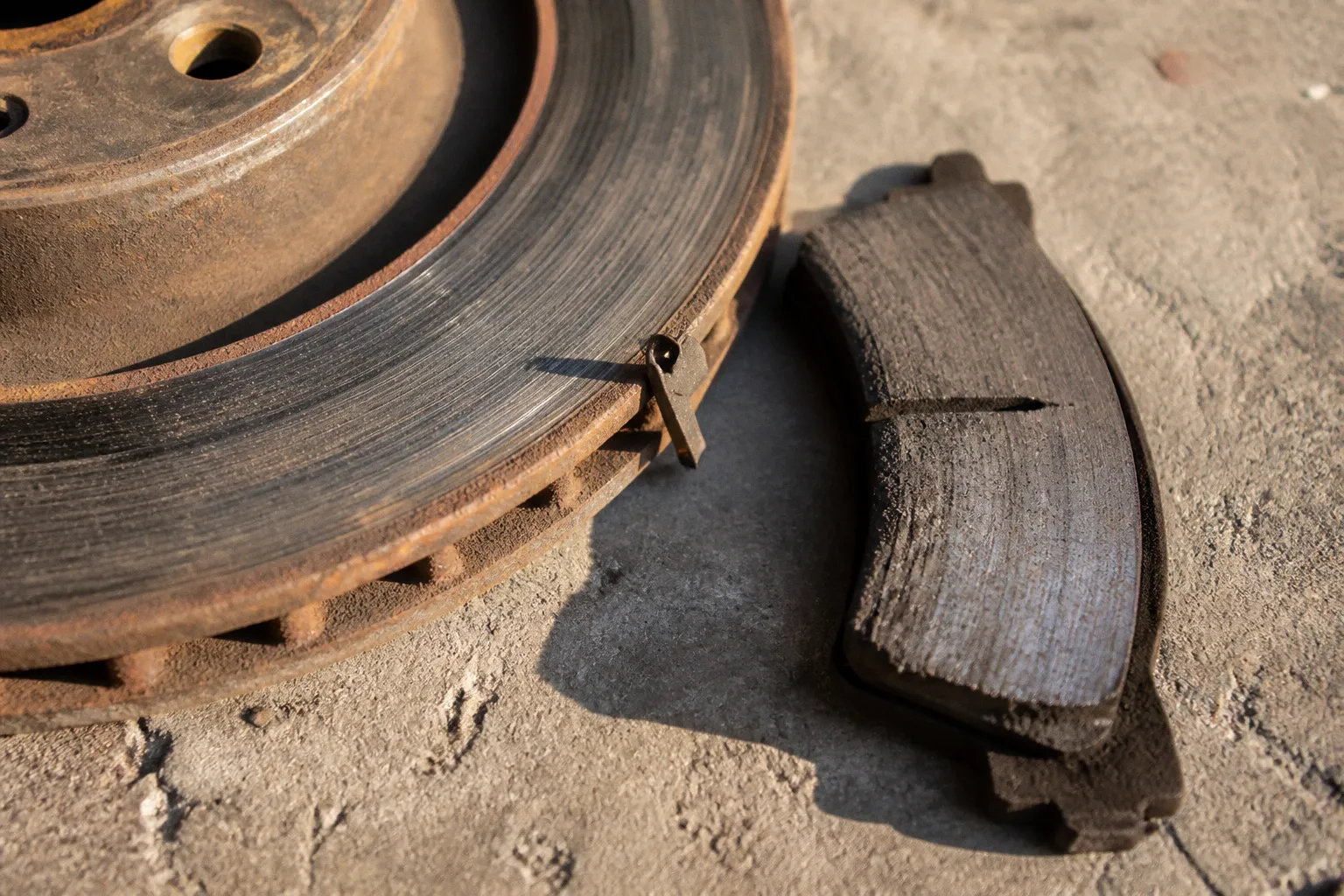
Acoustic wear indicators—small metal tabs attached to some pads—were designed as a late warning, not as a complete diagnostic system. They tell you that friction material is approaching a service limit. They do not tell you whether the inner and outer pads are wearing evenly, whether the caliper is releasing correctly, or whether the rotor has already suffered damage.
For owners of European and Asian imports, the distinction matters. Brake-pad compounds vary widely, from low-metallic organic formulations to ceramic and semi-metallic blends, and each produces a different wear and noise pattern. A ceramic pad on a Lexus may remain quiet while approaching replacement thickness. A semi-metallic pad on a BMW may squeal because of its compound, temperature, or surface condition long before the friction material is critically thin.
The useful question is not simply whether the brakes are making noise. It is what the noise represents in the wear cycle—and what a visual inspection might reveal that sound cannot.
The Mechanics of Acoustic Wear Indicators: How Squealers Work
Mechanical acoustic wear indicators are deceptively simple. A small steel tab is riveted or bonded to the brake pad assembly, positioned so that its edge sits close to the rotor once the friction material has worn to a predetermined level. As the pad becomes thinner, the tab eventually touches the rotor’s swept surface. The contact produces the familiar high-frequency squeal commonly associated with worn brake pads.
The device is often called a squealer or a mechanical wear indicator. It is not a separate sensor that measures pad life continuously. It is a physical contact point, and its warning arrives only when the friction material has already reached a late stage of wear.
That timing is intentional. The tab is meant to give the driver an opportunity to schedule service before the backing plate begins cutting into the rotor. It is not necessarily calibrated to the point at which replacement is most convenient or economical. Depending on the pad design, installation position, rotor condition, temperature, and driving environment, the warning may appear with more or less time remaining. The noise can be persistent, intermittent, or absent altogether.
The location of the tab also matters. Some vehicles place the indicator on only one pad at a given axle position. If that pad is the outer pad but the inner pad is wearing faster, the audible warning may arrive too late. In another design, the indicator may be on the inner pad and remain difficult to hear through the wheel, especially with road noise, winter tires, or a heavily insulated cabin.
Brake-pad noise has causes beyond the wear tab. A high-pitched squeal can result from vibration between the pad and caliper, a glazed friction surface, corrosion on the rotor, incorrect bedding, contamination, or pad hardware that has lost its proper tension. A scraping sound may indicate something more serious, such as a pad worn through, a bent backing plate, or debris caught between the rotor and its shield. A brief squeak during the first few stops in damp weather may not indicate critical wear at all.
The friction compound changes the acoustic picture as well. Semi-metallic pads contain a greater proportion of metallic material and can transmit more vibration through the braking assembly. Ceramic pads are often quieter, but quiet operation is not proof of abundant friction material. A pad can be well below its comfortable service margin without producing the classic squeal associated with a mechanical indicator.
Electronic wear sensors operate on a different principle. Many systems use a conductive loop or wire built into the pad. When the friction material wears down far enough, the loop may be exposed and broken, which opens the circuit and prompts a warning from the vehicle’s control system. Other designs use a contact-based arrangement that triggers when the sensor reaches the rotor or otherwise changes its electrical state. The exact behavior varies by manufacturer and vehicle.
That qualification is important because electronic sensors are sometimes described too generally. They do not all complete a circuit at the moment of wear. In many loop-style systems, the warning appears because the circuit has been opened rather than completed. The dashboard message is useful, but it still represents a designed threshold, not a full assessment of the brake system. It will not necessarily identify uneven wear, a sticking caliper, a damaged rotor, or friction material contaminated with grease or brake fluid.
A wear tab is a last line of defense against metal-to-metal contact, not a substitute for measuring both pads and checking the caliper.
An electronic warning can also remain active after the pads have been replaced if the sensor was damaged, reused when it should have been replaced, or not properly connected. Conversely, a vehicle without an electronic sensor may have severe inner-pad wear without any dashboard warning. The sensor is one part of the system’s information, not the system itself.
The Hidden Danger of Uneven Wear and Stuck Calipers
The most consequential weakness in noise-based inspection is that noise does not show you how the wear is distributed. Disc brakes can wear unevenly between the inner and outer pads on the same wheel, and the difference can be substantial.
A floating caliper must move laterally so that the piston can press the inboard pad while the caliper body draws the outboard pad against the opposite side of the rotor. The slide pins, boots, pad abutments, and piston all have to function correctly for that movement to remain balanced. If a slide pin corrodes, loses lubrication, or seizes inside its boot, the caliper may not center itself. If the piston does not retract properly, one pad may continue dragging after the pedal is released.
The result is a wear pattern that a driver cannot reliably detect through the wheel spokes. The outer pad may appear to have several millimeters of material remaining while the inner pad is close to its backing plate. Looking at the visible pad and concluding that the axle has plenty of life left is not a complete inspection. It is only an inspection of the part that happens to be visible.
Uneven wear can develop for other reasons:
- The caliper slide pins may move with resistance or not move at all.
- The pad ears may bind in corroded abutment clips.
- The piston may be sticking because of corrosion, contamination, or a damaged piston boot.
- The rotor may have excessive runout or uneven thickness variation.
- The pad may be installed incorrectly or fitted with incompatible hardware.
- A flexible brake hose may deteriorate internally and restrict fluid return.
- One side of the axle may operate at a different temperature because of a mechanical fault.
A partially seized caliper does not always announce itself through dramatic symptoms. The vehicle may pull slightly under braking, feel reluctant to roll freely, or produce a hot-brake smell after a short drive. One wheel may be noticeably hotter than the opposite wheel. Fuel economy can suffer as the brake drags, although that symptom is easy to miss. In other cases, the driver notices only a faint change in pedal feel or a recurring squeak at low speed.
The acoustic indicator may fail to help. The pad wearing fastest may not carry the tab. The tab may break away from the pad. The sound may be masked by tire noise or may occur only when the wheel is turning in a particular direction. A pad can also wear rapidly enough that the driver moves from a mild, intermittent noise to rotor contact with very little usable time in between.
This is why a meaningful brake-pad assessment usually requires wheel removal. The technician—or a careful owner with the appropriate equipment—needs to see both pads, the rotor faces, the caliper hardware, and the condition of the boots. The slide pins should move smoothly and return without binding. The pad edges should sit freely in their abutments rather than hang up on rust or scale.
A difference between the inner and outer pads is not a cosmetic detail. If one pad is substantially thinner, replacing the pads without finding the mechanical cause risks repeating the same failure. New friction material cannot correct a caliper that is still dragging.
Mastering Visual Inspection: Beyond the Wheel Spokes
Visual inspection is a procedure, not a glance through the wheel. A quick view can identify an obviously thin pad or a rotor with severe scoring, but it cannot reliably establish remaining life. The wheel should be removed when possible, and the caliper should be inspected from both sides.
The first task is to measure the friction material itself, not the combined thickness of the backing plate and pad. A brake-pad gauge is convenient, while a vernier caliper can be useful where the pad shape allows accurate access. Measurements should be taken at more than one point because a tapered pad may look acceptable at one end and be nearly exhausted at the other.
For a practical inspection, compare:
1. The inner pad with the outer pad on the same wheel.
2. The left side with the right side on the same axle.
3. The leading and trailing edges of each pad.
4. The measured pad thickness with the vehicle manufacturer’s service limit.
5. The pad condition with the rotor’s surface and minimum thickness specification.
New friction material on many passenger vehicles begins in the general range of ten to twelve millimeters, but the correct reference is vehicle-specific. Pad dimensions vary by application, and some designs begin with less material than others. The important point is to track the rate of wear and to use the specified minimum rather than a universal number.
A center groove can provide a useful visual reference. If the groove is nearly gone or no longer visible, the pad is approaching the end of its practical service life. It should not, however, replace measurement. Grooves differ between pad designs, and dirt or corrosion can make them difficult to interpret.
The edges and bonding surface deserve equal attention. Look for:
- Tapered friction material, with one end noticeably thinner than the other.
- Cracks, chips, or sections breaking away from the pad.
- Separation between the friction material and the backing plate.
- A shiny, glass-like surface associated with glazing or overheating.
- Oil, grease, brake fluid, or other contamination.
- Corrosion that prevents the pad from sliding in its carrier.
- Uneven contact marks across the face of the pad.
A glazed pad may still be thick enough, but its friction behavior can be compromised. The surface may have overheated and become hard and shiny, reducing initial bite and producing noise. Glazing can be connected to repeated heavy braking, improper bedding, a pad that is constantly dragging, or a rotor surface that is not compatible with the replacement pad.
The rotor provides additional evidence. Light surface discoloration is not automatically a failure, but deep grooves, heavy scoring, blue heat spots, cracks, and pronounced ridges deserve attention. A lip at the outer edge forms because the pad does not sweep across that portion of the rotor. Its presence is normal to a degree, but an excessive lip indicates material loss and may make it difficult to judge the actual swept surface by eye.
Rotor thickness must be measured at the locations specified by the manufacturer, not at the outer lip. The minimum thickness may be stamped or cast into the rotor, listed in service documentation, or specified through the vehicle’s repair information. A rotor can look smooth and still be below its service limit. It can also be thick enough to remain in service while having a surface condition that makes replacement the better repair.
Inspection through the spokes still has a place. It is useful before a long trip, after a new noise appears, or when checking for an obviously dragging brake. It can reveal whether one pad is visibly much thinner than another and may show a damaged rotor. But it should be treated as an early warning check, not a diagnosis.
Interpreting Wear Patterns and Friction Material Thresholds
Thickness is important, but the pattern of wear often tells the more useful story. A uniformly worn pair of pads suggests that the caliper and hardware are operating in a reasonably balanced way. A tapered pad, a heavily glazed section, or a large difference between the inner and outer pads points toward a mechanical or thermal issue that needs to be addressed before the next set is installed.
A practical way to think about pad thickness is in service zones rather than a single magic replacement number.
At the thicker end of the range, the pad generally has substantial usable material remaining. That does not mean the vehicle can be ignored indefinitely. A pad wearing quickly because of city traffic, mountainous roads, towing, or a dragging caliper may move through this range faster than expected. Recording the measurement during routine service creates a wear-rate history and makes future replacement planning less speculative.
The middle range is where proactive scheduling becomes sensible. Once the pad is clearly approaching the lower part of its usable thickness, waiting for a squeal provides little benefit. The driver may still have braking performance, but the margin for uneven wear, a long trip, winter corrosion, or a missed service interval is shrinking. Replacing the pads before the mechanical indicator activates also reduces the chance that the rotor will be damaged while the car is being used normally.
At the very thin end of the range, the risk is no longer limited to inconvenience. The pad has less thermal mass and less room to tolerate uneven wear. A small difference between the inner and outer pads can become critical quickly. The backing plate is closer to the rotor, and the pad may not maintain the friction characteristics expected by the caliper manufacturer. If the friction material is nearly gone, the vehicle should not be treated as safe simply because the brake pedal still feels normal.
There is no universal thickness that overrides the vehicle’s service information. Some manufacturers specify a minimum pad thickness; others provide inspection guidance that accounts for the pad design and wear sensor position. The replacement decision should consider the measured thickness, wear balance, pad condition, rotor condition, and expected use before the next service opportunity.
The following comparison shows what each inspection method can and cannot establish:
| Inspection method | What it can reveal | Main limitation | Best use |
|---|---|---|---|
| Mechanical acoustic indicator | That a particular pad has reached the tab’s contact point | It activates late and may not represent the thinnest pad on the axle | Supplementary warning |
| Electronic wear sensor | That the monitored pad and sensor circuit have reached the vehicle’s programmed trigger condition | Designs vary; it does not assess caliper movement or rotor condition | Dashboard monitoring where fitted |
| Visual check through the spokes | An obvious thin pad, damaged rotor, or major visible discrepancy | Usually shows only the outer pad and provides no reliable measurement | Quick pre-trip or follow-up check |
| Wheel-off inspection | Both pads, rotor surfaces, hardware, and caliper components | Requires safe lifting, wheel removal, and suitable tools | Proper diagnosis and scheduled maintenance |
| Thickness measurement | Remaining friction material and differences across pads | A number alone does not identify the cause of uneven wear | Replacement planning and fault diagnosis |
These methods are complementary rather than interchangeable. Sound answers whether a mechanical tab may be contacting the rotor. A dashboard warning answers whether the electronic monitoring circuit has reached its trigger condition. A through-spoke view answers whether there is an obvious external problem. A wheel-off inspection answers what the friction system is actually doing.
Identifying brake wear patterns is especially valuable on imported vehicles because pad and rotor configurations can differ substantially between trims, markets, and model years. A European model may use a floating caliper on one trim and a fixed multi-piston design on another. A Japanese-market vehicle may have a different pad compound or sensor arrangement from the version sold elsewhere. Parts should be matched by the vehicle’s exact application, not only by a photograph or a general model name.
The Financial Cost of Ignoring Early Warning Signs
The economics of brake maintenance favor early, controlled replacement. A routine pad job is comparatively predictable: the pads are replaced, the hardware is assessed, the rotor is measured, and the caliper is checked for proper movement. If the rotor remains within specification and the caliper is healthy, the repair may end there.
Once the pad reaches metal-to-metal contact, the repair becomes less predictable. The backing plate can score the rotor, create a pronounced ridge, and generate heat that damages the friction surfaces. A rotor that is deeply grooved may no longer be suitable for machining, particularly if removing enough material would place it below the minimum thickness. Replacement then becomes necessary, usually on both sides of the axle so that braking performance remains balanced.
The secondary damage can be more expensive than the original pad replacement:
- A damaged rotor may need to be replaced rather than resurfaced.
- A seized caliper may require cleaning, rebuilding, or replacement.
- Overheated pad hardware can lose tension or become distorted.
- A damaged piston boot can allow corrosion to develop inside the caliper.
- Brake fluid may be affected by excessive heat near a dragging brake.
- New pads fitted to a severely scored rotor may wear unevenly and produce noise.
- The vehicle may need a second repair if the underlying cause of uneven wear is missed.
Replacing pads alone on a damaged rotor is often a false economy. The new pads cannot establish full, even contact with a heavily scored or irregular surface. Bedding becomes inconsistent, braking efficiency may be reduced, and the new friction material can be consumed faster than expected. The driver may return with noise or vibration and pay for the same area of the brake system twice.
Cost is also affected by the type of import vehicle. Some European applications use electronic wear sensors that should be replaced with the pads. Certain calipers require specific reset procedures, especially when the vehicle has an electronic parking brake. Performance models may use larger rotors, multi-piston calipers, or pad shapes that make parts and labor more expensive. These differences are another reason to identify the vehicle correctly before deciding that a warning can be postponed.
There is a safety cost as well. A thin or overheated pad may still stop the car during a single moderate brake application, but repeated braking on a descent, in traffic, or while towing demands more thermal capacity. A brake system that feels acceptable in one situation can become unreliable when its remaining margin is reduced.
Establishing a Monitoring Discipline
The most reliable approach to brake service is to monitor the friction system at fixed intervals rather than waiting for an acoustic event. For many import vehicles, inspecting the brakes whenever the wheels are removed for tire rotation provides a sensible routine. The exact interval should follow the vehicle’s maintenance schedule and the conditions in which it is driven.
Urban stop-and-go traffic, steep terrain, towing, repeated short trips, and aggressive driving all increase brake use. Highway cruising generally places less demand on the friction material, although a vehicle that is driven lightly for long periods may develop corrosion on the rotor surfaces. Winter road salt and moisture can also affect slide pins, pad abutments, and backing plates. The inspection interval should reflect those conditions rather than rely on a fixed assumption about mileage.
At each wheel-off inspection, check the parts that acoustic indicators cannot evaluate:
- Measure the inner and outer pads instead of estimating from appearance.
- Compare wear across the left and right sides of the axle.
- Move the caliper through its permitted travel and check for binding.
- Inspect slide-pin boots for tears, hardening, or displaced edges.
- Check pad abutment areas for corrosion that could restrict movement.
- Examine piston boots for damage, swelling, or signs of brake-fluid leakage.
- Inspect the rotor for scoring, cracks, heat discoloration, and excessive edge lip.
- Confirm rotor thickness against the manufacturer’s minimum specification.
- Look for fluid leaks and damaged hoses.
- Make sure any electronic wear sensor is correctly routed and connected.
Lubrication must be handled carefully. Slide pins require the lubricant specified for the application, commonly a brake-compatible silicone-based product where appropriate. Ordinary grease or an incompatible petroleum product can swell rubber boots or interfere with caliper movement. Friction surfaces, rotor faces, and pad material should never be coated with lubricant.
The same discipline applies after pad replacement. New pads need correct hardware, clean contact points, and a rotor surface suitable for bedding. The bedding procedure should follow the pad and vehicle manufacturer’s guidance. Hard repeated stops immediately after installation can overheat the new friction material before it has established an even transfer layer on the rotor.
Brake fluid belongs in the wider inspection because pad thickness is not the only factor affecting braking performance. Fluid absorbs moisture over time, and its boiling point can fall as contamination increases. That concern becomes more significant during sustained braking, but it is separate from the question of whether the pads are thin. A vehicle can have thick pads and old fluid, or thin pads and fresh fluid. Both conditions deserve attention for different reasons.
Noise remains useful, but it needs to be interpreted rather than obeyed. A new squeal should prompt inspection. So should grinding, rhythmic scraping, vibration, pulling, a hot wheel, a burning smell, or a change in pedal behavior. The absence of noise is not evidence that the pads are healthy, and the presence of noise is not proof that the pads alone are the problem.
The brake pad is a consumable interface whose service life depends on caliper geometry, rotor condition, driving environment, installation quality, and friction-compound chemistry. A mechanical tab or electronic warning can mark the end of that life, but neither can describe the condition of the entire system. Visual inspection—ideally with the wheel removed and both pads measured—provides the missing context.
For drivers deciding when to replace import brake pads, the practical rule is simple: do not wait for the warning mechanism to become the maintenance plan. Use sound as a reason to look closer, use measurement to establish remaining material, and use wear patterns to find the mechanical cause before it turns a routine pad replacement into a complete brake repair.