Timing belt tensioner noise: diagnostic steps and solutions
A timing belt tensioner should not produce a distinct mechanical noise. Squeaking, high-pitched squealing, grinding, rattling, or knocking from the timing cover area indicates a fault in the tensioner, idler pulley, belt alignment, or tensioning mechanism.
Aldous Moorland·Updated: August 19, 2026·13 min read
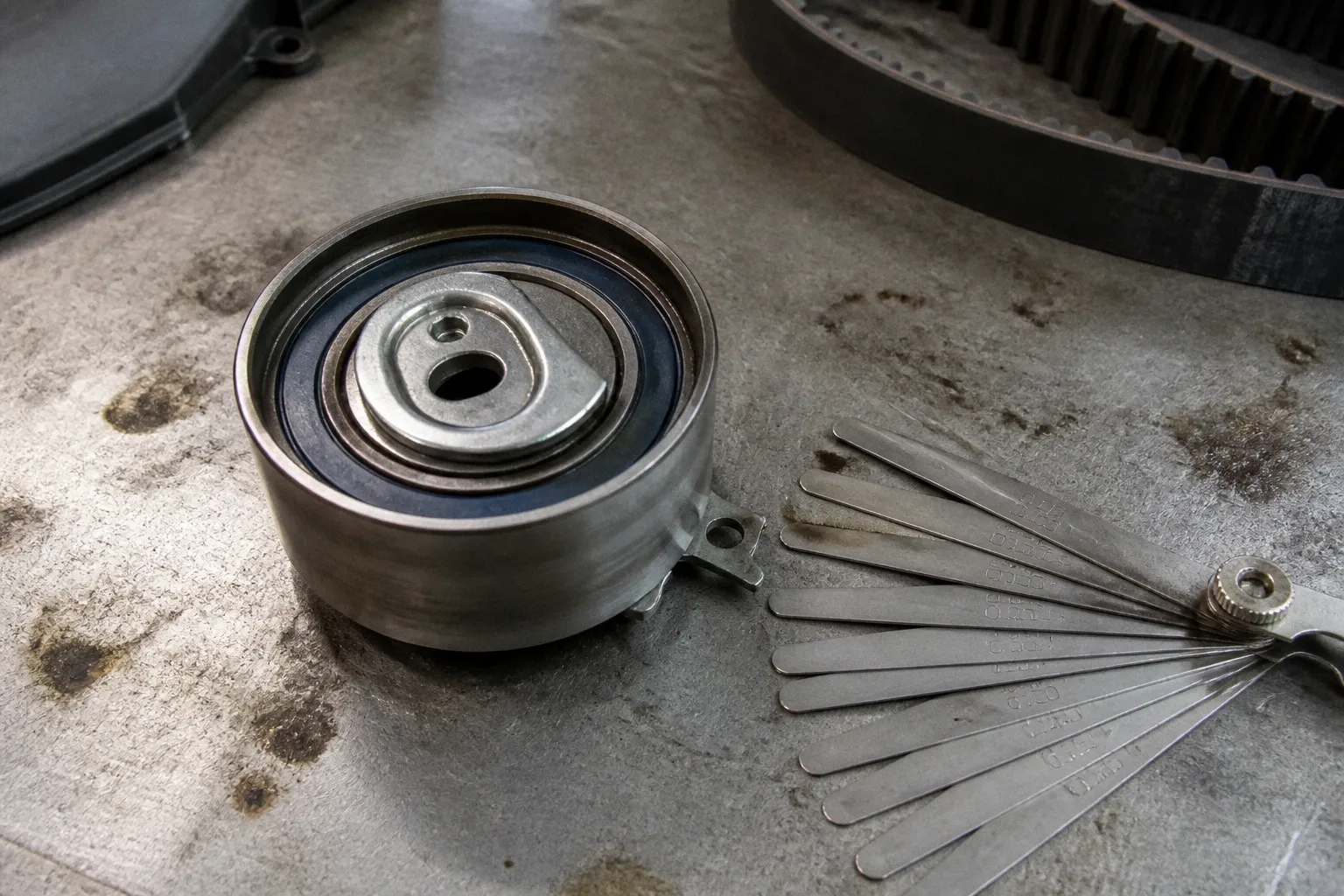
The sound is not a maintenance reminder. It is mechanical evidence.
Timing belt tensioner noise diagnostics must begin by separating the timing drive from the accessory drive. A serpentine belt tensioner, alternator bearing, water pump, air-conditioning compressor, or idler pulley can produce a similar acoustic pattern. Misidentification leads to the wrong repair. A timing belt failure leads to loss of valve synchronization and, on interference engines, possible contact between valves and pistons.
The standard timing belt replacement interval is commonly between 60,000 and 100,000 kilometers, but a new belt does not make a worn tensioner acceptable. The tensioner and idlers are loaded by the same drive and are commonly replaced with the belt.
Distinguishing timing drive sounds from accessory belt noise
The first diagnostic gate is location. The second is operating condition.
Timing-drive noise is generally concentrated at the timing cover. Accessory-drive noise is located at the exposed belt path on the front or side of the engine. Sound travels through castings and covers, so location by ear is not conclusive. The belt systems must be isolated.
A cold-start noise is relevant, but it does not identify the failed component by itself. A timing belt tensioner rattle on startup may be caused by a loose tensioner assembly or by a hydraulic or spring-loaded tensioner that fails to maintain force. An accessory pulley can rattle under the same condition.
The following patterns provide an initial separation:
| Noise pattern | Probable mechanism | Diagnostic direction |
|---|---|---|
| High-pitched squeal or squeak | Dry or damaged tensioner-pulley bearing; severe friction | Inspect pulley bearing and belt tracking |
| Grinding that follows engine speed | Bearing wear, depleted grease, or pulley damage | Isolate the belt system and inspect for rough rotation |
| Rattle from the timing-cover area | Loose tensioner assembly or failed hydraulic dampener/spring mechanism | Check tensioner mounting, movement, and retained belt force |
| High-pitched whine after belt replacement | Excessive belt tension or misalignment | Verify belt routing and tensioning procedure |
| Misfire, rough idle, hard starting, sluggish acceleration | Valve timing has shifted because belt tension was lost | Stop operation and verify crankshaft-to-camshaft timing |
| Noise that disappears when the serpentine belt is removed | Accessory-drive source | Inspect accessory pulleys, tensioner, alternator, pump, and compressor |
Removal of the serpentine belt is an isolation procedure, not a repair. The engine should be operated without it only within the limits permitted by the vehicle design and for the minimum time required for diagnosis. On some engines, the water pump is driven by the accessory belt. Operation without that belt can remove coolant circulation and produce rapid overheating.
If the noise remains with the accessory belt removed, the timing drive becomes the primary suspect. If the noise disappears, the timing belt should not be disassembled without further evidence. The fault is outside the timing cover.
The first correct answer is not “replace the tensioner.” It is “prove which belt system is producing the noise.”
A mechanic’s stethoscope can assist with localization, but the probe must not contact a moving belt, pulley, fan, or rotating shaft. The instrument identifies vibration transfer. It does not replace visual inspection or belt removal.
High-pitched whining and bearing friction
A failing timing belt tensioner pulley bearing commonly produces a squeak, high-pitched squeal, or grinding noise. The mechanism is direct. Bearing grease is depleted or contaminated. Rolling resistance increases. The pulley may develop roughness, radial play, or an uneven acoustic signature that rises with engine speed.
The noise can be confused with an over-tightened belt. A belt installed with excessive tension increases radial load on the tensioner and idler bearings. The result is a high-pitched whine immediately after belt replacement. In that case, the belt may look intact and the engine may run correctly, but the load condition is wrong.
The diagnostic sequence is conditional:
1. If the noise appeared immediately after timing belt service, verify belt routing, tensioner position, and the prescribed tensioning method.
2. If belt tension is excessive, correct the installation before condemning the bearing.
3. If the belt tension is correct but the pulley produces grinding or roughness, replace the affected pulley or tensioner assembly.
4. If the noise is present before the scheduled belt interval, do not defer the repair solely because the belt has remaining service distance.
5. If the noise is accompanied by belt-edge wear or tracking toward one flange, inspect alignment and mounting surfaces.
A belt can remain visually serviceable while the bearing behind the pulley is failing. Cracks or missing teeth are not required for a tensioner to become unsafe. The bearing may seize first. Once the pulley stops rotating freely, the belt can overheat, shed material, jump teeth, or break.
Belt spray and lubricants do not correct this condition. They can degrade belt compounds, alter friction at the pulley interface, and mask the original sound without changing bearing damage. A noise that changes after chemical application has not been repaired.
How to check timing belt tensioner play
Play must be checked with the belt removed and the engine stopped. The exact disassembly procedure varies by engine layout. The tensioner must not be forced against its travel stop, and the pulley must not be pried laterally with a tool that can distort the bearing seal or mounting flange.
Once access is obtained, inspect the pulley for:
- Radial movement relative to the mounting stud or shaft.
- Axial movement toward and away from the engine.
- Roughness during slow manual rotation.
- Notches, binding, or a gritty sensation.
- Visible grease leakage or seal damage.
- Contact marks on the pulley flange.
- Uneven belt wear or polished edges.
- Movement of the tensioner body that is not part of its designed range.
The pulley should rotate smoothly. A pulley that spins freely by hand for more than two full rotations indicates that bearing grease has been lost and the component must be replaced. Free spinning is not evidence of a healthy bearing. A correctly lubricated bearing normally presents controlled resistance.
This test is not a substitute for vehicle-specific service information. A hydraulic tensioner may require a separate inspection of the piston, body, oil leakage, or locking position. A spring tensioner may require a check of spring force and indicator alignment. The pulley bearing and the tensioner mechanism are separate failure points.
Rattling from the timing cover
A rattling or knocking sound differs from bearing squeal. It indicates movement, impact, or unstable belt force.
The most common mechanisms are a loose tensioner assembly and an internal hydraulic dampener or spring tensioner that no longer maintains consistent force. When tension varies, the belt span can oscillate. The tensioner arm moves. The pulley or mounting hardware may contact adjacent components. The noise is often strongest at startup, during deceleration, or when engine speed passes through a narrow resonance range.
The timing belt tensioner rattle on startup should not be classified as harmless without inspection. Oil pressure may affect some hydraulic mechanisms, but a brief duration does not eliminate mechanical wear. Repeated noise means the tensioning system is not maintaining a stable operating condition.
The diagnostic logic is as follows:
- If the rattle is present only during the first seconds after startup, inspect the hydraulic tensioner, belt slack, and mounting condition.
- If the rattle changes with engine speed, inspect for belt oscillation, loose hardware, and a damaged pulley bearing.
- If the rattle occurs during throttle release, inspect tensioner damping and belt alignment.
- If the rattle is accompanied by a rough idle or misfire, treat valve timing displacement as a possible cause.
- If the belt has jumped teeth or timing marks no longer align, the engine must not be operated until synchronization is restored and the cause of lost tension is corrected.
A loose timing belt noise may be described by owners as tapping, slapping, rattling, or knocking. The label is less important than the physical evidence. The belt must be observed for abnormal movement only where the procedure is safe and permitted by the manufacturer. A timing cover should not be removed or bypassed casually on a running engine. Exposed rotating components create an immediate entanglement hazard.
Mounting fasteners must be checked for correct seating and damage. Exact torque values are vehicle-specific and must be taken from the service data for the engine. A tensioner that has been tightened against a contaminated, damaged, or incorrectly positioned mounting surface can lose alignment even when the fastener appears secure.
The impact of incorrect tension on engine performance
A tensioner fault can remain acoustic for a limited period. It then becomes a timing fault.
The camshaft and crankshaft are mechanically synchronized by the timing belt. The tensioner maintains belt engagement as the engine accelerates, decelerates, and changes load. If tension is lost, the belt can move across the teeth. Valve timing then shifts relative to crankshaft position.
The resulting symptoms are not random:
1. Rough idle. Valve events occur outside the intended crankshaft position. Cylinder filling becomes uneven.
2. Misfire. Combustion quality deteriorates because valve opening and closing no longer match the calibrated event.
3. Sluggish acceleration. Torque production is reduced across the affected operating range.
4. Hard starting. Crankshaft rotation may continue while valve timing is displaced.
5. Abnormal cranking speed. Compression characteristics can change when camshaft timing shifts.
6. Engine stall. A larger timing error can prevent stable combustion.
7. Internal mechanical damage. On an interference engine, sufficient timing displacement can allow valve-to-piston contact.
These symptoms do not prove a tensioner fault. Ignition, fuel delivery, compression, variable valve timing, and sensor faults can produce similar results. The timing drive becomes a priority when performance symptoms appear together with noise from the timing-cover area.
A diagnostic scan may show misfire or camshaft-crankshaft correlation faults, but the absence of a fault code does not clear the timing system. Mechanical timing can be incorrect before the control module registers a correlation threshold violation. Code status is supporting evidence. Belt position and tensioner condition are physical evidence.
If a timing belt tensioner has lost force, the belt should be inspected for tooth damage, edge wear, contamination, and abnormal elongation. The camshaft and crankshaft timing marks must be aligned according to the engine’s service procedure. Rotating the engine by hand after installation is required to confirm that the marks return to their specified positions and that no mechanical interference is present.
Inspection of the pulley and tensioner assembly
The tensioner assembly should be evaluated as a mechanism, not as a single noisy wheel.
A typical inspection includes the pulley bearing, tensioner arm, spring or hydraulic element, mounting surface, fastener, belt path, and adjacent idler. Each part can create a similar symptom. Replacing only the pulley when the tensioner arm has lost damping leaves the original fault in place.
With the belt removed, the pulley is rotated slowly by hand. A healthy pulley should have no grinding, binding, or abrupt resistance. Side movement should not be present beyond the tolerance specified for that engine. The pulley should not wobble relative to its mounting axis.
The tensioner body is then inspected for:
- Hydraulic fluid leakage, where a hydraulic unit is used.
- A displaced or damaged indicator.
- Broken or distorted spring components.
- Cracks around the mounting boss.
- Contact with the timing cover.
- Evidence of belt misalignment.
- Incorrect installation orientation.
- Hardware that has loosened or pulled threads.
The belt itself is inspected for:
- Missing, damaged, or polished teeth.
- Frayed edges.
- Oil or coolant contamination.
- Glossy surfaces caused by excessive heat or slip.
- Uneven wear across the belt width.
- Contact with the timing cover.
- Incorrect routing around the idlers and camshaft sprockets.
A pulley that rotates more than two full turns freely by hand should be treated as a failed component because the bearing grease has been depleted. This is a clear replacement condition. A pulley that feels smooth can still have a load-related defect, so the belt tension and alignment remain part of the diagnosis.
The replacement decision follows the failure mode:
| Finding | Required action |
|---|---|
| Rough, gritty, or grinding pulley | Replace the pulley or complete tensioner assembly specified for the engine |
| More than two free manual rotations | Replace the pulley or tensioner assembly |
| Hydraulic leakage or unstable piston movement | Replace the hydraulic tensioner |
| Excessive belt tension after service | Correct belt installation and tensioning procedure |
| Belt-edge wear or flange contact | Correct alignment and inspect mounting surfaces |
| Loose mounting hardware | Restore the specified hardware condition and verify alignment |
| Belt contamination | Identify the leak source and replace the contaminated belt |
| Jumped timing marks | Restore valve timing and locate the cause of lost tension before operation |
The complete timing-drive service may include the belt, tensioner, idlers, and water pump where the pump is driven by the timing belt. The correct parts combination depends on the engine. No universal replacement interval or torque value applies to every import vehicle.
Repair logic and post-repair verification
The repair begins only after the noise source has been isolated. Parts are installed in accordance with the engine-specific procedure. Timing marks, tensioner indicators, belt routing, and fastener torque are verified before the engine is started.
If the belt was removed, the crankshaft is rotated manually through the required procedure. Resistance must be treated as a stop condition. Force must not be applied to overcome suspected valve contact. Timing marks are checked again after rotation. A belt that appears correctly installed before manual rotation can settle incorrectly if the tensioning procedure was incomplete.
After startup, the following conditions are checked:
- No squeak, squeal, grinding, rattle, or knock from the timing-cover area.
- Stable belt tracking.
- Correct tensioner-indicator position, where provided.
- No visible belt oscillation beyond the design behavior of the system.
- No hydraulic leakage.
- No misfire or abnormal idle.
- No camshaft-crankshaft correlation fault.
- No abnormal change in noise during acceleration or deceleration.
The engine is then brought to operating temperature and rechecked. Some tensioner faults become evident only after the oil and components reach temperature. A cold silent start does not certify the repair.
The diagnosis should also account for the original cause. If excessive tension was created during installation, a replacement pulley alone is insufficient. If coolant or oil reached the belt, the leak must be repaired before the new belt is installed. If a mounting surface is damaged, the new tensioner can develop the same alignment fault.
A silent belt drive is not the complete repair. Correct belt timing, stable tension, clean tracking, and repeatable bearing resistance are the verification baseline.
Final verification parameters
Timing belt tensioner noise diagnostics are complete only when the mechanical source has been identified and the repaired system meets the engine-specific baseline.
The final conditions are exact:
- Belt routing matches the manufacturer’s diagram.
- Crankshaft and camshaft timing marks align after manual rotation.
- The tensioner indicator, where fitted, is within its specified range.
- The belt tracks centrally without edge contact.
- The tensioner pulley has no roughness, wobble, or abnormal axial or radial play.
- A removed pulley that spins freely beyond two full manual rotations has been replaced.
- No hydraulic leakage is present on hydraulic tensioners.
- No timing-cover rattle, bearing squeal, grinding, or excessive whine remains.
- Idle quality and acceleration are stable.
- No new misfire or camshaft-crankshaft correlation fault is recorded.
- The next belt service interval is documented within the vehicle-specific range, commonly 60,000 to 100,000 kilometers unless the manufacturer specifies otherwise.
A tensioner noise is a mechanical warning, not an acoustic inconvenience. The belt system either maintains synchronization under load or it does not. Once the noise indicates bearing wear, unstable damping, or incorrect tension, continued operation converts a contained component failure into a timing failure. The correct response is isolation, inspection, replacement of the failed mechanism, and verification against the engine’s exact timing and tension parameters.