Microfiber vs foam pads: paint correction comparison
The widespread assumption that one pad type dominates all paint correction scenarios reflects a fundamental misunderstanding of abrasive mechanics.
Merritt Vane·Updated: August 15, 2026·9 min read
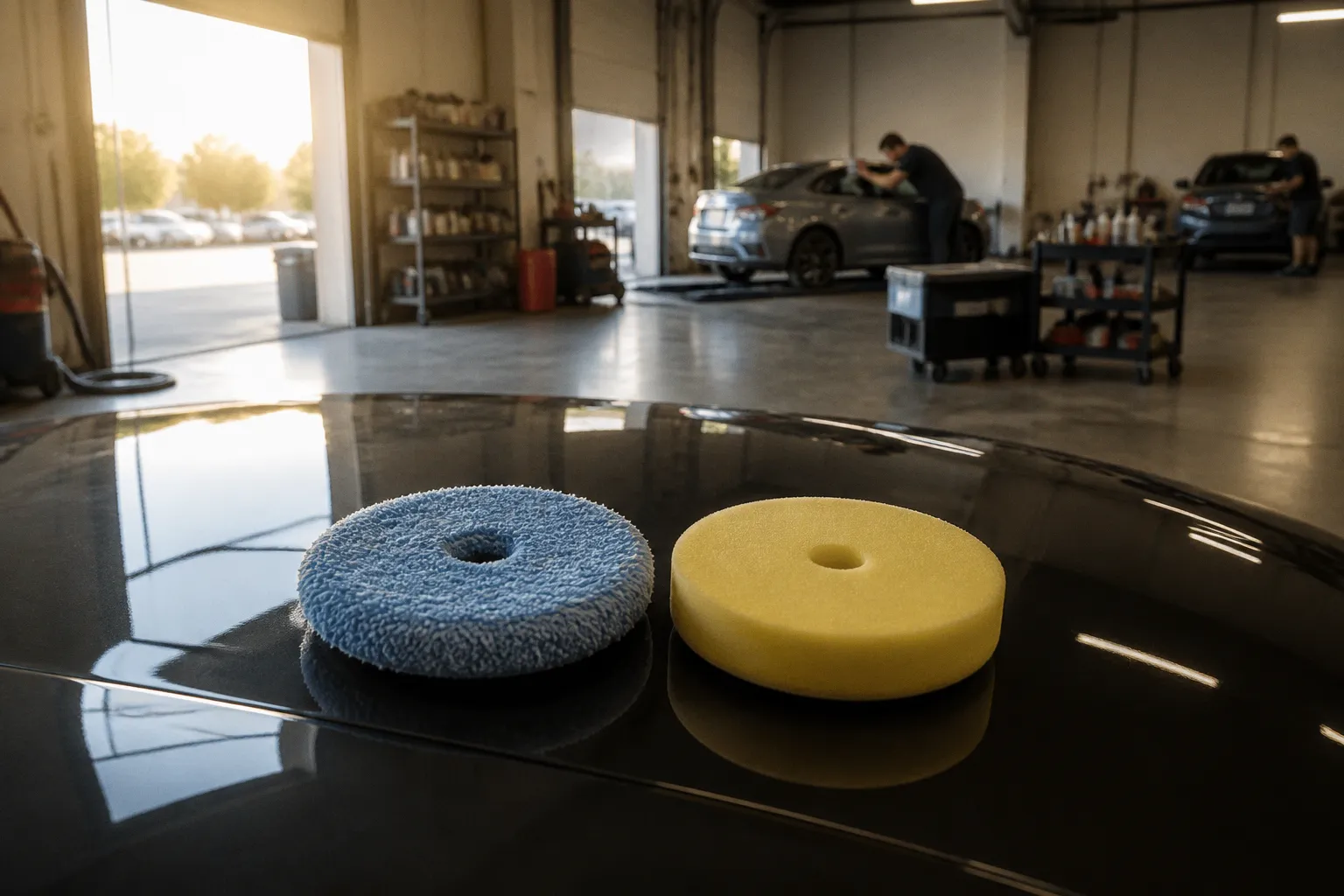
In practice, the choice between microfiber and foam represents a deliberate engineering trade-off between cutting efficiency and finish quality; each substrate interacts with the clear coat through distinct physical principles, and the substrate that excels at one phase of correction typically underperforms at another.
Compare car rental deals in United Kingdom
See available offersPartner link — DiscoverCars comparisonThe decision is not which pad is superior in isolation, but how each tool performs against specific defect profiles, clear coat hardnesses, and finishing outcomes. Treating paint correction as a single-step operation almost always yields either incomplete defect removal or unacceptable haze, while a calibrated sequence that leverages both pad architectures consistently produces the clarity the underlying chemistry actually allows.
The Mechanics of Microfiber: Aggressive Leveling and Surface Contact
Microfiber pads derive their cutting capability from a fundamental geometric advantage: thousands of individual fiber tips create a vastly greater contact area with the paint surface than the relatively planar face of a foam pad. Each filament acts as a discrete abrasive delivery point, channeling compound into microscopic scratches and mechanically leveling oxidized or swirled clear coat at a rate that foam cannot match. The substrate is engineered around a simple cause-and-effect relationship—more contact points yield faster material removal.
This architecture makes microfiber the default choice for heavy correction work. Hard clear coats, typical of many European manufacturers, resist foam's distributed pressure and demand the aggressive bite of fiber-based abrasives to make meaningful progress against deep swirl marks, acid etchings, and oxidation. The pad's high surface-area contact also accelerates leveling across larger defects, reducing the number of passes required to reach the defect floor; on a neglected panel with years of accumulated micro-scratches, that efficiency is often the difference between a practical correction and a labor-intensive one that the operator abandons before completion.
The fibers themselves are typically composed of split-end synthetic filaments engineered to retain compound within their structure while presenting sharp working edges to the paint. This retention behavior carries chemical implications: the compound is metered out gradually rather than smeared across the surface, which improves cutting consistency but also concentrates both mechanical and thermal energy at the fiber-paint interface. The result is faster correction, paired with a higher working temperature that the operator must actively manage.
Foam Pad Dynamics: Pressure Distribution and Finishing Clarity
Foam operates on an entirely different principle. Where microfiber concentrates force across thousands of discrete points, foam distributes pressure evenly across its cellular matrix, producing a fundamentally smoother interaction with the clear coat. The result is not cutting speed but finish quality; foam pads refine the surface left by aggressive microfiber passes, or—on softer paints—perform meaningful correction on their own without inducing the micro-marring that fiber tips can leave behind.
The diversity of foam formulations further complicates any simple comparison. Open-cell structures permit air circulation through the pad body, dissipating thermal buildup during prolonged operation; closed-cell variants provide denser contact for more aggressive finishing work. Foam density ratings, typically expressed in PPI (pores per inch), directly govern aggressiveness: lower PPI yields a firmer, more cutting-oriented pad, while higher PPI delivers the smooth, jewel-like refinement associated with finishing stages. A single foam lineup can therefore span the range from moderate cutting to ultra-fine finishing, simply by varying the cellular architecture.
The practical consequence is that foam pads carry the final stages of any serious correction. After microfiber has done the heavy leveling, a finishing foam paired with a fine polish eliminates the micro-haze and produces the optical clarity that defines a properly corrected surface. On softer clear coats, common among certain Japanese and domestic manufacturers, foam may be the only safe cutting option, as fiber tips can embed themselves in the relatively pliable surface and induce holograms or buffer trails that require additional refinement to remove.
Foam pads do not compete with microfiber on speed; they compete on clarity. Each substrate governs a distinct phase of the correction sequence.
Managing Thermal Buildup and Pad Maintenance
The abrasive interaction between pad and paint generates heat; this is not a peripheral concern but a central variable in correction chemistry. Excessive thermal buildup softens the clear coat, alters compound viscosity, and accelerates pad degradation, with cascading effects on finish quality. A pad that runs hot will smear compound rather than cut, glaze over prematurely, and in extreme cases induce irreversible clear coat damage.
Microfiber pads, by virtue of their concentrated contact points, generate heat faster than foam. The fibers themselves can be cleaned mid-process using compressed air, which expels spent compound and paint residue while simultaneously cooling the working surface; this is one of microfiber's underappreciated operational advantages and a primary reason experienced detailers keep an air line within reach. Foam pads require a different maintenance protocol: brushing the face after each pass, or rinsing periodically with a dedicated pad cleaner, prevents loaded compound from glazing the cellular structure and reducing cutting efficiency.
Dual-layer designs address both substrates' weaknesses. The Lake Country HDO microfiber pad, for instance, incorporates an intermediate foam backing layer that absorbs machine vibration and assists in heat regulation; this hybrid construction reduces operator fatigue and extends pad lifespan while preserving the aggressive cutting characteristics of the fiber face. Similarly, open-cell foam pads leverage their porous structure to circulate air and mitigate thermal accumulation during extended polishing sessions, and are generally favored for their cooler operation even at the cost of slightly slower cutting.
| Parameter | Microfiber Pads | Foam Pads |
|---|---|---|
| Cutting speed | High; rapid defect leveling on hard clear coats | Moderate to low; governed by PPI and density |
| Finish quality | Risk of micro-marring or haze on soft paints | Superior clarity and high-gloss refinement |
| Heat generation | Higher; concentrated at fiber tips | Lower; distributed and often dissipated via open-cell structure |
| Pressure distribution | Localized across fiber tips | Even across cellular matrix |
| Mid-pass maintenance | Compressed air cleaning | Brushing or rinsing with pad cleaner |
| Best application | Heavy cutting on hard clear coats | Finishing, soft paint correction, refining stages |
Strategic Workflow: Combining Pad Types for Multi-Stage Correction
The contemporary correction workflow treats pad selection as a sequence rather than a single decision. A typical multi-stage process begins with microfiber paired with a heavy-cut compound to address severe defects—deep swirl marks, oxidation, etchings from bird droppings or tree sap, and sanding marks from prior bodywork. This first stage prioritizes defect removal over finish quality, accepting that the fiber tips will leave their own characteristic micro-haze in exchange for the rate of material removal.
The second stage transitions to foam. A medium-cut foam pad with a polishing compound addresses the micro-marring left by the microfiber stage, smoothing the surface and beginning to develop gloss. A third stage, often considered optional in casual work but essential in professional correction, employs a soft finishing foam with a fine polish or glaze to extract maximum depth and clarity from the now-leveled clear coat.
This staged approach reflects a chemical reality: each successive pad and compound combination refines the surface at a smaller scale. The abrasive particles in finishing polishes are typically finer and more uniformly dispersed than those in cutting compounds, and the foam pad's smooth contact allows them to work without inducing new defects. Skipping stages, or attempting to achieve finishing clarity with a microfiber pad, invites the very haze the process is designed to eliminate.
Some detailers substitute heavy-cut foam pads for the initial microfiber stage on softer clear coats, accepting slower cutting in exchange for a safer interaction with the substrate. This is not a compromise but a calibration; the pad must match the paint, and a universal approach consistently underperforms a tailored one.
Navigating Clear Coat Hardness and Potential Micro-Marring
Clear coat hardness varies substantially across manufacturers, model years, and even individual panels depending on repaint history. Hard clear coats, often found on German vehicles and certain premium segments, resist abrasive penetration and demand the mechanical advantage of microfiber to achieve meaningful defect removal within reasonable working time. Soft clear coats, common on many Japanese and domestic vehicles, respond readily to foam and may be actively damaged by aggressive fiber cutting.
The failure mode most often associated with microfiber is micro-marring: microscopic scratches left by fiber tips when the pad is worked too aggressively, when the compound breaks down prematurely, or when the underlying paint is simply too soft to tolerate the contact geometry. These defects are typically invisible under casual inspection but become apparent under strong directional lighting or direct sunlight, manifesting as a faint haze that undermines the gloss the correction was meant to restore. Compounding the problem, micro-marring often requires its own refinement stage to remove, adding time and product cost to a workflow that the operator believed was already complete.
A test spot is therefore not an optional preliminary but a procedural requirement. Working on a discrete section, typically two feet by two feet, and cycling through pad and compound combinations allows the detailer to observe how the specific clear coat responds before committing to a full-vehicle correction. This empirical step accounts for variables that no manufacturer specification fully captures: ambient temperature, paint age, prior polishing history, and the inherent variability of factory or refinish applications. The information gained in fifteen minutes of test-spot work routinely prevents hours of rework on panels that responded differently than expected.
The pad must match the paint, and a universal approach consistently underperforms a tailored one.
Conclusion
The microfiber-versus-foam decision resolves into a discipline of matching tool to substrate, defect profile, and finishing objective. Neither pad type obsoletes the other; their roles are complementary within a sequential correction workflow. Microfiber delivers the rate of material removal necessary to address severe defects on hard clear coats, while foam carries the refinement stages that translate leveled surfaces into genuine optical clarity. The detailer's task is less to choose a winner than to orchestrate both instruments according to the chemistry and condition of the paint at hand—and to verify, through disciplined test spotting, that the orchestration matches the actual substrate rather than an assumed one.