Connected Cars vs. Software-Defined Vehicles: A Diagnostic Guide for Import Owners
According to The Economic Times, connected-car systems and software-defined vehicles are increasingly appearing across Hyundai, Kia, Tata and other brands, but the two terms describe different levels…
Aldous Moorland·updated August 27, 2026
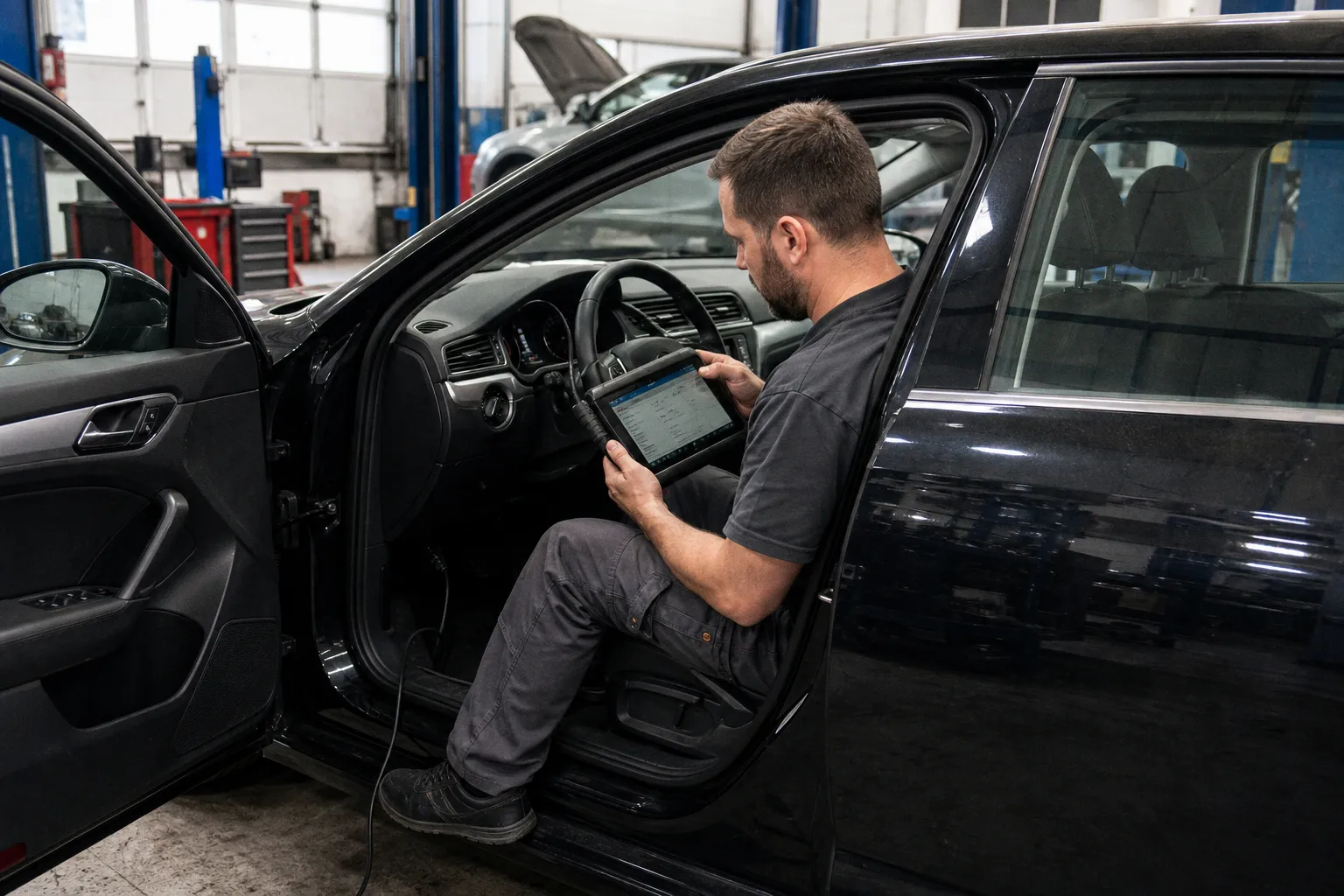
According to The Economic Times, connected-car systems and software-defined vehicles are increasingly appearing across Hyundai, Kia, Tata and other brands, but the two terms describe different levels of vehicle capability. The distinction matters during diagnostics: an internet-connected vehicle can exchange data, while an SDV uses software and computing to control, coordinate and update a wider range of functions.
For import owners, this is not a terminology issue. It determines whether a fault belongs to the phone application, cloud connection, infotainment system, vehicle network or a control function managed by software.
Connectivity is not the same as software control
A connected car provides a digital link between the vehicle, its owner, cloud services and the automaker. Depending on the model and variant, the available functions may include:
- Remote locking, unlocking, starting and climate control
- Live location, tracking and geofencing
- Vehicle-health information, alerts and diagnostics
- Connected navigation and live traffic data
- Voice assistants
- Digital keys, smartwatch integration and smartphone connectivity
- Emergency and safety services
- OTA updates for maps, infotainment or compatible software
The minimum definition is communication. The vehicle can send and receive information through an external network.
A Software-Defined Vehicle goes further. Software increasingly determines what the vehicle can do. Its computing architecture is designed to control, coordinate and update a broader range of vehicle functions over the vehicle’s lifecycle. An SDV may be connected, but a connected car is not automatically an SDV.
The practical diagnostic dead-end is treating a failed app command as proof of a vehicle hardware fault. If the vehicle still reports status but does not execute a remote command, the failure may be in the communication path or the software function rather than in the lock, starter or climate-control hardware. The available evidence does not establish a universal fault-isolation procedure, so the exact model and variant must be identified first.
Hyundai, Kia and Tata use different labels
The Economic Times lists connected technologies across multiple manufacturers and segments in India. Examples include Hyundai Bluelink, Kia Connect, MG i-SMART, Mahindra’s connected-vehicle ecosystem, Maruti Suzuki Suzuki Connect, Tata Motors connected-car technology and connected services on selected Toyota models.
The badge is not the specification. Functions vary by model and variant. Hyundai and Kia are reported to list remote controls, tracking, vehicle-health reports, diagnostics, voice functions and OTA-related capabilities among their connected-car features. That does not establish that every vehicle carrying the brand name supports every function.
For a used import or a vehicle brought from another market, the correct check is therefore configuration-specific:
1. Identify the exact model and variant.
2. Record which connected functions are explicitly supported.
3. Separate remote-control, tracking, diagnostic, navigation and voice functions.
4. Confirm whether OTA support applies to maps, infotainment or other compatible software.
5. Treat a touchscreen alone as insufficient evidence of connected-car capability.
This prevents a common classification error. Infotainment hardware may be present without the cloud link or software architecture required for remote services and OTA operation.
OTA changes the service boundary
Over-the-Air updating is one of the clearest visible elements of software-led vehicles. Certain compatible systems can receive software improvements remotely through a connected network instead of requiring a workshop visit for every update.
That does not remove the need for conventional diagnostics. It changes the point at which the fault must be measured. A technician must determine whether the symptom is caused by vehicle hardware, the electronic architecture, the connected service or the software package supported by that vehicle.
A separate example comes from Heavy Duty Trucking, which reported a U.S. Department of Transportation pilot involving vehicle-to-vehicle and vehicle-to-infrastructure communication. The test used devices that allowed vehicles and infrastructure to exchange safety and mobility information. In that project, some aftermarket devices transmitted speed and location without being connected to the vehicle systems, while retrofitted safety devices were connected to the vehicle data bus.
That distinction is useful in workshop terms. A device can communicate around the vehicle without controlling the vehicle. Communication capability alone does not prove integration with the vehicle’s control systems.
The verification baseline is exact: the vehicle’s model and variant, the connected functions listed for that configuration, and the specific OTA or data-bus capabilities supported. Anything beyond those parameters remains unconfirmed.