Control Arm Bushing Replacement vs Complete Assembly
A fifteen-dollar bushing and a three-hundred-dollar control arm assembly occupy very different positions in the parts catalog, yet they often arrive at the same repair-bay decision.
Merritt Vane·Updated: August 14, 2026·19 min read
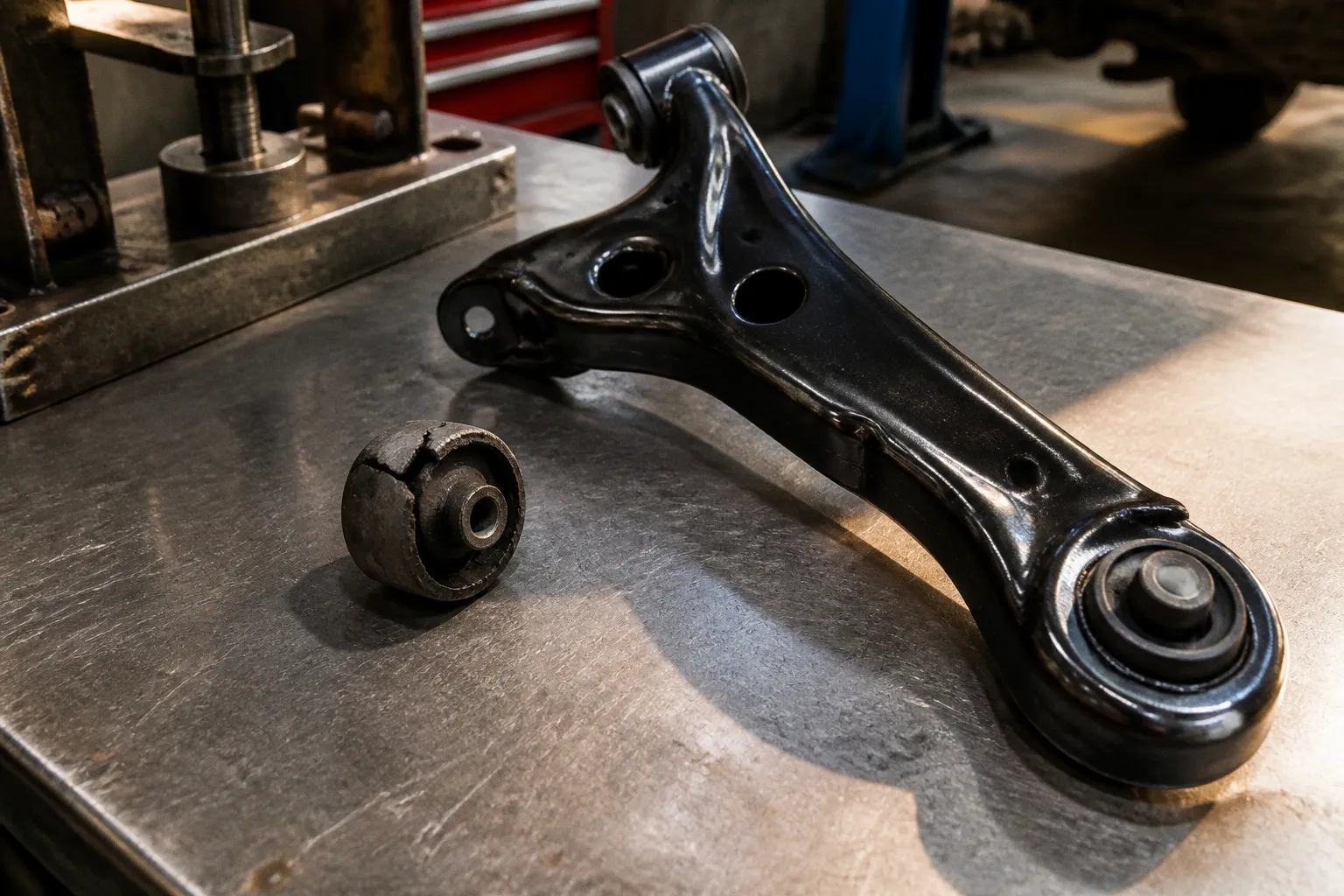
The quoted price of a single control arm bushing is, on its face, dramatically lower than the price of a complete arm. That difference creates an understandable reflex: replace the small part, avoid paying for components that appear to be perfectly usable, and keep the repair within budget.
Compare car rental deals in United Kingdom
See available offersPartner link — DiscoverCars comparisonThe comparison becomes less straightforward once the arm is on the bench. Pressing out the old bushing, preparing the bore, positioning the replacement correctly, checking the condition of the arm and ball joint, and completing the alignment can change the financial and mechanical calculation. On some vehicles, replacing only the bushing is a sensible repair. On others, the complete assembly is the more reliable way to restore the suspension without paying twice for labor.
The control arm is not just a bracket that carries a rubber insert. It locates the wheel relative to the body under braking, acceleration, and cornering loads. The bushing controls how much that relationship can move and in which direction. When the rubber has hardened, cracked, separated from a sleeve, or become excessively compliant, the question is not simply whether a new bushing is cheaper. It is whether the arm, its bore, its mounting points, and any integrated ball joint are still suitable for another repair.
The cheapest part on the estimate is not necessarily the cheapest way to finish the job.
The Hidden Labor Costs of Pressing Bushings
Pressing a control arm bushing is a proper repair operation, not a minor accessory replacement. The arm usually has to be removed from the vehicle, cleaned, supported correctly, and secured in a press or a vehicle-specific bushing tool. The old bushing then has to be removed without deforming the arm or damaging nearby surfaces. On a rust-prone import, removal can take considerably more time than the parts catalog suggests.
A hydraulic shop press is useful, but force alone is not the solution. The cups and adapters must support the arm in the correct places and push on the bushing through the appropriate sleeve or outer shell. Pushing against the rubber, a flange, or an unsupported section of the arm can distort the new bushing or bend the housing. A specialty puller may be preferable where the arm cannot be positioned safely in a general-purpose press.
The labor typically includes several separate tasks:
- Removing the control arm and freeing hardware that may be corroded or seized.
- Marking the original bushing orientation where the design requires a specific clocking position.
- Pressing out the old bushing without enlarging, gouging, or distorting the bore.
- Cleaning the housing and inspecting it for corrosion, cracks, deformation, or fretting.
- Aligning the replacement bushing correctly before pressing it into place.
- Reinstalling the arm with the suspension loaded as specified by the manufacturer.
- Checking related joints, fasteners, and alignment angles after the repair.
The removal stage is often the least predictable. A bushing that slides out cleanly on a relatively young vehicle is a different job from one bonded to a sleeve by corrosion and road contamination. Some designs also require the rubber portion to be removed first, followed by the outer shell. Others use a bushing that is difficult to access because of the shape of the arm or the surrounding subframe.
This is where the phrase “press in control arm bushings DIY” needs a dose of realism. A home mechanic with a suitable press, the correct adapters, a stable work surface, and the manufacturer’s orientation information may be able to complete the job successfully. A threaded rod and a collection of improvised sockets are not automatically an equivalent substitute. If the tool bends, the adapter slips, or the arm is supported at the wrong point, the damage can be more expensive than the labor that the DIY approach was intended to avoid.
The press-in operation has its own failure modes. The replacement must enter squarely, and the force must be applied through the part intended to carry that force. Some bushings have voids, directional features, or offset sleeves that must face a particular direction. The bushing may appear seated while still being slightly tilted, or it may be pressed to the wrong depth. Those errors can affect compliance, clearance, and alignment even when the vehicle can be reassembled.
A new bushing also does not necessarily make the arm “new.” The arm may have accumulated corrosion, impact damage, or wear at other attachment points. A complete assembly can reduce the number of individual operations, but it is not automatically a better part simply because it arrives in a box. The quality of the replacement arm, ball joint, bushing compound, and included hardware still matters.
When a Complete Control Arm Assembly Is Mandatory
The bushing-versus-assembly decision is sometimes settled by the condition of the arm before the cost calculation begins. A control arm that is bent, cracked, deeply corroded, or damaged around a mounting point should not be treated as a reusable housing. A new bushing cannot restore the arm’s original geometry, and it cannot compensate for a mounting surface that no longer provides proper support.
A bent arm may be obvious after a collision or a hard curb strike, but not every deformation is visible at a glance. Unequal wheel positions, abnormal alignment readings, disturbed clearances, or a history of impact can all justify comparing the arm with the opposite side or with the manufacturer’s geometry. The correct decision depends on the design and the inspection results, not on a general rule that every old arm must be discarded.
Corrosion around the bushing bore deserves the same careful treatment. Surface rust that can be cleaned without changing the shape of the bore is different from flaking metal, pitting, a distorted opening, or a bore whose dimensions are no longer within the required fit. The replacement bushing depends on the housing providing the intended support. If that support is compromised, installing a new insert may only postpone the need for the complete arm.
Bushing migration is another condition that requires inspection rather than prediction. If the inner sleeve has shifted, if the outer shell has moved in the housing, or if repeated movement has marked the bore, the arm may no longer be a good candidate for a pressed replacement. The amount of wear that makes the housing unusable is vehicle-specific. Some arms have replaceable sleeves or designs that tolerate service work; others rely on a close fit that leaves little room for damage.
The important question is not whether the old bushing moved “a lot” in the abstract. It is whether the arm still provides the correct fit and whether the replacement can be installed at the specified depth and orientation. A competent inspection should look for:
- Elongation, scoring, or deformation of the bushing bore.
- Cracks or fatigue marks near the mounting ears and welds.
- Corrosion that has removed material rather than merely discoloring the surface.
- Contact marks showing that the sleeve or shell has been moving where it should remain controlled.
- Damage from a previous installation attempt.
- A ball joint that has excessive play, a torn boot, or rough movement.
The ball joint changes the calculation
Many control arms carry a ball joint that wears independently of the bushings. Depending on the vehicle, the joint may be bolted in, pressed in, riveted in, or integrated into the arm. That detail is central to the repair choice.
If the ball joint is serviceable and the arm is sound, replacing a bushing alone may be entirely reasonable. If the joint is worn or its boot has allowed contamination to enter, a bushing-only repair leaves a second suspension problem in place. The complete assembly may then be the cleaner repair, especially when the arm and ball joint are supplied together and the labor to replace them separately would be similar.
The reverse is also true: an inexpensive complete assembly is not a guarantee of component integrity. Some low-cost assemblies use bushings or ball joints with different compliance, sealing, or fit characteristics from the original equipment. A repair that eliminates one worn component while introducing a marginal replacement is not a real improvement.
Comparing Part Longevity and Component Integrity
The longevity question is more nuanced than “factory assembly good, pressed bushing bad.” A properly selected replacement bushing installed in an undamaged arm can provide a durable repair. The result depends on the vehicle’s design, the quality of the part, the installation method, the condition of the housing, and the loads the vehicle sees in service.
A complete assembly does offer one practical advantage: several related components are renewed at once. That advantage matters most when the arm has high mileage, the ball joint is original, access is difficult, or the cost of returning to the same area later would be substantial. It is less decisive when the arm is in excellent condition and the bushing is the only failed component.
Rubber, polyurethane, and the original design
Control arm bushings are not interchangeable pieces of rubber with identical behavior. Original-equipment designs may use voided rubber, directional cavities, hydraulic features, bonded sleeves, or carefully tuned stiffness in different axes. The bushing is allowed to move in some directions while resisting movement in others.
A solid polyurethane bushing may last well in a particular application, but it can also change noise, vibration, harshness, steering feel, and the way the suspension responds to small impacts. An aftermarket rubber bushing may be closer to the original behavior, but quality and dimensions vary between suppliers. “Fits the arm” is not the same as “preserves the intended suspension response.”
Material age also has to be considered on both repair paths. The remaining bushings on the vehicle may be the same age as the failed one. Replacing a single bushing with a substantially stiffer component can produce an imbalance between the two sides, particularly when the opposite side has already hardened or cracked. That does not mean both sides must always be replaced together, but it is a reason to inspect the axle as a system rather than treating one side in isolation.
Bonded designs and press-fit designs
Some bushings are bonded to the inner sleeve, the outer shell, or both. Others are designed primarily around a press fit and controlled movement. The service procedure is therefore not universal. A bushing that is meant to rotate slightly in a particular mounting arrangement should not be treated like one that is bonded and must remain fixed relative to the arm.
This distinction also affects installation torque. Many control-arm fasteners should be tightened with the suspension at ride height or with the arm positioned at its normal loaded angle. Tightening a bonded rubber bushing while the arm hangs at full droop can place the rubber in an unintended resting position. The result may be reduced travel, premature stress, or a ride-height-dependent change in the suspension’s behavior. The exact procedure should follow the vehicle’s service information.
The housing is part of the repair
The housing does not have a universal service life or a universal limit on the number of times it can be pressed. Some manufacturers provide procedures for replacing the bushing separately; others specify replacement of the arm as an assembly. Even where a separate bushing is permitted, the condition of the bore controls whether that procedure remains appropriate.
A prior press operation is not, by itself, proof that the arm must be thrown away. It does mean that the housing deserves a careful inspection for distortion and damage. The technician should not assume that a new bushing will restore the original fit without confirming that the arm remains within the relevant specification.
The same caution applies to corrosion and contact between different metals. Corrosion can affect a bushing, sleeve, fastener, or arm through moisture, salt, contamination, and damaged protective coatings. The exact mechanism and severity depend on the materials and environment. It is not useful to describe every aged bushing interface as a predictable galvanic failure. What matters in the workshop is observable damage: loss of fit, pitting, seized components, fretting marks, or material loss that affects the joint.
A control arm is a structural part of the suspension, not merely a container for a replaceable rubber insert.
The Financial Reality: Total Job Cost Analysis
The most useful comparison is not the price printed beside the bushing. It is the total cost of returning the vehicle to service with a sound arm, a sound joint, and verified alignment.
The figures below are broad examples rather than a universal price list. Labor rates, access, rust, vehicle design, part quality, and regional pricing can move the result substantially.
| Cost parameter | Standalone bushing replacement | Complete assembly replacement |
|---|---|---|
| Part cost | Lower in many applications | Higher, especially with quality or OEM-grade parts |
| Arm removal | Usually required | Usually required |
| Pressing or specialty-tool labor | Required when the design uses a pressed bushing | Usually not required |
| Housing inspection | Essential | Still important, but the replacement arm supplies a new housing |
| Ball joint | Reused if serviceable | Included on some assemblies, separate on others |
| Installation complexity | Sensitive to orientation and press technique | Usually simpler, but fit and hardware still need checking |
| Alignment assessment | Commonly required after the repair | Commonly required after the repair |
| Main risk | Paying for labor on an arm that later proves unsuitable | Buying a low-quality assembly or replacing good components unnecessarily |
For a single-side repair, the bushing option can be economical when the arm is easy to remove, the housing is clean, the ball joint is healthy, and the replacement part is known to match the original design. It becomes less attractive when the shop must spend significant time removing a seized bushing, cleaning corrosion, or diagnosing damage that was hidden before disassembly.
The complete assembly often has a higher parts price but a more predictable labor path. That predictability has value. It can also reduce the chance of paying for bushing labor and then discovering that the arm, ball joint, or bore must be replaced anyway. On the other hand, the assembly route may be wasteful if it replaces a good ball joint and a sound arm solely because the bushing is worn.
A useful estimate should separate the major variables instead of presenting one unexplained total:
1. Parts. Identify whether the bushing or assembly is original equipment, a reputable aftermarket equivalent, or an economy part. Confirm whether the assembly includes the ball joint and whether new hardware is supplied.
2. Removal and installation. Ask whether both options require the same arm removal labor. In many vehicles they do, which makes the additional pressing labor the key difference.
3. Inspection. Find out what happens if the bore is damaged or the ball joint fails inspection. A realistic quote should explain whether additional labor is charged if the repair changes from a bushing to a complete arm.
4. Related work. Consider seized fasteners, stabilizer links, eccentric bolts, damaged dust shields, and other parts that may be disturbed during the repair.
5. Alignment. Include the cost of checking and, when necessary, correcting alignment after the arm has been removed or replaced.
6. Future access. If the ball joint is already close to the end of its service life, replacing the bushing alone may defer rather than eliminate another visit to the same area.
The “control arm assembly vs bushing cost” comparison therefore has no fixed winner. A low-priced bushing is most compelling when it avoids unnecessary component replacement without creating uncertain labor. A complete arm is more compelling when it packages several worn components, reduces difficult press work, or removes a questionable housing from the repair.
One side or both?
Replacing both sides of an axle is sometimes recommended because the bushings have lived through the same mileage, weather, and road conditions. It is not a substitute for inspection, and it is not automatically required for every isolated failure. The condition of the opposite side, the vehicle’s suspension design, and the owner’s plans for the vehicle should guide the decision.
If the opposite bushing is visibly cracked, has excessive movement, or shows similar deterioration, replacing it at the same time may produce more consistent handling and avoid repeating the labor. If it is sound and the failure has a clear one-sided cause, a single-side repair may be appropriate. The estimate should make that reasoning visible rather than presenting axle-pair replacement as an unexplained rule.
Why Professional Alignment Is Non-Negotiable Post-Repair
The repair is not complete simply because the control arm is bolted back onto the vehicle. Removing or replacing an arm can affect the wheel’s position, camber, caster, toe, or thrust relationship, depending on the suspension design. The change may be small enough to escape a visual inspection while still exceeding the preferred alignment range.
That is why an alignment check is normally the correct final step after control-arm work. Whether the vehicle requires a front-end alignment or a four-wheel procedure depends on its suspension layout and the alignment angles specified by the manufacturer. A professional shop can also identify a problem that the repair itself did not cause, such as a bent knuckle, shifted subframe, worn tie-rod end, or an adjustment that has reached the end of its range.
Tire wear from misalignment is not governed by one fixed mileage or one guaranteed replacement cost. It depends on the amount and direction of the error, the tire, the road surface, inflation, driving style, and how quickly the condition is noticed. Even so, skipping the check can turn a relatively modest final step into accelerated wear, a steering complaint, or the need to revisit the suspension when the underlying geometry was never verified.
Alignment is also about more than tire life. Incorrect toe can affect straight-line stability and steering effort. A change in caster can alter steering return and the vehicle’s tendency to track. Camber differences can contribute to handling imbalance and uneven wear. On vehicles with a sensitive thrust angle, the rear axle’s relationship to the vehicle centerline matters to the way the front wheels are set and the way the car feels on the road.
The post-repair process should include:
- A check for looseness in the ball joints, tie-rod ends, and stabilizer links.
- Verification that the control-arm fasteners are tightened using the correct procedure.
- Confirmation that bonded bushings were tightened at the specified suspension position.
- A review of alignment readings before and after adjustment.
- A road test for pulling, steering return, brake stability, noise, and unusual movement.
- A recheck if the alignment cannot be brought into specification.
If the control arm leaves the bench, the wheel position may have changed; verify the geometry before calling the repair finished.
Choosing Between the Repair Options
The decision to replace the control arm or just the bushing should begin with the vehicle’s service design and the condition of the components, not with the smallest number on the estimate.
A bushing-only repair is usually the more defensible option when:
- The manufacturer supports separate bushing replacement.
- The control arm is straight and free of structural corrosion.
- The bore remains correctly shaped and provides the required fit.
- The ball joint and other arm hardware pass inspection.
- The replacement bushing matches the original dimensions, orientation, and intended compliance.
- The additional pressing labor remains meaningfully lower than a complete assembly.
- The repair can be performed with the proper tooling and installation procedure.
A complete assembly is often the better route when:
- The arm is bent, cracked, or materially damaged.
- The bushing bore is distorted, deeply corroded, or visibly worn.
- The ball joint is worn or integrated into the arm.
- The vehicle has high mileage and several arm components are near the end of their service life.
- Pressing labor is substantial or access makes the operation unusually difficult.
- The available assembly comes from a supplier with dependable bushing and ball-joint quality.
- The cost difference is small once labor, alignment, and the possibility of repeat work are included.
There is also a practical distinction between a repair performed for a short-term ownership plan and one intended to return the vehicle to long-term service. That does not justify fitting an unsafe part. It does affect whether it makes sense to renew one isolated bushing or replace an arm whose ball joint and mounting hardware are also aging.
For import vehicles, parts catalog accuracy is particularly important. A model may use different arm shapes, bushing orientations, ball-joint arrangements, or alignment procedures across model years, engines, drivetrains, and markets. The correct part number and installation position should be confirmed by the vehicle identification number and service information where possible. A bushing that appears dimensionally similar may still have a different void pattern, offset, or stiffness.
A Question of System Integrity
The comparison between control arm bushing replacement and complete assembly replacement ultimately comes down to the integrity of the entire suspension connection. A sound arm with a serviceable ball joint and an undamaged bore can justify replacing only the bushing. A damaged housing, a worn integrated joint, or a repair process that consumes most of the labor savings points toward the complete assembly.
The strongest decision is not the one that chooses the cheapest component in isolation. It is the one that accounts for fit, material behavior, installation accuracy, future labor, and alignment. A thirty-dollar bushing can be excellent value when the arm is a proper candidate and the work is done correctly. It can also become an expensive detour if the housing is already compromised or if the repair leaves another worn component ready to fail.
Ask for the condition of the bore, the result of the ball-joint inspection, the labor difference between the two options, and the alignment plan. Those answers make the estimate more useful than a parts-price comparison. They also reveal whether the proposed repair is restoring the suspension as a system or merely replacing the part that is easiest to list on the invoice.
For a vehicle that is otherwise sound, the right bushing installed in the right arm remains a legitimate repair. For an arm whose geometry, fit, or attached joint can no longer be trusted, a complete assembly is not unnecessary upselling; it is the more coherent way to put the suspension back on a reliable foundation.