Does a bad wheel bearing always make noise?
A persistent hum is among the most recognizable sounds in automotive diagnostics: a low, cyclically modulated growl that rises with road speed and may change as the vehicle loads one side in a turn.
Merritt Vane·Updated: August 16, 2026·16 min read
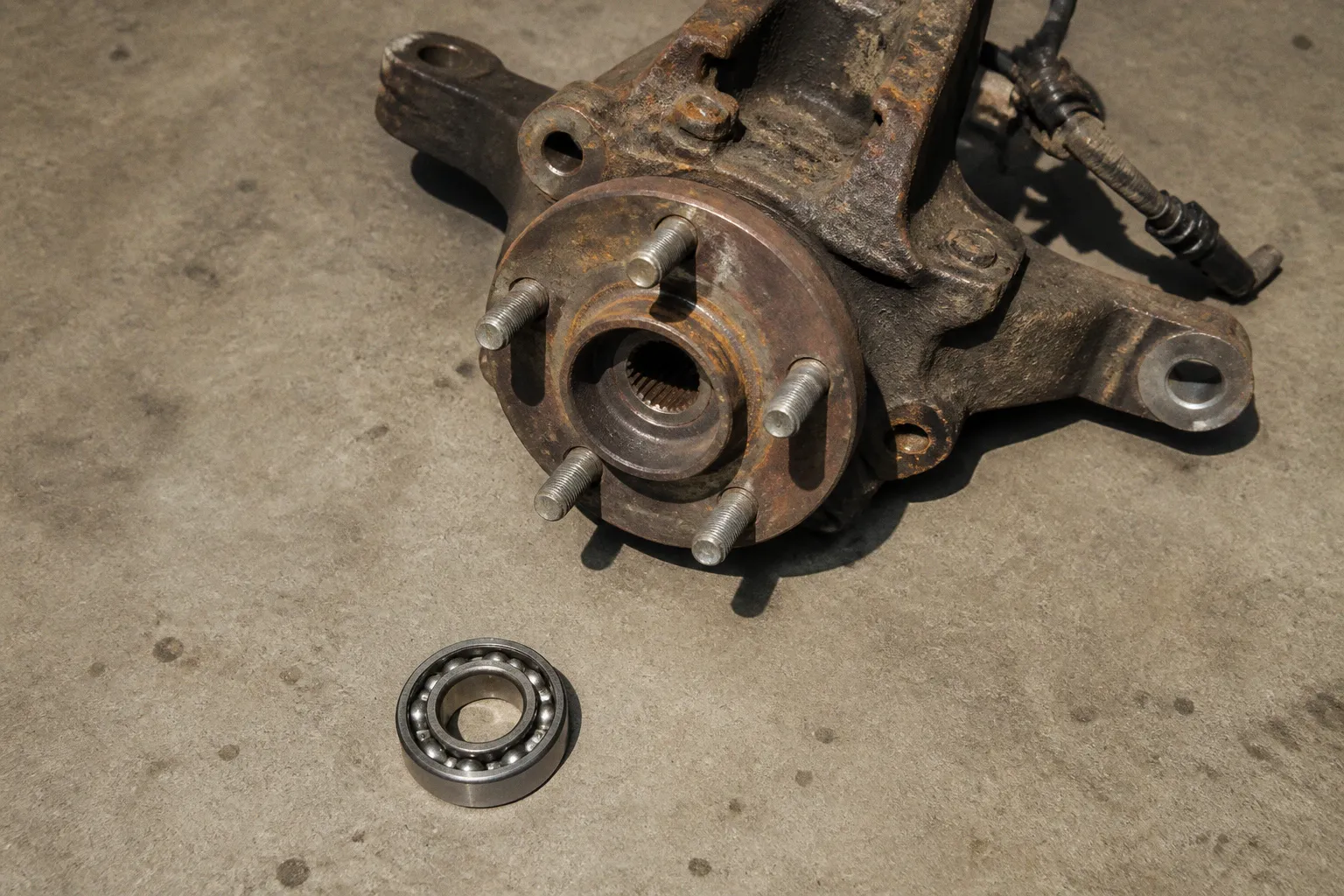
But noise is not a prerequisite for a bad wheel bearing, and its absence is not evidence that the bearing is healthy.
A bearing can develop wear, contamination, looseness, or damage without producing a sound that reaches the cabin. The opposite is also true: a bearing may become noisy while still showing little detectable looseness. Failure does not follow one universal timetable. It depends on the bearing design, preload, sealing, lubrication, road conditions, installation quality, and the type of damage taking place.
For owners of imported chassis, the problem can be harder to interpret. Some vehicles use pressed-in bearings, others use complete bolt-in hub units, and cabin insulation can suppress low-frequency mechanical noise. A tire with irregular wear, a brake rotor with excessive runout, a worn suspension joint, or an ABS sensor problem can also imitate a bearing fault.
A bad wheel bearing without noise is entirely possible—but silence tells you almost nothing about how far the problem has progressed.
How a Wheel Bearing Can Fail Without Making Noise
A wheel bearing is a precision assembly built around hardened raceways, rolling elements, a cage, seals, and grease. Depending on the application, the rolling elements may be balls or tapered rollers. The assembly is designed to maintain the wheel’s position while carrying radial loads, cornering loads, and braking forces.
The contact between a rolling element and a raceway is small, but the load concentrated in that contact is substantial. Under normal conditions, the grease and the bearing surfaces keep friction within a controlled range. Problems begin when the seal is damaged, water reaches the rolling surfaces, contamination enters during service, or the bearing has been installed with incorrect force or alignment.
Wear can develop in several different ways:
- The raceway can become rough without producing enough periodicity to create an obvious hum.
- The grease can lose its effectiveness or become contaminated while the bearing still rotates quietly.
- The internal clearance can change as surfaces wear, although the change may remain below what can be felt by hand.
- The bearing can suffer damage concentrated in one small area rather than evenly around the raceway.
- A bolt-in hub unit can develop sensor or flange-related problems that appear alongside, but are not identical to, bearing wear.
- Excessive preload or an installation error can create heat and premature damage without the familiar sound associated with a long-worn bearing.
This is why the question “can a wheel bearing be bad without noise?” has a qualified answer. Yes, but the qualification matters: the absence of noise does not identify the failure mode, confirm its severity, or establish how long the vehicle can safely be driven.
A quiet bearing may have a minor developing defect. It may also have a problem that is difficult to detect acoustically but significant mechanically. Noise is only one output of the system, and a particularly imperfect one because the cabin, tires, road surface, drivetrain, and suspension all affect what reaches the driver.
The traditional bearing hum usually appears when surface damage produces a repeating disturbance as the bearing rotates. If the damage is not yet evenly distributed, if the vehicle’s load does not excite it at ordinary speeds, or if other noises mask it, the bearing can remain silent from the driver’s perspective. That does not mean the internal surfaces are undamaged.
Diagnosing a Silent Wheel Bearing
The most useful diagnostic approach combines several observations instead of treating one driveway test as a verdict. A jack, safe support equipment, a careful hand, and—where available—a dial indicator can provide useful information. None of these tests should be performed with the vehicle supported only by a jack.
Before lifting the vehicle, note the conditions under which the symptom appears. Does the steering feel different on a smooth road? Is there a vibration that follows vehicle speed rather than engine speed? Does the issue become more noticeable in a long, gentle bend? Does an ABS or traction-control warning appear? These details help separate a bearing from a tire, brake, steering, or driveline problem.
Check the wheel for play, but do not name the cause too quickly
With the wheel safely off the ground, grip the tire at the twelve-and-six positions and gently rock it. Then repeat the check at the three-and-nine positions. Movement can be relevant, but it is not automatically bearing play.
Looseness at twelve and six can also come from:
- A worn ball joint.
- A loose or worn control-arm bushing.
- A damaged steering knuckle or hub interface.
- Loose wheel hardware.
- A suspension component that is moving under load.
- Play in the bearing itself.
Movement at three and nine may point toward a tie rod, steering linkage, or steering rack, although the result depends on the vehicle’s suspension layout. The test is therefore a screening step, not a component identification procedure.
The tire itself can flex, especially when the sidewall is tall or the tire is underinflated. A small amount of apparent movement may come from the contact between the tire and the wheel, from suspension compliance, or from the person performing the test. A helper can watch the joint areas while another person rocks the wheel, but even that does not replace a proper inspection.
If movement is present, the next question is where it originates. The technician may need to support the suspension, use a pry bar carefully, inspect the ball joint and tie rod, check the wheel fasteners, and measure hub movement with a dial indicator. The manufacturer’s service information is the correct reference for allowable movement; there is no universal amount that can be declared safe across all vehicles.
Feel the bearing through the suspension
A roughness check can sometimes reveal a problem before the cabin produces an audible hum. On a strut-type suspension, placing a hand on the coil spring while rotating the raised wheel by hand may allow the technician to feel vibration transmitted through the spring. A healthy assembly should rotate without a distinct gritty or pulsing sensation, although the exact feel varies with the brake system, drivetrain, and suspension design.
This method has limitations. The brake pads may lightly contact the rotor. A dust shield may rub. A front differential or driveshaft can add resistance on some vehicles. An electric parking brake can affect the rear wheels. The spring may transmit vibrations from other components, and the absence of a noticeable sensation does not clear the bearing.
For a rear axle without a strut, a technician may use the spring seat, trailing arm, knuckle, or another rigid part connected to the hub. The reference point must be mechanically close enough to the bearing to transmit useful vibration. The test can support a diagnosis, but it cannot prove that a quiet bearing is safe.
Turning the wheel by hand also tells only part of the story. A bearing under no load may feel smooth even though it behaves differently when carrying the vehicle’s weight and responding to cornering or braking forces. Conversely, a rough sensation may come from brake contact or another part of the rotating assembly.
Use temperature as a comparison, not a verdict
Heat can be a useful clue, but it is easy to misuse. A damaged or incorrectly adjusted bearing may generate additional heat. So can a sticking brake caliper, a dragging parking brake, a restricted brake hose, excessive brake friction, or a tire problem. Brake components can be hotter than the hub, sometimes substantially so, and comparing hub temperature with the brake rotor does not establish that the bearing is at fault.
A more sensible field comparison is between corresponding corners of the vehicle after similar driving conditions. If one hub area is noticeably hotter than the other side and the vehicle has not experienced unequal braking, different exposure to airflow, or a recent brake event, the difference deserves investigation. An infrared thermometer can make the comparison more repeatable, but readings depend on the target surface, viewing angle, emissivity, wheel design, and how soon the measurement is taken after stopping.
Do not place a bare hand on a brake rotor, caliper, or hub after driving. A visual check from a safe position is preferable, and an infrared thermometer is safer and more informative. Temperature is evidence of an abnormal condition, not a direct measurement of bearing health. A bearing can be worn without running conspicuously hot, and a hot hub can have a perfectly serviceable bearing but a brake problem.
The useful question is not whether the hub exceeds the brake rotor by a particular amount. It is whether there is a repeatable, unexplained difference between comparable wheel ends and what other inspections say about that difference.
Other Symptoms That Can Point Toward the Hub
A silent bearing may still be associated with changes in steering, tire wear, braking feel, or wheel-speed signals. These symptoms are not specific enough to stand alone, but they can help determine which inspection should come next.
Steering vibration and road-speed symptoms
A vibration that follows road speed rather than engine speed can be caused by a bearing, but tire imbalance, a damaged tire, a bent wheel, an out-of-round tire, or a driveshaft problem may produce the same pattern. A bearing-related vibration may change when the vehicle is gently loaded in a turn, because cornering changes the forces acting on the bearing. That observation is useful, but it is not a laboratory test: road camber, tire condition, and suspension geometry can change the result.
The driver may describe the sensation as a faint tingling through the steering wheel rather than a strong shake. That description is worth recording, but it should not be treated as proof of a bearing fault. The location of the vibration and the speed at which it appears are more useful when combined with tire inspection and a check for looseness.
Pulling and changes under braking
A vehicle that pulls under braking may have a sticking caliper, unequal pad friction, a hydraulic problem, tire differences, alignment issues, or a suspension fault. Hub movement can contribute to brake judder or changes in rotor runout, but the symptom does not belong to the bearing alone.
If the steering changes under braking, the vehicle should be inspected promptly. That does not mean the bearing is necessarily the cause. It means a braking or suspension fault may be affecting control, and continued diagnosis is more important than guessing which part to replace.
Uneven tire wear
A loose hub can allow the wheel to move relative to its intended axis, but uneven tire wear more commonly starts with pressure, alignment, worn suspension parts, tire construction, or incorrect wheel installation. A bearing should be considered when unusual tire wear appears together with looseness, vibration, or a change in wheel alignment that cannot be explained by adjustment.
Replacing the tire without finding the reason for the wear can repeat the expense. Replacing the bearing without checking alignment and suspension can do the same. The tire is reporting that the contact patch has not been behaving normally; it is not naming the failed component.
ABS and traction-control warnings
Many hub assemblies incorporate a tone ring or magnetic encoder used by the wheel-speed sensor. If the hub develops excessive movement, the sensor-to-encoder relationship can change enough to create an implausible signal. But an ABS warning can also come from a damaged sensor, wiring, corrosion at a connector, a contaminated encoder, a cracked tone ring, or a mismatch in tire size or circumference.
A scan tool can show whether a wheel-speed signal is dropping out or disagreeing with the others, but the code does not automatically identify the bearing. Live data should be compared with a physical inspection of the hub, sensor, wiring, and encoder. On some vehicles, the encoder is integrated into the bearing or hub, making the correct part and installation direction especially important.
| Symptom or finding | What it may indicate | Other faults to rule out |
|---|---|---|
| Road-speed vibration | Tire, wheel, hub, bearing, or driveline irregularity | Balance, bent wheel, damaged tire, driveshaft |
| Play at the wheel | Bearing or suspension looseness | Ball joint, tie rod, bushing, loose hardware |
| One wheel end noticeably hotter | Bearing friction or brake drag | Sticking caliper, parking brake, brake hose |
| Uneven tire wear | Abnormal contact-patch movement or alignment | Pressure, alignment, bushings, tire damage |
| ABS or traction-control warning | Wheel-speed signal problem, possibly related to hub movement | Sensor, wiring, encoder, tone ring, tire mismatch |
The value of this table is its restraint. A symptom is a direction for inspection, not permission to replace the most familiar part.
The best answer to a silent wheel-bearing question is not a louder guess. It is a diagnosis that accounts for the bearing, the brake, the tire, the suspension, and the wheel-speed signal together.
When the Vehicle Should Stop Driving
There is no reliable safety threshold based only on whether a bearing makes noise. A quiet bearing may be acceptable for normal operation, or it may have a serious fault that has not yet announced itself acoustically. The decision has to rest on the physical findings and the vehicle’s behavior.
Driving should be treated as unsafe, or at least limited to moving the vehicle for professional inspection, when there is substantial or unexplained wheel play, a wheel that does not rotate normally, repeated grinding or binding, severe heat at one corner, smoke or a burning smell, visible hub movement, loose wheel hardware, an active handling problem, or warning lights accompanied by abnormal wheel behavior.
A strong vibration, sudden change in steering, clunking that increases with movement, or a wheel that appears to sit out of alignment with the body also warrants caution. These signs may come from a failed bearing, but they may equally indicate a dangerous suspension, brake, or wheel-retention problem.
If the only finding is a suspected bearing with no noise, no confirmed looseness, no abnormal temperature pattern, and no change in vehicle behavior, the correct response is not to declare it safe indefinitely. Arrange a proper inspection and avoid using the absence of noise to postpone it. If a technician has confirmed bearing damage, ask what was measured and whether the finding concerns the bearing itself or another part of the hub assembly. The urgency should be based on that evidence.
A shop may recommend limiting driving or towing the vehicle. That recommendation should carry more weight than a generic mileage or speed rule. Bearing construction and failure consequences vary too much for a universal “safe until” number to be meaningful.
What to Ask the Repair Shop
The shop conversation becomes more productive when the complaint is described as a set of observations rather than a conclusion.
Give the technician:
- The wheel position, if the symptom can be localized.
- The road speed at which the vibration or steering change appears.
- Whether the symptom changes during gentle left or right turns.
- Whether the vehicle pulls during braking.
- Whether an ABS or traction-control warning appears.
- Whether one wheel end has shown unusual heat after comparable driving.
- Whether the wheel has been removed recently or the suspension has been serviced.
Ask the shop to identify the source of any play rather than simply confirming that the wheel moves. A dial-indicator measurement may be appropriate, but the method and specification depend on the vehicle. The technician should also inspect ball joints, tie rods, control-arm bushings, wheel fasteners, the brake assembly, and the tire before assigning the movement to the bearing.
It is also useful to ask whether the vehicle uses a pressed-in bearing or a complete hub unit. A pressed-in repair requires correct support and press force. Pressing on the wrong race can damage a new bearing before the car leaves the shop. A bolt-in unit may be simpler to replace, but its mounting surfaces, fastener torque, ABS encoder, and sensor clearance still matter.
For imported vehicles, parts quality and application accuracy deserve attention. The correct bearing must match the hub, axle position, sensor arrangement, and vehicle specification. A bearing that physically fits but has the wrong encoder or inadequate sealing can create a second problem after the original repair.
During the repair, the technician should inspect the hub and knuckle for damage, clean the mating surfaces, check the ABS sensor and encoder, and examine the axle or CV-joint area where access requires disturbing related components. If the old bearing has spun in its seat, damaged the hub, or left corrosion on the mounting surface, installing a new bearing alone may not restore the assembly.
Catching the Problem Without Overdiagnosing It
The phrase “silent wheel bearing failure” is useful because it corrects one common assumption: a bearing does not have to hum before it deserves attention. It becomes misleading when it suggests that silence identifies an early stage or provides a predictable repair window.
There are several reasonable ways to look for a problem without relying on sound:
1. Start with the driving symptom. Record whether the issue follows road speed, engine speed, braking, steering angle, or road surface.
2. Inspect the wheel and tire. Check wheel fasteners, tire condition, pressure, irregular wear, and any visible damage.
3. Check for movement safely. Use the twelve-and-six and three-and-nine tests, then trace any movement to the bearing, ball joint, tie rod, bushing, or hardware.
4. Compare rotation and temperature carefully. Treat roughness or a heat difference as clues, while considering brake drag and other sources.
5. Use vehicle data where appropriate. ABS live data can identify a wheel-speed problem, but it does not by itself identify the failed component.
6. Confirm against the vehicle specification. Bearing clearance, allowable play, tightening procedure, and inspection method are application-specific.
7. Escalate when the findings are serious. Excessive play, binding, abnormal heat, or handling changes should not be managed by continued observation alone.
A bearing can be quiet because the damage does not generate a strong repeating vibration. It can be quiet because the cabin and tires mask the frequency. It can be quiet because the problem is clearance, preload, contamination, or encoder-related rather than a classic worn raceway. Those are different conditions, and they cannot be assigned the same urgency from sound—or the lack of it.
The practical conclusion is simple but deliberately less reassuring than a mileage rule: a bad wheel bearing without noise is possible, and how to tell if a wheel bearing is bad without noise requires more than listening. Look for corroborating evidence, rule out the faults that mimic bearing play, and treat any confirmed looseness, abnormal heat, or change in vehicle control as a safety issue. Noise may confirm a problem. Silence does not clear one.