Head gasket diagnostic tests: block tester vs compression
A cooling system that reaches 15–20 PSI, loses coolant, and produces no visible external leak has entered the diagnostic dead zone. A compression test can still show acceptable cylinder pressure.
Aldous Moorland·Updated: August 12, 2026·18 min read
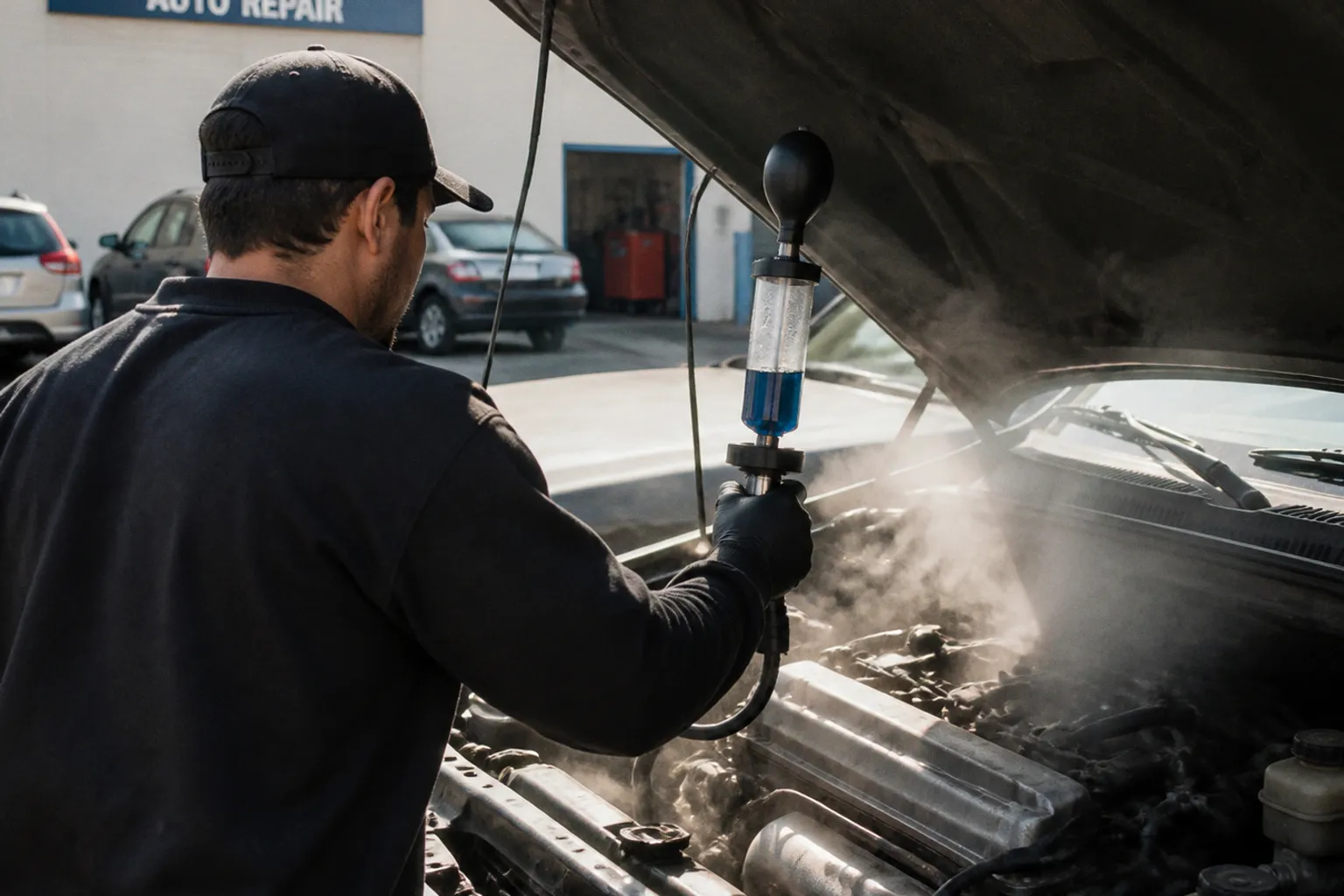
A combustion leak test can still detect exhaust gases in the coolant. The two tests measure different failures.
The distinction is mechanical. A compression test measures pressure retained inside a cylinder during the compression stroke. A combustion leak test, also called a block test, checks whether combustion gases are entering the cooling system. One evaluates cylinder sealing under cranking conditions. The other evaluates gas transfer into the cooling circuit.
That is why combustion leak test vs compression test is not a choice between two equivalent procedures. The tests answer different questions.
The mechanics of a combustion leak test
A chemical block test samples air from the radiator neck or coolant expansion tank. The sampled air is passed through a test fluid. If combustion gases are present, the fluid changes color.
For a gasoline engine, the normal diagnostic transition is blue to yellow. For a diesel engine, the expected transition is blue to green. The difference is caused by the composition and concentration of the gases reaching the tester. Standard gasoline tester behavior must not be applied to a diesel engine.
The test does not measure pressure. It does not measure cylinder compression. It detects combustion products, primarily through a chemical reaction associated with carbon dioxide and other exhaust gases.
Correct test conditions
The engine should be brought to operating temperature unless the manufacturer’s procedure specifies otherwise. A small gasket breach may only open when the cylinder head, block, and gasket have expanded. The cooling system also needs to be active. Thermostat operation, coolant circulation, and combustion pressure all change the result.
The tester is then installed at the radiator neck or expansion tank. Coolant must not be drawn into the test chamber. The sample should consist of gas above the coolant surface.
A dual-chamber combustion leak tester is preferable. Its first chamber filters alkaline particles and coolant contamination. The second chamber contains the reactive fluid. Without this separation, coolant vapor or chemical contamination can create an incorrect color change.
The logic is direct:
1. If the fluid remains blue after a properly collected sample, combustion gases were not detected during that test cycle.
2. If the fluid changes toward yellow on a gasoline engine, combustion gas is entering the cooling system.
3. If the fluid changes toward green on a diesel engine, the same fault path is indicated, but the diesel-specific color response must be used.
4. If the fluid changes color only after coolant has been drawn into the tester, the result is contaminated and must be repeated.
5. If the result is positive, the source can be a failed head gasket, a cracked cylinder head, or a cracked engine block.
A positive block test identifies gas transfer. It does not identify the exact damaged component.
A block test detects combustion gas in the cooling system. It does not label the damaged part.
The radiator cap must not be removed from a hot pressurized system without controlled release. Scalding coolant and vapor can be discharged immediately. The test is performed at the filler neck only after the system has been made safe, or through the expansion tank when the vehicle’s design permits reliable sampling there.
What a positive result means
A positive chemical block test has high diagnostic value when the sample is clean and the procedure is controlled. Combustion gas should not be present in the cooling system under normal operation.
If the result is positive and the cooling system develops pressure rapidly from a cold start, the leak path is likely combustion chamber to coolant passage. If the result becomes positive only after sustained load or high temperature, the breach may be opening with thermal expansion.
If coolant is forced from the expansion tank, the upper radiator hose hardens unusually early, or repeated bubbles appear before normal coolant circulation begins, the same fault path is supported. These observations are not substitutes for the chemical test. They are corroborating evidence.
A positive result should be followed by cylinder-specific testing and inspection. The block test identifies the system being contaminated. It does not identify which cylinder is responsible.
Interpreting compression test results for gasket health
An engine compression test measures the pressure generated when each cylinder is cranked with the throttle open and the fuel and ignition systems disabled. The gauge records pressure in PSI.
A healthy gasoline engine commonly produces approximately 125–180 PSI. The absolute number matters, but cylinder-to-cylinder consistency matters more. The difference between the highest and lowest cylinder should generally remain within 10–15 percent, with approximately 20 PSI used as a practical upper limit in many diagnostic situations.
The test must be performed under controlled conditions:
- The battery must provide stable cranking speed. A weak battery can reduce every reading.
- The throttle should be open so that intake restriction does not limit cylinder filling.
- Fuel injection and ignition should be disabled according to the vehicle’s service procedure.
- All spark plugs should be removed before testing.
- The gauge adapter must seal correctly in the spark plug threads.
- The same number of compression strokes should be allowed for every cylinder.
- Cranking speed should remain consistent between cylinders.
A single low cylinder has a different meaning from two adjacent low cylinders. A uniform reduction across all cylinders has a different meaning again.
Reading the pattern, not only the number
If one cylinder produces 90 PSI while the remaining cylinders produce 150–170 PSI, a local mechanical fault is present. Possible causes include a burned valve, damaged piston, worn rings, or a gasket breach affecting that cylinder.
If two adjacent cylinders produce similarly low readings, a head gasket breach between those cylinders becomes more plausible. The actual values will depend on engine design and test conditions, but the adjacency pattern is significant.
If all cylinders are low by a similar amount, the first suspects should include low cranking speed, incorrect valve timing, throttle restriction, or a test setup error. A gasket failure that affects every cylinder equally is less likely than a common testing or mechanical timing issue.
A wet compression test can be used after a dry test. A small amount of oil is introduced into the suspect cylinder, and the test is repeated.
- If compression rises materially, ring or cylinder-wall sealing is implicated.
- If compression changes little, a valve or head gasket fault remains more likely.
- If two adjacent cylinders remain low, the gasket or cylinder head requires further examination.
The wet test is not a final verdict. Oil can alter the seal temporarily and can obscure the original fault pattern. It is a discriminator between lower-end sealing and upper-end sealing, not a replacement for leak-down testing or head removal.
| Compression pattern | More probable fault path | Required next step |
|---|---|---|
| One cylinder low | Valve, ring, piston, or local gasket breach | Wet test, leak-down test, borescope inspection |
| Two adjacent cylinders low | Gasket breach between cylinders or head distortion | Combustion leak test and cylinder head inspection |
| All cylinders uniformly low | Low cranking speed, valve timing, throttle restriction, or severe general wear | Verify test conditions and cam timing |
| Normal compression with coolant loss | Small gasket breach, coolant-to-exhaust leak, or external leak not yet located | Block test and cooling system pressure test |
| Low compression with positive block test | Cylinder sealing failure with combustion gas entering coolant | Localize cylinder and inspect head, block, and gasket |
Why a compression test can miss a blown head gasket
A compression test is often treated as a definitive head gasket test. That interpretation is incorrect.
The test is performed while the engine is cranking. Cylinder pressure is generated for a short period at relatively low engine speed. A gasket breach that opens only under combustion temperature and load may not leak enough during cranking to lower the gauge reading.
The leak path also determines the result.
A breach from the combustion chamber into a coolant passage can allow gas to enter the cooling system while leaving compression readings within an acceptable range. A breach from coolant into the cylinder may cause coolant consumption, white exhaust vapor, or a misfire after shutdown without producing a dramatic compression loss during the test. A breach between two cylinders may lower both readings, but only if the opening is sufficiently large under cranking conditions.
The following conditions make a standard compression test less conclusive:
1. Thermal expansion controls the leak.
The gasket, cylinder head, and block may seal when cold and separate when hot.
2. The breach is load-dependent.
Combustion pressure under throttle is substantially different from starter-motor cranking pressure. A leak that appears under load can remain absent during a stationary test.
3. The leak is one-way.
Combustion gas may enter the coolant while coolant does not enter the cylinder in a measurable volume.
4. The opening is small.
A minor breach can contaminate the cooling system gradually. The loss may be too small to affect peak compression.
5. The leak is between a cylinder and an oil or coolant passage.
The cylinder may still build normal pressure while fluids cross the damaged gasket.
For that reason, a normal compression result cannot exclude a head gasket fault. If coolant loss is present, the exhaust shows unexplained white vapor, or cooling system pressure rises abnormally, the block test remains necessary.
Normal cylinder pressure does not prove that the head gasket is sealing the cooling system.
A leak-down test provides another layer of information. Compressed air is introduced into a cylinder at a controlled piston position. Air escaping through the intake, exhaust, crankcase, or cooling system can be identified by sound or bubbling. If bubbles appear in the radiator or expansion tank during a leak-down test, the cylinder-to-coolant path is strongly indicated.
The leak-down test is more useful for localization than a standard compression test. It does require the piston to be positioned correctly and the crankshaft to be restrained. The procedure is sensitive to valve timing and piston position. It should not be interpreted from gauge percentage alone.
Cooling system pressure testing and false positives
A cooling system pressure test examines whether the system can hold pressure. The tester is attached in place of the radiator cap or to the expansion tank adapter. Pressure is applied to the rating specified for the vehicle. Typical test values are approximately 15–20 PSI, but the radiator-cap rating remains the controlling parameter.
The pressure should not be exceeded. The purpose is to reproduce the system’s normal static pressure, not to stress components beyond their operating limit.
Pressure loss with no visible external leak creates several possible paths:
- Radiator or heater-core seepage.
- Water-pump seal leakage.
- Hose, flange, or thermostat-housing leakage.
- Coolant entering a cylinder.
- Coolant entering the engine oil.
- A breach through the head gasket, cylinder head, or block.
The test should be performed with the engine cold unless the service procedure states otherwise. A hot engine introduces expansion and safety risks. It can also produce a misleading result because coolant evaporation may hide the source.
If pressure falls and an external leak is found, the cooling system fault has been identified but the engine gasket has not necessarily been cleared. Multiple leaks can exist. If no external leak is visible, the spark plugs can be removed and the cylinders inspected for coolant. A borescope may reveal a steam-cleaned piston crown or liquid contamination.
The test has limitations. A pressure test applies coolant-side pressure to the system. It does not reproduce combustion pressure. A gasket that leaks only from the cylinder into the coolant may pass a static pressure test if the coolant-side pressure is lower than the combustion-side pressure required to open the breach.
The tests therefore work in opposite directions:
- The block test asks whether combustion gas enters the cooling system.
- The pressure test asks whether coolant escapes from the cooling system.
- The compression test asks whether each cylinder can build pressure.
- The leak-down test asks where compressed air escapes from a cylinder.
No single result should be isolated from the pressure and temperature conditions under which it was obtained.
Contamination inside the tester
Chemical block testing is vulnerable to contamination. Coolant can be alkaline. Exhaust residue can remain in the adapter. The test fluid can be old, exposed to air, or incorrectly selected for the engine type.
A false positive is possible if coolant is pulled into the chamber or if the sampling path is contaminated. A dual-chamber tester reduces this risk, but it does not eliminate procedural errors.
The result should be rejected and repeated if:
- The fluid was splashed with coolant.
- The sample was taken from a container contaminated with oil or cleaning chemicals.
- The tester was used on a diesel engine with gasoline-specific interpretation.
- The color change occurred immediately after visible coolant entered the chamber.
- The fluid was already discolored before the test began.
- The engine was not warm enough to reproduce the suspected failure condition.
The color transition should be judged against fresh fluid and the manufacturer’s reference scale. “Somewhat different” is not a diagnostic category. The starting color, final color, engine type, sample location, and test temperature should be recorded.
Choosing the diagnostic path for the engine
The correct sequence depends on the symptom. The fastest procedure is the one that places the test at the suspected leak path.
Coolant loss with normal compression
If the engine loses coolant and the compression readings are within 10–15 percent of one another, a block test should be performed next. A normal compression test has not cleared the gasket.
If the block test is positive, the head gasket, cylinder head, or block is allowing combustion gas into the cooling circuit. A pressure test can then be used to determine whether coolant is also leaving the system through an external or internal path.
If the block test is negative, the cooling system should be pressure-tested at the radiator-cap rating. External leaks should be located before the engine is disassembled.
One low cylinder
If one cylinder is materially below the others, the compression result identifies a mechanical abnormality but not the component. A wet test should be followed by a leak-down test.
If the wet reading rises, piston-ring or cylinder-wall sealing is more likely. If the reading does not rise and air is heard at the intake, the intake valve is leaking. If air is heard at the exhaust, the exhaust valve is leaking. If air enters the crankcase, lower-end sealing is implicated. If bubbles enter the cooling system, a combustion-chamber-to-coolant path is present.
A block test should still be performed when coolant loss or cooling-system pressurization is reported. The two faults can coexist.
Two neighboring cylinders with low readings
Two adjacent low cylinders are a classic reason to suspect a gasket breach between bores. The compression test should be repeated to exclude an adapter leak or inconsistent cranking speed. If the pattern remains, the block test and leak-down test should be used before cylinder-head removal.
The head surface and block deck should be measured after disassembly. A new gasket installed on a distorted surface will reproduce the fault. The gasket thickness and bolt procedure must match the engine specification. Torque-angle fasteners must not be reused when the manufacturer identifies them as one-time-use components.
Overheating with no coolant loss
Overheating without obvious coolant loss can result from a thermostat, radiator restriction, fan-control fault, water-pump impeller failure, trapped air, incorrect coolant mixture, or a combustion leak.
A negative compression test is weak evidence in this case. A block test should be performed after the engine reaches the condition in which overheating occurs. If the chemical result is negative, system flow, fan activation, thermostat opening, and radiator temperature distribution should be evaluated.
If the upper hose becomes rigid immediately after cold start, the block test becomes more important. If pressure develops only after the engine is fully hot, the suspected breach may be thermal or load-dependent.
Diesel-specific interpretation
Diesel engines require a separate interpretation of the combustion leak detector fluid. A gasoline tester is commonly described as turning blue to yellow when combustion gases are detected. Diesel exhaust typically produces a blue-to-green transition because of its lower carbon dioxide concentration and different gas composition.
Compression values from diesel engines must not be compared with the 125–180 PSI gasoline reference range. Diesel compression systems operate at substantially higher pressures, and the correct baseline is engine-specific. Glow plugs or injectors may need to be removed depending on the test adapter and engine design. The battery, starter, and decompression strategy must be considered because cranking speed directly affects the result.
For a diesel with coolant contamination, the block test remains useful, but the fluid color must be interpreted for diesel operation. If the test fluid is selected or read incorrectly, a valid result can be rejected or an invalid result accepted.
A controlled diagnostic sequence
A practical head gasket diagnostic should be run in a fixed order rather than by replacing parts after each symptom.
1. Verify the complaint.
Confirm coolant loss, overheating, misfire, exhaust vapor, oil contamination, or cooling-system pressure. The fault must be reproduced before the test is selected.
2. Inspect the external system.
Check hoses, radiator seams, water-pump housing, thermostat housing, heater-core evidence, and the expansion-tank cap. A visible external leak must not be converted into an engine teardown.
3. Perform the cooling system pressure test.
Use the radiator-cap rating, typically within the 15–20 PSI range. Record pressure loss and locate external leakage.
4. Perform the combustion leak test.
Use a clean sample path. Keep coolant out of the chamber. Apply gasoline or diesel color interpretation correctly.
5. Run a dry compression test if cylinder sealing is still in question.
Compare cylinders under identical cranking conditions. Record every reading, not only the lowest value.
6. Use a wet test or leak-down test to localize a low cylinder.
The result should separate ring, valve, piston, and coolant-passage faults.
7. Inspect before disassembly.
Spark plugs, borescope images, oil condition, coolant condition, and cylinder adjacency can identify the likely failure path before the head is removed.
8. Verify the repair under the same conditions that produced the fault.
A cold idle check is insufficient if the original leak appeared only at operating temperature or under load.
The order can be changed when access or engine design requires it. The logic cannot. A chemical test should not be used as a substitute for a mechanical measurement, and a compression gauge should not be used as proof that the cooling system is uncontaminated.
The practical distinction in combustion leak test vs compression test is therefore simple:
- Use the block test when the question is whether exhaust gas is entering the coolant.
- Use the compression test when the question is whether each cylinder can build and retain pressure.
- Use the cooling system pressure test when the question is whether coolant is escaping.
- Use the leak-down test when the question is where cylinder pressure is escaping.
Baseline parameters for repair verification
A repair is not verified when the engine starts. It is verified when the original failure path is no longer present.
For a gasoline engine, compression should be compared against the pre-repair readings and should generally fall within approximately 125–180 PSI when the engine design supports that range. The highest-to-lowest cylinder difference should remain within 10–15 percent, or approximately 20 PSI.
The cooling system should hold pressure at the radiator-cap rating, commonly 15–20 PSI, without unexplained loss. No external leak should be present. The block-test fluid should remain blue on a gasoline engine and should not transition toward yellow during the complete test cycle. On a diesel engine, the fluid should remain blue rather than turning green.
If the block test remains positive, the combustion-to-coolant path remains active. If compression remains uneven, cylinder sealing remains unresolved. If pressure is lost with no external leak, internal coolant migration remains possible.
The final baseline is not a single number. It is a matched set of results:
- No unexplained cooling-system pressure loss at the specified cap rating.
- No combustion-gas color transition in the correct block-test fluid.
- Compression readings within the engine’s specified range.
- Cylinder variation no greater than the accepted 10–15 percent range or approximately 20 PSI where applicable.
- No coolant entry into the cylinders, oil, or exhaust.
- No recurrence of the original overheating or coolant-loss condition at operating temperature.
That is the diagnostic boundary. Compression measures the cylinder. The block test measures the coolant. The pressure test measures containment. A head gasket is cleared only when all three systems return to their defined baselines.