Jack stands vs ramps: safety and clearance differences
The question of whether to elevate a vehicle with drive-on ramps or with jack stands is not a matter of convenience or garage real estate; it is a question of which interface between tire and support structure actually permits the work to be performed.
Merritt Vane·Updated: August 19, 2026·19 min read
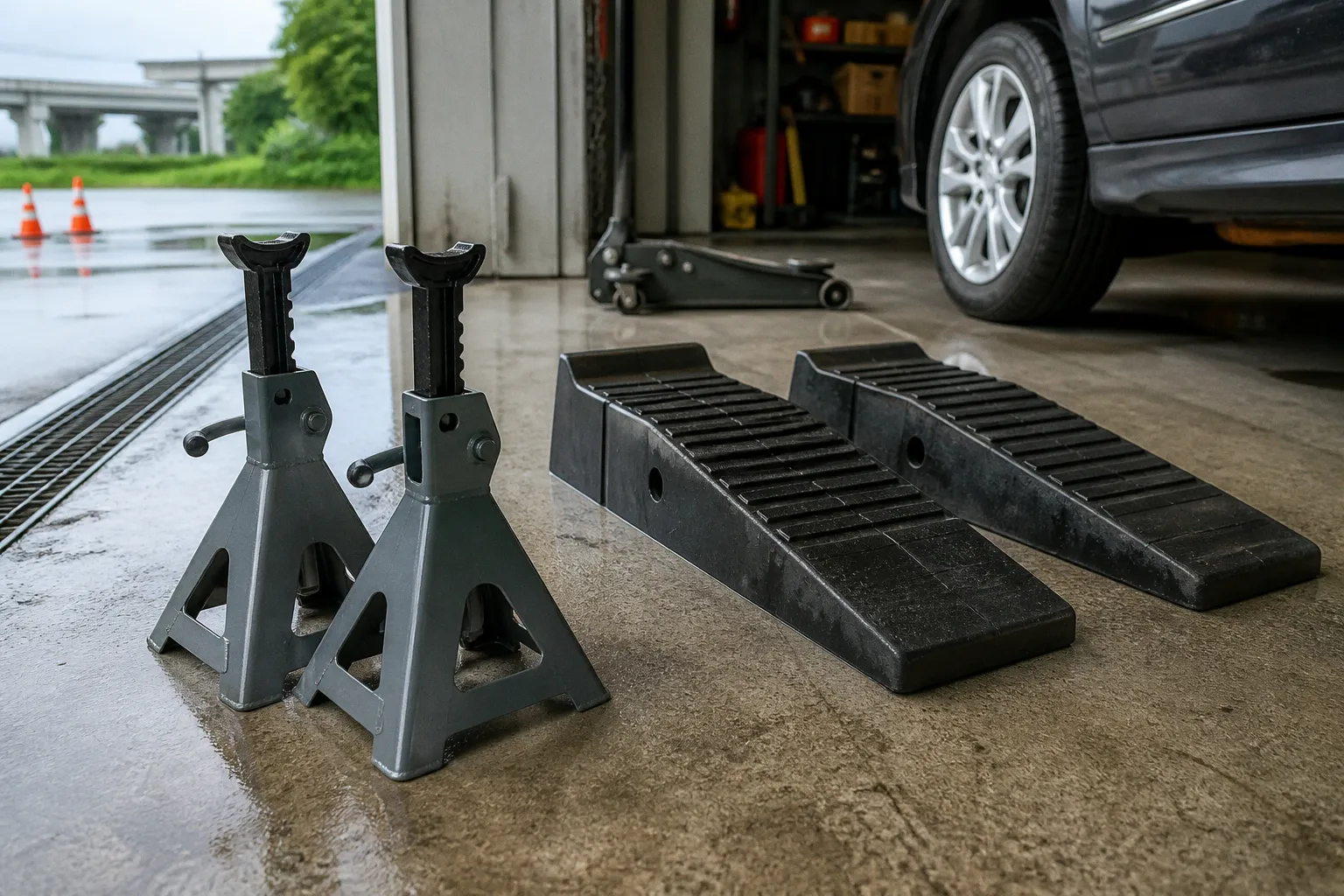
Both systems elevate a chassis off the ground, but they do so through fundamentally different mechanical relationships with the vehicle — one maintains the rolling contact patch, the other removes it. That single distinction governs nearly every downstream consideration: working clearance, approach geometry, wheel accessibility, and the load path through which the car's mass is distributed into the substrate. Understanding that distinction is the difference between a productive weekend in the garage and a vehicle sitting irrevocably on its nose.
Compare car rental deals in United Kingdom
See available offersPartner link — DiscoverCars comparisonThe trade-off is rarely framed this way in marketing copy, which tends to treat both as interchangeable “vehicle support solutions.” They are not. One is an incline; the other is a cradle. One supports the tire; the other supports the structure.
Ramps and jack stands are not competing products — they are tools built for different load paths, and choosing the wrong one often means the work itself cannot be done.
Elevation Mechanics: Drive-on Ramps vs Hydraulic Jacking
A drive-on ramp is, mechanically, a wedge. The vehicle is rolled forward under its own propulsion until the tires rest on the inclined surface, at which point the chassis is held at a fixed elevation determined by the ramp's geometry. There is no hydraulic actuation, no force multiplication, and no adjustment once the vehicle is positioned. The height is the height specified by the ramp's design. Standard drive-on ramps typically produce a lift height of roughly 6 to 10 inches (150 to 250 mm), with approach slope angles of approximately 15 to 20 degrees. That range is a function of the ramp's length and the height it must achieve: longer ramps produce shallower slopes, which are gentler on low-clearance bumpers but consume more garage floor space.
A ramp also preserves the normal relationship between the tire, suspension, and ground. The tire carries the vehicle through its contact patch, the suspension remains loaded, and the vehicle's weight is distributed across the ramp surfaces in much the same basic arrangement as it is on the road. That can make the setup feel intuitive. There is no need to find a lifting point, pump a handle, or coordinate the height of multiple supports. The simplicity is real, provided the vehicle can climb the ramp without contacting the bumper, the ramp is aligned correctly, and the tires reach the intended stop.
Jack stands operate on a completely different principle. The stands themselves do no lifting; they are passive receivers. The vehicle must first be raised by a hydraulic floor jack positioned at a manufacturer-specified lift point — typically a frame rail, pinch weld, subframe point, or dedicated jack pad — and only then is the load transferred onto the stands as the jack is slowly lowered. This two-stage process introduces a level of mechanical complexity that ramps simply do not have, but it also delivers something ramps cannot: adjustable elevation.
The load-capacity rating of a jack stand and its physical height adjustment are separate specifications. A stand may be labeled for a 2-ton, 3-ton, or 6-ton load, while its working height is determined by the range of its ratchet mechanism, locking pin, or other adjustment system. A higher tonnage rating does not mean the stand automatically reaches a greater height, and a taller stand is not necessarily rated for a heavier vehicle. The operator has to evaluate both numbers: whether the stand can support the intended load and whether it can place the vehicle at a usable, stable working height.
That distinction matters because a stand's capacity is about load, not elevation. A 3-ton stand with a short adjustment range may be perfectly suitable for a compact sedan but unusable for the clearance required to remove a transmission. A tall stand may provide useful access under a truck or SUV but be physically impossible to place safely beneath a low pinch weld. The correct choice is the intersection of rated capacity, minimum height, maximum height, saddle shape, and the vehicle's approved support points.
The load path is different as well. On a ramp, the vehicle's weight is transmitted through the tires — the same elastomeric contact patches that are designed to deform and absorb road shock. The ramp compresses the tire slightly under the static load, and the chassis is held at a height where the suspension is still partially loaded. On jack stands, the weight is removed from the tires entirely and transferred directly to the stand's saddle or pin cradle, which is in turn loaded into a steel column and base. The tires hang free; the suspension unloads; the chassis sits on a support point the vehicle manufacturer designed to tolerate lifting or holding loads.
That last point does not make every convenient-looking piece of the chassis a valid stand location. A suspension arm, thin floor pan, exhaust component, or unsupported section of subframe may appear strong because it carries the vehicle while driving, but dynamic road loads are not the same as a stationary support load applied at an unintended point. The service manual or the vehicle's lifting markings should govern the location.
Clearance Limitations and Approach Angles for Low-Profile Cars
The approach geometry of a drive-on ramp is the first place a vehicle's real-world packaging reveals itself. A standard ramp's slope — typically 15 to 20 degrees — sounds modest in the abstract, but the leading edge of a low-slung bumper has its own agenda. Sport-tuned vehicles, lowered imports, and anything with a chin spoiler or a front splitter will scrape the lower fascia long before the front tire reaches the incline. This is not a hypothetical concern; it is a routine frustration that pushes owners toward low-profile ramps with shallower approach angles, or toward modular ramp extensions that bridge the gap between the floor and the actual incline.
The mathematics are unforgiving. A 15-degree ramp rising to a 10-inch platform needs to begin its incline roughly 37 inches back from the lip of the platform. A 20-degree ramp doing the same job needs only about 27 inches of run-up — which is why steeper ramps exist, and also why they eat front air dams. The ramp's published height is therefore only part of the clearance story. Its length, leading edge, stop design, and the angle between the tire and the front overhang all affect whether a particular car can use it.
Ground clearance should also be measured at the part of the car that arrives first, not at the lowest point near the center of the vehicle. A front splitter may sit lower than the oil pan. A plastic bumper lip may flex slightly but still scrape against a sharp ramp edge. A long front overhang can make a car vulnerable even when the measured ride height appears adequate. For a lowered vehicle, the approach angle can be more important than the final platform height.
Jack stands sidestep the ramp's approach slope, but they do not eliminate clearance requirements. The floor jack still has to slide under the vehicle and reach an approved lifting point. A standard floor jack may not fit beneath a low front subframe or pinch weld, particularly if the tire is flat or the vehicle has been lowered. Low-profile floor jacks exist precisely for this reason, but their low saddle position does not by itself guarantee enough lifting range. The jack must be able to get underneath and then raise the vehicle high enough for the stand to be placed without forcing the stand into an unstable or extreme adjustment position.
This is where under-car clearance with jack stands becomes a planning problem rather than a simple height comparison. The stand has to fit under the selected support point while the car is still low, and the jack has to lift far enough to create working room. If the stand is adjusted near the end of its range, the arrangement may be less stable than it would be at a moderate setting. Raising the vehicle higher also increases the consequences of movement, so the desire for more clearance should not override the need for a broad, level base and a properly engaged locking mechanism.
For ramps, clearance is fixed by the product. For jack stands, clearance is adjustable but constrained by the jack, the support point, the stand's adjustment range, and the vehicle's structure. Neither option should be evaluated by maximum advertised height alone.
Task Versatility: Why Wheel Removal Dictates Your Choice
The single most consequential difference between ramps and jack stands is whether the wheels remain on the ground. Drive-on ramps, by their very geometry, leave the tires in continuous contact with the ramp surface. The vehicle cannot be supported on a ramp while a wheel is removed, because there is nothing else holding that corner of the car aloft. Once a wheel is unbolted and pulled off the hub, that corner no longer has the support the ramp was providing. This is not a marginal limitation; it defines the entire task envelope of a ramp.
Any procedure that requires wheel removal — brake pad replacement, rotor service, tire rotation, caliper work, hub bearing replacement, or suspension component removal — requires a different support arrangement. That may mean jack stands placed at the correct support points, a properly rated four-post or two-post vehicle lift configured for the job, or another support system specifically designed for the vehicle and procedure. Drive-on ramps are not the right tool for the task because they cannot hold the vehicle once the tire is no longer carrying the load.
Conversely, tasks that can be performed with the wheels still installed and in contact with a surface — oil changes on certain chassis configurations, underbody inspections, exhaust work at the rear, fluid top-offs at low-mounted reservoirs, and visual inspections of the drivetrain — are often faster on ramps because the setup time is minimal. The wheels remaining loaded can also be useful when the task calls for the suspension to stay at or near its normal ride position. Exhaust alignment, for example, may look different with the suspension hanging than it does with the vehicle supported through the tires.
The wheel is the dividing line. If it stays on, a ramp may be faster. If it comes off, use jack stands or another properly rated vehicle lift or support system.
Jack stands, by removing the wheel from the load equation, unlock the full range of under-car work. With the vehicle supported on stands at all four corners, or at the appropriate working pair with the opposite end secured according to the service procedure, the wheels can be removed, brake assemblies can be disassembled, and suspension components can be accessed from different angles. The trade-off is setup time. A jack-and-stand sequence takes longer, requires more attention to lift-point identification, and demands a floor jack with adequate capacity and reach.
There is a second advantage to jack stands that is less obvious than wheel access: the vehicle can be positioned at a height that matches the job. A drain plug may be accessible with only modest elevation, while a driveshaft, transmission, or exhaust system may require more room for tools and body position. Ramps provide a consistent, limited height. Stands allow the mechanic to choose a working height within the stand's safe range, subject to the limits of the lifting equipment and the vehicle's stability.
That flexibility does not mean the car should automatically be placed as high as possible. More height can improve access but may make the vehicle harder to stabilize and can complicate the use of a transmission jack, creeper, or long-handled tool. For many brake and suspension jobs, a moderate, even lift is preferable to maximum clearance. The goal is a stable work envelope, not an impressive gap beneath the rocker panel.
Weight Ratings and Structural Safety Standards
Weight ratings for vehicle supports are not interchangeable, and reading them carefully matters. Drive-on ramps are typically rated by Gross Vehicle Weight (GVW) capacity — the total mass of the vehicle the ramp is designed to support. A pair of ramps rated at 6,000 pounds GVW, for example, is intended for vehicles whose relevant loaded weight falls below that limit and whose tire dimensions are compatible with the ramp. Because the load is distributed across both ramps and the tires, the per-contact-patch load is comparatively modest, but the rating still has to cover the vehicle as a whole.
Jack stands are rated by load capacity, while their height is specified separately. Product labeling varies: some stands identify the capacity of one stand, while retailers and manufacturers may describe a matched pair using a combined or pair rating. The label and instructions are the authority. A 3-ton marking should never be interpreted as permission to place a 3-ton corner load on one stand, and a pair rating should not be divided or combined casually without understanding what the manufacturer intended.
The practical rule is straightforward: calculate against the vehicle's weight, the number of supports actually carrying it, and the manufacturer's rating convention. Do not assume that four stands automatically provide four times the usable capacity. Load can shift during lifting, lowering, wheel removal, or suspension work, and the supports may not share the load perfectly. A stand must be selected with a margin appropriate to the vehicle and the way the vehicle will be supported.
| Rating basis | Typical expression | What it describes |
|---|---|---|
| Drive-on ramps | Gross Vehicle Weight, such as 6,000 lb GVW | The vehicle mass the ramp set is designed to support, subject to the product instructions |
| Individual jack stand | A capacity in tons or pounds | The maximum load assigned to that single stand under the manufacturer's conditions |
| Jack stand pair or set | A combined rating used in product marketing or packaging | The supported load for the specified pair or set; the label must clarify how the rating is defined |
Capacity is only one part of structural safety. The saddle must contact a suitable section of the vehicle without slipping, the adjustment mechanism must be fully engaged, and the base must sit flat. A stand with a high numerical rating can still be the wrong stand if its saddle does not match the vehicle's pinch weld or frame geometry. A ramp with a generous GVW rating can still be unsuitable if the tire is too wide, the ramp stop is poorly positioned, or the vehicle's approach angle causes contact before the tire reaches the platform.
Material construction also differs and is worth noting. Lower-cost ramps are often molded from high-density polyethylene, which is resistant to oil and coolant but can deform under sustained load in hot environments — a consideration in unconditioned garages. Steel and aluminum ramps carry different combinations of strength, weight, and corrosion resistance, but none should be treated as immune to damage. Steel can corrode if its protective coating is breached; aluminum components can bend, crack, or suffer permanent deformation when overloaded or struck.
Jack stands are commonly welded steel, but their appearance is not a substitute for a readable rating, intact welds, and a functioning lock. A capacity marking tells you the manufacturer's stated load limit under the product's specified conditions. It does not, by itself, prove a particular steel alloy, weld geometry, or independent certification. Inspect the stand as a manufactured support device: check for bent legs, cracked welds, distorted saddles, damaged teeth, missing pins, and a locking mechanism that does not fully engage. If the mechanism is questionable, the stand is not ready for use regardless of its label.
Surface Requirements and Essential Stability Protocols
Both systems share one non-negotiable substrate requirement: a hard, level surface. Concrete is the standard reference; asphalt, even when visually flat, is not equivalent. Asphalt softens in summer heat and deforms under sustained point loading. A jack stand base plate sitting on hot asphalt can slowly sink, changing the geometry of the support and introducing a tilt that the adjustment mechanism was never designed to compensate for. Unpaved dirt, gravel, and any surface that can be displaced by hand pressure create the same basic problem: the support must bear against something that bears back.
The surface should be clear of oil, coolant, loose tools, and debris that could prevent a ramp or stand from sitting flat. A ramp needs a straight, unobstructed run-up. A floor jack needs room to roll as the vehicle rises because the jack's position changes through its arc. Trying to lift against a wall, a raised threshold, or a surface transition can place side loads into the jack and make alignment more difficult.
Before using ramps, inspect the ramp's underside and tire channel. The ramp should not rock, crack, or show deformation. Align both ramps with the vehicle's direction of travel and confirm that their stops are positioned where the tires can contact them without overrun. Drive up slowly, with the steering straight, and do not rely on a visual impression that the tires have reached the same position. If the ramp design includes a stop or upper platform, the tire should be seated against it as intended. Once positioned, switch off the engine, apply the parking brake, and secure any tires that remain on the floor with chocks.
For a front-end ramp setup, the rear tires are the ones normally chocked; for a rear-end setup, the front tires require chocks. The exact arrangement depends on which end is elevated and which wheels remain on the ground, but the principle is constant: prevent the vehicle from rolling toward or away from the elevated support. Chocks are not a replacement for correct ramp alignment, and they do not make an unsuitable surface safe.
When using jack stands, the sequence matters. Identify the approved lift points and support points before raising the vehicle. Place the floor jack so that it can lift vertically without contacting vulnerable components. Raise the vehicle only high enough to position the stands, set both stands to matching heights where appropriate, and lower the load slowly until the vehicle is fully seated. The locking pin or ratchet must be engaged according to the stand's design; a partially engaged mechanism is not a usable safety position.
After lowering onto the stands, verify that the saddle is centered and that the base remains flat. A controlled visual check is not the same as violently shaking the vehicle. The vehicle should be stable, with no obvious rocking or slipping, and the supports should remain aligned with the intended points. If the vehicle moves unexpectedly, stop and lower it or reset the arrangement rather than trying to correct a loaded stand by hand.
The parking brake and transmission setting are additional layers of control. An automatic transmission should be in Park; a manual transmission should be left in gear, with the parking brake applied. Wheel chocks should be used on every suitable wheel that remains on the ground. These measures address rolling, but they do not compensate for a poor lift point, an overloaded support, or a damaged tool.
A specific point deserves emphasis because it is frequently misunderstood: a hydraulic floor jack is a lifting device, not a long-term support device. Once the vehicle is at working height, the load should be transferred to jack stands or to another properly rated vehicle lift or support system appropriate for the job. The floor jack may remain positioned as a secondary precaution only if doing so is permitted by its instructions and does not interfere with the primary supports, but it should not be treated as the sole thing holding a person beneath the vehicle. A hydraulic seal, hose, valve, or mechanical component can fail without warning.
No jack, regardless of brand or tonnage, should be treated as the sole support under a vehicle. The jack lifts; a properly rated stand or vehicle lift holds.
The same thinking applies to ramps. They are not simply pieces of plastic or steel placed in front of a tire; they are the primary support system for a vehicle that remains on them. If a ramp is damaged, undersized, poorly aligned, or placed on a deformable surface, its nominal capacity does not repair the setup. The support system includes the ramp, the tire, the surface, the vehicle's parking and chocking arrangement, and the way the car is driven into position.
Closing Position
For the DIY mechanic working on an imported sedan, hatchback, or sport coupe, the practical recommendation follows directly from the mechanical analysis. Drive-on ramps are the correct tool for tasks that do not require wheel removal and that fit within the ramp's clearance envelope — oil service, exhaust inspections, underbody fluid checks, and routine visual surveys that catch a weeping gasket before it becomes a stain on the driveway. They are faster, simpler, and require less procedural work at the lifting points. Their limitations are equally clear: fixed height, fixed approach geometry, tire-dependent support, and no practical route to wheel-off service.
Jack stands are the more versatile option when the wheel has to come off, when suspension components must hang free, or when the required working height does not match a ramp's platform. They require a floor jack, more setup time, and a disciplined approach to lift-point selection. Their capacity rating must be read separately from their height range, and both must suit the vehicle. Used correctly, they unlock the under-car workspace that ramps fundamentally cannot provide.
A properly rated vehicle lift can serve the same broad purpose in a suitably equipped shop, but it is not automatically safer simply because it is larger or more permanent. The lift must be rated for the vehicle, installed on a suitable surface, positioned at approved lifting points, and used according to its instructions. The meaningful comparison is not “ramps versus stands at any cost.” It is the right support system for the task, the load, the vehicle geometry, and the workspace.
The two options are not rivals. They are complements, each suited to a different load path and a different category of work. The mechanic who owns both — and understands which task calls for which — has effectively doubled the range of maintenance they can perform at home, without compromising on the principle that governs all of it: the vehicle must rest on a support system engineered and rated to hold it for as long as the work takes.