Fuel injector cleaner vs professional flush: when to use each
The misconception worth confronting first is chemical, not mechanical. A bottle of pour-in additive is not a smaller dose of what a shop pours into a pressurized canister; the two interventions operate under entirely different conditions.
Merritt Vane·Updated: August 17, 2026·17 min read
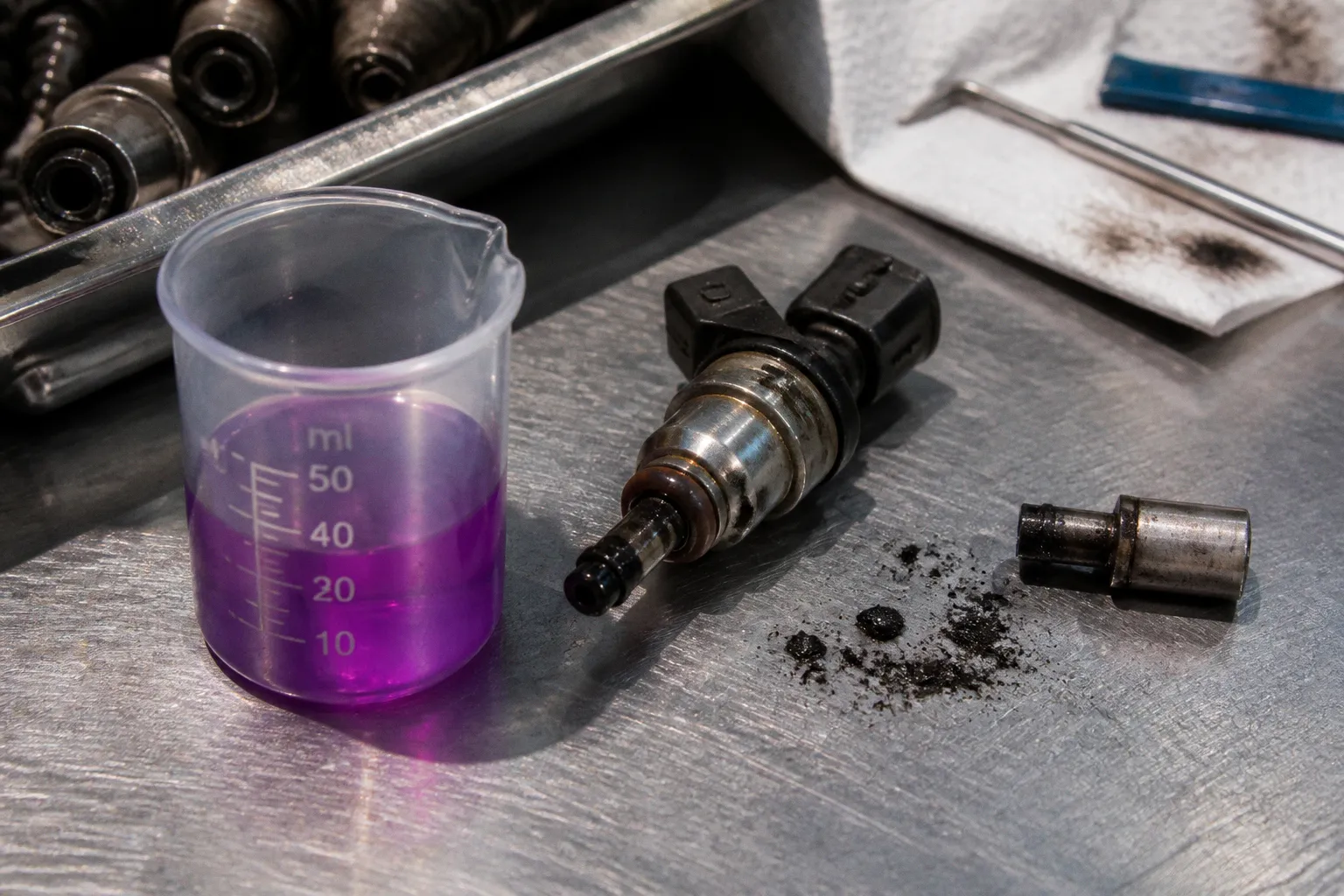
One travels with gasoline through the normal fuel system, gradually exposing the injector to a diluted detergent over many combustion events. The other replaces the vehicle’s normal fuel supply with a concentrated cleaning solvent and sends it through the rail while the engine runs.
Compare car rental deals in United Kingdom
See available offersPartner link — DiscoverCars comparisonTreating them as interchangeable creates two predictable mistakes: buying a bottle of additive to solve a problem that requires diagnosis or a professional service, or paying for a pressurized flush when a maintained engine only needs sensible preventive chemistry. The useful question in fuel injector cleaner vs professional flush is not which product is universally better. It is which method matches the injector, the symptom, and the evidence.
Fuel injectors on European and Asian platforms rarely fail without warning. More often, their performance drifts. Flow becomes uneven, the spray pattern loses symmetry, or deposits accumulate around the pintle and nozzle. The result may be a slightly unstable idle, a cold-start stumble, fuel-trim changes, or misfire activity that is still too subtle to trigger an immediate fault code.
The deposits themselves are not the diagnosis. The engine’s design matters, especially the difference between port fuel injection and gasoline direct injection. The service history matters too. So does the possibility that the problem is not contamination at all, but a wiring fault, weak fuel pressure, an air leak, or an injector that has failed electrically.
How the Two Cleaning Methods Work
Pour-in cleaner: diluted chemistry over time
A fuel-system additive is mixed with gasoline in the tank. As the fuel pump circulates that mixture, the detergent passes through the filter, rail, and injectors at the pressure and flow rate the vehicle normally uses. It is a low-concentration treatment, but it can be useful precisely because it is easy to repeat and does not require removing parts or connecting shop equipment.
The active chemistry matters more than the label on the bottle. Higher-tier products commonly rely on polyetheramine, or PEA, a detergent valued for its ability to remain effective at high temperatures and to attack gum, varnish, and carbon-related deposits in the fuel path and combustion chamber. Other formulations use polyisobutylene amine, solvent naphtha, or a mixture of detergents and carriers. Those products are not automatically useless, but they should not be treated as chemically identical to a concentrated PEA formulation.
The practical distinction is concentration and exposure. A quality additive may help maintain a clean injector and gradually reduce deposits that are still soluble. It is less convincing as a rescue treatment for a badly restricted injector, a leaking injector, or an injector with a distorted spray pattern.
A bottle also cannot increase fuel pressure, repair a damaged winding, restore a cracked piezo stack, or correct a mechanical problem inside the injector. It is chemistry, not a substitute for a fuel-system test.
A pour-in cleaner is preventive chemistry at maintenance intervals; a pressurized flush is corrective chemistry for deposits that diluted fuel treatment may not remove.
Product labels do not always make comparison easy. The stated dosage, the amount of fuel it is designed to treat, and the detergent package matter more than the size of the bottle. A small container intended for a full tank can be more concentrated than a larger product intended for repeated low-dose use. If the manufacturer provides no meaningful dosing guidance or avoids identifying the type of detergent used, there is less reason to assume that the product will deliver a strong cleaning effect.
Pressurized rail flushing: concentrated solvent at the injector
A professional fuel rail flush connects a canister of cleaning solvent to the fuel rail while the engine runs on that solvent rather than on gasoline from the tank. The vehicle’s fuel pump is normally isolated for the procedure, and the shop regulates the canister pressure so the injectors can operate without the engine receiving fuel from the normal tank supply.
That changes the exposure in two important ways:
- The solvent reaches the injectors without being diluted by a full tank of gasoline.
- The engine consumes the cleaning fluid continuously during the service instead of receiving a small detergent dose over many miles.
The injector still opens and closes according to the vehicle’s control strategy, so the flush does not turn a worn injector into a new one. It does, however, give the cleaning chemistry a more concentrated and sustained opportunity to work on deposits around the nozzle and internal passages.
For a port-fuel-injection engine with mild-to-moderate deposit-related symptoms, this is often a reasonable intermediate service. It may improve idle quality, cold-start behavior, and small flow differences caused by contamination. But the word may matters. If the actual fault is low fuel pressure, a vacuum leak, an ignition problem, or an injector with an electrical defect, the flush is aimed at the wrong target.
The procedure also has limits on gasoline direct-injection engines. A GDI injector operates in a high-pressure system and is built to very tight leak-down and spray-pattern specifications. A rail flush can clean the injector side of the system, but it cannot clean the intake valves. Because fuel is injected directly into the combustion chamber, it does not wash over the back of the intake valves in the way it does on a conventional port-injected engine. Deposits in that area require a separate intake-valve service, often using walnut-shell media or another method specified for the platform.
PFI and GDI Change the Decision
The phrase fuel injector cleaning is too broad to be useful without identifying the injection system.
Port fuel injection
PFI injectors sit in the intake port and spray fuel before the intake valve. They usually operate at much lower pressure than GDI injectors, and the fuel path is comparatively straightforward. Many older European and Asian engines use this arrangement, including the BMW N52, Toyota 1GR-FE, Honda J-series, and the Audi A4 B5 1.8T.
On these engines, a tank additive can be sensible maintenance when the injectors are functioning normally. A pressurized flush becomes more reasonable when symptoms suggest that a diluted treatment has not been enough or when the vehicle has accumulated substantial mileage without fuel-system attention.
PFI does not mean trouble-free. Deposits can still affect the nozzle, and an injector can develop internal wear, a poor spray pattern, or a leak. It only means that the cleaning methods have a more direct relationship with the surfaces receiving the fuel.
Gasoline direct injection
GDI systems place the injector in the cylinder head and spray fuel directly into the combustion chamber. The fuel rail operates at much higher pressure, and the injector’s timing, atomization, and leak-down behavior are especially sensitive to contamination and wear.
A tank additive still passes through the GDI injector, so it can contribute to injector and combustion-chamber deposit control. It does not, however, reach the intake-valve surfaces. That is the central limitation owners often miss when they expect a bottle of cleaner to solve every form of carbon buildup on a direct-injection engine.
The GDI distinction also matters when a shop proposes testing or cleaning the injectors off the vehicle. A low-pressure PFI bench cannot reproduce the operating conditions of a high-pressure GDI injector. Numbers produced on the wrong type of equipment may look precise while saying very little about the injector’s real behavior.
A suitable GDI service requires equipment designed for the injector’s pressure class and electrical control method. Depending on the design, that may include solenoid or piezo actuation, specialized adapters, and a test procedure that accounts for the injector’s operating pressure. This is one area where a generic cleaning machine is not automatically a professional result.
Bench Testing Is the Diagnostic Step
The statement that an injector is clogged is often an inference. The engine misfires, fuel trims are unusual, or one cylinder looks weaker, and the injector becomes the convenient suspect. Bench testing is what separates that suspicion from a measured fault.
A proper injector bench evaluation can include:
- Static flow rate, measured at a known test pressure and compared with the injector’s specification.
- Dynamic flow rate, measured during pulsed operation rather than with the injector held continuously open.
- Spray pattern, checked for an even, correctly shaped cone or stream.
- Leak-down, which shows whether the injector loses pressure while electrically de-energized.
- Electrical condition, including resistance for many solenoid injectors and additional electrical checks where the design requires them.
The test results are more useful when the injectors are evaluated as a set. A single injector that flows less than the others may be the problem even if its absolute number does not look dramatic. Conversely, an engine-wide issue is less likely to be solved by replacing one injector simply because it was easiest to blame.
Bench service is also where a shop can determine whether cleaning made a measurable difference. The sequence is generally to test the injectors, clean them using equipment appropriate to the design, and test them again. Without the before-and-after comparison, the owner receives a service but not much evidence of what changed.
For PFI injectors, specialist cleaning services commonly use low-pressure test rigs matched to the injector’s normal operating range. GDI injectors require high-pressure equipment capable of reproducing their much more demanding conditions. A GDI injector evaluated at a PFI pressure cannot be judged by the same standards.
Off-car bench testing does not replace cleaning; it tells you whether cleaning changed the injector and whether replacement is necessary.
The cost question is therefore not simply whether bench service costs more than a bottle. It is whether the diagnosis is valuable enough to prevent parts-swapping. If a vehicle has a persistent misfire and the owner is already considering several replacement injectors, a measured test may be cheaper than guessing. If the engine has no symptoms and the only goal is routine maintenance, removing every injector for bench service is usually excessive.
When Each Approach Makes Sense
The choice among additive, pressurized flush, and bench service comes down to four variables: symptom severity, injection type, service history, and diagnostic evidence.
Use a pour-in additive when:
- The engine has no meaningful drivability complaints and the goal is maintenance rather than repair.
- The vehicle is a PFI platform with a reasonable service history.
- Symptoms are mild and nonspecific, such as a barely perceptible idle change, with no stored fault codes.
- The fuel system is otherwise operating normally, with no known pressure problem or injector leak.
- The product is used at the manufacturer’s stated concentration rather than poured into a tank several times larger than intended.
A tank additive is most defensible as a low-effort maintenance step. It can help prevent deposits from becoming a larger problem, but it should be given time to work and should not be used to postpone diagnosis indefinitely. If the same roughness remains after the treated fuel has been consumed, the next step is not necessarily another bottle.
On GDI engines, the additive may help the injectors and combustion chamber, but it should not be sold as an intake-valve cleaning service. That distinction is important enough to repeat because it explains many disappointing results.
Use a pressurized professional flush when:
- Mild or moderate symptoms persist after a properly dosed additive treatment.
- The vehicle has a PFI system and the symptoms are consistent with restricted or uneven injector flow.
- The car has gone a long time without fuel-system service and the shop has ruled out basic ignition, air, and fuel-pressure faults.
- The owner wants a concentrated cleaning procedure without removing the injectors.
- The service provider can identify the correct connection method and solvent for the vehicle.
A flush is not a universal cure for a high-mileage fuel system. It can improve deposit-related restrictions, but it cannot restore an injector that has worn internally or failed electrically. It also cannot correct an intake-valve deposit problem on a GDI engine.
A good shop should be able to explain what the flush is intended to address, how the normal fuel supply will be isolated, what solvent will be used, and what symptoms would justify further testing. If the only explanation is that every rough-running engine needs a flush, the process has become a sales script rather than a diagnosis.
Use off-car bench service when:
- Misfire codes or cylinder imbalance persist after a correctly performed flush.
- One cylinder’s behavior differs from the others and the injector is a plausible cause.
- The injector is suspected of leaking, sticking, or producing a poor spray pattern.
- The engine has high mileage and the injectors have never been removed, especially when other fuel-system work is already being performed.
- The question is whether an injector can be cleaned and returned to service or must be replaced.
Bench cleaning is also appropriate when the owner is installing used, remanufactured, or replacement injectors and wants to confirm that the set is matched. An injector that looks clean externally can still have poor dynamic flow or leak-down behavior. Conversely, an injector with visible deposits may perform normally once tested.
A Practical Sequence for Import Cars
For a normally running PFI engine, the sequence should be deliberately unexciting. Use good fuel, follow the vehicle’s maintenance schedule, and treat a quality additive as occasional preventive maintenance rather than a repair. If drivability symptoms appear, begin with ordinary diagnostics: scan data, ignition components, vacuum leaks, fuel pressure, and cylinder-specific behavior. Only then does a pressurized flush become a logical response to suspected injector deposits.
For European and Asian PFI platforms such as the BMW N52, Toyota 1GR-FE, Honda J-series, or Audi A4 B5 1.8T, a sensible working pattern is:
1. Preventive additive use when the engine is healthy and the product is correctly dosed.
2. Basic diagnosis when idle quality, cold starts, or fuel trims change.
3. Pressurized flushing when the evidence points toward deposits and the injector has not shown signs of electrical or mechanical failure.
4. Bench testing when symptoms remain, the flow balance is questionable, or replacement is being considered.
The exact mileage interval should not be treated as a universal rule. Fuel quality, engine design, operating temperature, short-trip use, previous maintenance, and the condition of the fuel system all affect deposit formation. An additive every few thousand miles may be reasonable for one use case, while another owner may be better served by following the product and vehicle manufacturer’s guidance without adding an extra treatment to every tank.
GDI platforms need a wider service plan. The injector may benefit from detergent chemistry, but intake-valve deposits are a separate maintenance issue. If a GDI engine has rough running, reduced airflow, or cylinder-specific misfires, the diagnostic process should consider valve deposits, ignition, crankcase ventilation, boost leaks where applicable, fuel pressure, and injector condition rather than assuming that the tank is the entire fuel system.
This is also where the difference between cleaning and restoration becomes important. Cleaning may remove a deposit that is restricting flow. It cannot recreate a worn needle seat, repair a leaking body, or restore an injector whose electrical characteristics have moved outside the control unit’s usable range.
What to Watch Before Approving a Flush
A pressurized service is not inherently risky, but it is not a magic maintenance button either. The procedure should be matched to the vehicle and followed by verification.
Pay attention to these details:
- Injection type: Confirm whether the engine is PFI or GDI. The equipment, pressure requirements, and likely deposit locations are different.
- Fuel-pressure isolation: The shop should know how to disable or bypass the normal fuel supply without creating a new problem.
- Solvent compatibility: The cleaning fluid must be suitable for the injector seals, fuel rail, pump arrangement, and engine-management system.
- Symptoms before service: Record the fault codes, fuel trims, idle behavior, and affected cylinder if known. Otherwise, improvement is difficult to judge.
- Post-service checks: A scan, road test, and review of fuel trims or misfire data are more useful than simply being told that the canister emptied.
- Persistent faults: If the problem remains, repeat flushing is not automatically the answer. The injector may need bench testing, or the original diagnosis may have been wrong.
On high-mileage engines with heavy deposits, the correct response is not to repeat the claim that flushing will inevitably create a catalyst problem. Whether dislodged combustion deposits contribute to catalyst loading in a particular case is not established as a general outcome. A professional service should follow the equipment and chemical manufacturer’s procedure, avoid overpromising, and investigate any post-service symptom rather than assigning it to an assumed deposit event.
The clearer concern is diagnostic: an aggressive treatment can make owners believe that a mechanical or electrical fault has been addressed when it has not. If a vehicle has an active misfire, raw-fuel smell, or a catalyst-efficiency fault, continuing to drive while trying stronger cleaning products is a poor substitute for finding the cause. Unburned fuel and an existing misfire can damage emissions hardware independently of whether an injector was dirty.
Do Fuel Injector Additives Work?
They can, but the answer depends on what work means.
A detergent additive can reduce or remove certain soluble deposits. It can help maintain injector cleanliness, improve the condition of the fuel path, and sometimes improve a mild deposit-related symptom. The result is more plausible when the injector is basically healthy and the problem is contamination rather than wear.
The additive is not likely to solve:
- An injector with an open or shorted electrical circuit.
- A cracked piezo element or damaged solenoid.
- A mechanically leaking injector.
- A fuel pump that cannot maintain pressure.
- A blocked filter or restricted line.
- A vacuum leak, ignition fault, or compression problem.
- Carbon on the intake valves of a GDI engine.
That is why product comparisons based only on the bottle’s marketing claim are less useful than comparisons based on the failure mode. The best fuel injector cleaning method is the least invasive method that can address the actual fault. For a healthy engine, that may be a properly dosed additive. For deposit-related PFI symptoms, it may be a pressurized flush. For persistent imbalance, it is a bench test that determines whether the injector can be restored or should be replaced.
Closing Position
A pour-in cleaner and a professional flush are not competing versions of the same service. They work at different concentrations, under different pressure conditions, and on different time scales. The additive is convenient preventive chemistry. The pressurized flush is a more concentrated intervention for a problem that has already become noticeable. Bench testing is different again: it is the measurement that shows whether the injector is restricted, leaking, electrically defective, or operating normally.
For an import owner with no drivability complaints and a recent service history, a quality additive used according to its instructions is the economical choice. For a PFI vehicle with mild symptoms that remain after basic checks and a properly dosed treatment, a professional flush is a reasonable next step. For a vehicle with persistent codes, measurable cylinder-to-cylinder imbalance, suspected leakage, or a high-mileage injector set that has never been evaluated, off-car testing provides the information that chemistry alone cannot.
The mistake is not choosing the cheaper method. The mistake is treating every fuel-system complaint as a deposit problem and every cleaning method as interchangeable. Additive, flush, and bench service are rungs on the same diagnostic ladder. Use the lowest rung that fits the evidence, and move higher only when the engine gives you a reason.