Windshield chip repair: when is the damage too large to fix?
The practical answer to the question “how big of a windshield chip can be repaired?” is not a single number. A one-inch chip is the familiar retail benchmark, but it is not an automatic replacement line.
Merritt Vane·Updated: August 20, 2026·18 min read
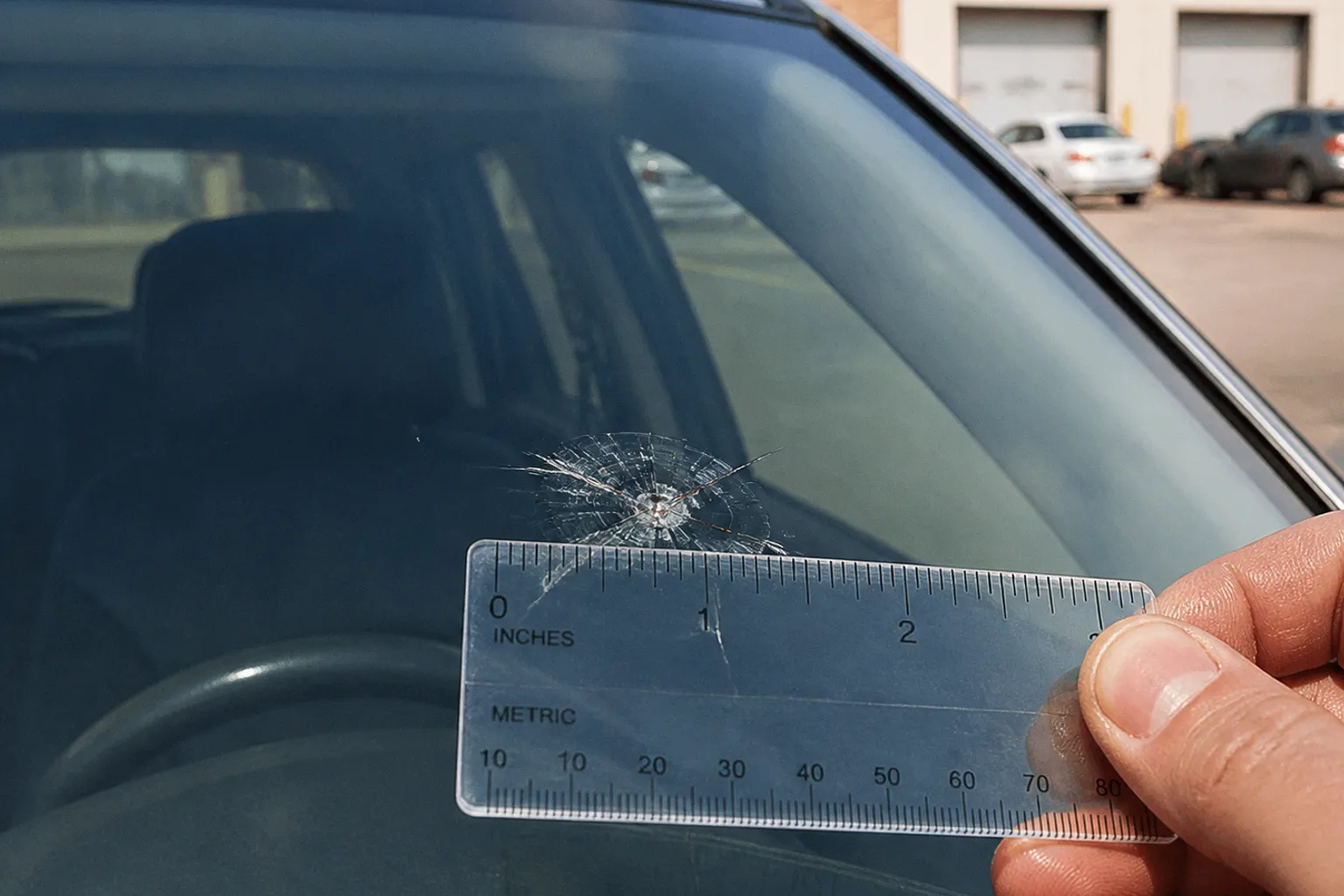
The shape of the damage, the number and length of its cracks, its position in the driver’s view, the depth of the impact and the condition of both glass plies all matter.
That distinction is important because a windshield is not one solid sheet of glass. It is a laminate: two glass plies bonded around a polyvinyl butyral (PVB) interlayer. The laminate is designed to absorb impact energy, keep broken glass together and help maintain the vehicle’s safety structure. A repair injects resin into the damaged outer ply and reconnects part of the fractured load path. It does not recreate missing glass or return the panel to factory condition.
The industry benchmark most often used to frame these decisions is the Repair of Laminated Automotive Glass Standard, or ROLAGS. Its limits are more precise than the usual “quarter-sized chip” advice, and they leave room for some damage that a general repair shop may still decline as a matter of risk, equipment or warranty policy.
Understanding ROLAGS: the industry benchmark for glass integrity
A laminated windshield usually takes an impact on its outer glass ply first. The impact creates a cavity and may send short cracks outward in several directions. The PVB layer beneath the outer ply helps arrest that fracture and keeps the inner glass ply in place.
That is the basic condition in which a repair can work. The resin is drawn into the damaged area, filling the cavity and the connected cracks in the outer ply. Once cured, it bonds the fractured surfaces and reduces the pathways through which a crack can continue to spread.
The PVB is therefore not, by itself, a reason to reject a repair. Ordinary repairable damage in the outer ply commonly terminates at the PVB. In fact, that is how the laminate is supposed to contain many impacts: the outer glass is damaged, while the interlayer prevents the fracture from continuing into the passenger compartment.
The critical distinction is whether the damage has gone through both glass plies.
If the inner ply is also fractured or penetrated, the laminate has lost the separation that makes an outer-ply repair possible. Moisture, dirt and air can reach the interlayer and the inner surface of the windshield. Resin injected from the outside cannot rebuild the inner glass or restore the original barrier between the two plies. Damage extending through both the inner and outer glass layers is a replacement condition under the ROLAGS framework.
That is very different from a crack that reaches the PVB but stops there. In that case, a trained technician still has to assess the geometry, depth, cleanliness and accessibility of the damage, but the presence of the PVB alone does not make repair impossible.
What the standard is actually measuring
ROLAGS does not reduce every windshield decision to one universal diameter. It distinguishes among fracture patterns because different patterns place different stresses on the laminate.
Common categories include:
- Bullseye or half-moon breaks: a central impact with a curved or circular fracture pattern.
- Star breaks: several radial cracks spreading from the impact point.
- Combination breaks: more than one pattern occurring around the same impact.
- Linear cracks: a directional crack that may begin at an impact point or develop independently.
- Surface pits: missing or crushed glass at the point of impact, which can be deeper or wider than the visible surrounding cracks.
The commonly quoted one-inch figure is a practical benchmark for a straightforward chip. It is useful when discussing a simple repair with a general shop, but it should not be treated as a universal windshield chip repair maximum size limit.
Under the standard’s more specific criteria, some star breaks may be repairable up to 75 mm, or 3 inches, and some half-moon-type damage up to 25 mm, or 1 inch. Linear cracks may be repairable up to 350 mm, or 14 inches, when the applicable technician and location requirements are met.
Those numbers do not mean that every three-inch star break or fourteen-inch crack is a suitable repair. They describe the outer limits for particular geometries under defined conditions. A shop may set a shorter internal limit because it does not have the equipment, resin system, training or warranty policy required for that type of work.
The one-inch rule is a useful first filter, not a verdict. Geometry and location decide whether the damage remains a repair or becomes a replacement.
The 1-inch rule: distinguishing between minor chips and major damage
A chip around one inch in diameter is the size most drivers hear about first because it corresponds to the capability of many standard repair operations. A contained impact with a small central cavity and short radial legs is usually a much better candidate than a chip of the same diameter with several cracks already running away from it.
The visible circle is not the whole assessment. A technician will look at the impact point, the legs of the fracture, the depth of the pit and whether the damage can be reached and filled without leaving significant voids.
A small chip is more likely to be repairable when:
- the damage is confined to the outer ply;
- the central pit is clean enough to prepare and fill;
- the cracks are short and contained;
- the damage is not in a restricted viewing area;
- no crack has already reached the edge of the windshield;
- the glass around the impact is not heavily contaminated or delaminated.
The repair may still leave a small mark. Resin has a refractive index close to glass, but it is not identical to the original material, and the surface pit may remain faintly visible after curing. The objective is to stop the damage, restore useful integrity and reduce optical disturbance—not to make the impact disappear as if it had never happened.
Why a larger star break can be different from a smaller crack
A star break spreads in several directions, but its individual legs may remain relatively short. A linear crack, on the other hand, concentrates the problem along one path and can continue to grow with changes in temperature, body flex and vibration.
That is why ROLAGS can allow a qualifying star break to reach a larger overall diameter than a simple half-moon chip. The dimensions describe different fracture behavior. The central impact, the number of legs and the length of those legs must be considered together.
A star break may remain within the standard’s repairable range when its radial cracks are limited and it is outside restricted optical areas. As the legs grow longer, the pattern stops behaving like a contained chip and begins to resemble a network of connected cracks. The resin then has more paths to fill and more crack tips to arrest.
The number of legs matters as well. A pattern with multiple long radial cracks is more difficult to stabilize than a simple impact with two short legs. It is not enough to measure the widest point of the damage and ignore the shape inside it.
A visible chip is not the same as a surface pit
The chip is the entire damaged area. The pit is the crater or missing material at the surface of the outer glass. A chip can have a broad crack pattern but a relatively small pit, or a smaller-looking impact can leave a deep, irregular crater.
That difference matters because resin can fill a fracture cavity, but it cannot replace glass that has been blown out of the surface. A technician may be able to clean and prepare a modest pit so the resin bonds properly. A deep or oversized pit can leave a weak, contaminated or visibly depressed repair even if the surrounding cracks appear manageable.
This is also where many DIY windshield chip repair kit limits become obvious. A consumer kit may be adequate for a clean, shallow, contained chip. It is not a substitute for the inspection and preparation needed when the impact has crushed or removed a significant amount of glass.
Navigating the Driver’s Primary Viewing Area (DPVA) restrictions
A repair that is structurally acceptable in one part of the windshield may be rejected in another. The Driver’s Primary Viewing Area, or DPVA, is treated more strictly because even a small residual blemish can interfere with the driver’s direct sightline.
The exact boundaries used in practice can depend on the applicable standard, vehicle configuration and local inspection requirements, but the principle is consistent: the area directly used to read traffic, brake lights, pedestrians and lane markings has less tolerance for optical distortion.
Within the DPVA, ROLAGS criteria include limits on the original damage, the finished pit and the distance between repairs. The draft repair must not simply be judged by whether resin can reach the crack. The finished result must also be acceptable in the driver’s line of sight.
A commonly cited DPVA framework includes:
- original damage no larger than 25 mm, or 1 inch, for the relevant chip category;
- a finished pit no larger than 5 mm, or 3/16 inch;
- at least 100 mm, or 4 inches, between a new repair and an existing repair on the same windshield.
The finished pit is especially important. After curing, the resin may reduce the appearance of the damage without eliminating every optical artifact. A small crescent or point of distortion may be tolerable near the edge of the driver’s view and distracting directly ahead of the steering wheel.
This is one reason a technician may recommend replacement for a chip that appears technically repairable by size. The question is not only “will the crack stop?” It is also “will the finished windshield provide a clear and safe view?”
Optical clarity and structural repair are separate judgments
A successful fill does not guarantee an invisible repair. The result depends on the impact angle, contamination, the age of the damage, the resin, the shape of the cavity and the technician’s ability to evacuate air before injection.
Older damage often contains moisture and road debris. A technician can sometimes clean and dry the area, but contamination may prevent the resin from reaching every branch. A repair can stop further growth while leaving a visible scar. That can still be a reasonable outcome outside the DPVA, but it is a more serious concern in the primary viewing zone.
A windshield with several previous repairs also deserves closer attention. Even when each repair is individually sound, multiple altered areas can reduce the available space for another repair and increase the chance of optical distraction. The four-inch separation guideline is intended to keep repairs from being placed too close together, not to turn every previous repair into an automatic reason for replacement.
When linear cracks exceed the 6-inch retail shop threshold
The windshield crack repair size limit people encounter at a retail shop is often around 6 inches. This is a practical service threshold, not the same thing as the maximum contemplated by ROLAGS.
A general repair shop may decline a crack longer than six inches because the probability of a clean, stable fill becomes less predictable. The crack may be repairable under more specialized criteria, but the shop may not have the injector, resin, heating method or experience needed to attempt it responsibly.
ROLAGS may permit certain linear cracks up to 350 mm, or 14 inches, when the damage meets the standard’s requirements. That allowance should not be read as a promise that every fourteen-inch crack can be repaired. The crack’s position, age, connection to other damage, proximity to the edge and effect on the driver’s view remain decisive.
Long cracks are difficult for a simple mechanical reason: there is more distance between the injection point and the crack tip, and more opportunity for air, moisture or contamination to block the resin. The glass also continues to move as the vehicle heats and cools. A crack that is stable in the morning may open further when one side of the windshield warms in direct sun or when the vehicle body flexes over an uneven surface.
Specialized long-crack repairs may use staged injection and carefully selected low-viscosity resin. The technician may also control the temperature of the glass and work methodically toward the end of the crack. These methods are more demanding than filling a compact impact cavity, and their availability varies significantly between shops.
The crack’s endpoint matters more than the ruler alone
A six-inch crack in the middle of the windshield is not automatically equivalent to a six-inch crack that reaches the edge. Edge-connected cracks are exposed to additional stress and have a clear route for continued propagation. A crack that terminates near a mounting point, sensor area or previous repair may also be less predictable.
The direction of the crack matters too. A line crossing the driver’s main sightline may be rejected for optical reasons even if it is within a nominal length limit. A crack outside that area may be considered differently, provided it does not compromise other parts of the laminate.
The correct sequence is therefore:
1. Identify whether the damage is a linear crack, a star break or a combination pattern.
2. Measure the crack and inspect both endpoints.
3. Check whether it touches the windshield edge or another damaged area.
4. Check whether it lies in the DPVA or another restricted optical zone.
5. Confirm that the damage remains in the outer ply.
6. Ask whether the shop’s equipment and warranty policy cover that length and pattern.
This is a geometry- and location-based assessment, not a single-number replacement rule.
Critical failure points: why deep pits and inner-layer damage demand replacement
Some conditions do move the decision firmly toward replacement. They are not merely cases where a shop is being conservative; they involve damage that resin cannot properly reverse.
Damage through both glass plies
A repairable outer-ply chip commonly ends at the PVB. That is normal for the laminate and does not, by itself, disqualify the windshield.
Replacement is required when the damage extends through both glass plies. Once the inner glass is fractured as well, an outside injection cannot restore the inner surface or rebuild the original separation between the plies. The PVB may still hold pieces together, but the windshield no longer has the same intact barrier and structural arrangement.
A useful inspection clue is damage visible from inside the vehicle, although a technician should make the final determination. If there is a corresponding mark, crack or impact trace on the inner surface, the issue is no longer an ordinary outer-ply chip.
An oversized or deep surface pit
ROLAGS identifies a maximum surface pit size of 3/8 inch, or 9 mm, for the relevant repair criteria. A pit beyond that limit may have removed too much outer glass for the resin to establish a sound repair. Even when the crack network is small, the missing material at the impact point can prevent proper preparation and leave a visible depression.
A deep pit can also hide contamination. Dust, moisture and road film settle below the surface and may not be fully removed by a basic consumer tool. Injecting resin over an unprepared cavity can create a partial fill that looks better at first but remains vulnerable to further cracking and delamination.
A crack that reaches the edge
A crack connected to the edge of the windshield has less room to remain stable. The edge is an area where the laminate is constrained by the frame and exposed to changing loads. Some edge-connected damage may be assessed under specialist criteria, but it should not be treated like a contained chip simply because its measured length is short.
A complex network of long legs
A star break with several long legs is more difficult than a compact star with short, stable branches. The issue is not that resin cannot enter any crack that reaches the PVB. The issue is whether the complete fracture geometry can be filled and stabilized without leaving active tips or creating new propagation paths.
When the pattern becomes a broad network, the technician has to evaluate each leg, its endpoint and its relationship to the other fractures. A single injector may not address the entire network reliably. At that point, replacement can be the more responsible option even if one measurement falls below a retail limit.
The decisive boundary is not “glass versus PVB.” It is whether the damage remains confined to a repairable outer-ply geometry and a safe optical location.
What DIY windshield chip repair kits can—and cannot—do
A DIY kit is designed for a narrow class of damage: a recent, shallow, contained impact with a small central cavity and limited cracking. The tools can create pressure or vacuum over the chip and push resin into the visible fracture. That can be useful when the alternative is allowing a small impact to collect moisture and grow.
The limits are equally important. A consumer kit is a poor choice when:
- the pit is deep, wide or visibly missing glass;
- the damage has multiple long legs;
- a crack is longer than the kit’s injector can reach effectively;
- the crack has reached the windshield edge;
- the damage is visible from inside the vehicle;
- the impact is in the driver’s primary viewing area;
- the windshield already contains nearby repairs;
- the area is dirty, wet or contaminated;
- the resin cannot be drawn through the entire fracture.
A kit also cannot reliably diagnose inner-layer damage. It may cover the visible mark and give the impression that the job is complete without addressing a fracture that extends beyond the outer ply.
The sentence that often causes confusion is that a kit cannot inject into a crack that has reached the PVB. That is too broad. A normal outer-ply fracture commonly terminates at the PVB, and that condition is part of how a laminated windshield contains damage. The real limitation is whether the kit can fill the outer-ply cavity and connected cracks properly, and whether the damage has gone through the PVB and into the inner glass.
For a small chip, early action is generally more useful than waiting. Covering the impact temporarily can help keep out moisture and debris until it is assessed, but tape does not repair the glass. If the damage is large, complex or in the DPVA, a professional inspection is more valuable than experimenting with a kit that was not designed for the geometry.
When to replace the windshield instead of repairing it
The decision to replace the windshield should follow the damage pattern and location, not an oversimplified rule that every measurement over one inch is fatal.
Replacement becomes the stronger choice when one or more of these conditions apply:
- the fracture extends through both glass plies;
- the surface pit exceeds the applicable repair limit or has removed substantial glass;
- the damage reaches the edge and cannot be stabilized under the shop’s criteria;
- a linear crack exceeds the shop’s equipment or warranty limit;
- a star or combination break has too many long legs;
- the damage leaves unacceptable optical distortion in the DPVA;
- multiple repairs are too close together;
- contamination or delamination prevents a complete fill;
- the windshield has additional damage that makes another repair impractical.
By contrast, a chip larger than the ordinary one-inch retail benchmark is not automatically a replacement. A qualifying star break may still fall within the ROLAGS allowance up to 3 inches, and a qualifying linear crack may still be considered up to 14 inches. Those exceptions depend on geometry, location, depth, optical effect and technician criteria.
The same principle applies in reverse. A chip smaller than one inch may still require replacement if it has penetrated both plies, sits directly in the driver’s critical sightline, has a deep pit or connects to the edge. Small does not always mean safe to repair.
A practical assessment before booking the job
Before choosing a repair or replacement, record more than the widest visible measurement. Note:
- the approximate overall diameter or length;
- the shape of the break;
- the number and length of radial legs;
- whether the pit is shallow or deeply cratered;
- whether the damage is visible from inside;
- whether it touches the edge;
- whether it lies in the driver’s primary viewing area;
- whether another repair is nearby;
- how long the damage has been exposed to weather and road contamination.
A shop should be able to explain which part of the damage makes it repairable or unsuitable. If the answer is only “over one inch means replacement,” that may reflect the shop’s policy rather than the full ROLAGS framework. A conservative policy is not necessarily wrong—shops must account for equipment, workmanship and warranty risk—but it should not be confused with a universal technical prohibition.
The most useful question is not simply, “What is the windshield chip repair maximum size limit?” Ask instead: Is the damage confined to the outer ply? What is its geometry? Does it enter the DPVA? Does it reach the edge? Can the entire fracture be filled and stabilized within the technician’s operating limits?
The windshield is a structural and safety component, so a repair should be judged by more than appearance. But the opposite mistake is just as common: replacing glass merely because one familiar number has been exceeded. ROLAGS allows a more careful conclusion. Some larger, well-contained fractures remain repair candidates; some small impacts do not. The dividing line is the combination of depth, geometry, location and optical consequence.